High Hardness & Wear Resistance
Hard ceramic surfaces resist abrasion in wear components. Contact loads, surface finish and the counterface still require assessment.
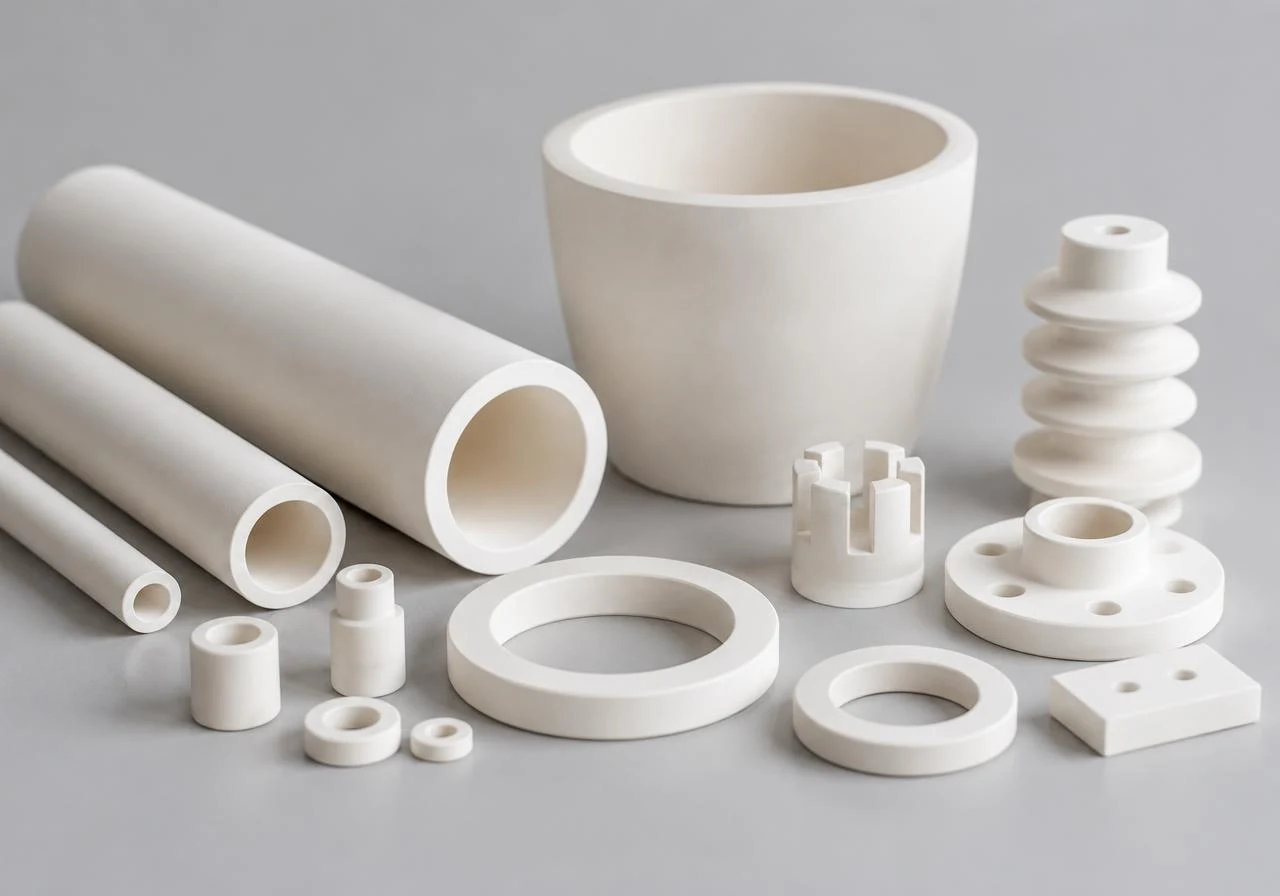
Technical Ceramics / Oxide Ceramics
High-performance aluminium oxide ceramics offering excellent wear resistance, mechanical strength, electrical insulation and thermal stability for demanding industrial applications.
Material overview
Alumina, also known as aluminium oxide (Al₂O₃), is a widely used advanced technical ceramic. Its combination of mechanical, thermal, electrical and chemical properties makes it a practical material for precision-engineered components exposed to wear, heat or electrically demanding conditions.
High hardness, abrasion resistance and compressive strength are complemented by electrical insulation, thermal stability and resistance to many corrosive environments. Dimensional stability supports accurate component geometries, while a range of purity grades allows material selection to reflect the application.
Performance varies with alumina content, additives, microstructure, manufacturing method and operating conditions. Higher-purity grades generally offer improved chemical purity, electrical performance and high-temperature capabilities, but individual properties must be assessed against grade-specific technical data.
Hard ceramic surfaces resist abrasion in wear components. Contact loads, surface finish and the counterface still require assessment.
Supports electrical isolation in equipment and instrumentation. Temperature, frequency, geometry and contamination affect performance.
Thermal stability supports demanding process environments. Temperature limits and thermal cycling depend on grade and application.
Resists many corrosive environments; compatibility must be checked against the specific chemicals, concentration and temperature.
High compressive strength supports suitable loaded components. As a brittle ceramic, alumina requires careful design against impact and tensile stress.
Stable ceramic geometries support precision parts, with allowance for thermal expansion, processing tolerances and service conditions.
Hardness and compressive strength favour wear components and supports. Brittle fracture, edge loading and assembly stresses must be addressed during design.
Alumina offers useful thermal stability, but thermal conductivity, expansion, shock resistance and maximum use temperature are grade-specific. Avoid sudden temperature changes without application assessment.
Electrical insulation depends on purity, temperature and operating conditions. Dielectric strength, dielectric constant and resistivity should be selected from the relevant grade data.
Chemical durability can support process components. No universal corrosion-resistance claim applies: media, temperature, exposure and material composition determine suitability.
Grade-specific technical information
Alumina ceramics are available in a range of purity grades, each offering different mechanical, thermal, electrical and chemical characteristics. Explore our material grades and technical datasheets to identify the most suitable material for your application.
Oxide Ceramics / 95% alumina (Al₂O₃)
95% alumina is a versatile technical ceramic combining high hardness, excellent wear resistance, high compressive strength and excellent electrical insulation with good thermal and chemical stability. Its balance of performance and cost supports electrical insulators, precision-engineered components, wear-resistant parts and high-temperature industrial applications, subject to application assessment.
| Property | Unit | Typical value |
|---|---|---|
| Density | g/cm³ | 3.65 |
| Porosity | % | 0 |
| Flexural strength | MPa | 345 |
| Compressive strength | MPa | 2,100 |
| Elastic modulus | GPa | 300 |
| Poisson’s ratio | — | 0.21 |
| Hardness | kg/mm² | 1,100 |
| Fracture toughness (KIC) | MPa·m½ | 3.5 |
| Property | Unit | Typical value |
|---|---|---|
| Thermal conductivity | W/(m·K) | 25 |
| Coefficient of thermal expansion | 10⁻⁶/K | 8.2 |
| Specific heat capacity | J/(kg·K) | 880 |
| Thermal shock resistance | °C | 250 |
| Maximum use temperature | °C | 1,700 |
| Property | Unit | Typical value |
|---|---|---|
| Dielectric strength | kV/mm AC | 8.3 |
| Dielectric constant | — | 9 |
| Loss tangent | — | 0.0011 |
| Volume resistivity | Ω·cm | >10¹⁴ |
Values published are reported typical values for the specified material type, not guaranteed specification limits. Material suitability should be assessed against the specific application and operating conditions.
Maximum use temperature is application-dependent. Suitability and acceptance criteria should be confirmed for individual applications. Test methods and conditions are not specified in the supplied datasheet.
Document reference: QE / TECHNICAL CERAMICS / OXIDE / 95 ALUMINA
Typical values, not specification limits. Maximum use temperature is application-dependent.
Wear parts, isolators and precision components where material properties, component design and acceptance requirements are matched to the application.
Insulators, substrates and process components using electrical isolation and dimensional stability, with purity and contamination requirements assessed individually.
Wear and chemically exposed parts where compatibility with the actual process media and loading has been established.
Plungers, bushes and seal components selected for wear resistance, surface finish and compatibility with the pumped fluid.
Tubes, crucibles and supports for appropriate furnace conditions, allowing for thermal cycling, atmosphere and contact compatibility.
Electrical isolators and analytical or medical-instrument components where grade selection and applicable acceptance requirements are confirmed; no industry approval is implied.
Quest Engineering supplies standard forms and engineered ceramic components, including custom parts manufactured to customer drawings and application-specific requirements.
Discuss component geometry and material grade alongside dimensional tolerances, surface finish, intended quantities and operating conditions. Machined ceramic components and machining blanks are included in our existing Technical Ceramics offering; precision grinding and machining requirements are assessed for each drawing rather than presented as a universal capability or tolerance guarantee.
Prototype and production requirements, inspection, quality documentation and application-specific technical support can be discussed during the enquiry. Availability and acceptance requirements are confirmed for the individual project.