Materials Supply / Titanium & Titanium Alloys
Titanium Grade 2
Commercially pure titanium | UNS R50400 | Annealed wrought products
Widely used commercially pure titanium balancing strength, ductility, formability and corrosion resistance for industrial fabrication.
TIMET identifies TIMETAL® 50A with ASTM Grade 2. The trade name alone is not proof of conformity to any ordered ASTM, AMS or pressure-equipment specification. TIMETAL® is a registered trademark of Titanium Metals Corporation; Quest Engineering does not manufacture or own this trademark.
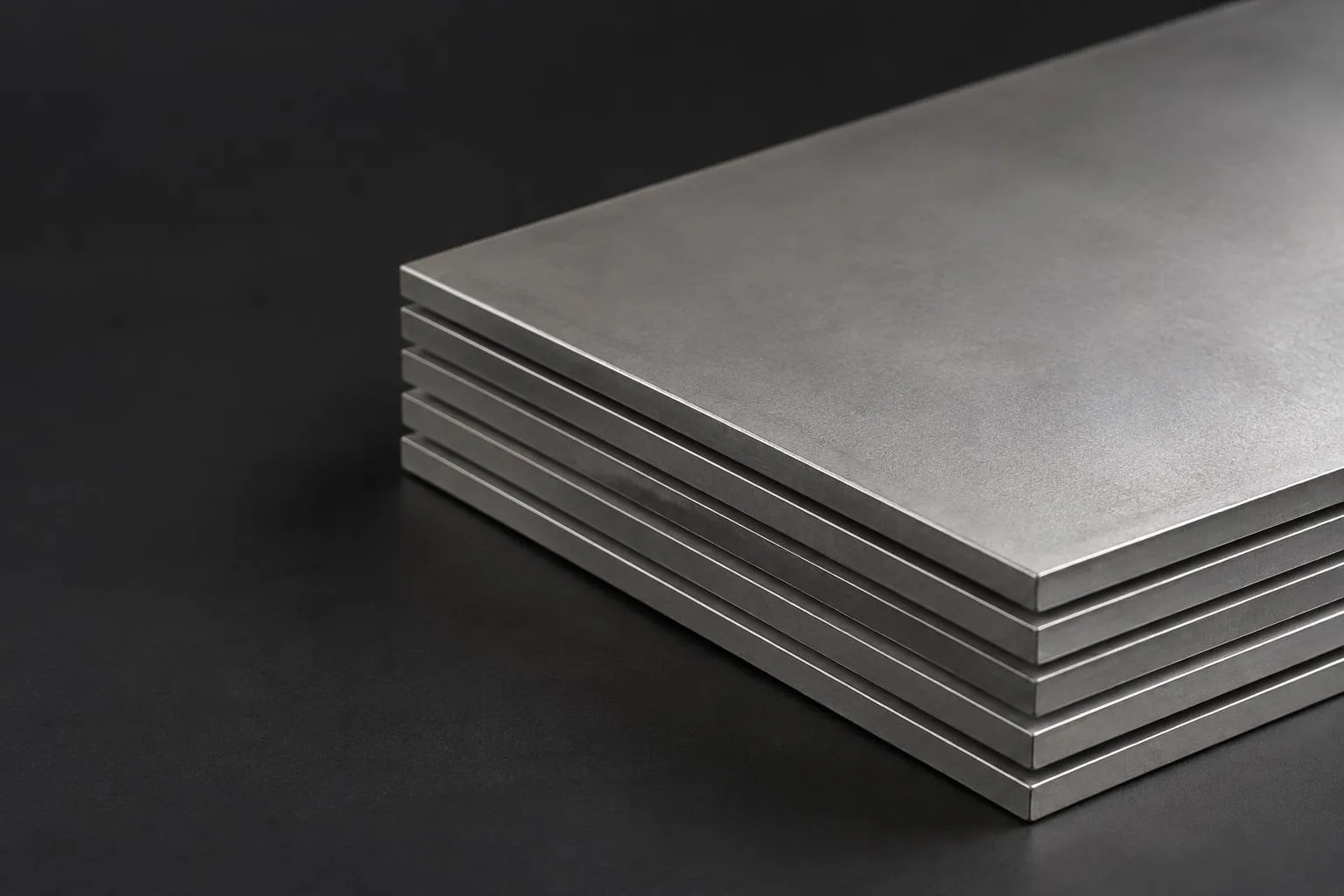
Imagery is illustrative only; it does not identify a certified grade, product condition or available stock.
Raw & semi-finished materials
Available material forms
Grade/form coverage supported by TIMET Design and Fabrication handbook, Table 2; forgings are specification-covered, not a TIMET availability claim. Supply remains subject to ordered specification, dimensions and supplier confirmation; no Quest stockholding is implied.
- Sheet
- Strip
- Plate
- Bar and billet
- Welded tube
- Forgings
Material overview
Titanium Grade 2
Widely used commercially pure titanium balancing strength, ductility, formability and corrosion resistance for industrial fabrication.
- Widely used commercially pure titanium balancing strength, ductility, formability and corrosion resistance for industrial fabrication.
- Controlled oxygen and iron, together with other interstitial limits and processing, distinguish the commercially pure titanium strength grades. Historical CP1–CP4 aerospace labels are not a safe substitute for ASTM grade numbers.
- Use the actual ordered product specification and certificate for acceptance. The mechanical selector below is limited to annealed ASTM B265 sheet/plate; it does not specify bar, tube or forging properties.
Designations and product specifications
| Designation / standard | Scope / status |
|---|---|
| UNS | R50400 |
| ASTM B265 | Grade 2; annealed sheet, strip and plate; B265-20a basis retrieved through SB-265 reproduction. |
| ASTM B348 | Grade 2; bar and billet; TIMET handbook Table 2; current revision unverified. |
| ASTM B338 | Grade 2; tubing; welded-tube coverage verified in TIMET handbook Table 2; current revision unverified. |
| ASTM B381 | Grade F-2 forging family; TIMET handbook confirms Grade 2 coverage; confirm exact forging designation and current edition before ordering. |
| Werkstoff (engineering) | 3.7035; TIMET alloy chart reference, not universally interchangeable with ASTM/AMS. |
| AMS 4902 | Commercially pure annealed sheet, strip and plate; TIMET-listed for 50A. Full controlled revision unverified; chemistry and acceptance requirements are not automatically ASTM Grade 2 equivalents. |
UNS also verified against SB-265 scope and Table 8. European reference: https://www.timet.com/assets/local/documents/technicalmanuals/TiAlloys.pdf. AMS 4902 scope checked against SAE public AMS4902M summary; full standard/current controlled revision not verified. No automatic dual certification or cross-standard interchangeability is implied.
Specification review
Technical verification requirements
Specification revision / product-form acceptance
Producer and historical references support much of the page; they do not establish all current ordered editions, product-form scope, treatment, section limits and acceptance provisions. This is a verification dependency, not evidence that these references are wrong.
Obtain ordered editions and record form/condition/thickness/orientation/test-temperature coverage separately for every listed specification; retain historical-data caveats.
Grade selection
Commercially pure titanium Grades 1–4 compared
| Property | Grade 1 | Grade 2 | Grade 3 | Grade 4 |
|---|---|---|---|---|
| UNS | R50250 | R50400 | R50550 | R50700 |
| Oxygen, max mass % | 0.18 | 0.25 | 0.35 | 0.40 |
| Iron, max mass % | 0.20 | 0.30 | 0.30 | 0.50 |
| Strength ranking | Lowest | Moderate | Higher | Highest |
| Tensile strength, min MPa | 240 | 345 | 450 | 550 |
| 0.2% yield strength, min MPa | 138 | 275 | 380 | 483 |
| Elongation in 50 mm, min % | 24 | 20 | 18 | 15 |
| Relative ductility and formability | Highest | High | Moderate | Lowest |
| Typical applications | Formed corrosion-resistant sheet, chemical plant linings, heat exchangers | General chemical, marine and heat-exchanger equipment | Pressure and process equipment needing more strength | Higher-strength corrosion-resistant and machined components |
Numerical rows are ASTM B265-20a specification minimums for annealed sheet, strip and plate only; they are not typical values and must not be compared with bar, tube or forging data. The grades differ principally through controlled interstitial elements (mainly oxygen, with iron) and the associated mechanical requirements. Rankings are qualitative. Confirm the ordered standard revision.
Engineering reference
Technical data
| Element | Mass % | Limit |
|---|---|---|
| Ti | Balance | Remainder |
| O | 0.25 | Maximum |
| Fe | 0.30 | Maximum |
| N | 0.03 | Maximum |
| C | 0.08 | Maximum |
| H | 0.015 | Maximum |
| Residual elements, each | 0.10 | Maximum |
| Residual elements, total | 0.40 | Maximum |
Single specification basis: reproduced B265-20a chemistry, not a claim of verification of the latest edition. Ti balance is consistent with TIMET Table 1. Hydrogen is 0.015% maximum on this sheet/plate basis; TIMET warns that hydrogen limits depend on product form. Do not transfer this table to other forms/specifications without checking their hydrogen and residual requirements. Product-analysis tolerances are separate from heat-analysis limits.
| Property | Value | Temperature / basis |
|---|---|---|
| Density | 4510 kg/m³ | Temperature not stated |
| Elastic modulus | 105–120 GPa | Typical at 20–25°C |
| Thermal conductivity | 21.79 W/(m·K) | Temperature not stated |
| Electrical resistivity | 0.53 µΩ·m | Temperature not stated |
| Mean thermal expansion | 8.6 × 10⁻⁶ K⁻¹ | 20–100°C |
| Mean thermal expansion | 9.5 × 10⁻⁶ K⁻¹ | 20–300°C |
| Mean thermal expansion | 9.7 × 10⁻⁶ K⁻¹ | 20–500°C |
Producer values, not acceptance limits. Temperature is shown only where provided; do not assume all properties were measured at 20°C. Density converted from 4.51 g/cm³. Specific heat and melting range not verified in this source and omitted; beta transus is not a melting point.
Annealed — ASTM B265 sheet/plate minimum
| Property | Requirement |
|---|---|
| Ultimate tensile strength, minimum | 345 MPa |
| 0.2% yield strength, minimum | 275 MPa |
| 0.2% yield strength, maximum | 450 MPa |
| Elongation, minimum | 20% in 50 mm |
Annealed sheet/plate only; specification limits, not typical data or design allowables. Room-temperature tension testing to ASTM E8 (§6.2); exact test temperature not stated in the reproduced table. Table 7 limits apply longitudinally and transversely. No separate Grade 2 thickness exception is stated in Table 7; apply all dimensional and specimen provisions of the ordered edition. Hardness and reduction of area are not specified in this table and are omitted.
Grade-specific TIMETAL 50A tabulated elevated-temperature tensile data; not extrapolated room-temperature strength.
Typical elevated-temperature tensile properties
| Test temperature (°C) | 0.2% yield strength (MPa) | Ultimate tensile strength (MPa) | Elongation (%) |
|---|---|---|---|
| 100 | 256 | 383 | 31 |
| 200 | 192 | 280 | 37 |
| 300 | 127 | 229 | 43 |
| 400 | 92 | 186 | 38 |
| 450 | 74 | 178 | 34 |
Typical producer measurements; product form, section, specimen orientation and heat-treatment condition are not identified in Table 6. Not specification minima or code design allowables; not assigned to the room-temperature condition selector.
No grade/form-qualified creep, rupture or oxidation-rate table has been verified here. Short-time tensile results do not establish long-term performance or a maximum service temperature. Atmosphere, exposure duration and contamination must be assessed; the producer service-temperature statements are not adopted as universal limits.
Annealing
TIMET producer schedule: 700°C for 1 hour, air cool.
Stress relieving
TIMET producer schedule: 500°C for 30 minutes, air cool.
Independent producer treatments, not a cumulative cycle or a guarantee for every section. Commercially pure titanium is not precipitation hardened; cold work can increase strength and reduce ductility, while annealing restores formability. Use qualified atmosphere, cleaning and surface-contamination controls. No solution-treatment-and-ageing schedule is specified.
Material selection
Corrosion resistance & performance
A protective oxide film supports resistance in many oxidising environments and chlorides. TIMET specifically describes 50A resistance to seawater erosion/corrosion and marine atmospheres.
Assess temperature, concentration, aeration, deposits and crevices for the actual duty. Seawater resistance does not establish resistance to all acids; hot reducing or poorly aerated conditions may require another titanium grade.
Hydrogen absorption and embrittlement require review where passivity is disrupted or cathodic conditions arise. Crevice geometry, galvanic connections and cathodic protection need engineering assessment; do not assume immunity.
Typical applications
Engineering applications
- Chemical-processing reactor vessels
- Seawater piping and heat exchangers
- Petrochemical and oil-and-gas corrosion-resistant equipment
- Marine fabricated components
- Pressure equipment only to the applicable material specification, design code and approved stress basis
Subsequent manufacturing
Machining & processing
Forming
Grade 2 offers useful cold and hot formability with more strength than Grade 1; account for springback and required ductility. Confirm tooling, bend direction and minimum radius for the actual section and specification.
Welding and inspection
TIMET identifies this grade as weldable. Use clean dedicated preparation, qualified procedures and inert shielding of the weld face, trailing hot metal and root. Prevent oxygen, nitrogen, hydrogen and iron contamination; inspect weld quality to the ordered acceptance requirements.
Machining
Use rigid workholding, sharp suitable tools, controlled engagement and effective cooling. Titanium concentrates cutting heat and can gall; avoid rubbing and excessive tool wear. Qualify tooling and feeds for this grade and condition rather than using universal cutting speeds.
Processing reference
TIMET Design and Fabrication handbook, machining, forming, welding and heat-treatment sections: https://www.timet.com/assets/local/documents/technicalmanuals/DesignandFabrication.pdf
Material certification & testing
Agree documentation and inspection at enquiry stage for the actual grade, specification, form and condition.
Not every test or certificate is automatically included. PMI alone does not establish interstitial chemistry or grade conformity. Any aerospace or pressure-equipment claim requires the applicable specification and documented acceptance; these records do not confer approval.
- EN 10204 3.1 material certificate, where ordered
- Certificate of Conformity, where required
- Heat/batch traceability and chemical analysis, including oxygen, nitrogen, hydrogen and iron
- Mechanical tests and heat-treatment records to the ordered specification
- Hardness, PMI, ultrasonic or additional aerospace inspection only where applicable and agreed
Material enquiry
Request a material quotation
Titanium Grade 2 supplied to your material form, dimensions and specification.