Materials Supply / Titanium & Titanium Alloys
Titanium Grade 4
Commercially pure titanium | UNS R50700 | TIMETAL 75A
The highest-strength of the four standard commercially pure titanium grades, with useful ductility and moderate formability.
Controlled interstitial content, particularly oxygen, and iron contribute to the strength and ductility differences between commercially pure grades. ASTM grade numbers must not be substituted for historical CP1–CP4 aerospace numbering.
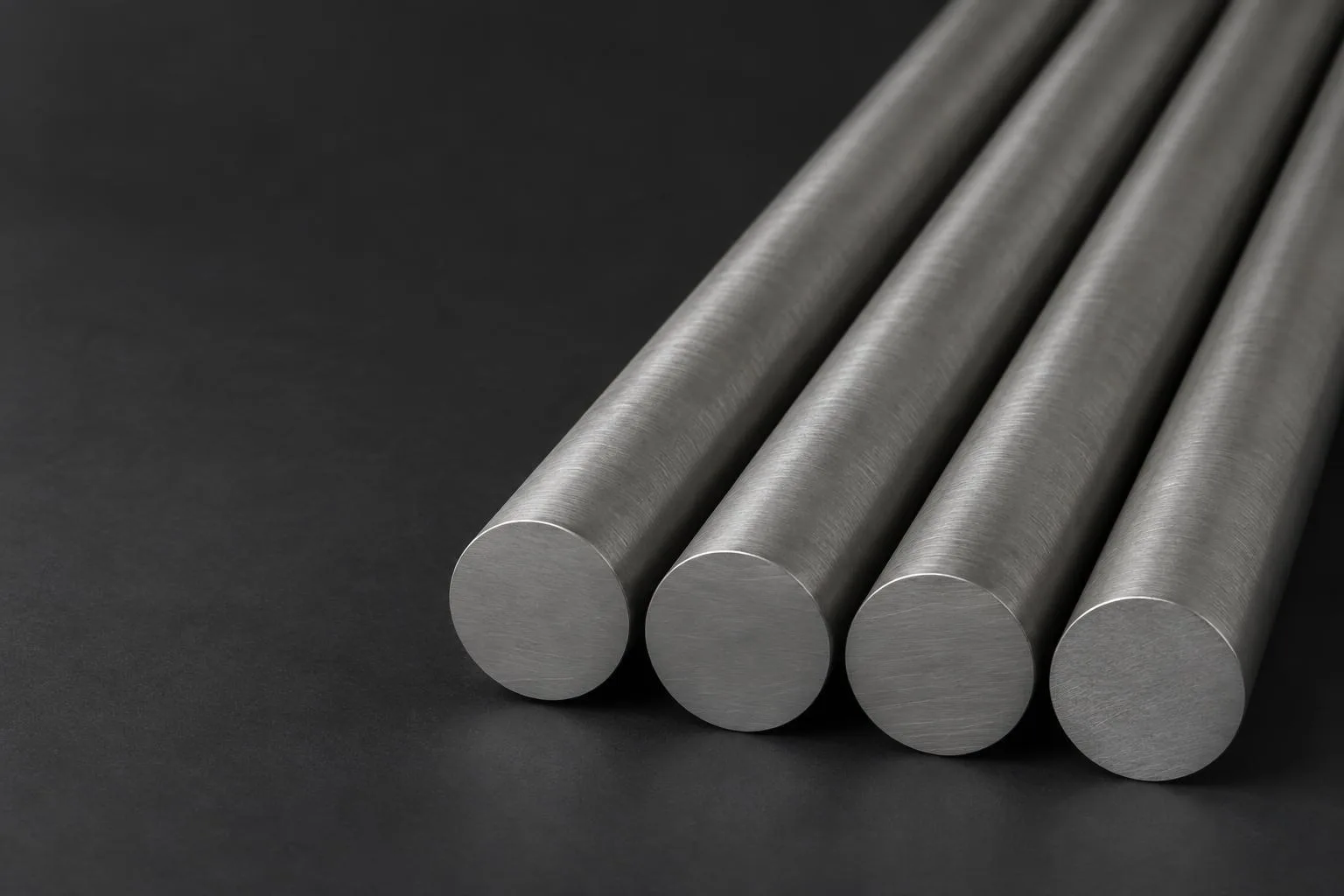
TIMETAL® is a registered trademark of Titanium Metals Corporation. Quest Engineering does not manufacture or own the trademark. Imagery is illustrative, not evidence of grade, certification or stock.
Raw & semi-finished materials
Available material forms
Supported specification/product forms, not a stock list. TIMET handbook Table 2 lists bar, sheet, strip and plate for both grades and specification coverage for forgings (not TIMET forging availability). Pipe/tube scope is separately verified for Grade 3 only. All supply is subject to ordered specification, dimensions and supplier confirmation.
- Bar and billet
- Sheet
- Strip
- Plate
- Forgings
Material overview
Titanium Grade 4
The highest-strength of the four standard commercially pure titanium grades, with useful ductility and moderate formability.
- The highest-strength of the four standard commercially pure titanium grades, with useful ductility and moderate formability.
- These are unalloyed alpha titanium grades, not Ti-6Al-4V Grade 5. Increased strength reduces forming latitude compared with lower-strength CP grades.
- Numerical acceptance values use one identified historical flat-product specification basis. Producer typical physical and elevated-temperature data are separate and are not guaranteed design allowables.
Designations and product specifications
| Designation / standard | Scope / status |
|---|---|
| UNS | R50700 |
| TIMETAL 75A | TIMET producer designation associated with ASTM Grade 4; not proof of conformity to every listed standard. |
| ASTM B265 | Annealed strip, sheet and plate; B265-20a numerical basis used here. |
| ASTM B348 | Bar and billet; producer handbook listing, current edition not verified. |
| ASTM B381 | Forgings, grade F4; producer handbook listing, current edition not verified. |
| AMS 4901 | Commercially pure annealed sheet, strip and plate; revision and full acceptance requirements unverified. |
References describe product scopes, not universal interchangeability or automatic multiple certification. AMS revisions and current full ASTM acceptance requirements must be checked against the purchase order. No European equivalence or medical approval is asserted.
Specification review
Technical verification requirements
Specification revision / product-form acceptance
Producer and historical references support much of the page; they do not establish all current ordered editions, product-form scope, treatment, section limits and acceptance provisions. This is a verification dependency, not evidence that these references are wrong.
Obtain ordered editions and record form/condition/thickness/orientation/test-temperature coverage separately for every listed specification; retain historical-data caveats.
Grade selection
Commercially pure titanium Grades 1–4 compared
| Property | Grade 1 | Grade 2 | Grade 3 | Grade 4 |
|---|---|---|---|---|
| UNS | R50250 | R50400 | R50550 | R50700 |
| Oxygen, max mass % | 0.18 | 0.25 | 0.35 | 0.40 |
| Iron, max mass % | 0.20 | 0.30 | 0.30 | 0.50 |
| Strength ranking | Lowest | Moderate | Higher | Highest |
| Tensile strength, min MPa | 240 | 345 | 450 | 550 |
| 0.2% yield strength, min MPa | 138 | 275 | 380 | 483 |
| Elongation in 50 mm, min % | 24 | 20 | 18 | 15 |
| Relative ductility and formability | Highest | High | Moderate | Lowest |
| Typical applications | Formed corrosion-resistant sheet, chemical plant linings, heat exchangers | General chemical, marine and heat-exchanger equipment | Pressure and process equipment needing more strength | Higher-strength corrosion-resistant and machined components |
Numerical rows are ASTM B265-20a specification minimums for annealed sheet, strip and plate only; they are not typical values and must not be compared with bar, tube or forging data. The grades differ principally through controlled interstitial elements (mainly oxygen, with iron) and the associated mechanical requirements. Rankings are qualitative. Confirm the ordered standard revision.
Engineering reference
Technical data
| Element | Mass % | Limit |
|---|---|---|
| Ti | Balance | By difference |
| O | 0.40 | Maximum |
| Fe | 0.50 | Maximum |
| N | 0.05 | Maximum |
| C | 0.08 | Maximum |
| H | 0.015 | Maximum |
| Residual elements, each | 0.10 | Maximum |
| Residual elements, total | 0.40 | Maximum |
Table 8 flat-product chemistry; not a blend of product specifications. Hydrogen is measured on final product; lower limits may be negotiated. TIMET flags hydrogen as product-form dependent: do not transfer this limit to other forms or medical specifications without checking them. Residual reporting and product-analysis tolerances follow the ordered standard; titanium is determined by difference.
| Property | Value | Temperature basis |
|---|---|---|
| Density | 4510 kg/m³ | Source does not specify temperature |
| Elastic modulus | 105–120 GPa | 20–25 °C |
| Thermal conductivity | 16.95 W/(m·K) | Source does not specify temperature |
| Electrical resistivity | 0.60 µΩ·m | Source does not specify temperature |
| Mean thermal expansion | 8.6 × 10⁻⁶ K⁻¹ | 20–100 °C |
| Mean thermal expansion | 9.5 × 10⁻⁶ K⁻¹ | 20–300 °C |
| Mean thermal expansion | 9.7 × 10⁻⁶ K⁻¹ | 20–500 °C |
Table 2 producer typical values, not acceptance limits. Density converted from 4.51 g/cm³. Specific heat and melting range omitted because a suitable grade-specific producer value was not established.
Annealed — ASTM B265 sheet/plate minimum
| Property | Requirement |
|---|---|
| Ultimate tensile strength | 550 MPa minimum |
| 0.2% offset yield strength | 483 MPa minimum |
| 0.2% offset yield strength | 655 MPa maximum |
| Elongation in 50 mm | 15% minimum |
Annealed sheet/plate only; Table 7, tested to E8 at ambient temperature (no exact test temperature specified here). Limits apply longitudinally and transversely. Elongation gauge length is 50 mm; specimen geometry and sampling follow the ordered standard. No additional Grade 3/4 thickness-specific tensile exception appears in this table. Do not apply these values to bar, forgings, tube, cold-worked material or elevated-temperature design.
TIMET publishes grade-specific typical elevated-temperature tensile results for TIMETAL 75A. These are test data, not allowable service stresses.
Typical elevated-temperature tensile properties
| Test temperature (°C) | 0.2% yield strength (MPa) | UTS (MPa) | Elongation (%) |
|---|---|---|---|
| 100 | 364 | 537 | 27 |
| 200 | 231 | 381 | 33 |
| 300 | 149 | 284 | 35 |
| 400 | 101 | 227 | 33 |
| 450 | 92 | 209 | Not reported |
Table 6. Product form, section size and prior heat-treatment condition are not stated by the producer and are not inferred. Typical data only; unsuitable as a guaranteed condition-specific acceptance table.
No creep life, oxidation-rate guarantee or universal maximum operating temperature is established by these tensile tests. Design must account for atmosphere, sustained load, exposure time and applicable code. Published SI entries are transcribed without recalculating rounded imperial entries.
Annealing
TIMETAL 75A: 700 °C for 1 hour, air cool; producer guidance, not a substitute for a qualified product-specific procedure.
Stress relief
TIMETAL 75A: 500 °C for 30 minutes, air cool. Confirm suitability for section size, prior cold work and the ordered specification.
Commercially pure titanium is not precipitation hardened. Cold work can increase strength at the expense of ductility; no unsupported cold-worked condition or solution-treatment-and-ageing schedule is offered. Control atmosphere and surface contamination during heating.
Material selection
Corrosion resistance & performance
A stable passive oxide film supports resistance to seawater, chlorides and many oxidising process environments. Grade strength does not confer universal chemical resistance.
Hot, concentrated, poorly aerated crevices and reducing acids require individual assessment; temperature, concentration, pH, impurities and galvanic coupling can change performance.
Hydrogen uptake and embrittlement require attention in reducing conditions or under inappropriate cathodic protection. Obtain a corrosion review for the actual service rather than relying on a generic seawater rating.
Typical applications
Engineering applications
- Corrosion-resistant industrial mechanical components requiring higher CP strength
- Precision machined parts
- Aerospace sheet and plate components where the specified AMS material and inspection requirements are met
Subsequent manufacturing
Machining & processing
Forming
Higher strength generally demands more forming load and allows less severe cold forming than lower CP grades. Confirm bend orientation and tooling; do not infer a universal minimum bend radius.
Welding
Use qualified procedures and clean surfaces with appropriate inert-gas shielding of weld face, root and cooling hot metal. Prevent oxygen, nitrogen and hydrogen contamination and inspect weld quality to the ordered requirements.
Machining
Use rigid workholding, sharp suitable tools and effective coolant delivery; avoid rubbing, heat accumulation and chip recutting. Establish parameters by grade, geometry and tooling trials rather than universal cutting speeds. Control titanium chip and fines fire hazards.
Material certification & testing
Define certification against the actual grade, specification edition, product form, dimensions and delivery condition.
Documentation and additional testing are subject to order and supplier agreement, not automatically included. No medical, aerospace or pressure-code approval is implied by grade name alone.
- EN 10204 3.1 material certificate or Certificate of Conformity, as agreed
- Heat/batch traceability and chemical analysis including oxygen, nitrogen, hydrogen and iron
- Specified tensile tests and heat-treatment records
- Hardness, ultrasonic examination and aerospace inspections where ordered
- PMI where appropriate; handheld XRF alone does not verify CP-grade interstitial limits
Material enquiry
Request a material quotation
Titanium Grade 4 supplied to your material form, dimensions and specification.