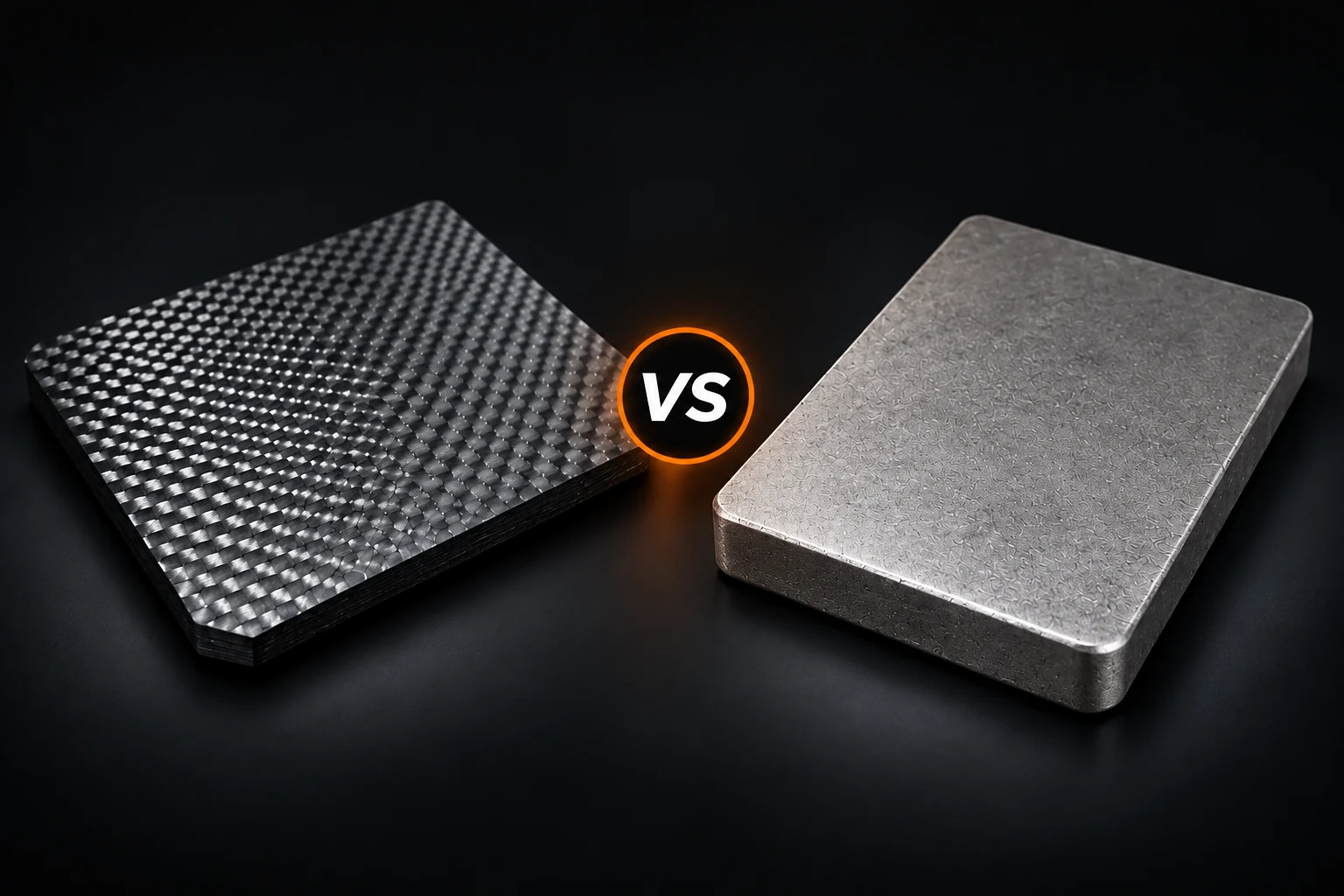
1. CFC vs Cast Steel — Key Benefits and Material Properties
CFC is a composite of carbon fibres within a carbon matrix. Unlike cast steel, its properties depend on fibre orientation and composite construction.
HK-type cast steel is a conventional heat-resistant austenitic casting alloy used in furnace equipment.
The following table compares their principal properties and explains what each difference means for furnace operators.
| Evaluation criterion | CFC fixture | HK-type cast steel fixture | Benefit of choosing CFC |
|---|
| Fixture weight | 🟢 Substantially lighter — Density approximately 1.45 g/cm³ | 🔴 Significantly heavier — Density approximately 7.75 g/cm³ | Increased furnace loading capacity. CFC is 81% lighter for equal material volume. A lighter fixture frees up more of a weight-limited furnace's permitted load for heat-treated components, increasing available payload. |
|---|
| Thermal mass | 🟢 Significantly lower — Volumetric heat capacity approximately 1.04 MJ/m³·K at 20°C | 🔴 Significantly higher — Approximately 3.88 MJ/m³·K at 20°C | Less energy absorbed by the fixture. For equal material volumes, CFC has approximately 73% lower volumetric heat capacity at room temperature, reducing the fixture's thermal burden during heating and cooling. |
|---|
| Thermal expansion | 🟢 Excellent dimensional stability — Representative in-plane CTE approximately 1 × 10⁻⁶/K | 🔴 Much greater expansion — Representative average CTE approximately 17 × 10⁻⁶/K | Far less thermal movement. CFC maintains more consistent fixture dimensions and component positioning during thermal cycling. The illustrative expansion difference is approximately 15.7 mm over a 1 m length heated from 20°C to 1,000°C. |
|---|
| Thermal conductivity | ⚪ Direction-dependent — Approximately 10–60 W/m·K | ⚪ More uniform — Approximately 14–25 W/m·K | Design flexibility. Fibre orientation and fixture geometry can influence heat transfer. There is no universal conductivity advantage over steel. |
|---|
| High-temperature performance | 🟢 Excellent in suitable vacuum/inert environments — Low expansion and high-temperature carbon stability | 🔴 Limited by temperature-dependent creep and deformation — Alloy-specific operating limits apply | Greater dimensional repeatability. CFC's low thermal expansion reduces thermally induced movement, helping fixtures maintain their geometry during repeated high-temperature vacuum cycles. |
|---|
| Mechanical handling | ⚪ Lightweight but impact-sensitive — Requires appropriate handling and joint design | 🟢 More impact-tolerant — Metallic ductility provides an advantage | Reduced handling loads. Lower fixture mass reduces the weight handled by operators, lifting equipment and automated systems. Steel retains an advantage where impact resistance is critical. |
|---|
| Initial purchase cost | 🔴 Generally higher — Specialist composite manufacturing | 🟢 Generally lower — Conventional casting processes | Higher initial investment. CFC should be evaluated against its operational benefits rather than purchase price alone. |
|---|
| Life-cycle cost | 🟢 Strong opportunity for lower operating costs — Lower mass, thermal burden and dimensional movement | ⚪ Application-dependent — Fixture life, maintenance and operating duty influence cost | Improved operating economics. Reduced fixture mass and thermal movement can improve loading efficiency and reduce the thermal burden on the furnace. Overall savings depend on actual operating conditions. |
|---|
Representative properties are provided for engineering comparison, not as certified design allowables. CFC properties vary by grade, fibre direction and temperature. The numerical benefits relate to the stated comparison basis.
Three measurable advantages of CFC
81% lower material mass: For equal material volumes, using representative densities of 1.45 g/cm³ for CFC and 7.75 g/cm³ for cast steel.
94% less linear thermal expansion: Based on illustrative average coefficients of 1 × 10⁻⁶/K for CFC in-plane and 17 × 10⁻⁶/K for cast steel.
73% lower volumetric heat capacity: For equal material volumes at approximately 20°C, using representative density and specific heat values.
These figures describe material-property differences, not guaranteed reductions in total fixture weight, furnace electricity consumption or cycle time.
2. How Does CFC Improve Furnace Loading Capacity?
Fixture weight contributes to the total mass supported by a furnace.
Where the furnace's permitted gross loading mass is the limiting factor, reducing fixture weight releases additional capacity for workpieces.
Example: 1,000 kg Vacuum Furnace
Cast steel fixture
750 kgAvailable workpiece capacity
Fixture mass: 250 kg
CFC fixture
925 kgAvailable workpiece capacity
Fixture mass: 75 kg
+23.3%Additional available workpiece mass
| Parameter | Cast steel fixture | CFC fixture |
|---|
| Maximum permitted gross load | 1,000 kg | 1,000 kg |
|---|
| Illustrative fixture mass | 250 kg | 75 kg |
|---|
| Available component mass allowance | 750 kg | 925 kg |
|---|
| Additional component mass allowance | — | 175 kg |
|---|
| Increase in available payload | — | 23.3% |
|---|
In this example, replacing a 250 kg steel fixture with a purpose-designed 75 kg CFC fixture increases the available component mass allowance by 23.3%.
The example uses assumed fixture masses. Actual throughput also depends on furnace working dimensions, load distribution, heating uniformity, quenching capacity and process requirements.
Reduced Thermal Expansion
For a 1,000 mm fixture element heated from 20°C to 1,000°C, using representative average expansion coefficients:
| Material | Calculated linear expansion |
|---|
| CFC, in-plane | 0.98 mm |
|---|
| HK-type cast steel | 16.66 mm |
|---|
| Difference | 15.68 mm |
|---|
The much lower expansion of CFC helps maintain consistent fixture dimensions and component positioning throughout repeated thermal cycles.
These are illustrative calculations; actual expansion must use the selected material's temperature-dependent data.
Reduced Thermal Mass
CFC's low density also reduces the amount of thermal energy stored in an equivalent volume of fixture material.
At room temperature, representative volumetric heat capacities are:
- CFC: 1.04 MJ/m³·K
- HK cast steel: 3.88 MJ/m³·K
This represents approximately 73% lower volumetric heat capacity for CFC.
Less fixture thermal mass reduces the thermal burden during furnace heating and cooling. The actual energy absorbed over a complete heat-treatment cycle must be calculated using temperature-dependent specific heat data.
3. Which Furnace Applications Are Suitable for CFC?
CFC is particularly well suited to vacuum and inert-atmosphere heat treatment.
| Furnace application | CFC suitability | Technical explanation |
|---|
| High-temperature vacuum | 🟢 Excellent | High-temperature capability, low fixture mass and excellent dimensional stability in suitable vacuum conditions. |
|---|
| Inert gas atmosphere | 🟢 Excellent | Well suited to compatible inert atmospheres where oxygen and moisture are controlled. |
|---|
| Vacuum brazing | 🟢 Excellent | Low thermal expansion supports accurate component positioning. Brazing alloy and contact compatibility must be checked. |
|---|
| Vacuum hardening | 🟢 Excellent | Well suited to repeated vacuum heat-treatment cycles and lightweight fixture construction. |
|---|
| Low-pressure carburising (LPC) | 🟢 Excellent | Well suited to appropriately designed LPC fixtures, with process and workpiece compatibility assessed. |
|---|
| High-pressure gas quenching | 🟢 Excellent | Lightweight, open-grid structures are well suited to gas-quench applications. Structural loads and gas flow must be considered. |
|---|
| High-temperature air exposure | 🔴 Generally unsuitable | Unprotected CFC oxidises in hot oxygen-containing atmospheres. Oxidation can become significant above approximately 400°C, depending on exposure conditions. |
|---|
| Oil quenching | 🔴 Generally unsuitable for conventional porous grades | Oil can penetrate accessible porosity and be released during reheating, creating smoke, contamination or ignition hazards. Modified and densified grades are being developed to improve suitability. |
|---|
The Two Principal Limitations of CFC
Oxidising atmospheres: Unprotected CFC is vulnerable to oxidation in the presence of oxygen at elevated temperatures. Approximately 400°C is a practical warning threshold, not a universal oxidation onset temperature. For sustained high-temperature air applications, heat-resistant metallic or suitable ceramic fixtures are generally more appropriate.
Oil quenching: Conventional porous CFC grades can absorb quenching oil. Retained oil may subsequently be released during reheating, creating contamination and ignition risks. Specially developed CFC grades are being investigated and offered to improve oil-quenching compatibility, but their suitability must be verified for the specific process.
For conventional vacuum hardening, vacuum brazing, LPC and high-pressure gas quenching, CFC remains an excellent fixture material when correctly designed.
4. Important CFC Fixture Design Considerations
Although CFC offers significant material advantages, a successful fixture must be designed around the operating conditions.
Mechanical loading: Fibre orientation, beam spans, support locations, concentrated loads and joint design determine structural performance. CFC should not be substituted directly into an existing steel fixture geometry without engineering assessment.
Carbon contamination: Direct contact between CFC and certain metallic workpieces can cause unwanted carbon transfer or surface reactions at elevated temperatures. Ceramic contact supports or barriers may be required.
Handling: CFC is lightweight but more vulnerable to impact and edge damage than metallic fixtures. Appropriate lifting and handling arrangements are important.
Thermal behaviour: CFC conductivity is direction-dependent. Fixture geometry, radiation and contact conditions influence heat distribution and component temperature uniformity.
Hybrid CFC and Ceramic Fixtures
Combining CFC structural components with suitable technical ceramic contact elements can provide lightweight construction while separating sensitive workpieces from direct carbon contact.
Ceramic supports, spacers and contact pads must be selected for the temperature, atmosphere, mechanical loading and workpiece material.
5. When Is Cast Steel the Better Choice?
Heat-resistant cast steel remains a practical option for applications involving:
- Sustained high-temperature oxidising atmospheres.
- Rough mechanical handling or significant impact.
- Operating conditions within the selected casting alloy's temperature and load capabilities.
- Workpieces where carbon contact cannot be adequately controlled.
- Processes where metallic fixtures already provide satisfactory service life and operating economics.
Higher-nickel heat-resistant casting alloys may also be appropriate for particular high-temperature duties.
The correct material choice depends on the complete application rather than purchase price or maximum temperature alone.
6. Is CFC Right for Your Application?
When evaluating a CFC furnace fixture, the following information is particularly important:
- Furnace working dimensions and permitted loading capacity.
- Maximum operating temperature, vacuum level and atmosphere.
- Workpiece alloys and surface-quality requirements.
- Component weights, positioning and fixture support arrangement.
- Heating, soaking and cooling profiles.
- Gas-quenching pressure and flow conditions, where applicable.
- Handling method, cycle frequency and expected fixture life.
These requirements allow the fixture design, material grade and contact-support arrangement to be evaluated together.
Conclusion
CFC furnace fixtures offer clear, measurable advantages over conventional heat-resistant cast steel for suitable vacuum heat-treatment applications.
Their substantially lower density reduces fixture weight, their low thermal expansion improves dimensional repeatability, and their reduced volumetric heat capacity lowers the thermal burden on the furnace.
These advantages make CFC an excellent choice for vacuum hardening, vacuum brazing, low-pressure carburising and high-pressure gas quenching.
However, oxidation, oil-quenching compatibility, carbon transfer and mechanical handling must be considered.
For many applications, a purpose-designed CFC or hybrid CFC/ceramic fixture provides an effective alternative to conventional cast steel.
Discuss Your Furnace Fixture Requirements
Quest Engineering supplies custom high-temperature fixture solutions, including CFC and hybrid CFC/ceramic designs.
Contact our team to discuss your furnace dimensions, operating conditions, workpiece materials and loading requirements.