Materials Supply / Alloy & High-Strength Steels
300M Modified 4340 Steel
Silicon–vanadium-modified 4340 | UNS K44220 | Not ordinary VAR 4340
300M is a modified 4340 steel with substantially higher silicon and intentional vanadium. Carpenter states that added silicon permits a higher tempering temperature; its VAC-ARC product also has a higher nominal molybdenum content than its 4340 product.
The producer’s principal-use range of 270–300 ksi (1862–2068 MPa) is a general application statement, not a universal minimum. The detailed transverse rows below retain the producer’s tested-size and specimen labels because stock form and specimen units are not fully identified.
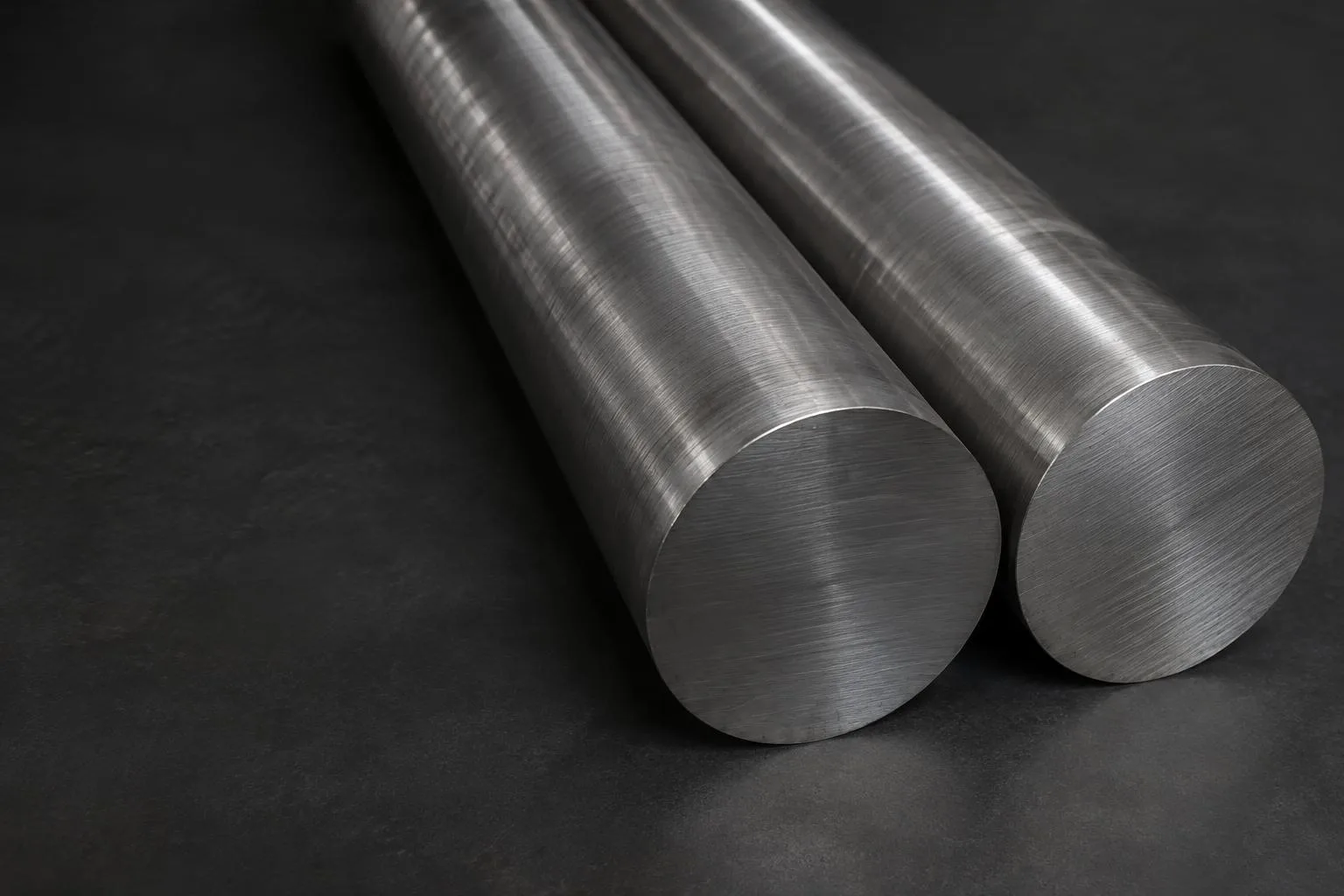
Imagery is illustrative steel product forms, not certified 300M stock or evidence of Quest stockholding.
Raw & semi-finished materials
Available material forms
Verified AMS scopes cover bars, forgings, mechanical tubing and forging stock. Current supplier dimensions were not established; sheet, plate, wire, powder and castings are not inferred. Confirm specification revision, form, section and condition at enquiry.
- Bar
- Forgings and forging stock
- Mechanical tubing
Material overview
300M Modified 4340 Steel
A high-silicon, vanadium-bearing modification of 4340 with its own chemistry, specifications and temper response; not an interchangeable name for vacuum-remelted 4340.
- Carpenter typical analysis: 0.42% carbon, 1.65% silicon, 1.80% nickel, 0.80% chromium, 0.40% molybdenum and 0.07% vanadium.
- UNS K44220 is corroborated by primary producers. Aubert & Duval NC40SW is a producer cross-reference to 300M; EU designation 40NiSiCrMo7 is not treated as automatic specification equivalence.
- AMS6417, AMS6419 and AMS6257 are separate requirements with different verified title carbon windows or unresolved scopes. They are not ordinary-4340 specifications or an automatic triple certification.
- 300M-HS is a distinct Carpenter variant with more stringent control and is excluded from this record. Vacuum melting alone does not turn 4340 into 300M.
Designations and product specifications
| Designation / standard | Scope and qualification |
|---|---|
| Common names | 300M; modified 4340; 4340 modified; LESCALLOY 300M VAC-ARC for the named producer product |
| UNS | K44220 |
| Producer cross-reference | Aubert & Duval NC40SW; 40NiSiCrMo7 producer EU designation — not automatic equivalence |
| AMS6417 | Premium consumable-electrode vacuum-remelted bars, forgings, mechanical tubing and forging stock; title identifies 0.38–0.43C. Official L entry dated 18 February 2025 is WIP, not an issued acceptance revision |
| AMS6419 | Same general product categories and alloy system; historical C title identifies 0.40–0.45C. Revision history lists K, 12 February 2021; obtain the complete ordered revision |
| AMS6257 | Carpenter lists for 300M and identifies replacement of MIL-S-8844 Class 3. Complete official revision, chemistry and supply-condition scope not verified |
Do not treat AMS6417, AMS6419 and AMS6257 as identical certificates. Their carbon requirements and clauses can differ, and a WIP entry is not a published acceptance requirement. Full current standards and supplier-specific conditions remain necessary.
SAE AMS6417L work-in-progress catalogue entry — status, title and product scope
Specification review
Technical verification requirements
Mechanical table metadata
The producer’s stock form, specimen units/geometry, sampling location, test temperature and complete treatment linkage are incomplete.
Obtain a fully qualified producer/specification dataset before using values for design or acceptance; do not reinterpret “size tested” as bar diameter.
Specification status
AMS6417L is WIP; complete current AMS6417/6419/6257 requirements and fracture/fatigue bases remain unresolved.
Obtain controlled published revisions and application-specific toughness, fatigue and process requirements before technical approval.
Grade selection
4340, 300M, 4330V and Modified 4330 / 4330M — distinct procurement identities
| Aspect | 4340 | 300M | 4330V | Modified 4330 / 4330M |
|---|---|---|---|---|
| Alloy relationship | Ni–Cr–Mo base grade | Silicon–vanadium-modified 4340 | Vanadium-modified 4330 producer/industry name | Industry shorthand; cited SAE documents use 4330 Mod |
| Carbon basis used here | 0.40% producer typical | 0.42% producer typical | 0.30% producer typical | 0.28–0.33% in AMS title |
| Silicon basis used here | 0.30% producer typical | 1.65% producer typical | 0.30% producer typical | Full AMS chemistry table not accessed |
| Molybdenum / vanadium | 0.25% / no intentional V listed | 0.40% / 0.07% | 0.40% / 0.07% | Approximately 0.42% Mo / 0.08% V in AMS title |
| Specification distinction | AMS6415 air-melt and AMS6414 VAR routes are separate | AMS6417, AMS6419 and AMS6257 are not ordinary-4340 requirements | AMS/customer specification and producer identity required | AMS6411 consumable-electrode remelt and AMS6427 are separate routes |
| Numerical property basis | Three transverse bar sizes/tempers | Five transverse size/specimen rows at 302°C temper | Large-block and 140 mm square orientation-specific results | No independent numerical dataset verified; values withheld |
Producer typical analyses and SAE title identifiers are shown on their own bases, not as interchangeable acceptance ranges. 300M is not simply VAR 4340; 4330V and 4330M names overlap and do not establish two universal compositions. No universal strength, toughness or fatigue ranking is inferred. Substitution requires engineering approval against the full specification, melt route, form, section, condition and tests.
Engineering reference
Technical data
| Element | Typical mass % | Basis |
|---|---|---|
| Carbon | 0.42 | Producer typical |
| Manganese | 0.75 | Producer typical |
| Silicon | 1.65 | Producer typical |
| Nickel | 1.80 | Producer typical |
| Chromium | 0.80 | Producer typical |
| Molybdenum | 0.40 | Producer typical |
| Vanadium | 0.07 | Producer typical |
| Iron | Balance | Remainder |
Carpenter/Latrobe 04/07, page 1, Typical Composition. Typical values, not acceptance ranges. Do not infer universal carbon superiority over 4340: verified AMS titles have overlapping carbon intervals. Impurity, residual and product-analysis requirements must come from the selected specification.
| Property | Producer value | Temperature / basis |
|---|---|---|
| Density | 7.84 g/cm³ (7,840 kg/m³) | Temperature and condition not stated |
| Thermal conductivity | 37.49 W/(m·K) | Temperature and condition not stated |
| Specific heat | 448 J/(kg·K) | Producer value; temperature not stated |
| Mean thermal expansion | 11.34 × 10⁻⁶/K | Approximately −17.8 to 93°C |
Producer reference values for the named VAC-ARC product, not acceptance limits. The 0.01 W/(m·K) difference from 4340 is not evidence of a meaningful alloy distinction. Elastic modulus, Poisson’s ratio, resistivity and melting range are omitted pending verification.
660–711 mm (26–28 in) tested size — 302°C temper — transverse typical (0.252 specimen)
| Property | Producer typical | Basis |
|---|---|---|
| Producer “size tested” | 660–711 mm (26–28 in) | Stock geometry/form not explicitly identified |
| Producer “specimen size” | 0.252 | Retained as printed; units and geometry not stated |
| Ultimate tensile strength | 1972 MPa (286 ksi) | Transverse typical |
| 0.2% yield strength | 1655 MPa (240 ksi) | Transverse typical |
| Elongation | 11% | Gauge length not stated |
| Reduction of area | 37% | Transverse typical |
Carpenter/Latrobe 300M VAC-ARC, 04/07, page 2, Typical Transverse Mechanical Properties with 575°F (302°C) Temper. The table does not explicitly identify stock form, specimen units/geometry, sampling location, test temperature, gauge length, temper duration or complete prior treatment. Producer evidence, not a fully qualified design-property or acceptance dataset.
559 mm (22 in) tested size — 302°C temper — transverse typical (0.505 specimen)
| Property | Producer typical | Basis |
|---|---|---|
| Producer “size tested” | 559 mm (22 in) | Stock geometry/form not explicitly identified |
| Producer “specimen size” | 0.505 | Retained as printed; units and geometry not stated |
| Ultimate tensile strength | 1986 MPa (288 ksi) | Transverse typical |
| 0.2% yield strength | 1689 MPa (245 ksi) | Transverse typical |
| Elongation | 8.5% | Gauge length not stated |
| Reduction of area | 31% | Transverse typical |
Carpenter/Latrobe 300M VAC-ARC, 04/07, page 2, Typical Transverse Mechanical Properties with 575°F (302°C) Temper. The table does not explicitly identify stock form, specimen units/geometry, sampling location, test temperature, gauge length, temper duration or complete prior treatment. Producer evidence, not a fully qualified design-property or acceptance dataset.
559 mm (22 in) tested size — 302°C temper — transverse typical (0.252 specimen)
| Property | Producer typical | Basis |
|---|---|---|
| Producer “size tested” | 559 mm (22 in) | Stock geometry/form not explicitly identified |
| Producer “specimen size” | 0.252 | Retained as printed; units and geometry not stated |
| Ultimate tensile strength | 1986 MPa (288 ksi) | Transverse typical |
| 0.2% yield strength | 1669 MPa (242 ksi) | Transverse typical |
| Elongation | 10% | Gauge length not stated |
| Reduction of area | 35% | Transverse typical |
Carpenter/Latrobe 300M VAC-ARC, 04/07, page 2, Typical Transverse Mechanical Properties with 575°F (302°C) Temper. The table does not explicitly identify stock form, specimen units/geometry, sampling location, test temperature, gauge length, temper duration or complete prior treatment. Producer evidence, not a fully qualified design-property or acceptance dataset.
≤305 mm (≤12 in) tested size — 302°C temper — transverse typical (0.505 specimen)
| Property | Producer typical | Basis |
|---|---|---|
| Producer “size tested” | ≤305 mm (≤12 in) | Stock geometry/form not explicitly identified |
| Producer “specimen size” | 0.505 | Retained as printed; units and geometry not stated |
| Ultimate tensile strength | 1979 MPa (287 ksi) | Transverse typical |
| 0.2% yield strength | 1682 MPa (244 ksi) | Transverse typical |
| Elongation | 10% | Gauge length not stated |
| Reduction of area | 33% | Transverse typical |
Carpenter/Latrobe 300M VAC-ARC, 04/07, page 2, Typical Transverse Mechanical Properties with 575°F (302°C) Temper. The table does not explicitly identify stock form, specimen units/geometry, sampling location, test temperature, gauge length, temper duration or complete prior treatment. Producer evidence, not a fully qualified design-property or acceptance dataset.
≤305 mm (≤12 in) tested size — 302°C temper — transverse typical (0.252 specimen)
| Property | Producer typical | Basis |
|---|---|---|
| Producer “size tested” | ≤305 mm (≤12 in) | Stock geometry/form not explicitly identified |
| Producer “specimen size” | 0.252 | Retained as printed; units and geometry not stated |
| Ultimate tensile strength | 1986 MPa (288 ksi) | Transverse typical |
| 0.2% yield strength | 1669 MPa (242 ksi) | Transverse typical |
| Elongation | 11% | Gauge length not stated |
| Reduction of area | 39% | Transverse typical |
Carpenter/Latrobe 300M VAC-ARC, 04/07, page 2, Typical Transverse Mechanical Properties with 575°F (302°C) Temper. The table does not explicitly identify stock form, specimen units/geometry, sampling location, test temperature, gauge length, temper duration or complete prior treatment. Producer evidence, not a fully qualified design-property or acceptance dataset.
Normalising
Carpenter specifies 927°C (1700°F) for one hour, followed by air cooling.
Austenitising and quenching
871°C (1600°F) for one hour, followed by oil quenching.
Tempering
260–316°C (500–600°F) for four hours, air cool. The source misprints the converted unit as °F; °C is the intended unit. A separate tempering-curve caption specifies two tempers of two hours each, so schedules are not treated as universally identical.
Machining preparation
Normalise and temper at approximately 649°C (1200°F) for optimum machinability; Carpenter gives typical hardness HBW 241–285 for this preparation.
Producer guidance for LESCALLOY 300M VAC-ARC, not a universal component procedure. The added silicon changes temper response relative to 4340. Qualify section, atmosphere, quench, exact double/single temper route and inspection against the ordered specification.
Typical applications
Engineering applications
- Aircraft landing gear, where approved
- Flap tracks and structural aircraft components
- Shafts and gears to an agreed specification
- Heavily stressed aerospace mechanical parts
Subsequent manufacturing
Machining & processing
Forging
Carpenter gives 1066–1232°C (1950–2250°F), with an approximate minimum forging temperature of 927°C (1700°F). Establish the complete section-specific process.
Welding
Gas or arc fusion is described by the producer, but this is not evidence of an approved flight-critical repair procedure or unrestricted welding in the final hardened condition.
Fracture and fatigue data
The datasheet reports ASTM E399 toughness without adequate orientation, specimen, section and treatment linkage; no standalone numerical KIC field is published. No fatigue allowable is inferred.
Variant control
300M-HS is a separate Carpenter variant and is not included. Normalized-and-tempered commercial bar is not the final 270–300 ksi service condition.
Material certification & testing
Documentation and inspection must be agreed for the actual grade name, specification revision, melting route, product form, ruling section and delivery condition.
No certificate, test, aerospace approval or grade equivalence is automatic. The short names 4330V and 4330M are not sufficient procurement specifications; quotation controls remain disabled.
- EN 10204 3.1 material certificate, where agreed with the supplier
- Certificate of Conformity
- Heat / batch traceability to the producing mill
- Chemical analysis and mechanical test reports to the ordered specification
- Heat-treatment records identifying the complete cycle and load, where required
- Melting / remelting-route evidence, ultrasonic inspection, PMI or customer-specific testing only where agreed
Material enquiry
Request a material quotation
300M Modified 4340 Steel supplied to your material form, dimensions and specification.