Materials Supply / Alloy & High-Strength Steels
4330V Vanadium-Modified Steel
Vanadium-modified 4330 low-alloy steel | Carpenter VAC-ARC producer data
4330V is a producer and industry designation for vanadium-modified 4330 nickel–chromium–molybdenum steel. Carpenter describes its LESCALLOY 4330+V VAC-ARC as a consumable-electrode vacuum-arc-remelted grade.
The name overlaps commercially with 4330 Mod and 4330M. This page uses Carpenter 4330+V data only; it does not establish universal equivalence with material carrying another modified-4330 name or specification.
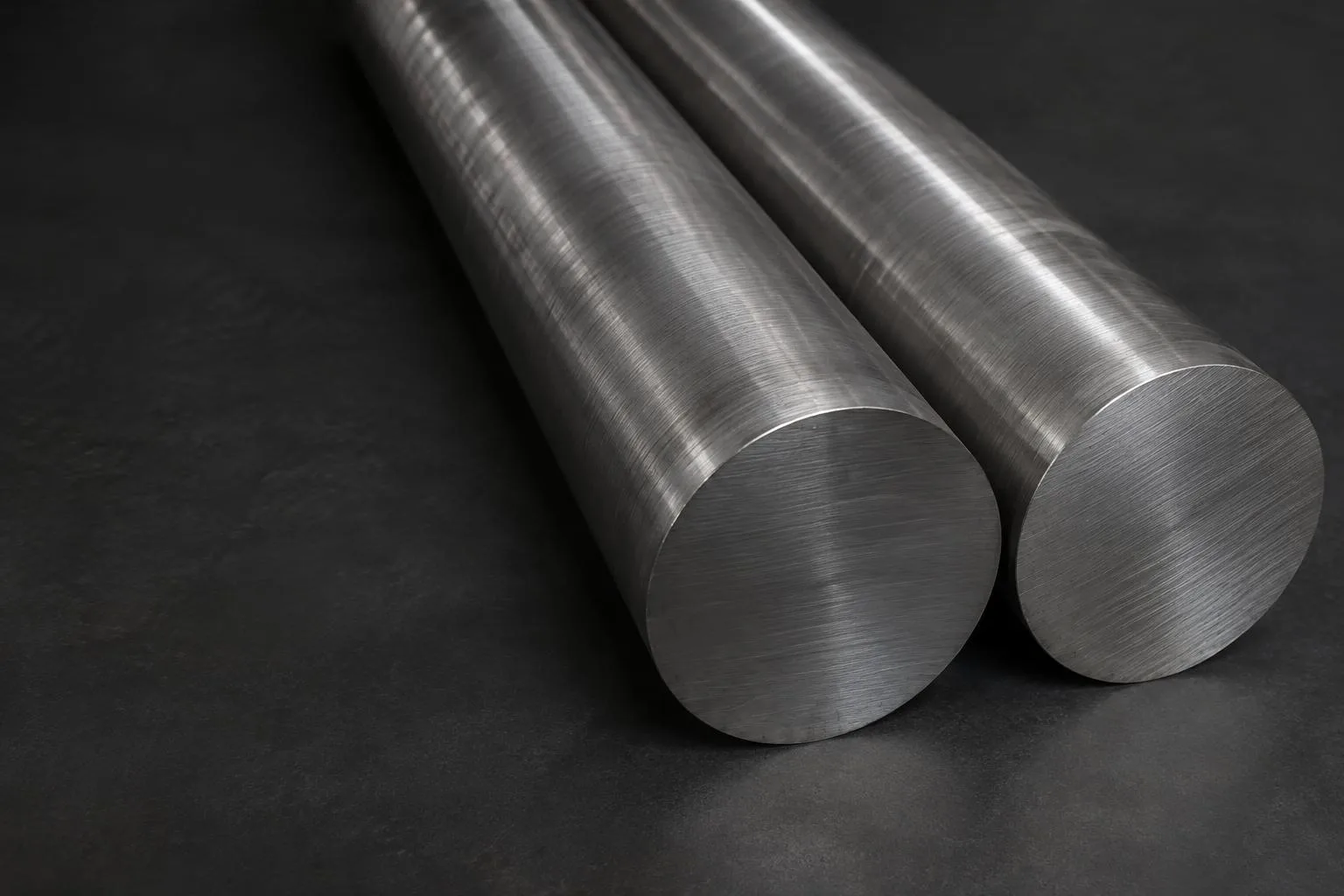
Imagery is illustrative steel product forms, not certified 4330V stock or evidence of Quest stockholding.
Raw & semi-finished materials
Available material forms
Carpenter publishes results for large blocks and a 5½ in (140 mm) square; Scot Forge lists 4330 VAR/E4330/4330 MOD forged bar. AMS scopes include mechanical tubing, but that does not establish current supplier availability. Confirm form, size, melt route and specification at enquiry.
- Large blocks / forging stock
- Square and forged bar
- Mechanical tubing — specification enquiry
Material overview
4330V Vanadium-Modified Steel
A vanadium-modified 4330 steel with producer typical data for large blocks and a 140 mm square section; procurement requires more than the short grade name.
- Producer typical composition includes approximately 0.30% carbon and 0.07% vanadium; it is not presented as an acceptance-limit table.
- Carpenter customary-use statements around 220–240 ksi are not adopted as mechanical guarantees. Actual results below are tied to section, sampling orientation and temper.
- Longitudinal and transverse results are separate conditions. In the cited 140 mm square dataset, transverse Charpy values are lower than longitudinal values.
- 4330V, 4330M, 4340 and 300M are not interchangeable on name alone; melting practice, cleanliness and ordered tests can be as important as nominal chemistry.
Designations and specification references
| Designation / standard | Scope and qualification |
|---|---|
| 4330V / 4330+V | Producer / industry wording for vanadium-modified 4330; not a complete purchase specification |
| UNS | K23080 — corroborated by Universal Stainless for its 4330M/4330 Modified/4330V product; official registry not directly inspected |
| AMS6411K | 4330 Mod, consumable-electrode remelted bars, forgings, mechanical tubing and forging stock; dated 24 July 2023 |
| AMS6427P | Aircraft-quality 4330 Mod bars, forgings, mechanical tubing and forging stock; dated 20 October 2023 |
| ASTM A29/A29M-23 | General requirements for hot-wrought carbon and alloy bars; not a finished-part strength specification or special-grade approval |
| ASTM A646/A646M-24 | Premium-quality alloy-steel semifinished blooms and billets for reforging critical aerospace parts; not a blanket finished-bar/forging specification |
| Producer customer-specification cross-references | Carpenter lists BMS 7-122, BMS 7-27, CE-0906, FMS 1012 and EMS 96242; current scopes and dual certification not verified |
The two SAE documents are separate procurement routes and are not interchangeable merely because their title chemistries match. Full current clauses and mechanical acceptance tables were not accessed. Carpenter customer-specification references do not establish current revision, approved-source status or certification.
SAE AMS6411K — 4330 Mod consumable-electrode-remelted products (24 July 2023)
Specification review
Technical verification requirements
Nomenclature and chemistry
4330V, 4330+V, 4330 Mod and 4330M overlap commercially; no universal chemistry distinction was established.
Require the producer, heat chemistry and governing specification before equivalence or substitution.
Mechanical evidence
Detailed producer data are from 2007 and omit some block dimensions, gauge lengths and Charpy specimen details.
Obtain current ordered-specification acceptance tables and application-specific test requirements before engineering use.
Grade selection
4340, 300M, 4330V and Modified 4330 / 4330M — distinct procurement identities
| Aspect | 4340 | 300M | 4330V | Modified 4330 / 4330M |
|---|---|---|---|---|
| Alloy relationship | Ni–Cr–Mo base grade | Silicon–vanadium-modified 4340 | Vanadium-modified 4330 producer/industry name | Industry shorthand; cited SAE documents use 4330 Mod |
| Carbon basis used here | 0.40% producer typical | 0.42% producer typical | 0.30% producer typical | 0.28–0.33% in AMS title |
| Silicon basis used here | 0.30% producer typical | 1.65% producer typical | 0.30% producer typical | Full AMS chemistry table not accessed |
| Molybdenum / vanadium | 0.25% / no intentional V listed | 0.40% / 0.07% | 0.40% / 0.07% | Approximately 0.42% Mo / 0.08% V in AMS title |
| Specification distinction | AMS6415 air-melt and AMS6414 VAR routes are separate | AMS6417, AMS6419 and AMS6257 are not ordinary-4340 requirements | AMS/customer specification and producer identity required | AMS6411 consumable-electrode remelt and AMS6427 are separate routes |
| Numerical property basis | Three transverse bar sizes/tempers | Five transverse size/specimen rows at 302°C temper | Large-block and 140 mm square orientation-specific results | No independent numerical dataset verified; values withheld |
Producer typical analyses and SAE title identifiers are shown on their own bases, not as interchangeable acceptance ranges. 300M is not simply VAR 4340; 4330V and 4330M names overlap and do not establish two universal compositions. No universal strength, toughness or fatigue ranking is inferred. Substitution requires engineering approval against the full specification, melt route, form, section, condition and tests.
Engineering reference
Technical data
| Element | Typical mass % | Basis |
|---|---|---|
| Carbon | 0.30 | Producer typical |
| Manganese | 0.85 | Producer typical |
| Silicon | 0.30 | Producer typical |
| Nickel | 1.80 | Producer typical |
| Chromium | 0.85 | Producer typical |
| Molybdenum | 0.40 | Producer typical |
| Vanadium | 0.07 | Producer typical |
| Iron | Balance | Remainder |
Carpenter/Latrobe 04/07, page 1, Typical Composition. These are typical values, not heat analysis or specification acceptance limits. Supplier-published 4330V/4330 Mod windows conflict; obtain the full ordered specification and heat certificate rather than merging ranges.
| Property | Value | Temperature / basis |
|---|---|---|
| Density | 7.84 g/cm³ (7,840 kg/m³) | Producer value; temperature and condition not stated |
| Specific heat | 0.16 cal/(g·°C) (approximately 670 J/(kg·K)) | Producer value and direct unit conversion; temperature not stated |
Producer reference values, not acceptance limits. Young’s modulus, Poisson’s ratio, thermal expansion, thermal conductivity, electrical resistivity and melting interval were not verified from grade-specific primary data and are omitted.
Large block — oil quenched and tempered 282°C — transverse typical
| Property | Producer result | Basis |
|---|---|---|
| Ultimate tensile strength | 1621 MPa (235 ksi) | Average producer result |
| 0.2% yield strength | 1345 MPa (195 ksi) | Average producer result |
| Elongation | 11% | Gauge length not stated |
| Reduction of area | 47% | Mid-radius transverse |
| Hardness | 50 HRC | Producer result |
Carpenter 04/07, page 2, Typical Transverse Mechanical Properties Data. Large blocks; dimensions not disclosed. Austenitised 871°C for 1 hour, oil quenched and tempered at 282°C; tempering duration not stated. Typical/experimental averages, not specification minima or design allowables.
Large block — oil quenched and tempered 316°C — transverse typical
| Property | Producer result | Basis |
|---|---|---|
| Ultimate tensile strength | 1552 MPa (225 ksi) | Average producer result |
| 0.2% yield strength | 1331 MPa (193 ksi) | Average producer result |
| Elongation | 11% | Gauge length not stated |
| Reduction of area | 47% | Mid-radius transverse |
| Hardness | 47 HRC | Producer result |
Carpenter 04/07, page 2, Typical Transverse Mechanical Properties Data. Large blocks; dimensions not disclosed. Austenitised 871°C for 1 hour, oil quenched and tempered at 316°C; tempering duration not stated. Typical/experimental averages, not specification minima or design allowables.
140 mm square — 45 HRC treatment — longitudinal results
| Property | Producer result | Basis |
|---|---|---|
| Ultimate tensile strength | 1559 MPa (226 ksi) | Actual producer tensile data |
| 0.2% yield strength | 1297 MPa (188 ksi) | Actual producer tensile data |
| Elongation | 13.0% | Gauge length not stated |
| Reduction of area | 58.3% | Mid-radius longitudinal |
| Charpy V impact — mean of eight | 35 J (26 ft·lbf) | Published range 33–39 J; specimen details not stated |
Carpenter 04/07, page 2, Actual Room Temperature Tensile and Charpy V Impact Data. Treatment: 927°C for ½ hour, air cool; 871°C for ¼ hour, oil quench; 316°C for 2 hours; producer states 45 HRC. Processing history, gauge length, Charpy specimen dimensions and notch orientation not stated. Not acceptance limits.
140 mm square — 45 HRC treatment — transverse results
| Property | Producer result | Basis |
|---|---|---|
| Ultimate tensile strength | 1531 MPa (222 ksi) | Actual producer tensile data |
| 0.2% yield strength | 1276 MPa (185 ksi) | Actual producer tensile data |
| Elongation | 11.5% | Gauge length not stated |
| Reduction of area | 51.0% | Mid-radius transverse |
| Charpy V impact — mean of eight | 23 J (17 ft·lbf) | Published range 14–34 J; specimen details not stated |
Carpenter 04/07, page 2, Actual Room Temperature Tensile and Charpy V Impact Data. Treatment: 927°C for ½ hour, air cool; 871°C for ¼ hour, oil quench; 316°C for 2 hours; producer states 45 HRC. Processing history, gauge length, Charpy specimen dimensions and notch orientation not stated. Not acceptance limits.
Normalising
Carpenter recommends 871–927°C (1600–1700°F), followed by air cooling.
Austenitising and quenching
843–871°C (1550–1600°F), held 15 minutes per inch of thickness, then oil quenched. Ruling section and ordered procedure remain controlling.
Tempering
260–593°C (500–1100°F), selected for required strength. Carpenter identifies 260–371°C (500–700°F) for its stated 220–240 ksi customary strength range; that range is not an acceptance guarantee.
Machining-related treatments
Before rough machining, Carpenter recommends normalise and temper at 677°C (1250°F) maximum. After machining at maximum strength, it recommends stress relief at approximately 204°C (400°F).
Producer processing guidance from the 04/07 datasheet, not a qualified aerospace heat-treatment procedure. Component geometry, section, furnace, quench severity and customer specification must be reviewed; do not transfer the cycle automatically to 4330M, 4340 or 300M.
Typical applications
Engineering applications
- Shock-loaded high-strength components, where qualified
- Stress-concentrated engineering components
- High-strength forged components to an agreed specification
Subsequent manufacturing
Machining & processing
Forging
Carpenter gives 1066–1232°C (1950–2250°F), with preheating and slow post-forging cooling recommended. Establish the complete forging and cooling procedure for the actual section.
Melting route
The property data are for Carpenter VAC-ARC material. Vacuum degassing is not synonymous with vacuum arc remelting; specify the required route and cleanliness explicitly.
Welding
Carpenter specifically identifies resistance flash welding. This does not establish unrestricted fusion or repair weldability, especially in the high-strength condition; qualify any procedure separately.
Test orientation
Specify tensile and Charpy specimen location, orientation, temperature and gauge details. The producer’s longitudinal and transverse datasets are not interchangeable.
Material certification & testing
Documentation and inspection must be agreed for the actual grade name, specification revision, melting route, product form, ruling section and delivery condition.
No certificate, test, aerospace approval or grade equivalence is automatic. The short names 4330V and 4330M are not sufficient procurement specifications; quotation controls remain disabled.
- EN 10204 3.1 material certificate, where agreed with the supplier
- Certificate of Conformity
- Heat / batch traceability to the producing mill
- Chemical analysis and mechanical test reports to the ordered specification
- Heat-treatment records identifying the complete cycle and load, where required
- Melting / remelting-route evidence, ultrasonic inspection, PMI or customer-specific testing only where agreed
Material enquiry
Request a material quotation
4330V Vanadium-Modified Steel supplied to your material form, dimensions and specification.