Materials Supply / Alloy & High-Strength Steels
4340 Nickel-Chromium-Molybdenum Steel
SAE / AISI 4340 | UNS G43400 | Air-melt and VAR specifications are distinct
4340 is a nominally 0.40% carbon nickel–chromium–molybdenum low-alloy steel capable of high strength after quenching and tempering. Carpenter’s LESCALLOY 4340 VAC-ARC is a specific consumable-electrode vacuum-arc-remelted product.
The name 4340 alone does not establish VAR processing or aerospace quality. Conversely, vacuum-remelted 4340 remains 4340: it does not acquire 300M’s high-silicon, vanadium-bearing composition or heat-treatment response.
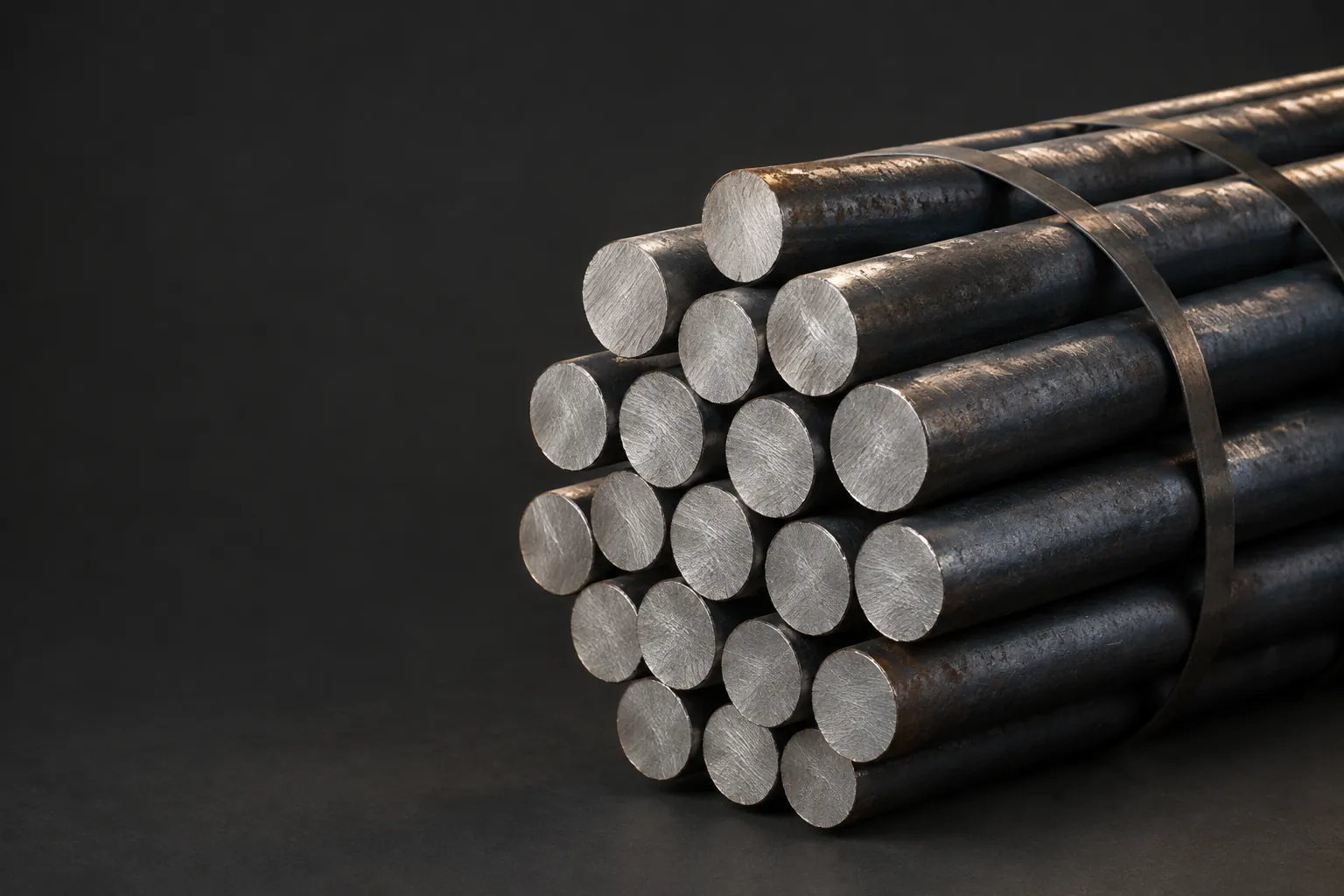
Imagery is illustrative steel product forms, not certified 4340 stock or evidence of Quest stockholding.
Raw & semi-finished materials
Available material forms
Carpenter verifies round and square bar property examples; AMS6414/6415 scopes cover bars, forgings, mechanical tubing and forging stock, and AMS6359 covers flat products. Form, size, melt route, condition and supplier availability must be confirmed at enquiry.
- Round and square bar
- Forgings and forging stock
- Mechanical tubing
- Sheet, strip and plate
Material overview
4340 Nickel-Chromium-Molybdenum Steel
A nickel–chromium–molybdenum through-hardening steel with separate air-melt and vacuum-remelt procurement routes; VAR 4340 is not 300M.
- Carpenter typical analysis contains 0.30% silicon, 0.25% molybdenum and no listed intentional vanadium addition. This is materially different from 300M’s typical 1.65% silicon, 0.40% molybdenum and 0.07% vanadium.
- AMS6415 is identified by Carpenter as air-melt material; AMS6414 covers premium vacuum-consumable-electrode-remelted products. Matching the name 4340 does not merge these quality routes.
- The three transverse property rows change bar size and temper together. They demonstrate condition sensitivity but do not isolate a size effect or justify a universal strength value.
- 300M, 4330V and 4330M are separate procurement identities, not alternate names for 4340. Substitution requires engineering approval.
Designations and product specifications
| Designation / standard | Scope and qualification |
|---|---|
| SAE / AISI | 4340 |
| UNS | G43400 |
| AMS6415V (2022) | Aircraft-quality SAE 4340 bars, forgings, mechanical tubing and forging stock; Carpenter identifies AMS6415 as air melt |
| AMS6414N (2023) | Premium aircraft-quality SAE 4340, vacuum consumable electrode remelted; bars, forgings, mechanical tubing and forging stock |
| AMS6359 | SAE 4340 sheet, strip and plate; SAE history lists 6359M (2025). Not a bar/forging specification |
| ASTM A322-24 | Hot-wrought standard-grade alloy bars; ESR or VAR may be used but is not inherently mandatory |
| ASTM A434/A434M-24 | Hot-wrought or cold-finished quenched-and-tempered alloy bars; strength class, size and condition require full-standard review |
| ASTM A29/A29M-26 | General requirements for hot-wrought carbon and alloy bars; invoked by product specifications or orders |
Air-melt and VAR routes are not interchangeable on grade name alone. Complete current standards are required for chemistry, delivery condition, cleanliness, section and acceptance tests. Carpenter customer-specification cross-references do not establish automatic certification.
SAE AMS6415V — SAE 4340 bars, forgings, mechanical tubing and forging stock (2022)
Specification review
Technical verification requirements
Specifications
Full current AMS/ASTM chemistry, cleanliness, section and acceptance clauses were not reviewed.
Obtain the ordered air-melt or VAR specification revision and matching heat-specific certification.
Mechanical evidence
Producer rows are typical transverse data with incomplete specimen, temperature and temper-duration metadata; size and temper vary together.
Do not use as design allowables or an isolated section-size comparison; obtain ordered-condition acceptance data.
Grade selection
4340, 300M, 4330V and Modified 4330 / 4330M — distinct procurement identities
| Aspect | 4340 | 300M | 4330V | Modified 4330 / 4330M |
|---|---|---|---|---|
| Alloy relationship | Ni–Cr–Mo base grade | Silicon–vanadium-modified 4340 | Vanadium-modified 4330 producer/industry name | Industry shorthand; cited SAE documents use 4330 Mod |
| Carbon basis used here | 0.40% producer typical | 0.42% producer typical | 0.30% producer typical | 0.28–0.33% in AMS title |
| Silicon basis used here | 0.30% producer typical | 1.65% producer typical | 0.30% producer typical | Full AMS chemistry table not accessed |
| Molybdenum / vanadium | 0.25% / no intentional V listed | 0.40% / 0.07% | 0.40% / 0.07% | Approximately 0.42% Mo / 0.08% V in AMS title |
| Specification distinction | AMS6415 air-melt and AMS6414 VAR routes are separate | AMS6417, AMS6419 and AMS6257 are not ordinary-4340 requirements | AMS/customer specification and producer identity required | AMS6411 consumable-electrode remelt and AMS6427 are separate routes |
| Numerical property basis | Three transverse bar sizes/tempers | Five transverse size/specimen rows at 302°C temper | Large-block and 140 mm square orientation-specific results | No independent numerical dataset verified; values withheld |
Producer typical analyses and SAE title identifiers are shown on their own bases, not as interchangeable acceptance ranges. 300M is not simply VAR 4340; 4330V and 4330M names overlap and do not establish two universal compositions. No universal strength, toughness or fatigue ranking is inferred. Substitution requires engineering approval against the full specification, melt route, form, section, condition and tests.
Engineering reference
Technical data
| Element | Typical mass % | Basis |
|---|---|---|
| Carbon | 0.40 | Producer typical |
| Manganese | 0.75 | Producer typical |
| Silicon | 0.30 | Producer typical |
| Chromium | 0.80 | Producer typical |
| Nickel | 1.80 | Producer typical |
| Molybdenum | 0.25 | Producer typical |
| Vanadium | Not listed as an intentional addition | Not a zero-content acceptance limit |
| Iron | Balance | Remainder |
Carpenter/Latrobe ©2007, page 1, Typical Composition. Typical values, not specification acceptance ranges or a heat certificate. Phosphorus, sulphur, copper, residual limits and product-analysis tolerances must come from the ordered specification; do not publish zero vanadium from omission in a nominal analysis.
| Property | Producer value | Temperature / basis |
|---|---|---|
| Density | 7.84 g/cm³ (7,840 kg/m³) | Temperature and condition not stated |
| Thermal conductivity | 37.48 W/(m·K) | Temperature and condition not stated |
| Specific heat | 0.107 cal/(g·°C) (approximately 448 J/(kg·K)) | Producer value and direct conversion; temperature not stated |
| Mean thermal expansion | 11.3 × 10⁻⁶/K | Approximately −18 to 93°C |
| Mean thermal expansion | 14.6 × 10⁻⁶/K | Approximately −18 to 649°C |
Producer reference values for the named VAC-ARC product, not acceptance limits. Elastic modulus, Poisson’s ratio, electrical resistivity and melting range were not adequately established from the detailed primary source and are omitted.
89 mm round bar — 204°C temper — transverse typical
| Property | Producer typical | Condition basis |
|---|---|---|
| Ultimate tensile strength | 1905 MPa (276 ksi) | Transverse |
| 0.2% yield strength | 1530 MPa (222 ksi) | Transverse |
| Elongation | 11.0% | Gauge length not stated |
| Reduction of area | 35.0% | Transverse |
Carpenter 4340 VAC-ARC, page 2. 3½ in / 89 mm round bar; normalized 899–927°C, austenitized 816–829°C, oil quenched and tempered 204°C. Temper duration, specimen location, test temperature and gauge length not stated. Typical values, not acceptance limits or design allowables.
191 mm square bar — 260°C temper — transverse typical
| Property | Producer typical | Condition basis |
|---|---|---|
| Ultimate tensile strength | 1830 MPa (265 ksi) | Transverse |
| 0.2% yield strength | 1530 MPa (222 ksi) | Transverse |
| Elongation | 8.0% | Gauge length not stated |
| Reduction of area | 25.0% | Transverse |
Carpenter 4340 VAC-ARC, page 2. 7½ in / 191 mm square bar; normalized 899–927°C, austenitized 816–829°C, oil quenched and tempered 260°C. Temper duration, specimen location, test temperature and gauge length not stated. Typical values, not acceptance limits or design allowables.
267 mm square bar — 593°C temper — transverse typical
| Property | Producer typical | Condition basis |
|---|---|---|
| Ultimate tensile strength | 1140 MPa (165 ksi) | Transverse |
| 0.2% yield strength | 1035 MPa (150 ksi) | Transverse |
| Elongation | 18.0% | Gauge length not stated |
| Reduction of area | 60.0% | Transverse |
Carpenter 4340 VAC-ARC, page 2. 10½ in / 267 mm square bar; normalized 899–927°C, austenitized 816–829°C, oil quenched and tempered 593°C. Temper duration, specimen location, test temperature and gauge length not stated. Typical values, not acceptance limits or design allowables.
Normalising
Carpenter recommends 871–927°C (1600–1700°F), air cool.
Austenitising and quenching
802–857°C (1475–1575°F), oil quench. The three mechanical rows use a narrower documented prior treatment shown in their notes.
Tempering
204–649°C (400–1200°F), selected for required properties. Carpenter identifies 204–260°C for tensile strengths above 1793 MPa (260 ksi) in its guidance; this is not an acceptance guarantee.
Machining preparation
Normalise and temper at approximately 1200°F. The source prints 629°C, but 1200°F converts to approximately 649°C; the corrected conversion is used and the source discrepancy is retained here.
Producer guidance for LESCALLOY 4340 VAC-ARC, not a universal aerospace component procedure. Qualify section, atmosphere, decarburisation control, quench and inspection against the ordered specification. Do not transfer this cycle to 300M.
Typical applications
Engineering applications
- Aircraft landing-gear components, where approved
- Gears, shafts and connecting rods
- Structural aircraft components
- Bearing components and high-strength engineering parts
Subsequent manufacturing
Machining & processing
Forging
Carpenter gives 1066–1232°C (1950–2250°F), recommending preheating and furnace cooling or cooling in ash/lime after forging because of air-hardening behaviour.
Welding
Gas or arc fusion is described by the producer, with annealing or normalising and tempering after welding because of air-hardening characteristics. This is not approval for flight-critical repair welding.
Melting and cleanliness
Specify air-melt or VAR and any cleanliness requirement explicitly. Carpenter’s VAC-ARC data must not be assigned automatically to air-melt stock.
Surface and manufacturing controls
Hydrogen-embrittlement prevention, plating/baking, grinding damage and repair procedures require approved process sources; the cited datasheet does not qualify them.
Material certification & testing
Documentation and inspection must be agreed for the actual grade name, specification revision, melting route, product form, ruling section and delivery condition.
No certificate, test, aerospace approval or grade equivalence is automatic. The short names 4330V and 4330M are not sufficient procurement specifications; quotation controls remain disabled.
- EN 10204 3.1 material certificate, where agreed with the supplier
- Certificate of Conformity
- Heat / batch traceability to the producing mill
- Chemical analysis and mechanical test reports to the ordered specification
- Heat-treatment records identifying the complete cycle and load, where required
- Melting / remelting-route evidence, ultrasonic inspection, PMI or customer-specific testing only where agreed
Material enquiry
Request a material quotation
4340 Nickel-Chromium-Molybdenum Steel supplied to your material form, dimensions and specification.