Materials Supply / Aluminium Alloys
Aluminium Alloy 2618 / 2618A
Heat-resistant Al-Cu-Mg-Fe-Ni alloy | UNS A92618 (2618) | EN AW-2618A (AlCu2Mg1.5Ni)
2618 (Aluminum Association, USA, 1954) and 2618A (European, 1972) are separate registered alloys with different composition limits. They are not treated as certified equivalents.
Iron and nickel form thermally stable intermetallics that help retain strength at elevated temperature.
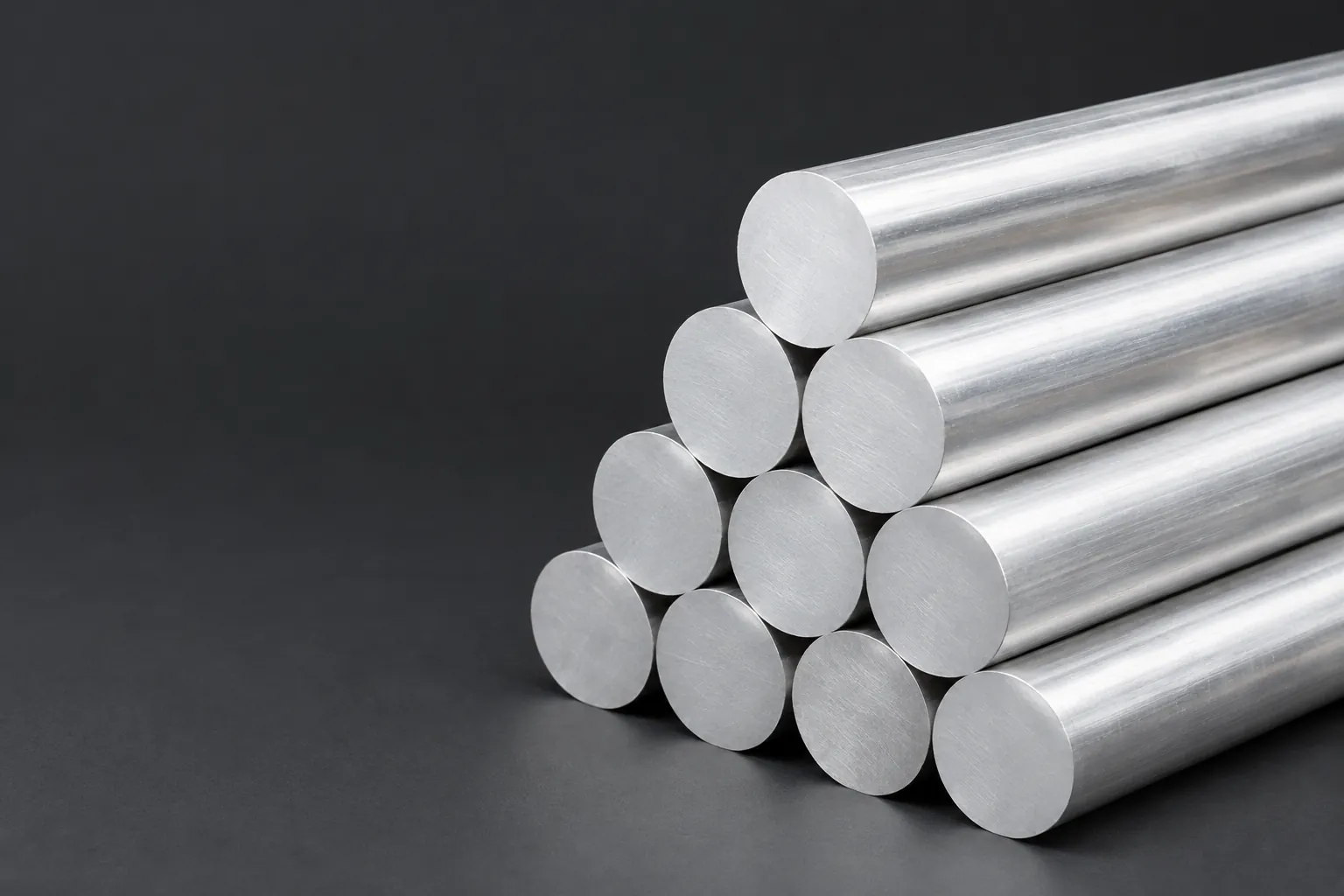
Imagery is illustrative only; it does not identify a certified alloy, temper or available stock.
Raw & semi-finished materials
Available material forms
Smiths describes 2618A bar, plate and tube; Leichtmetall supplies extruded round rod to 100 mm. Forgings are listed as a common form for this alloy family, subject to confirmation. Supply remains subject to supplier, specification, temper and dimensional confirmation; no Quest stockholding is implied.
- Round bar
- Plate
- Forgings
Material overview
Aluminium Alloy 2618 / 2618A
Aluminium-copper-magnesium alloy with iron and nickel for strength retention at elevated temperature in forgings and machined components.
- Key differences (AA Teal Sheets): 2618A has a Mn limit of 0.25% (2618: none), slightly wider Fe, Ni, Mg and Cu ranges, Ti 0.20% max (2618: 0.04–0.10%) and a Zr+Ti limit of 0.25%.
- Mechanical data are shown for 2618A only (UK DTD 5014A minimums and producer typical values). No verified 2618 or T61 forging data were found; AMS 4132 was not verified.
- Smiths states strength is retained relatively well to about 200°C; Leichtmetall cites use up to 300°C. These are producer statements, not tabulated elevated-temperature properties or a maximum service temperature.
Designations and product specifications
| Designation / standard | Scope / status |
|---|---|
| 2618 | AA registration (USA). UNS A92618 is commonly cited but not confirmed in the sources used. |
| 2618A | EN AW-2618A / AlCu2Mg1.5Ni (EAA registration) |
| DTD 5014A | 2618A bar and sections, T6 (Smiths) |
| AMS 4132 | Not verified — not shown as a confirmed specification |
Current EN 573-3, EN 586 and EN 754/755 texts not accessed.
Specification review
Technical verification requirements
Designations / form / temper / dimensions
Product scopes were reviewed row by row. Recorded cross-references do not establish every current revision, ordered form, temper and dimensional limit; EN/UNS registries and complete controlled AMS/ASTM/EN texts were not inspected.
Obtain applicable controlled specification and producer confirmation; submit to technical review.
Mechanical conditions / gauge / orientation
Every selector/table was read. Typical, supplier minima and producer limits must remain distinct. Resolve missing orientation, specimen/gauge length, temperature, exact boundary inclusivity and test basis in the quoted notes; do not extend a specimen diameter to stock thickness or to other forms.
Produce a condition-by-condition acceptance matrix with form, thickness interval, tensile orientation, elongation basis, test temperature and source revision; omit unavailable values rather than infer them.
Variant chemistry / T61 / AMS4132
Keep two chemistry columns and do not transfer 2618A T6 bar values to 2618-T61 forgings. Primary SAE public title now provides a usable scope lead, not full mechanical acceptance verification.
Obtain applicable controlled specification and producer confirmation; submit to technical review.
Grade selection
2219 compared with 2618 / 2618A
| Aspect | 2219 | 2618 / 2618A |
|---|---|---|
| Alloy system | Al-Cu-Mn with V and Zr (Cu 5.8–6.8) | Al-Cu-Mg-Fe-Ni (Cu ~1.8–2.7, Fe and Ni ~0.8–1.4) |
| Heat-treatment response | Solution treated; naturally or artificially aged, with or without cold work (T3x, T6x, T8x) | Solution treated and artificially aged (T6, T6511 per sources) |
| Elevated temperature (producer statements) | Useful from −269°C to 316°C (Kaiser / Aircraft Materials) | Strength retained relatively well to ~200°C; used up to 300°C (Smiths / Leichtmetall) |
| Weldability (producer ratings) | Rated A for gas, arc and spot welding (Kaiser T351/T851) | Conflicting producer statements — confirm per product |
| Typical applications | Welded space-booster and fuel tanks, elevated-temperature structures | Aerospace and high-temperature mechanical components |
Qualitative producer comparison. No numerical elevated-temperature tensile data with exposure duration were verified for either alloy, so no strength comparison or maximum service temperature is given.
The Aluminum Association — International Alloy Designations and Chemical Composition Limits (Teal Sheets), August 2025
Engineering reference
Technical data
| Element | 2618, mass % | 2618A, mass % |
|---|---|---|
| Al | Remainder | Remainder |
| Cu | 1.9–2.7 | 1.8–2.7 |
| Mg | 1.3–1.8 | 1.2–1.8 |
| Fe | 0.9–1.3 | 0.9–1.4 |
| Ni | 0.9–1.2 | 0.8–1.4 |
| Si | 0.10–0.25 | 0.15–0.25 |
| Mn | No limit stated | 0.25 max |
| Zn | 0.10 max | 0.15 max |
| Ti | 0.04–0.10 | 0.20 max |
| Zr + Ti | No limit stated | 0.25 max |
| Other, each / total | 0.05 / 0.15 max | 0.05 / 0.15 max |
Registered limits from the Aluminum Association Teal Sheets; the two alloys are shown separately. EN 573-3 text not accessed. One producer document gives Mn 0.4–1.0% for 2618A, which conflicts with the registered 0.25% maximum and is not adopted.
The Aluminum Association — International Alloy Designations and Chemical Composition Limits (Teal Sheets), August 2025
| Property | Value | Basis |
|---|---|---|
| Density | 2800 kg/m³ | Leichtmetall (AA nominal 2618A: 2.77; 2618: 2.76) |
| Elastic modulus | 72 GPa | Leichtmetall |
| Thermal conductivity | 142 W/m·K | Leichtmetall; temper not stated |
| Electrical conductivity | 22.2 MS/m | Leichtmetall; temper not stated |
| Solidification range | 560–670°C | Leichtmetall |
2618A values; not transferred to 2618.
2618A T6 bar ≤10 mm — DTD 5014A minimum
| Property | Value |
|---|---|
| Ultimate tensile strength, minimum | 400 MPa |
| 0.2% proof stress, minimum | 320 MPa |
| Elongation, minimum | 5% |
DTD 5014A minimums for bar and sections up to 10 mm as tabulated by Smiths; 2618A only.
2618A T6 bar 10–100 mm — DTD 5014A minimum
| Property | Value |
|---|---|
| Ultimate tensile strength, minimum | 420 MPa |
| 0.2% proof stress, minimum | 340 MPa |
| Elongation, minimum | 7% |
DTD 5014A minimums for over 10 to 100 mm as tabulated by Smiths; 2618A only.
2618A T6 extruded rod to 100 mm — producer typical
| Property | Value |
|---|---|
| Ultimate tensile strength | 410 MPa |
| 0.2% proof stress | 330 MPa |
| Elongation | 7% |
Leichtmetall typical attainable values; explicitly not guaranteed properties.
Temper designations (ANSI H35.1 summary)
T3: solution heat treated, cold worked, naturally aged. T4: solution heat treated, naturally aged. T6: solution heat treated, artificially aged. T8: solution heat treated, cold worked, artificially aged. A following 51 (e.g. T351, T651, T851) means stress relieved by controlled stretching; 510/511 apply to extruded products (511 allows minor straightening); 52 means stress relieved by compression. Not every alloy is produced in every temper or form.
T6 and T6511
Smiths lists T6 (solution treated and artificially aged) and T6511 (with controlled stretching) for 2618A. No producer-verified temperatures were found.
Schedules are not copied from 2219 or other alloys.
Material selection
Corrosion resistance & performance
Smiths rates atmospheric corrosion resistance fair; Leichtmetall describes it as average. Protective finishing is advised.
Typical applications
Engineering applications
- Aerospace components, where specified and approved
- High-temperature mechanical components
- Forgings
- High-performance machined components
Subsequent manufacturing
Machining & processing
Machining
Good machinability (Leichtmetall). Machining parameters depend on temper, tooling, set-up and part geometry; no universal cutting speed is given. Machining of stress-relieved (…51) tempers reduces, but does not eliminate, distortion from residual stress.
Welding
Producer statements conflict: Leichtmetall rates TIG/MIG/resistance welding positively; Smiths does not recommend inert-gas welding or brazing. Qualify any joining process.
Material certification & testing
Agree documentation and inspection at enquiry stage. Alloy designation alone does not define compliant aerospace material — the specification, temper, product form and dimensions must also be confirmed.
Not every test or certificate is automatically included. These records do not confer aerospace approval.
- EN 10204 3.1 material certificate, where agreed with the supplier
- Certificate of Conformity
- Heat / batch (cast) traceability to the mill certificate
- Chemical analysis and temper verification
- Mechanical testing and hardness testing to the ordered specification
- Heat-treatment records
- Ultrasonic, aerospace-specific or customer-specific inspection only where applicable and agreed
Material enquiry
Request a material quotation
Aluminium Alloy 2618 / 2618A supplied to your material form, dimensions and specification.