Materials Supply / Aluminium Alloys
Aluminium Alloy 5052
Non-heat-treatable Al-Mg-Cr | EN AW-5052 (AlMg2,5) | UNS A95052 (secondary cross-reference)
Non-heat-treatable aluminium-magnesium-chromium alloy with good corrosion resistance, cold formability and weldability for sheet-metal fabrications.
Strength is controlled by chemistry, strain hardening, annealing and stabilisation where applicable, together with product form and thickness. These alloys are not strengthened by conventional solution heat treatment and precipitation ageing.
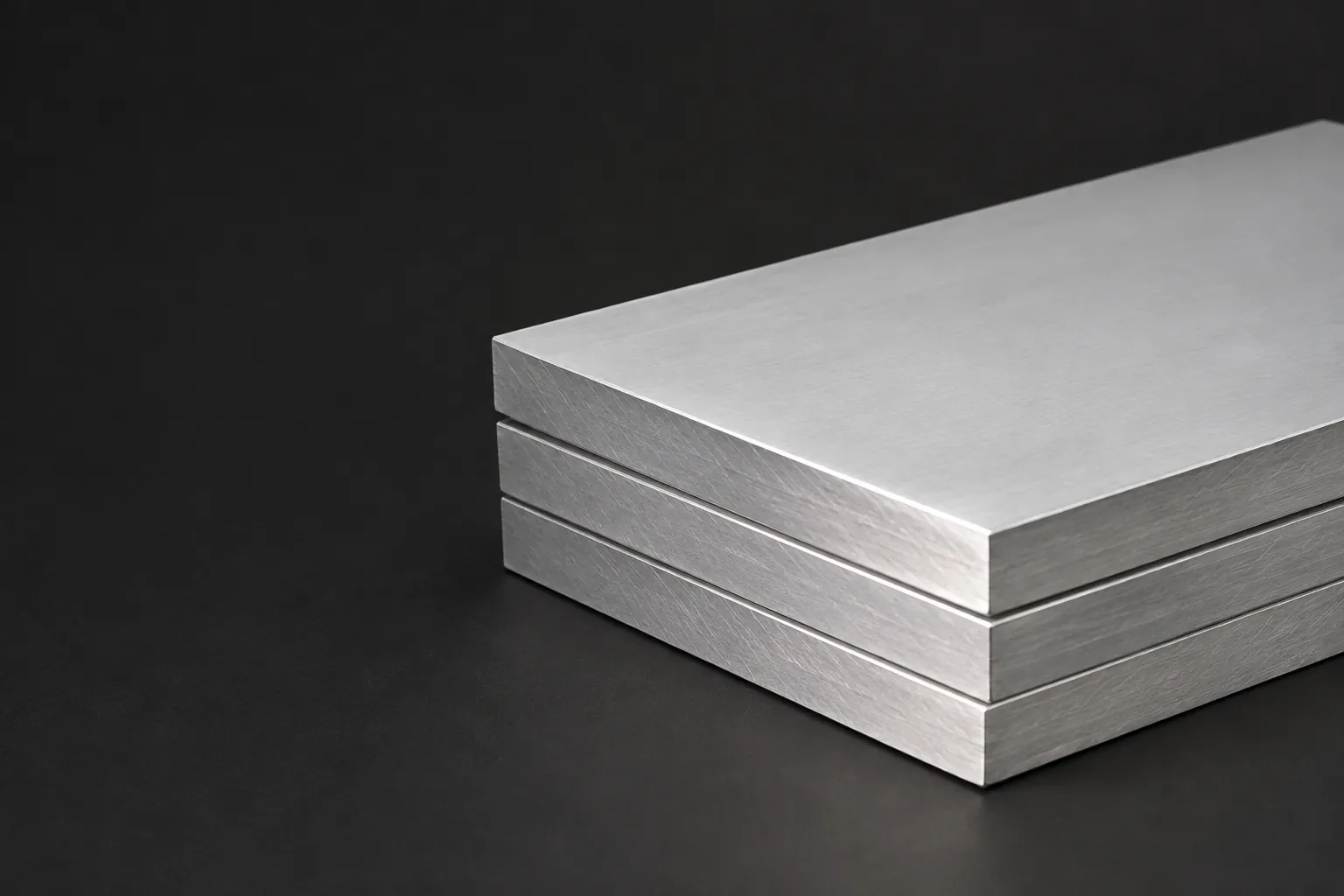
Illustrative aluminium sheet, plate and fabricated components; not certified alloy stock or evidence of Quest stockholding.
Raw & semi-finished materials
Available material forms
Documented rolled-product forms only. Availability is subject to supplier, specification, temper and dimensional confirmation; no Quest stockholding is implied.
- Sheet
- Plate
- Coil / strip
Material overview
Aluminium Alloy 5052
Non-heat-treatable aluminium-magnesium-chromium alloy with good corrosion resistance, cold formability and weldability for sheet-metal fabrications.
- O and H3x sheet/coil properties are kept separate. H32/H34/H36/H38 mean strain hardened and stabilised, not precipitation aged.
- Vulcan producer sheet limits retain each thickness band. Hulamin gives an independent metric dataset for H32/H34; the two datasets are not merged.
- Hydro and Hulamin support corrosion-resistant formed and welded components, but no critical-aerospace structural approval or welded-joint design allowable is implied.
Designations and product specifications
| Designation / specification | Form / temper / scope |
|---|---|
| AA / EN AW | 5052 / EN AW-5052 (AlMg2,5); not an EN numerical material number |
| UNS | A95052 — Atlas secondary cross-reference; UNS registry not inspected |
| ASTM B209/B209M | Flat sheet, coiled sheet and plate; Vulcan publishes 5052 limits under B209. Full current text not accessed. |
| AMS 4015N (2023 abstract) | 5052-O sheet/plate, 0.15–76.20 mm |
| AMS 4016N (April 2024 abstract) | 5052-H32 sheet/plate, 0.43–50.80 mm |
| AMS 4017M (January 2024 abstract) | 5052-H34 sheet/plate, 0.23–25.40 mm |
| EN 573-3 / EN 485-2 | Chemistry / rolled-product mechanical requirements; current full tables not accessed |
| EN 754 / EN 755 / EN 586 | Drawn / extruded / forged product standards; applicability not established for the forms/conditions shown here |
AMS scope ranges are from public abstracts, not reviewed acceptance tables. Mechanical data below are not automatically AMS-qualified. Source links: https://webstore.ansi.org/standards/sae/saeams4015n2023 ; https://saemobilus.sae.org/standards/ams4016n-aluminum-alloy-sheet-plate-25mg-025cr-5052-h32-strain-hardened-quarter-hard-stabilized ; https://store.accuristech.com/standards/sae-ams4017m?product_id=2580061 . No European numerical material number verified.
Specification review
Technical verification requirements
Designations / form / temper / dimensions
Product scopes were reviewed row by row. Recorded cross-references do not establish every current revision, ordered form, temper and dimensional limit; EN/UNS registries and complete controlled AMS/ASTM/EN texts were not inspected.
Obtain applicable controlled specification and producer confirmation; submit to technical review.
Mechanical conditions / gauge / orientation
Every selector/table was read. Typical, supplier minima and producer limits must remain distinct. Resolve missing orientation, specimen/gauge length, temperature, exact boundary inclusivity and test basis in the quoted notes; do not extend a specimen diameter to stock thickness or to other forms.
Produce a condition-by-condition acceptance matrix with form, thickness interval, tensile orientation, elongation basis, test temperature and source revision; omit unavailable values rather than infer them.
Grade selection
5052, 5083 and 5754 compared
| Aspect | 5052 | 5083 | 5754 |
|---|---|---|---|
| Registered Mg range, mass % | 2.2–2.8 | 4.0–4.9 | 2.6–3.6 |
| Other principal additions | Cr 0.15–0.35% | Mn 0.40–1.0%; Cr 0.05–0.25% | Mn ≤0.50%; Cr ≤0.30%; Mn+Cr 0.10–0.60% |
| Metallurgical classification | Non-heat-treatable Al-Mg-Cr | Non-heat-treatable, higher-Mg Al-Mg-Mn | Non-heat-treatable Al-Mg |
| Conditions on these pages | O, H32, H34, H36, H38 sheet/coil | O/H111/H112 extrusions; H111/H116/H321 plate (independent form-specific tables) | O, H111, H22, H24, H26, H28 rolled products |
| Strength characteristics | Cold work raises strength and reduces formability | Used for demanding welded structural plate; corrosion-qualified marine tempers require specific procurement | Strength varies with cold work and partial annealing; not identical to 5052 |
| Formability | Good cold forming; softer tempers allow tighter bends | Formability depends on temper and thickness | Soft O/H111 suited to stamping and deep drawing |
| Weldability | Good; strain-hardened HAZ may soften | Good; parent, HAZ and weld-metal properties differ | Excellent producer rating; qualify joint properties |
| Corrosion and marine selection | Good seawater/atmospheric resistance, not immunity | Marine plate requires appropriate temper and corrosion qualification; sensitisation is exposure dependent | Good atmospheric and seawater resistance; not interchangeable with qualified 5083 plate |
| Documented product focus | Sheet and coil | Sheet/plate; confirm temper-specific availability | Sheet, strip/coil and plate |
Qualitative selection guide. Chemistry from AA; fabrication from Vulcan/Hulamin/Gränges and the grade-specific references below. No numerical strength ranking: temper, form, thickness and test basis are not matched. No alloy is universally superior or automatically approved for marine, aerospace or pressure duty.
The Aluminum Association — Teal Sheets, December 2025 (registered composition limits)
Engineering reference
Technical data
| Element | Mass % | Limit |
|---|---|---|
| Si | 0.25 | Maximum |
| Fe | 0.40 | Maximum |
| Cu | 0.10 | Maximum |
| Mn | 0.10 | Maximum |
| Mg | 2.2–2.8 | Range |
| Cr | 0.15–0.35 | Range |
| Zn | 0.10 | Maximum |
| Other elements, each | 0.05 | Maximum |
| Other elements, total | 0.15 | Maximum |
| Al | Remainder | Balance |
Registered wrought-alloy limits, not nominal values. Ti has no separately registered numerical limit in this row; it must not be assigned an invented limit. AA limits are not represented as an independently checked EN 573-3 table. Confirm the ordered specification and mill certificate.
The Aluminum Association — Teal Sheets, December 2025 (registered composition limits)
| Property | Value |
|---|---|
| Density | 2680 kg/m³ |
| Elastic modulus | 70 GPa |
| Shear modulus | 26.3 GPa |
| Thermal conductivity | 138 W/(m·K) |
| Thermal expansion | 23.8 × 10⁻⁶ K⁻¹ |
| Electrical resistivity | 50 nΩ·m |
| Melting interval | 607–650°C |
Hulamin producer reference values. Measurement temperature and temper are not stated; not guaranteed acceptance criteria. Specific heat omitted because no qualified value was verified. Melting interval is not a service-temperature limit.
O sheet / coil — Vulcan published limits
| Thickness (source bands) | UTS, MPa | Yield minimum, MPa | Elongation minimum |
|---|---|---|---|
| 0.8128–1.2700 mm (.032–.050 in) | 172.4–213.7 | 65.5 | 18% |
| 1.2954–2.8702 mm (.051–.113 in) | 172.4–213.7 | 65.5 | 19% |
| 2.8956–3.1750 mm (.114–.125 in) | 172.4–213.7 | 65.5 | 20% |
Vulcan ASTM B209-labelled limits. UTS ranges and minimum yield/elongation converted from ksi to MPa (1 ksi = 6.894757 MPa). Original printed thickness intervals retained, including gaps; do not interpolate. Orientation, tensile test temperature, yield-offset definition, gauge length and statistical sampling are not stated. Not design allowables or universal plate requirements.
H32 sheet / coil — Vulcan published limits
| Thickness (source bands) | UTS, MPa | Yield minimum, MPa | Elongation minimum |
|---|---|---|---|
| 0.8128–1.2700 mm (.032–.050 in) | 213.7–262.0 | 158.6 | 5% |
| 1.2954–2.8702 mm (.051–.113 in) | 213.7–262.0 | 158.6 | 7% |
| 2.8956–3.1750 mm (.114–.125 in) | 213.7–262.0 | 158.6 | 9% |
Vulcan ASTM B209-labelled limits. UTS ranges and minimum yield/elongation converted from ksi to MPa (1 ksi = 6.894757 MPa). Original printed thickness intervals retained, including gaps; do not interpolate. Orientation, tensile test temperature, yield-offset definition, gauge length and statistical sampling are not stated. Not design allowables or universal plate requirements.
H34 sheet / coil — Vulcan published limits
| Thickness (source bands) | UTS, MPa | Yield minimum, MPa | Elongation minimum |
|---|---|---|---|
| 0.8128–1.2700 mm (.032–.050 in) | 234.4–282.7 | 179.3 | 4% |
| 1.2954–2.8702 mm (.051–.113 in) | 234.4–282.7 | 179.3 | 6% |
| 2.8956–3.1750 mm (.114–.125 in) | 234.4–282.7 | 179.3 | 7% |
Vulcan ASTM B209-labelled limits. UTS ranges and minimum yield/elongation converted from ksi to MPa (1 ksi = 6.894757 MPa). Original printed thickness intervals retained, including gaps; do not interpolate. Orientation, tensile test temperature, yield-offset definition, gauge length and statistical sampling are not stated. Not design allowables or universal plate requirements.
H36 sheet / coil — Vulcan published limits
| Thickness (source band) | UTS, MPa | Yield minimum, MPa | Elongation minimum |
|---|---|---|---|
| 0.8128–3.1750 mm (.032–.125 in) | 255.1–303.4 | 199.9 | 4% |
Vulcan ASTM B209-labelled limits converted from original ksi; orientation, temperature, yield offset and elongation gauge length not specified. No hardness, shear or fatigue data added. These limits apply only to the published sheet/coil band.
H38 sheet / coil — Vulcan published limits
| Thickness (source band) | UTS, MPa | Yield minimum, MPa | Elongation minimum |
|---|---|---|---|
| 0.8128–3.2512 mm (.032–.128 in) | ≥268.9 | 220.6 | 4% |
Vulcan ASTM B209-labelled limits converted from original ksi; orientation, temperature, yield offset and elongation gauge length not specified. No hardness, shear or fatigue data added. These limits apply only to the published sheet/coil band.
H32 rolled sheet — Hulamin metric limits
| Thickness, mm | UTS, MPa | Rp0.2 minimum, MPa | A50 minimum |
|---|---|---|---|
| 0.4–0.63 | 215–265 | 160 | 4% |
| 0.63–1.2 | 215–265 | 160 | 5% |
| 1.2–6.3 | 215–265 | 160 | 7% |
Independent Hulamin producer table: single numbers are minimums, yield is Rp0.2 and elongation A50. Thickness endpoints are preserved as printed; exact inclusivity, orientation and tensile-test temperature are not specified. Do not merge with Vulcan converted limits.
H34 rolled sheet — Hulamin metric limits
| Thickness, mm | UTS, MPa | Rp0.2 minimum, MPa | A50 minimum |
|---|---|---|---|
| 1.2–3.2 | 235–285 | 180 | 6% |
Independent Hulamin producer table: single numbers are minimums, yield is Rp0.2 and elongation A50. Thickness endpoints are preserved as printed; exact inclusivity, orientation and tensile-test temperature are not specified. Do not merge with Vulcan converted limits.
O: annealed
Annealed soft condition for forming. Strengthening requires cold work, not precipitation ageing.
H32 / H34 / H36 / H38
Strain hardened and stabilised: quarter-hard / half-hard / three-quarter-hard / fully hard. Stabilisation controls the softened/ductility state of strain-hardened material; it is not a T-temper ageing treatment.
Annealing and process qualification
No original-producer numerical annealing schedule was verified, so none is prescribed. Full or partial annealing reduces cold-work strength; qualify temperature, time, section thickness and subsequent processing with the mill.
Forming and weld-zone softening
Prefer softer conditions for severe forming; cold working changes the temper. Welding strain-hardened material can reduce heat-affected-zone strength. Stress relief and straightening must not be assumed to preserve the original temper.
EN 515-based temper terminology from the cited producer supplement; that supplement is not proof of rolled-product supply. 5052 sheet availability comes from Vulcan/Hulamin. H1x and H2x families are not added as unsupported selectable conditions.
Material selection
Corrosion resistance & performance
Hulamin rates resistance to seawater and marine/industrial atmospheres very good; Hydro supports salt-water resistance. This is not immunity to pitting, crevice or galvanic attack. Environment, cleanliness, surface condition and drainage matter.
5052 must not be substituted for corrosion-qualified 5083 H116/H321 structural plate solely because both are marine-associated Al-Mg alloys. No ASTM G66/G67 qualification is asserted for 5052 here.
Assess chlorides, dissimilar-metal coupling and protective finishes for the actual assembly. No numerical SCC, intergranular, exfoliation or lifetime seawater guarantee was verified.
Typical applications
Engineering applications
- Formed sheet-metal components
- Fabricated housings and enclosures
- General engineering fabrications
- Marine and coastal components, subject to design
- Tanks, where the design and material specification permit
- Precision sheet-metal components
Subsequent manufacturing
Machining & processing
Forming
Hulamin supports good cold formability. O and lower-hardness H32 sheet permit more forming than heavily strain-hardened H36/H38; bend radius depends on thickness, orientation and tooling. No universal minimum bend radius is prescribed.
Welding and joints
Hulamin rates weldability very good. Atlas secondary guidance supports MIG/TIG and warns of HAZ softening. Parent sheet, heat-affected zone, weld metal and assembled joint are distinct: the tabulated parent limits do not guarantee joint strength. Qualify filler and welding procedure; no universal filler is specified. Reference: https://atlassteels.com.au/wp-content/uploads/2021/08/Aluminium-Alloy-5052-Data-Sheet-24-06-21.pdf
Machining and finishing
Hydro describes machinability as fair. Use appropriate aluminium tooling, lubrication and chip control; no universal speeds are specified. Qualify cutting, anodising or coating against dimensional and corrosion requirements. Hydro reference: https://www.shapesbyhydro.com/en/knowledge/strength-and-corrosion-resistance-with-aluminium-alloy-5052/
Distortion control
Fixture thin sheet and plan forming/joining sequence, heat input and dimensional checks. No guaranteed distortion or as-welded strength value is established.
Material certification & testing
Agree certification, temper, dimensions and inspection against the ordered material specification. Catalogue placement does not confer aerospace or pressure-equipment approval.
No test or certificate is automatically included. 5083 marine qualification must be evidenced for the ordered product, temper and specification; an alloy label alone is insufficient.
- EN 10204 3.1 material certificate, where agreed
- Certificate of Conformity
- Heat / cast / batch traceability
- Chemical analysis and temper verification
- Mechanical testing and hardness testing where specified
- Corrosion qualification testing where applicable (particularly 5083 H116/H321)
- Ultrasonic testing where applicable and agreed
- Customer-specific inspection and acceptance requirements
Material enquiry
Request a material quotation
Aluminium Alloy 5052 supplied to your material form, dimensions and specification.