Materials Supply / Copper & Copper-Base Alloys
PB2 Cast Phosphor Bronze
BS 1400 PB2 | nearest EN cross-reference CC483K CuSn12-C
PB2 is a historical BS 1400 cast phosphor bronze. The Copper Development Association and foundries cross-reference PB2 to EN 1982 CC483K (CuSn12-C); this is a nearest-grade relationship, not proof of identical specification requirements.
PB2 is distinct from PB1, whose nearest EN designation is CC481K CuSn11P-C. Producers describe PB2 as higher in tin and lower in phosphorus than PB1. Neither grade is wrought CW451K / PB102 (CuSn5).
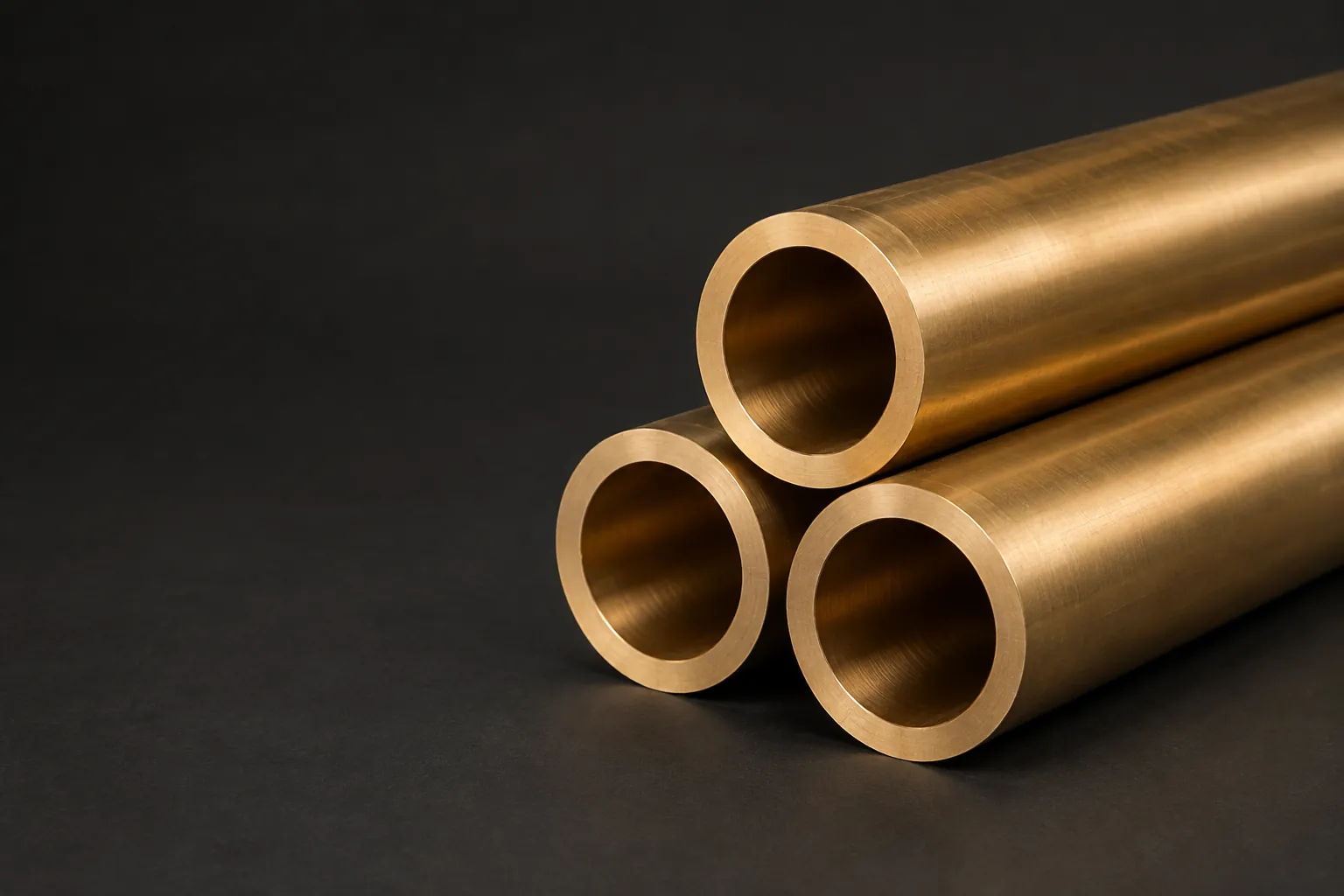
Imagery is illustrative metal product forms, not certified PB2 stock or evidence of Quest stockholding.
Raw & semi-finished materials
Available material forms
Copper Alloys Ltd identifies continuously cast PB2. Kormax lists solid/hollow round bar and continuous/centrifugal casting; James Coppell Lee identifies PB2 sand and chill castings. These are supplier-specific forms, not Quest stock commitments. Confirm the actual grade, casting process, dimensions and certification before supply; continuous-casting properties do not apply automatically to other processes.
- Continuously cast solid and hollow bar
- Sand and chill castings — by specification
- Centrifugal castings — subject to confirmation
Material overview
PB2 Cast Phosphor Bronze
A separate cast tin–phosphorus bronze for bearings, bushes, gears and worm wheels, with casting-process-specific properties.
- Only independently supported continuously cast mechanical tables are selectable; no sand, chill, centrifugal, annealed or cold-worked condition is invented.
- The chemistry table is foundry-published EN 1982:2017 CC483K casting limits, not authenticated original BS 1400 PB2 acceptance limits. Ingot chemistry is separate.
- Producer typical values and foundry-published standard minima are kept separate. Section, specimen and test details remain incomplete.
Designations and specifications
| Designation / standard | Scope and qualification |
|---|---|
| BS 1400:1985 PB2 | Historical cast phosphor bronze; original controlled PB2 chemistry and process-specific requirements not verified |
| EN 1982 CC483K / CuSn12-C | CDA nearest BS PB2 comparison; foundry-published 2017 casting tables shown, not exact cross-certification |
| CB483K / CuSn12-B | Remelting ingots — distinct chemistry limits; not the casting table below |
| BS EN 1982:2024 | Current BSI-listed ingots and castings edition, published 31 October 2024; full grade tables and changes not independently checked |
| PB1 / CC481K CuSn11P-C | Separate cast grade, not PB2 |
| CC482K CuSn11Pb2-C | Separate leaded tin bronze, not the supported PB2 cross-reference |
| CW451K / PB102 | Separate wrought CuSn5 grade; not PB1 or PB2 |
| UNS / ASTM / SAE / AMS | No exact equivalence or applicable controlled acceptance specification independently verified; conflicting producer equivalence lists are not adopted |
Identity comparison: CDA EN 1982 / BS 1400 table (linked in the comparison section). BSI public listings establish standard title/status, not PB2 numerical acceptance requirements. Agree the actual standard, edition, alloy and casting process.
BSI — BS EN 1982:2024, Copper and copper alloys. Ingots and castings
Specification review
Technical verification requirements
Chemistry and standards
Original BS 1400 PB2 controlled chemistry and EN 1982:2024 numerical requirements are not independently authenticated. Foundry tables cite EN 1982:2017.
Obtain controlled ordered BS/EN documents and compare grade-specific clauses.
Source conflicts
Copper Alloys correctly identifies CC483K in its introduction but lists CC481K in its equivalence block. NovaCast historic PB2 ranges differ from EN limits, including P/Ni/Pb/Si; its mechanical ranges lack casting-process allocation.
Resolve producer inconsistencies before accepting equivalence or historical chemistry; no mixed table is used here.
Mechanical
Sand/chill/centrifugal numerical requirements, section limits, sampling and test details remain unverified. Producer proof/yield offset is unstated.
Obtain form/process-specific foundry data and certified test basis.
Physical and processing
CTE unit/multiplier, modulus, specific heat and complete heat-treatment schedules remain unverified.
Obtain PB2-specific producer confirmation; do not borrow PB1 or wrought-grade data.
Grade selection
PB2, PB1 and wrought PB102 — separate identities
| Aspect | PB2 | PB1 | CW451K / PB102 |
|---|---|---|---|
| Material route | Cast phosphor bronze | Cast phosphor bronze | Wrought CuSn5 phosphor bronze |
| CDA nearest EN comparison | CC483K CuSn12-C | CC481K CuSn11P-C | CW451K CuSn5; related to C51000, not an exact identity |
| Property basis | Only independently sourced PB2 / qualified CC483K tables | Separate PB1 / qualified CC481K tables | Form- and cold-work-temper-specific wrought data |
| Interchangeability | Not automatically PB1 or PB102 | Not automatically PB2 or PB102 | Not cast PB1 or PB2 |
Nearest historical/EN comparisons are not declarations that chemistry, acceptance limits or mechanical properties match. No existing PB1 or C51000 technical tables are changed.
Engineering reference
Technical data
| Element | Mass % |
|---|---|
| Copper | 85.0–89.0 |
| Tin | 10.5–13.0 |
| Lead | 0.7 max |
| Zinc | 0.5 max |
| Nickel | 2.0 max |
| Aluminium | 0.01 max |
| Iron | 0.2 max |
| Manganese | 0.2 max |
| Phosphorus | 0.6 max |
| Sulphur | 0.05 max |
| Silicon | 0.01 max |
| Antimony | 0.15 max |
Published limits, not a typical analysis and not verified BS 1400 PB2 chemistry. No phosphorus minimum is stated in this casting table. CB483K ingots instead have Cu 85.5–88.5%, Sn 11.2–13.0%, Pb ≤0.6%, Zn ≤0.4% and P ≤0.2%. Unlisted elements are not implied to be zero. Do not merge historic BS PB2 producer ranges with these EN casting limits.
| Property | Value | Basis |
|---|---|---|
| Density | 8.8 g/cm³ | Continuously cast producer product; temperature not stated |
| Melting temperature range | 831–999°C | Producer range; measurement basis not stated |
| Thermal conductivity | 45 W/(m·K) | Temperature not stated |
| Electrical resistivity | 0.17 µΩ·m | 15°C |
| Mean CTE 0–250°C | Not verified | Producer prints 19 without unit/multiplier; no conversion inferred |
| Elastic modulus / specific heat | Not verified | No PB1 or UNS data substituted |
Indicative producer data, not specification acceptance limits or design allowables. Form is identified as continuously cast; section and detailed test method are not stated. The CTE unit omission is unresolved.
Continuously cast — EN 1982:2017 minimum
| Property | Minimum | Basis |
|---|---|---|
| Tensile strength | 300 MPa | Continuous casting |
| 0.2% proof stress (Rp0.2) | 150 MPa | Continuous casting |
| Elongation | 6% | Gauge length not stated |
| Brinell hardness | 90 HBW | Continuous casting |
KMM EN 1982:2017-labelled CC483K continuous-casting minima, not typical measurements or independently authenticated 2024 requirements. Section range, specimen location, elongation gauge length, hardness load and test temperature are not stated. No additional heat-treatment cycle is specified. Do not transfer to BS PB2, sand, chill or centrifugal castings without contractual verification.
Continuously cast — Copper Alloys Ltd typical
| Property | Typical | Basis |
|---|---|---|
| Tensile strength | 400 MPa | Continuously cast producer product |
| Proof / yield strength | 190 MPa | Offset / definition not stated |
| Elongation | 20% | Gauge length not stated |
| Brinell hardness | 120 HB | Test load not stated |
Producer indicative typicals, not BS/EN acceptance minima or design allowables. Section, specimen location and test temperature are not stated; proof/yield is not relabelled Rp0.2. No additional heat-treatment schedule is stated. The producer’s contradictory CC481K equivalence block is not adopted.
Continuously cast reference
The cited product is continuously cast. No additional annealing, stress-relief or hardening schedule is independently verified; no treated mechanical condition is created.
Other casting processes
Sand, chill and centrifugal forms are separately qualified. Their process-specific strength, hardness and elongation must be obtained for the ordered specification and section.
Not a wrought temper series
Wrought CuSn5 cold-work H tempers are not PB2 conditions. No welding, brazing or hot-working schedule is inferred.
Processing must follow the agreed casting specification and qualified foundry procedure. This is not a production heat-treatment recipe.
Typical applications
Engineering applications
- Bearings and bushes
- Gears and worm wheels
- Gearboxes and speed reducers
- Valve bodies and pump components
- Machine-tool spindle bearings and high-stress spindle nuts
Subsequent manufacturing
Machining & processing
Machining
Foundry and producer descriptions support machined bearing and gear applications; tooling, allowance and finishing must suit the actual casting.
Bearing interfaces
Copper Alloys Ltd requires adequate lubrication and alignment and a minimum mating-shaft hardness of 300 HB. This is a shaft requirement, not PB2 material hardness.
Service limits
No numerical allowable bearing pressure, speed or PV limit is verified. Producer application categories do not establish suitability for every load, speed or corrosive environment.
Material certification & testing
Agree documentation for the actual BS/EN alloy, standard edition, casting process, section and test basis.
A nearest-grade cross-reference is not automatic cross-certification. Forms and documentation remain subject to supplier confirmation; quotation and upload controls remain disabled.
- EN 10204 3.1 material certificate, where agreed with the foundry
- Certificate of Conformity
- Cast / lot traceability
- Chemical analysis and mechanical tests to the ordered specification
Material enquiry
Request a material quotation
PB2 Cast Phosphor Bronze supplied to your material form, dimensions and specification.