Materials Supply / Controlled-Expansion & Electronic Alloys
Alloy 46 (Fe–46Ni sealing alloy)
Fe–46Ni | Carpenter Glass Sealing 46 | UNS not verified
Alloy 46 sits between Alloys 42 and 48 in nickel content. Carpenter’s Glass Sealing 46 contains about 0.4% titanium for enamelling without degassing.
No primary producer expansion, physical or mechanical data were verified, and none are borrowed from Alloy 42 or 48.
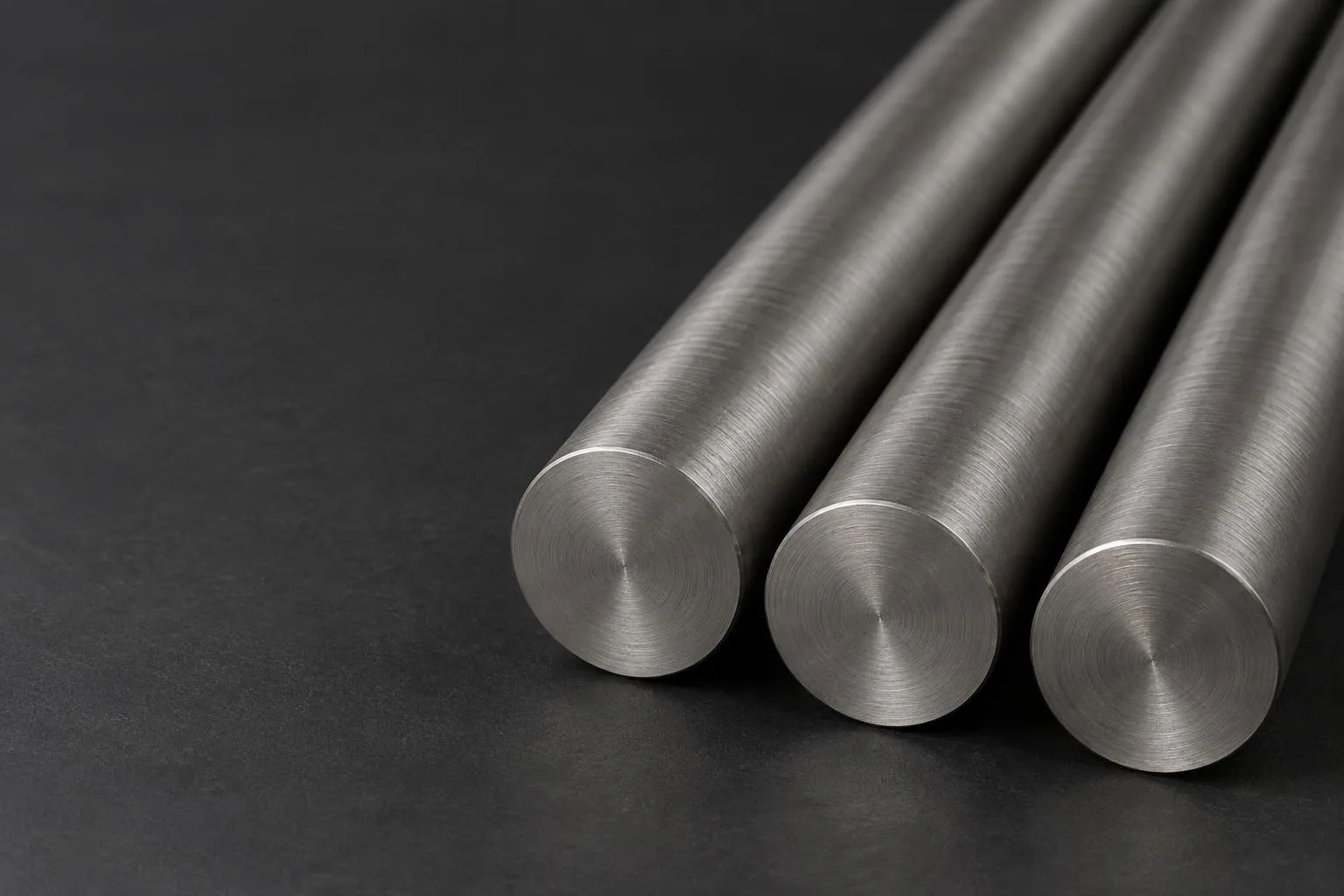
Imagery is illustrative metal product forms, not certified Alloy 46 stock or evidence of Quest stockholding.
Raw & semi-finished materials
Available material forms
No producer product-form scope was verified. Confirm forms, sizes and availability at enquiry.
- Product forms — specification enquiry
Material overview
Alloy 46 (Fe–46Ni sealing alloy)
A 46% nickel–iron sealing alloy; verified producer data are limited to Carpenter’s titanium-bearing Glass Sealing 46 chemistry.
- Thermal-expansion values are withheld: no primary source with a stated interval was found.
- UNS and ASTM F30 coverage are not confirmed for the titanium-bearing Carpenter variant.
Designations and specifications
| Designation / standard | Scope and qualification |
|---|---|
| UNS | Not verified |
| Producer names | Carpenter Glass Sealing 46 |
| Specifications | Carpenter lists none; ASTM F30 coverage not verified |
Specification review
Technical verification requirements
All numerical properties
No primary CTE, physical or mechanical data verified.
Obtain producer datasheet for the ordered variant.
Designations
UNS (commonly K94600) and ASTM F30 coverage not verified.
Confirm from ASTM F30 full text or producer.
Grade selection
Controlled-expansion alloys — distinct grades, not substitutes
| Alloy | Nominal base (mass %) | UNS (as verified) | Published mean CTE and interval | Primary intended use (per source) |
|---|---|---|---|---|
| Invar 36 | Fe–36Ni | K93601 / K93603 (Carpenter) | 1.30 × 10⁻⁶/K to 93°C; lower reference not stated (Carpenter) | Dimensionally stable structures, tooling, instruments |
| Super Invar | Fe–32Ni–5.5Co | K93500 (Carpenter) | 0.63 × 10⁻⁶/K, −55 to 95°C (Carpenter) | Lower expansion than Invar 36 over a narrow range |
| Kovar | Fe–29Ni–17Co | K94610 (ASTM F15) | 5.85 × 10⁻⁶/K, 25–100°C; 5.13 × 10⁻⁶/K, 25–300°C (Carpenter, annealed) | Seals to hard borosilicate glass and alumina ceramics |
| Alloy 42 | Fe–41/42Ni | K94100 (Carpenter, VDM) | 5.40 × 10⁻⁶/K, 21–343°C (Carpenter); 5.3 × 10⁻⁶/K, 20–300°C (NILO 42) | Glass sealing (e.g. 1075, 0120, 0010 glasses per Carpenter), lead frames |
| Alloy 46 | Fe–46Ni(–0.4Ti, Carpenter) | Not verified | Not verified | Enamelled-resistor terminal bands (Carpenter) |
| Alloy 48 | Fe–48Ni | K94800 (Special Metals, Aperam) | 8.7 × 10⁻⁶/K, 20–300°C (NILO 48) | Soft lead or soda-lime glass seals |
| Alloy 52 | Fe–51/52Ni | N14052 (Aperam, VDM) | Not verified from a primary producer table | Soft-glass seals (Aperam) |
Each value keeps its own producer, interval and conditioning; values from different sources are not directly comparable. Glass-to-metal sealing requires matching the alloy expansion curve to the specific glass or ceramic over the whole sealing-to-service temperature range — Kovar and Alloys 42/46/48/52 are not interchangeable.
Engineering reference
Technical data
| Element | Mass % |
|---|---|
| Nickel | 46 (nominal) |
| Titanium | 0.4 (nominal) |
| Carbon | 0.03 max |
| Silicon | 0.25 max |
| Manganese | 0.5 max |
| Iron | Balance |
Producer values for this titanium-bearing variant only; not a generic Alloy 46 specification.
| Property / condition | Verified value | Required basis |
|---|---|---|
| Tensile, ductility and hardness | Not verified from a primary producer source | Ordered specification, product form, temper and test basis |
No primary producer mechanical data were verified for Alloy 46; values are not borrowed from neighbouring alloys. Acceptance data must be agreed for the ordered specification and condition.
| Property | Verified value | Basis |
|---|---|---|
| Mean CTE, density, modulus, Curie / inflection temperature | Not verified | No primary producer table found; Alloy 42/48 values not substituted |
Obtain a producer datasheet stating CTE interval and conditioning for the ordered material.
Typical applications
Engineering applications
- Enamelled-resistor terminal bands (Carpenter)
- Enamelling without degassing (Carpenter)
Subsequent manufacturing
Machining & processing
Machining and forming
Machining and cold forming introduce residual stress that changes expansion behaviour and dimensional stability; final stabilising or annealing treatments should follow rough machining, near final size.
Magnetic transformation
The low-expansion range of these Fe–Ni(–Co) alloys ends near their Curie (or inflection) temperature; above it, expansion rises sharply. Do not extrapolate a mean CTE beyond its stated interval.
Not a corrosion-resistant alloy
These alloys are not stainless; protection must be specified for humid or corrosive service.
Application evidence
Listed applications are producer-cited categories, not claims of stock or component approval.
Material certification & testing
Documentation must be agreed for the actual alloy, specification, product form, temper and any expansion-test requirement. Expansion acceptance depends on the specified interval and pre-test conditioning.
No certificate, expansion guarantee, sealing approval or alloy equivalence is automatic. Low-expansion and sealing alloys are not interchangeable; quotation controls remain disabled.
- EN 10204 3.1 material certificate, where agreed with the supplier
- Certificate of Conformity
- Heat / batch traceability to the producing mill
- Chemical analysis to the ordered specification
- Thermal-expansion test report over the specified interval and conditioning, only where ordered
Material enquiry
Request a material quotation
Alloy 46 (Fe–46Ni sealing alloy) supplied to your material form, dimensions and specification.