Materials Supply / Controlled-Expansion & Electronic Alloys
Alloy 42 (Fe–42Ni sealing alloy)
Fe–41/42Ni | UNS K94100 | EN 1.3917
Alloy 42 has low expansion up to its inflection temperature, around 340°C per Carpenter, and is matched to particular sealing glasses.
It is not Kovar and not the copper-clad Dumet core rod (Carpenter Low Expansion 42, UNS K94101, ASTM F29), which is a separate material.
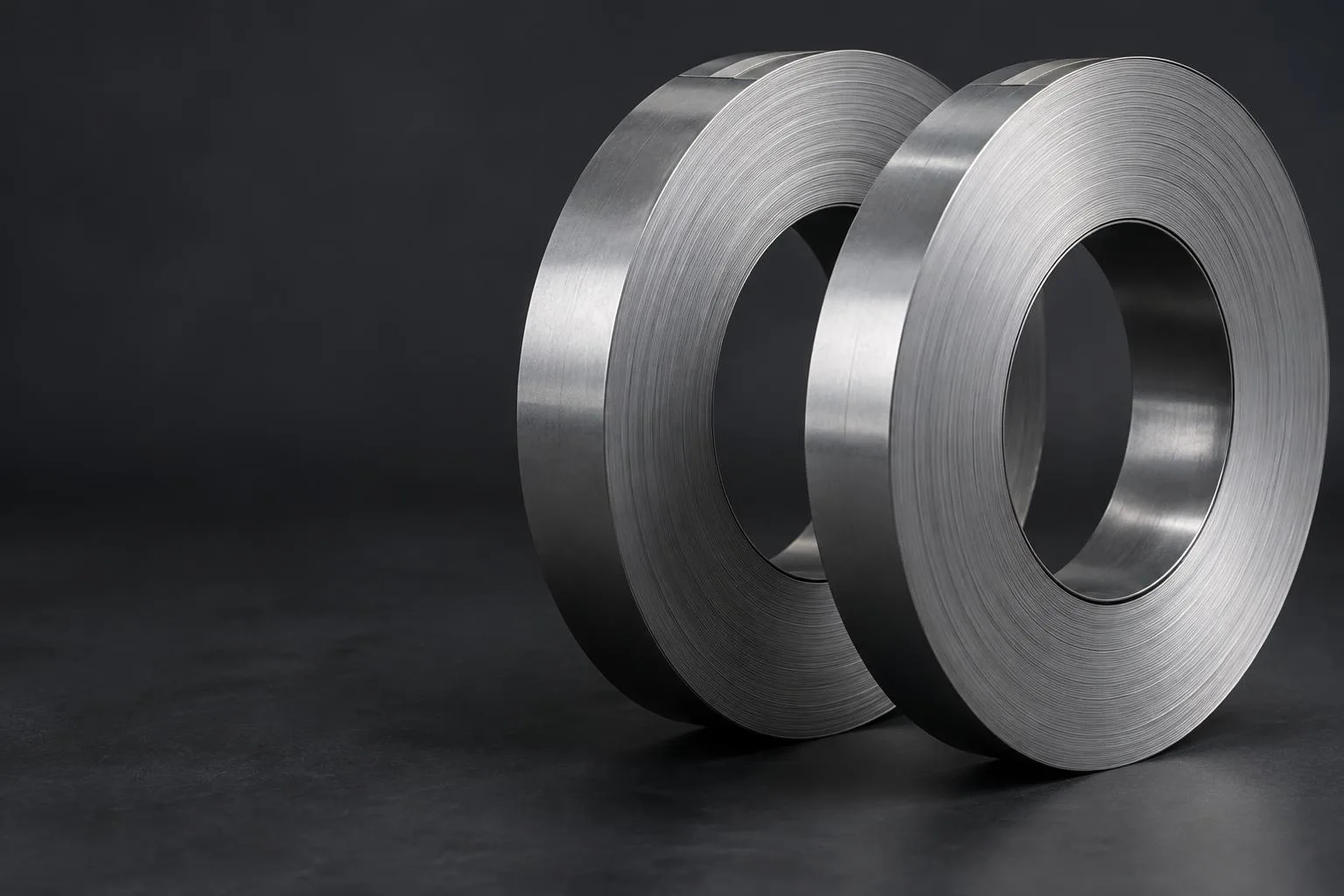
Imagery is illustrative metal product forms, not certified Alloy 42 stock or evidence of Quest stockholding.
Raw & semi-finished materials
Available material forms
Carpenter lists round bar, billet, strip and wire. Confirm forms, sizes and availability at enquiry.
- Round bar and billet
- Strip
- Wire
Material overview
Alloy 42 (Fe–42Ni sealing alloy)
A 41–42% nickel–iron alloy used for glass-to-metal seals, lead frames and controlled-expansion parts.
- Two producer CTE datasets are shown separately with their own intervals; they are not merged.
- Carpenter distinguishes the inflection temperature (343°C) from the Curie temperature (379°C).
Designations and specifications
| Designation / standard | Scope and qualification |
|---|---|
| UNS | K94100 (Carpenter, VDM) |
| European | EN 1.3917 (VDM Alloy 42 / Pernifer 40) |
| Producer names | Carpenter Glass Sealing 42 (titanium-bearing “42 Gas-Free” variant also offered); VDM Alloy 42 / Pernifer 40; Special Metals NILO 42 |
| ASTM F30 | Fe–Ni sealing alloys for electronic glass seals; Carpenter cites F30-77 — standard withdrawn; excludes metal-to-ceramic sealing |
| Not equivalent | Carpenter Low Expansion 42 Dumet core rod — UNS K94101, ASTM F29 |
Obtain controlled current standards before ordering.
ASTM F30 — official listing (withdrawn)
Specification review
Technical verification requirements
Chemistry
Carpenter Mn/Si nominal vs maxima conflict.
Use the certificate of the ordered heat.
Specifications
ASTM F30 withdrawn; grade/form coverage not verified from full text.
Agree the governing specification.
Grade selection
Controlled-expansion alloys — distinct grades, not substitutes
| Alloy | Nominal base (mass %) | UNS (as verified) | Published mean CTE and interval | Primary intended use (per source) |
|---|---|---|---|---|
| Invar 36 | Fe–36Ni | K93601 / K93603 (Carpenter) | 1.30 × 10⁻⁶/K to 93°C; lower reference not stated (Carpenter) | Dimensionally stable structures, tooling, instruments |
| Super Invar | Fe–32Ni–5.5Co | K93500 (Carpenter) | 0.63 × 10⁻⁶/K, −55 to 95°C (Carpenter) | Lower expansion than Invar 36 over a narrow range |
| Kovar | Fe–29Ni–17Co | K94610 (ASTM F15) | 5.85 × 10⁻⁶/K, 25–100°C; 5.13 × 10⁻⁶/K, 25–300°C (Carpenter, annealed) | Seals to hard borosilicate glass and alumina ceramics |
| Alloy 42 | Fe–41/42Ni | K94100 (Carpenter, VDM) | 5.40 × 10⁻⁶/K, 21–343°C (Carpenter); 5.3 × 10⁻⁶/K, 20–300°C (NILO 42) | Glass sealing (e.g. 1075, 0120, 0010 glasses per Carpenter), lead frames |
| Alloy 46 | Fe–46Ni(–0.4Ti, Carpenter) | Not verified | Not verified | Enamelled-resistor terminal bands (Carpenter) |
| Alloy 48 | Fe–48Ni | K94800 (Special Metals, Aperam) | 8.7 × 10⁻⁶/K, 20–300°C (NILO 48) | Soft lead or soda-lime glass seals |
| Alloy 52 | Fe–51/52Ni | N14052 (Aperam, VDM) | Not verified from a primary producer table | Soft-glass seals (Aperam) |
Each value keeps its own producer, interval and conditioning; values from different sources are not directly comparable. Glass-to-metal sealing requires matching the alloy expansion curve to the specific glass or ceramic over the whole sealing-to-service temperature range — Kovar and Alloys 42/46/48/52 are not interchangeable.
Engineering reference
Technical data
| Element | Mass % |
|---|---|
| Nickel | 41 (nominal) |
| Manganese | 0.40 |
| Silicon | 0.20 |
| Carbon | 0.05 max |
| Iron | Balance |
Historical datasheet gives Mn and Si as nominal; current product page lists them as maxima — unresolved. VDM gives typical Ni 41 / Fe 59.
| Property / interval | Producer value | Basis |
|---|---|---|
| Density | 8.11 g/cm³ (0.2930 lb/in³) | Carpenter; temperature not stated |
| Elastic modulus | 148 GPa (21.5 × 10³ ksi) | Carpenter; temperature not stated |
| Electrical resistivity | 400 Ω·circ-mil/ft | Carpenter, 21°C |
| Inflection temperature | 343°C (650°F) | Carpenter |
| Curie temperature | 379°C (715°F) | Carpenter |
| Mean CTE 21–343°C | 5.40 × 10⁻⁶/K (3.00 × 10⁻⁶/°F) | Carpenter; conditioning not stated |
| Mean CTE 20–100°C | 5.3 × 10⁻⁶/K | Special Metals NILO 42; condition not stated |
| Mean CTE 20–300°C | 5.3 × 10⁻⁶/K | Special Metals NILO 42 |
| Mean CTE 20–350°C | 5.4 × 10⁻⁶/K | Special Metals NILO 42 |
| Mean CTE 20–400°C | 6.2 × 10⁻⁶/K | Special Metals NILO 42 |
All values are mean coefficients from the stated lower temperature, not instantaneous. Carpenter and NILO 42 data come from different producers and are not averaged.
Annealed 788°C — Carpenter typical
| Property | Producer typical | Basis |
|---|---|---|
| 0.2% yield strength | 276 MPa | Test temperature not stated |
| Ultimate tensile strength | 517 MPa | Test temperature not stated |
| Elongation | 30% | 50.8 mm gauge |
| Hardness | 76 HRB | — |
Carpenter typical values; product form not stated. Not specification limits.
Annealing (Carpenter)
788°C (1450°F), at least 30 min per 25 mm thickness, air cool.
Gas-free variant
Carpenter offers titanium-bearing 42 Gas-Free for seals not hydrogen-annealed beforehand; it is a separate variant.
No quantified effect of decarburising or annealing on expansion was verified.
Typical applications
Engineering applications
- Glass-to-metal seals (Carpenter: closest to 1075 glass; also 0120 and 0010)
- Semiconductor lead frames
- Thermostat and controlled-expansion components
Subsequent manufacturing
Machining & processing
Machining and forming
Machining and cold forming introduce residual stress that changes expansion behaviour and dimensional stability; final stabilising or annealing treatments should follow rough machining, near final size.
Magnetic transformation
The low-expansion range of these Fe–Ni(–Co) alloys ends near their Curie (or inflection) temperature; above it, expansion rises sharply. Do not extrapolate a mean CTE beyond its stated interval.
Not a corrosion-resistant alloy
These alloys are not stainless; protection must be specified for humid or corrosive service.
Application evidence
Listed applications are producer-cited categories, not claims of stock or component approval.
Material certification & testing
Documentation must be agreed for the actual alloy, specification, product form, temper and any expansion-test requirement. Expansion acceptance depends on the specified interval and pre-test conditioning.
No certificate, expansion guarantee, sealing approval or alloy equivalence is automatic. Low-expansion and sealing alloys are not interchangeable; quotation controls remain disabled.
- EN 10204 3.1 material certificate, where agreed with the supplier
- Certificate of Conformity
- Heat / batch traceability to the producing mill
- Chemical analysis to the ordered specification
- Thermal-expansion test report over the specified interval and conditioning, only where ordered
Material enquiry
Request a material quotation
Alloy 42 (Fe–42Ni sealing alloy) supplied to your material form, dimensions and specification.