Materials Supply / Controlled-Expansion & Electronic Alloys
Super Invar (32-5)
Fe–32Ni–5.5Co | UNS K93500 | ASTM F1684
Super Invar replaces part of the nickel in Invar with cobalt, giving lower expansion than Invar 36 over −55 to 95°C according to Carpenter.
It is a different alloy from Invar 36, with a lower austenite-stability limit: Carpenter gives a martensite start of about −80°C.
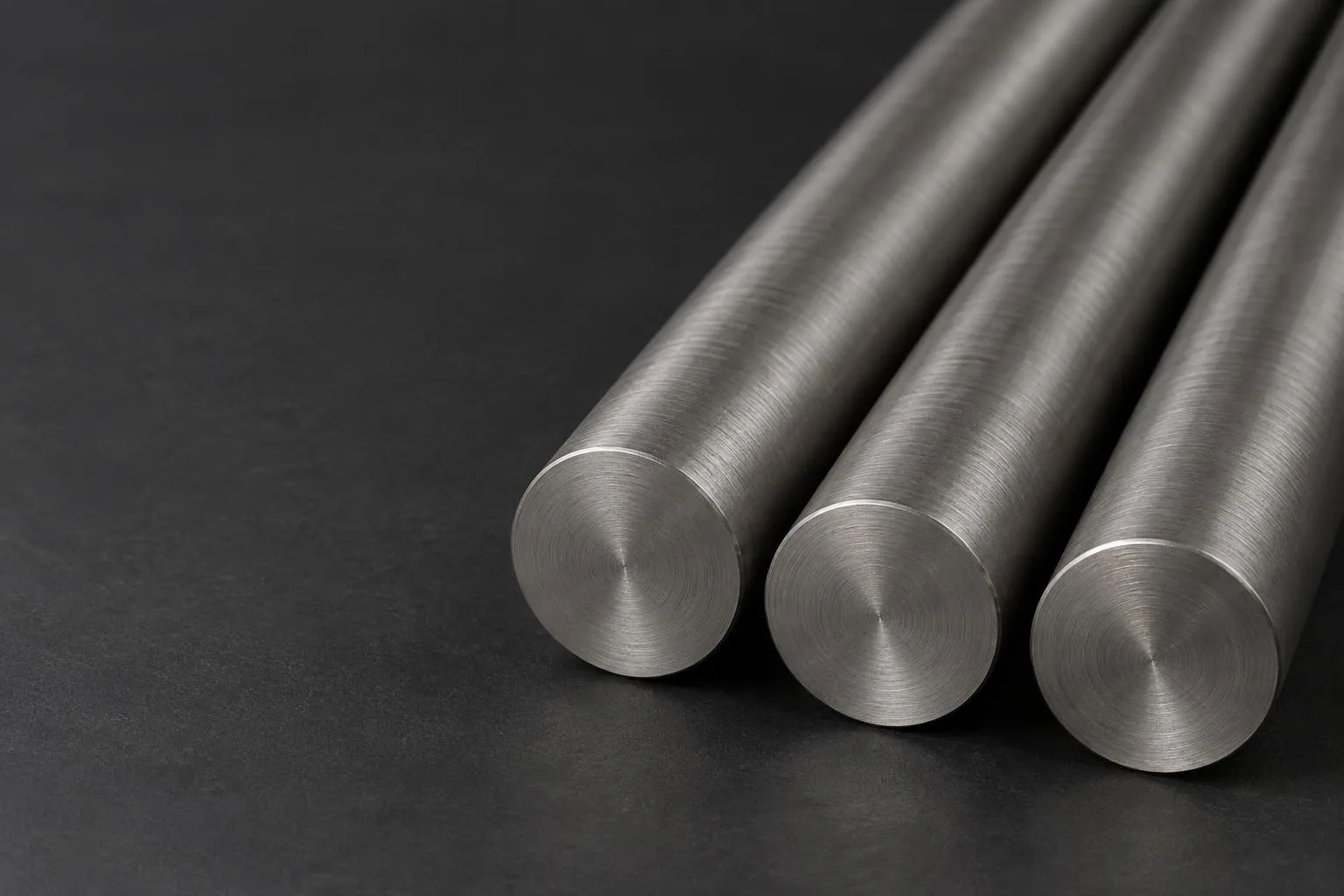
Imagery is illustrative metal product forms, not certified Super Invar stock or evidence of Quest stockholding.
Raw & semi-finished materials
Available material forms
Carpenter lists bar, billet, strip and wire. Confirm forms, sizes and availability at enquiry.
- Round bar and billet
- Strip
- Wire
Material overview
Super Invar (32-5)
An iron–nickel–cobalt alloy with lower thermal expansion than Invar 36 over a narrow temperature range around room temperature.
- The single published Carpenter mean CTE applies only over −55 to 95°C; it is not a coefficient for other temperatures.
- Cooling below about −80°C can transform the structure to martensite and permanently change expansion.
Designations and specifications
| Designation / standard | Scope and qualification |
|---|---|
| UNS | K93500 (Carpenter) |
| European | No European number verified |
| Producer names | Carpenter Super Invar 32-5 |
| ASTM F1684 | Fe–Ni–Co low-expansion grade K93500 — withdrawn 2024 |
| AMS / MIL | No AMS or MIL specification verified |
Do not order as “Invar”; specify Super Invar and the governing specification.
ASTM F1684-06(2021) — official listing (withdrawn 2024)
Specification review
Technical verification requirements
Mechanical properties
Carpenter cold-worked strength row duplicates the annealed row.
Obtain producer confirmation or mill test data.
Physical properties
Only one CTE interval; conductivity and Curie temperature not published.
Obtain CTE data over the service range.
Grade selection
Controlled-expansion alloys — distinct grades, not substitutes
| Alloy | Nominal base (mass %) | UNS (as verified) | Published mean CTE and interval | Primary intended use (per source) |
|---|---|---|---|---|
| Invar 36 | Fe–36Ni | K93601 / K93603 (Carpenter) | 1.30 × 10⁻⁶/K to 93°C; lower reference not stated (Carpenter) | Dimensionally stable structures, tooling, instruments |
| Super Invar | Fe–32Ni–5.5Co | K93500 (Carpenter) | 0.63 × 10⁻⁶/K, −55 to 95°C (Carpenter) | Lower expansion than Invar 36 over a narrow range |
| Kovar | Fe–29Ni–17Co | K94610 (ASTM F15) | 5.85 × 10⁻⁶/K, 25–100°C; 5.13 × 10⁻⁶/K, 25–300°C (Carpenter, annealed) | Seals to hard borosilicate glass and alumina ceramics |
| Alloy 42 | Fe–41/42Ni | K94100 (Carpenter, VDM) | 5.40 × 10⁻⁶/K, 21–343°C (Carpenter); 5.3 × 10⁻⁶/K, 20–300°C (NILO 42) | Glass sealing (e.g. 1075, 0120, 0010 glasses per Carpenter), lead frames |
| Alloy 46 | Fe–46Ni(–0.4Ti, Carpenter) | Not verified | Not verified | Enamelled-resistor terminal bands (Carpenter) |
| Alloy 48 | Fe–48Ni | K94800 (Special Metals, Aperam) | 8.7 × 10⁻⁶/K, 20–300°C (NILO 48) | Soft lead or soda-lime glass seals |
| Alloy 52 | Fe–51/52Ni | N14052 (Aperam, VDM) | Not verified from a primary producer table | Soft-glass seals (Aperam) |
Each value keeps its own producer, interval and conditioning; values from different sources are not directly comparable. Glass-to-metal sealing requires matching the alloy expansion curve to the specific glass or ceramic over the whole sealing-to-service temperature range — Kovar and Alloys 42/46/48/52 are not interchangeable.
Engineering reference
Technical data
| Element | Nominal mass % |
|---|---|
| Nickel | 32.00 |
| Cobalt | 5.50 |
| Manganese | 0.40 |
| Silicon | 0.25 |
| Carbon | 0.02 |
| Iron | Balance |
Producer nominal analysis, not specification limits.
| Property | Producer value | Basis |
|---|---|---|
| Density | 8.14 g/cm³ (0.2940 lb/in³) | Temperature and condition not stated |
| Elastic modulus | 145 GPa (21.0 × 10³ ksi) | Temperature and condition not stated |
| Electrical resistivity | 481.3 Ω·circ-mil/ft | 23°C; condition not stated |
| Mean CTE | 0.63 × 10⁻⁶/K (0.350 × 10⁻⁶/°F) | Mean over −55 to 95°C (−67 to 203°F); specimen condition not stated |
| Martensite start | About −80°C | Not a Curie temperature |
| Thermal conductivity / Curie temperature | Not verified | Not reported in the Carpenter datasheet |
Mean (secant) coefficient, not instantaneous. Metric value converted from the published imperial figure.
Annealed — Carpenter typical
| Property | Producer typical | Basis |
|---|---|---|
| 0.2% yield strength | 276 MPa | Test temperature not stated |
| Ultimate tensile strength | 483 MPa | Test temperature not stated |
| Elongation | 40% | 50.8 mm gauge |
| Hardness | 75 HRB | — |
Carpenter typical values, not specification limits.
Cold worked — Carpenter typical (strength row unconfirmed)
| Property | Producer typical | Basis |
|---|---|---|
| 0.2% yield strength | 276 MPa (as printed) | Identical to annealed row — unconfirmed |
| Ultimate tensile strength | 483 MPa (as printed) | Identical to annealed row — unconfirmed |
| Elongation | 40% (as printed) | 50.8 mm gauge |
| Hardness | 90 HRB | — |
The Carpenter datasheet prints the same strength and elongation for annealed and cold-worked material, differing only in hardness. Retained as published pending producer confirmation; do not use for design.
Annealing
790°C (1450°F), 30 min per 25 mm thickness, air cool.
Lowest expansion / stability
843°C 1 h, water quench → 316°C 1 h, air cool → 93°C 24 h, air cool.
Timing
Fabrication stresses alter expansion; heat-treat near final size.
Low-temperature limit
Austenite stable to at least −55°C; avoid exposure near the ~−80°C martensite start.
Carpenter producer guidance, not a universal acceptance treatment.
Typical applications
Engineering applications
- Optical and laser metrology structures
- Waveguides
- Assemblies with low-expansion glass or quartz
- Semiconductor equipment components
Subsequent manufacturing
Machining & processing
Machining and forming
Machining and cold forming introduce residual stress that changes expansion behaviour and dimensional stability; final stabilising or annealing treatments should follow rough machining, near final size.
Magnetic transformation
The low-expansion range of these Fe–Ni(–Co) alloys ends near their Curie (or inflection) temperature; above it, expansion rises sharply. Do not extrapolate a mean CTE beyond its stated interval.
Not a corrosion-resistant alloy
These alloys are not stainless; protection must be specified for humid or corrosive service.
Application evidence
Listed applications are producer-cited categories, not claims of stock or component approval.
Material certification & testing
Documentation must be agreed for the actual alloy, specification, product form, temper and any expansion-test requirement. Expansion acceptance depends on the specified interval and pre-test conditioning.
No certificate, expansion guarantee, sealing approval or alloy equivalence is automatic. Low-expansion and sealing alloys are not interchangeable; quotation controls remain disabled.
- EN 10204 3.1 material certificate, where agreed with the supplier
- Certificate of Conformity
- Heat / batch traceability to the producing mill
- Chemical analysis to the ordered specification
- Thermal-expansion test report over the specified interval and conditioning, only where ordered
Material enquiry
Request a material quotation
Super Invar (32-5) supplied to your material form, dimensions and specification.