Materials Supply / Controlled-Expansion & Electronic Alloys
Invar 36 (FeNi36)
FeNi36 | UNS K93600–K93603 | EN 1.3912
Invar 36 is an iron–nickel alloy whose thermal expansion is very low from cryogenic temperatures up to roughly 100–200°C, then rises as it approaches its Curie temperature.
It is not Super Invar: Super Invar adds cobalt and has a lower expansion over a narrower range.
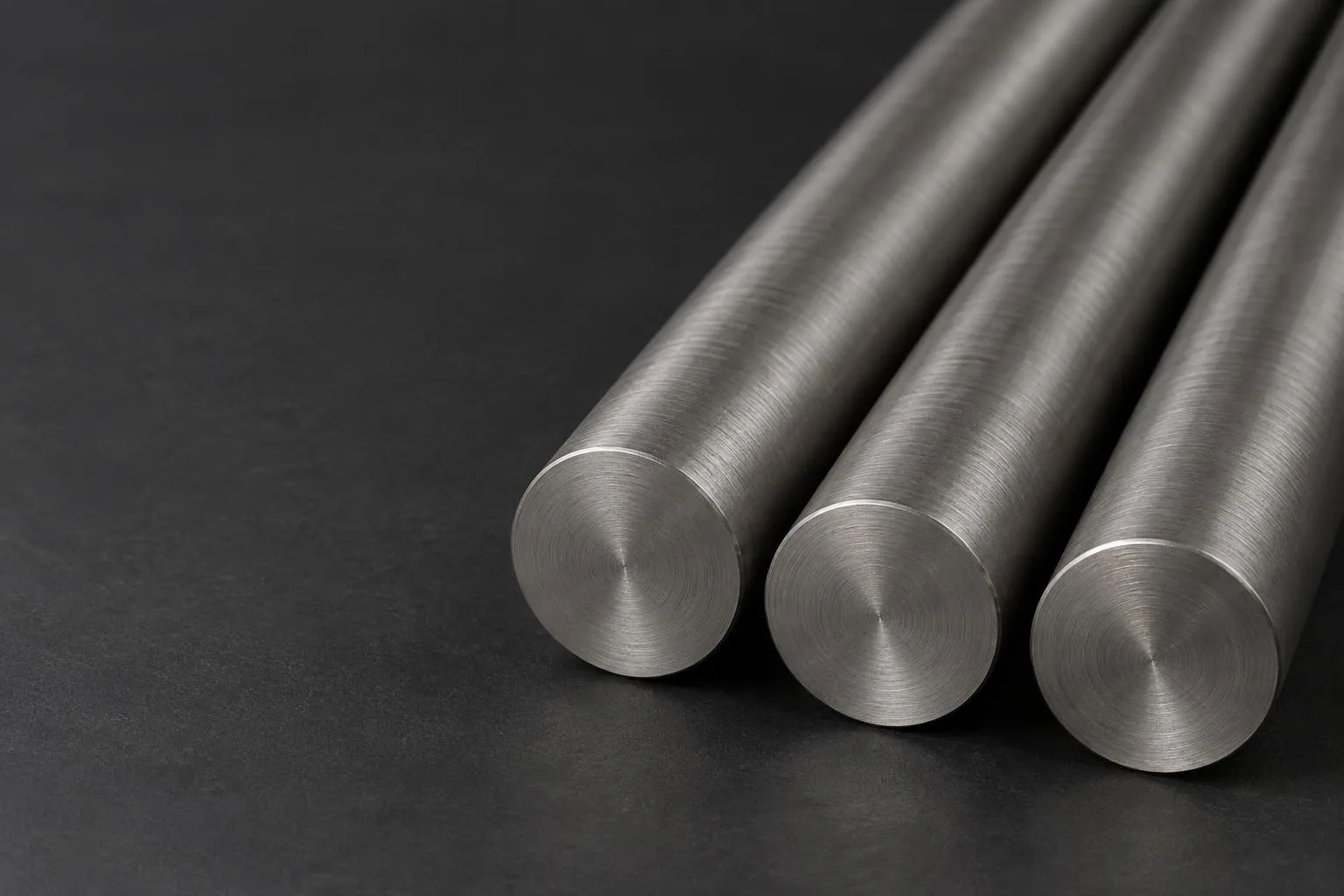
Imagery is illustrative metal product forms, not certified Invar 36 stock or evidence of Quest stockholding.
Raw & semi-finished materials
Available material forms
Carpenter lists bar, billet, strip and shaped wire; Aperam lists bar, plate, cold-rolled strip and wire for INVAR M93. Producer scopes are not Quest stock; confirm forms, sizes and availability at enquiry.
- Round bar and billet
- Strip and sheet
- Plate
- Wire
Material overview
Invar 36 (FeNi36)
A 36% nickel–iron alloy with very low thermal expansion near room temperature, used for dimensionally stable structures, tooling and instruments.
- Expansion depends on temperature interval, cold work and heat treatment. No single coefficient applies across all temperatures.
- Carpenter publishes mean CTE values to stated upper temperatures but does not state the lower reference temperature; they are shown exactly as published.
Designations and specifications
| Designation / standard | Scope and qualification |
|---|---|
| UNS | K93601 / K93603 (Carpenter); VDM distinguishes K93600 thermostats, K93601 pressure vessels, K93602 machining, K93603 low-expansion — related but not automatically identical procurement identities |
| European | EN 1.3912, Ni36 (VDM) |
| Producer names | Carpenter Invar 36; VDM Alloy 36 / Pernifer 36; Aperam INVAR M93 (a specific cryogenic grade) |
| ASTM F1684 | Iron–nickel and iron–nickel–cobalt low-expansion alloys; conventional grade K93603 — withdrawn 2024 |
| ASTM B753 (Alloy T36) | Thermostat-bimetal component alloys only, not a general precision-Invar specification |
| AMS / MIL | No AMS or MIL specification verified from primary sources |
Obtain controlled current standards before ordering; a withdrawn ASTM standard may still be cited contractually.
ASTM F1684-06(2021) — official listing (withdrawn 2024)
Specification review
Technical verification requirements
Thermal expansion
Carpenter mean CTE omits the lower reference temperature and condition; VDM ranges do not state mean/instantaneous basis.
Obtain a producer CTE table with stated interval and conditioning.
Physical properties
Curie temperature 279°C (Carpenter) vs 230°C (VDM) unresolved.
Confirm with the producer of the ordered heat.
Specifications
ASTM F1684 withdrawn 2024; no AMS/MIL verified; Aperam M93 chemistry limits not accessed.
Agree the governing specification at enquiry.
Grade selection
Controlled-expansion alloys — distinct grades, not substitutes
| Alloy | Nominal base (mass %) | UNS (as verified) | Published mean CTE and interval | Primary intended use (per source) |
|---|---|---|---|---|
| Invar 36 | Fe–36Ni | K93601 / K93603 (Carpenter) | 1.30 × 10⁻⁶/K to 93°C; lower reference not stated (Carpenter) | Dimensionally stable structures, tooling, instruments |
| Super Invar | Fe–32Ni–5.5Co | K93500 (Carpenter) | 0.63 × 10⁻⁶/K, −55 to 95°C (Carpenter) | Lower expansion than Invar 36 over a narrow range |
| Kovar | Fe–29Ni–17Co | K94610 (ASTM F15) | 5.85 × 10⁻⁶/K, 25–100°C; 5.13 × 10⁻⁶/K, 25–300°C (Carpenter, annealed) | Seals to hard borosilicate glass and alumina ceramics |
| Alloy 42 | Fe–41/42Ni | K94100 (Carpenter, VDM) | 5.40 × 10⁻⁶/K, 21–343°C (Carpenter); 5.3 × 10⁻⁶/K, 20–300°C (NILO 42) | Glass sealing (e.g. 1075, 0120, 0010 glasses per Carpenter), lead frames |
| Alloy 46 | Fe–46Ni(–0.4Ti, Carpenter) | Not verified | Not verified | Enamelled-resistor terminal bands (Carpenter) |
| Alloy 48 | Fe–48Ni | K94800 (Special Metals, Aperam) | 8.7 × 10⁻⁶/K, 20–300°C (NILO 48) | Soft lead or soda-lime glass seals |
| Alloy 52 | Fe–51/52Ni | N14052 (Aperam, VDM) | Not verified from a primary producer table | Soft-glass seals (Aperam) |
Each value keeps its own producer, interval and conditioning; values from different sources are not directly comparable. Glass-to-metal sealing requires matching the alloy expansion curve to the specific glass or ceramic over the whole sealing-to-service temperature range — Kovar and Alloys 42/46/48/52 are not interchangeable.
Engineering reference
Technical data
| Element | Carpenter nominal % | VDM limits % |
|---|---|---|
| Nickel | 36.00 | 35.0–37.0 |
| Manganese | 0.35 | 0.6 max |
| Silicon | 0.20 | 0.4 max |
| Carbon | 0.02 | 0.05 max |
| Chromium | — | 0.25 max |
| Cobalt | — | 0.5 max |
| Sulphur | — | 0.015 max |
| Phosphorus | — | 0.015 max |
| Iron | Balance | Balance |
Carpenter values are nominal, not acceptance limits; VDM values are producer limits for VDM Alloy 36. Neither is an ASTM acceptance range.
| Property | Producer value | Basis |
|---|---|---|
| Density | 8.05 g/cm³ (0.2910 lb/in³) | Carpenter; temperature and condition not stated |
| Density | 8.1 g/cm³ | VDM, 20°C |
| Elastic modulus | 141 GPa (20.5 × 10³ ksi) annealed; 148 GPa (21.5 × 10³ ksi) cold rolled | Carpenter; test temperature not stated |
| Elastic modulus | 143 GPa | VDM, 20°C |
| Thermal conductivity | 12.8 W/(m·K) | VDM, 20°C |
| Electrical resistivity | 78 µΩ·cm | VDM, 20°C |
| Curie temperature | 279°C (Carpenter); 230°C (VDM) | Unresolved producer difference — not averaged |
| Mean CTE to 93°C | 1.30 × 10⁻⁶/K | Carpenter; lower reference temperature and condition not stated |
| Mean CTE to 149°C | 2.11 × 10⁻⁶/K | Carpenter; as above |
| Mean CTE to 260°C | 4.18 × 10⁻⁶/K | Carpenter; as above |
| Mean CTE to 371°C | 7.60 × 10⁻⁶/K | Carpenter; as above |
All CTE values are mean (secant) coefficients, not instantaneous coefficients. VDM publishes CTE ranges (e.g. 0.6–2.1 × 10⁻⁶/K at 100°C) without stating mean or instantaneous basis or reference temperature, so they are not tabulated. 10⁻⁶/K equals µm/(m·°C).
Annealed bar / strip — Carpenter typical
| Property | Producer typical | Basis |
|---|---|---|
| 0.2% yield strength | 276 MPa | Test temperature not stated |
| Ultimate tensile strength | 448 MPa | Test temperature not stated |
| Elongation | 35% | 50.8 mm gauge |
| Hardness | 70 HRB | — |
Carpenter typical values, not specification limits.
Cold-drawn bar — Carpenter typical
| Property | Producer typical | Basis |
|---|---|---|
| 0.2% yield strength | 483 MPa | Test temperature not stated |
| Ultimate tensile strength | 621 MPa | Test temperature not stated |
| Elongation | 20% | 50.8 mm gauge |
| Hardness | 90 HRB | — |
Cold work alters expansion and dimensional stability; these strength values do not imply annealed expansion data.
Cold-rolled strip — Carpenter typical
| Property | Producer typical | Basis |
|---|---|---|
| 0.2% yield strength | 679 MPa | Test temperature not stated |
| Ultimate tensile strength | 717 MPa | Test temperature not stated |
| Elongation | 5.5% | 50.8 mm gauge |
| Hardness | 98 HRB | — |
Carpenter typical values; reduction and thickness not stated.
Soft annealed — VDM typical, 20°C
| Property | Producer typical | Basis |
|---|---|---|
| 0.2% yield strength | 270 MPa | 20°C |
| Ultimate tensile strength | 490 MPa | 20°C |
| Elongation | 40% | 20°C |
VDM typical values; product form not stated. Not specification limits.
Annealing (Carpenter)
790°C (1450°F), 30 min per 25 mm thickness, air cool.
Dimensional stabilisation (Carpenter)
815°C, 30 min per 25 mm, water quench; then 315°C for 1 h, air cool; optional 93°C for 24–48 h.
Annealing and stress relief (VDM)
Anneal 820–900°C, air cool; water quenching lowers expansion but leaves an unstable state. Stress relief approximately 700°C.
Lowest expansion at 100°C (VDM)
830°C ~30 min, water quench → 300°C 1 h, air cool → 100°C 30 min, furnace cool to room temperature over 48 h.
Effect of cold work
Cold work can lower expansion slightly, but the state is unstable, particularly at elevated temperature (VDM); cold-work stresses affect long-term dimensional stability (Carpenter).
Producer cycles serve different purposes and are not universal acceptance treatments; qualify the cycle for the component and expansion requirement.
Typical applications
Engineering applications
- Precision instruments and optical / laser mounts
- Composite lay-up moulds and tooling
- Cryogenic transfer lines (Aperam M93)
- Semiconductor and electronic components
Subsequent manufacturing
Machining & processing
Machining and forming
Machining and cold forming introduce residual stress that changes expansion behaviour and dimensional stability; final stabilising or annealing treatments should follow rough machining, near final size.
Magnetic transformation
The low-expansion range of these Fe–Ni(–Co) alloys ends near their Curie (or inflection) temperature; above it, expansion rises sharply. Do not extrapolate a mean CTE beyond its stated interval.
Not a corrosion-resistant alloy
These alloys are not stainless; protection must be specified for humid or corrosive service.
Application evidence
Listed applications are producer-cited categories, not claims of stock or component approval.
Material certification & testing
Documentation must be agreed for the actual alloy, specification, product form, temper and any expansion-test requirement. Expansion acceptance depends on the specified interval and pre-test conditioning.
No certificate, expansion guarantee, sealing approval or alloy equivalence is automatic. Low-expansion and sealing alloys are not interchangeable; quotation controls remain disabled.
- EN 10204 3.1 material certificate, where agreed with the supplier
- Certificate of Conformity
- Heat / batch traceability to the producing mill
- Chemical analysis to the ordered specification
- Thermal-expansion test report over the specified interval and conditioning, only where ordered
Material enquiry
Request a material quotation
Invar 36 (FeNi36) supplied to your material form, dimensions and specification.