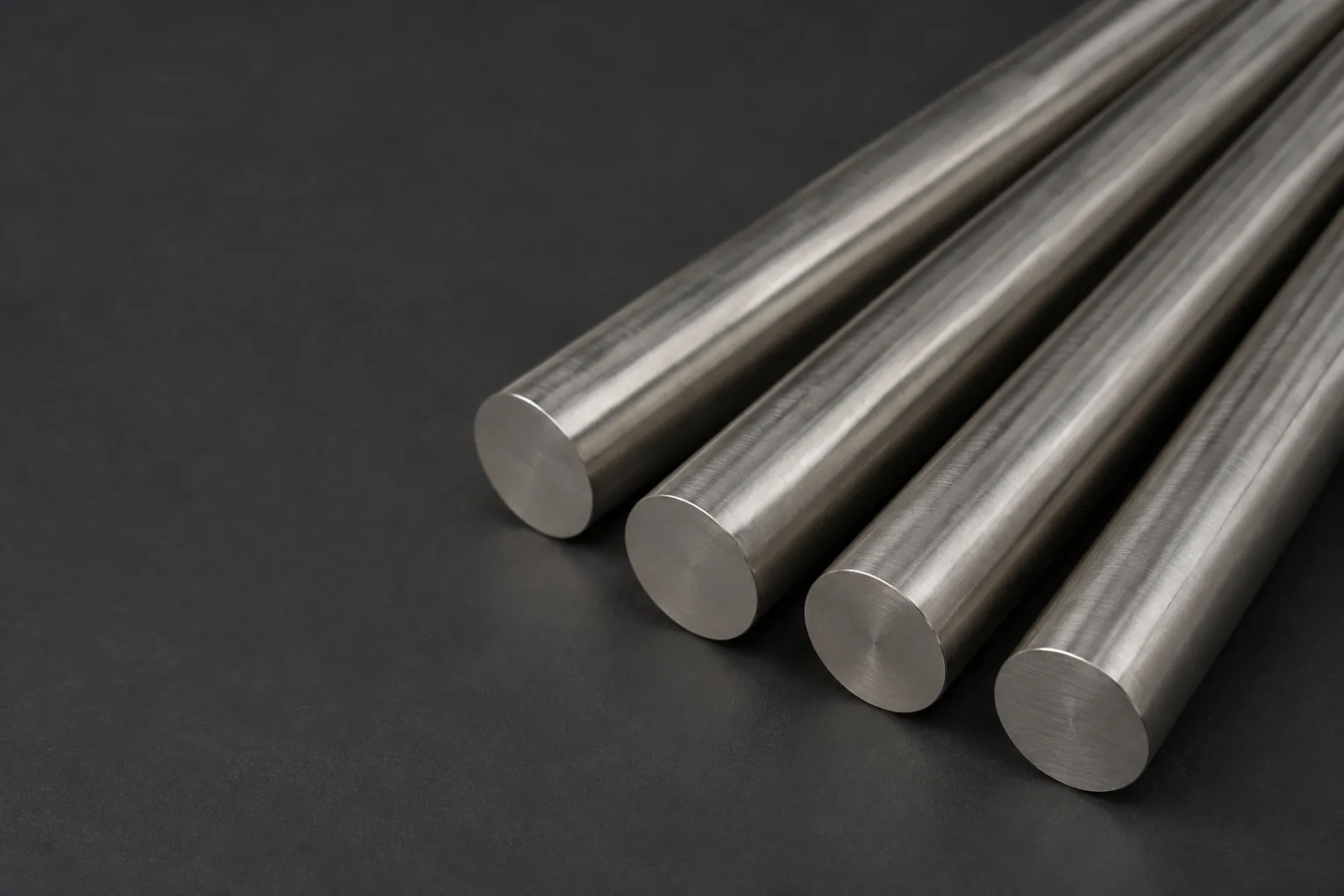
Materials Supply / Nickel, Cobalt & High-Temperature Alloys
Waspaloy Nickel Superalloy
Precipitation-hardening nickel superalloy | UNS N07001
Waspaloy is a precipitation-hardenable nickel-based superalloy combining chromium, cobalt and molybdenum with aluminium and titanium additions for gamma-prime strengthening.
Used for elevated-temperature turbine and aerospace components, its tensile, fatigue and creep performance depends on product form, heat treatment and service loading. Published typical data are not design allowables.
Waspaloy is a trademark of Pratt & Whitney. Quest Engineering does not own this trademark or manufacture the alloy.
Raw & semi-finished materials
Available material forms
Producer-supported product forms; availability is subject to ordered specification, dimensions and supplier confirmation. No Quest Engineering stockholding is implied.
- Round bar
- Forging stock
- Extruded section
- Wire
Material overview
Waspaloy Nickel Superalloy
Age-hardenable nickel superalloy for highly stressed gas-turbine components.
- Precipitation hardening and solid-solution strengthening contribute to elevated-temperature performance.
- Separate verified bar treatments retain independent tensile and rupture data; optimum tensile and creep schedules must not be interchanged.
- Fatigue design requires qualified condition-specific data; no numerical fatigue allowables or universal service temperature are inferred.
Specifications and designations
| Reference | Producer-listed scope / status |
|---|---|
| UNS | N07001 |
| Werkstoff | 2.4654 |
| ASTM B637; AMS5704/5706/5707/5708/5709/5828 | Collective producer rod, bar, wire and forging-stock listing; not individual verified scopes |
| AMS5544 | Producer plate, sheet and strip listing |
No full standards reviewed. SAE direct public scope retrieval unsuccessful. Confirm edition, product scope and condition before ordering. Reference associations only: no equivalence, stock availability, aerospace approval or certified conformity is established by this page. Specify the ordered revision, product form, dimensions, manufacture/melt route, delivery condition and acceptance tests; obtain matching supplier confirmation and inspection documents.
Specification review
Technical verification requirements
Specifications / product form
Producer listings and historic references support alloy association but not every listed standard’s current revision, individual form, section-size, melt-route, heat-treatment tolerances or acceptance requirements. Existing qualification wording is appropriate, not proof of conformity.
Obtain controlled ordered-standard and producer confirmation before technical release.
Engineering reference
Technical data
| Element | Minimum mass % | Maximum mass % |
|---|---|---|
| Cr | 18 | 21 |
| B | 0.003 | 0.01 |
| Zr | 0.02 | 0.12 |
| Al | 1.2 | 1.6 |
| Ti | 2.75 | 3.25 |
| Mo | 3.5 | 5 |
| Co | 12 | 15 |
| Cu | — | 0.5 |
| Fe | — | 2 |
| S | — | 0.03 |
| Si | — | 0.75 |
| Mn | — | 1 |
| C | 0.02 | 0.1 |
| P | — | 0.03 |
| Ni | balance | balance |
Limiting composition mass percent; single source, not merged with tighter Carpenter composition; balance does not imply exclusively nickel. No unlisted residual limits inferred.
| Property | Value | Unit | Temperature / interval |
|---|---|---|---|
| Density — Special Metals | 8190 | kg/m³ | Measurement temperature not stated |
| Melting range — Special Metals | 1330–1360 | °C | Solidus–liquidus interval |
| Electrical resistivity — Special Metals, solution treated | 1.24 | µΩ·m | 1080°C / 4 h air cool; measurement temperature not stated |
| Electrical resistivity — Special Metals, fully aged | 1.20 | µΩ·m | 1080°C / 4 h AC + 845°C / 24 h AC + 760°C / 16 h AC; measurement temperature not stated |
| Mean specific heat | 0.52 | kJ/(kg·K) | 93°C |
| Mean specific heat | 0.54 | kJ/(kg·K) | 538°C |
| Mean specific heat | 0.55 | kJ/(kg·K) | 649°C |
| Mean specific heat | 0.56 | kJ/(kg·K) | 760°C |
| Mean specific heat | 0.58 | kJ/(kg·K) | 871°C |
| Mean specific heat | 0.71 | kJ/(kg·K) | 982°C |
| Mean thermal expansion | 12.2 | µm/(m·K) | 25°C to 93°C |
| Mean thermal expansion | 13.1 | µm/(m·K) | 25°C to 316°C |
| Mean thermal expansion | 13.9 | µm/(m·K) | 25°C to 538°C |
| Mean thermal expansion | 15.7 | µm/(m·K) | 25°C to 816°C |
| Mean thermal expansion | 18.7 | µm/(m·K) | 25°C to 1093°C |
| Thermal conductivity | 11 | W/(m·K) | 21.1°C |
| Thermal conductivity | 16 | W/(m·K) | 427°C |
| Thermal conductivity | 20 | W/(m·K) | 649°C |
| Thermal conductivity | 23 | W/(m·K) | 816°C |
| Thermal conductivity | 26 | W/(m·K) | 982°C |
| Elastic modulus | 211 | GPa | 25°C |
| Elastic modulus | 200.6 | GPa | 260°C |
| Elastic modulus | 184.1 | GPa | 538°C |
| Elastic modulus | 171.7 | GPa | 704°C |
| Elastic modulus | 156.5 | GPa | 871°C |
Carpenter series: condition not specified; mean specific-heat reference baseline undefined. First four rows separately cite Special Metals SMC-011 Table 2: https://www.specialmetals.com/documents/technical-bulletins/waspoloy.pdf . Density converted from 8.19 g/cm³; resistivity treatment is not its measurement temperature. Alternative producer melting ranges are not merged.
Bar — 1010°C solution treated and aged
| Property | Typical value | Basis |
|---|---|---|
| Ultimate tensile strength | 1441 MPa | 21°C; bar stock |
| 0.2% proof / yield strength | 1076 MPa | 21°C; bar stock |
| Elongation | 27% | Gauge length not specified |
| Reduction of area | 47% | 21°C; bar stock |
| Hardness | 42 HRC | As tabulated |
Independent condition: 1010°C / 4 h oil quenched + 843°C / 4 h AC + 760°C / 16 h AC. Bar stock; solution treatment as row, oil quench; then 843 C 4h AC + 760 C 16h AC; typical not minimum Typical producer values, not specification minima or design allowables; confirm ordered condition, section limits, specimen requirements and gauge length where not stated.
Bar — 1024°C solution treated and aged
| Property | Typical value | Basis |
|---|---|---|
| Ultimate tensile strength | 1427 MPa | 21°C; bar stock |
| 0.2% proof / yield strength | 1041 MPa | 21°C; bar stock |
| Elongation | 28% | Gauge length not specified |
| Reduction of area | 49% | 21°C; bar stock |
| Hardness | 41/42 HRC | As tabulated |
Independent condition: 1024°C / 4 h oil quenched + 843°C / 4 h AC + 760°C / 16 h AC. Bar stock; solution treatment as row, oil quench; then 843 C 4h AC + 760 C 16h AC; typical not minimum Typical producer values, not specification minima or design allowables; confirm ordered condition, section limits, specimen requirements and gauge length where not stated.
Bar — 1038°C solution treated and aged
| Property | Typical value | Basis |
|---|---|---|
| Ultimate tensile strength | 1331 MPa | 21°C; bar stock |
| 0.2% proof / yield strength | 848 MPa | 21°C; bar stock |
| Elongation | 33% | Gauge length not specified |
| Reduction of area | 38% | 21°C; bar stock |
| Hardness | 37/38 HRC | As tabulated |
Independent condition: 1038°C / 4 h oil quenched + 843°C / 4 h AC + 760°C / 16 h AC. Bar stock; solution treatment as row, oil quench; then 843 C 4h AC + 760 C 16h AC; typical not minimum Typical producer values, not specification minima or design allowables; confirm ordered condition, section limits, specimen requirements and gauge length where not stated.
Bar — 1051°C solution treated and aged
| Property | Typical value | Basis |
|---|---|---|
| Ultimate tensile strength | 1310 MPa | 21°C; bar stock |
| 0.2% proof / yield strength | 841 MPa | 21°C; bar stock |
| Elongation | 32% | Gauge length not specified |
| Reduction of area | 37% | 21°C; bar stock |
| Hardness | 36/37 HRC | As tabulated |
Independent condition: 1051°C / 4 h oil quenched + 843°C / 4 h AC + 760°C / 16 h AC. Bar stock; solution treatment as row, oil quench; then 843 C 4h AC + 760 C 16h AC; typical not minimum Typical producer values, not specification minima or design allowables; confirm ordered condition, section limits, specimen requirements and gauge length where not stated.
Bar — 1066°C solution treated and aged
| Property | Typical value | Basis |
|---|---|---|
| Ultimate tensile strength | 1296 MPa | 21°C; bar stock |
| 0.2% proof / yield strength | 814 MPa | 21°C; bar stock |
| Elongation | 32% | Gauge length not specified |
| Reduction of area | 36% | 21°C; bar stock |
| Hardness | 35/36 HRC | As tabulated |
Independent condition: 1066°C / 4 h oil quenched + 843°C / 4 h AC + 760°C / 16 h AC. Bar stock; solution treatment as row, oil quench; then 843 C 4h AC + 760 C 16h AC; typical not minimum Typical producer values, not specification minima or design allowables; confirm ordered condition, section limits, specimen requirements and gauge length where not stated.
Bar — 1079°C solution treated and aged
| Property | Typical value | Basis |
|---|---|---|
| Ultimate tensile strength | 1276 MPa | 21°C; bar stock |
| 0.2% proof / yield strength | 800 MPa | 21°C; bar stock |
| Elongation | 31% | Gauge length not specified |
| Reduction of area | 29% | 21°C; bar stock |
| Hardness | 35 HRC | As tabulated |
Independent condition: 1079°C / 3 h oil quenched + 843°C / 4 h AC + 760°C / 16 h AC. Bar stock; solution treatment as row, oil quench; then 843 C 4h AC + 760 C 16h AC; typical not minimum Typical producer values, not specification minima or design allowables; confirm ordered condition, section limits, specimen requirements and gauge length where not stated.
Numerical producer tables only; conditions retained independently.
Complete elevated-temperature tensile rows
| Solution temperature (°C) | Solution hold (h) | Test temperature (°C) | 0.2% yield strength (MPa) | Ultimate tensile strength (MPa) | Elongation (%) | Reduction of area (%) |
|---|---|---|---|---|---|---|
| 1010 | 4 | 538 | 980 | 1358 | 22 | 30 |
| 1024 | 4 | 538 | 917 | 1289 | 23 | 29 |
| 1038 | 4 | 538 | 745 | 1158 | 31 | 32 |
| 1051 | 4 | 538 | 731 | 1124 | 31 | 35 |
| 1066 | 4 | 538 | 703 | 1110 | 32 | 35 |
| 1079 | 3 | 538 | 690 | 1096 | 31 | 35 |
Bar stock; solution treatment as row, oil quench; then 843 C 4h AC + 760 C 16h AC; typical not minimum
Table 3 typical 1000 h rupture strength
| Test temperature (°C) | Rupture stress (MPa) |
|---|---|
| 649 | 615 |
| 704 | 450 |
| 760 | 290 |
| 816 | 180 |
| 870 | 110 |
Typical 1000-hour rupture strengths; Special Metals treatment A: 1080°C / 4 h air cool, 845°C / 24 h air cool, 760°C / 16 h air cool. Product form not specified in this table; not design allowables.
Complete stress rupture table
| Solution temperature (°C) | Solution hold (h) | 732°C / 517 MPa — Life (h) | 732°C — Elongation (%) | 732°C — Reduction of area (%) | 816°C / 327.5 MPa — Life (h) | 816°C — Elongation (%) | 816°C — Reduction of area (%) |
|---|---|---|---|---|---|---|---|
| 1010 | 4 | 35.3 | 32.8 | 42.2 | 5.6 | 39.4 | 62.6 |
| 1024 | 4 | 56.1 | 11 | 17.2 | 8.2 | 36.1 | 54.6 |
| 1038 | 4 | 131.7 | 13.2 | 13.2 | 46.5 | 30 | 30.9 |
| 1051 | 4 | 125.6 | 8.7 | 17.4 | 38.9 | 19.2 | 26.6 |
| 1066 | 4 | 92.7 | 10.3 | 13.2 | 43.6 | 22.7 | 26.1 |
| 1079 | 3 | 91.3 | 5.3 | 12 | 52.4 | 19.4 | 23.3 |
Bar stock; solution treatment as row, oil quench; then 843 C 4h AC + 760 C 16h AC; typical not minimum
Oxidation performance
- Producer reports oxidation resistance in continuous exposure up to 1038°C; this is not a quantitative oxidation test table.
No graph reading. Values are typical, not guaranteed minima. SM melting 1330-1360 C conflicts with ATI 1329-1407 C; retained independently, not reconciled. Suitability depends on loading, temperature, atmosphere, exposure duration and required service life. Test temperatures are not universal maximum service temperatures.
Optimum high-temperature creep and stress rupture
1080 C 4 h air cool; HRC20-25 → 845 C 24 h air cool → 760 C 16 h air cool; HRC34-40 [SM p2] Source: https://www.specialmetals.com/documents/technical-bulletins/waspoloy.pdf
Optimum room and high temperature tensile
995-1035 C 4 h oil quench → 845 C 4 h air cool → 760 C 16 h air cool; HRC34-44 [SM p2] Source: https://www.specialmetals.com/documents/technical-bulletins/waspoloy.pdf
Independent Special Metals producer recommendations, not cumulative steps between schedules. The Carpenter bar conditions above use separate verified schedules. Confirm product form, section size, tolerances and ordered specification; AC means air cool.
Material selection
Corrosion resistance & performance
Oxidation resistance does not establish resistance to all hot-corrosion or aqueous environments. Confirm atmosphere, temperature and stress for the intended application.
Typical applications
Engineering applications
- compressor and rotor discs
- shafts
- spacers
- seals
- rings and casings
- fasteners
- airframe and missile systems
Subsequent manufacturing
Machining & processing
Processing precautions
VIM/VAR or VIM/ESR; Cold form solution treated; frequent anneals for severe work; Welding difficult; inert gas fusion welding in solution treated condition, matching filler; re-solution and age after welding/brazing
Machining condition and tooling
Confirm the actual material condition before planning machining. Allow for work hardening; qualify tool material, rigidity, coolant and cutting engagement for the product. No universal speeds or feeds are specified.
Distortion, finishing and inspection
Agree machining allowance, final surface condition and dimensional inspection around heat treatment. Define surface and internal inspection, acceptance criteria and traceability to the ordered specification; additional testing is not automatic.
Material certification & testing
Certification and inspection options are subject to customer requirements and supplier confirmation.
Conformity must be demonstrated against the ordered specification, form and condition. Tests are not automatic; agree scope, acceptance criteria and documentation before ordering.
- EN 10204 3.1 material certificates
- Certificates of Conformity
- Heat/batch traceability
- Chemical analysis
- Mechanical testing
- Heat-treatment records
- Hardness testing
- Positive Material Identification (PMI)
- Ultrasonic testing where applicable
- Additional aerospace or customer-specific inspection requirements
Material enquiry
Request a material quotation
Waspaloy Nickel Superalloy supplied to your material form, dimensions and specification.