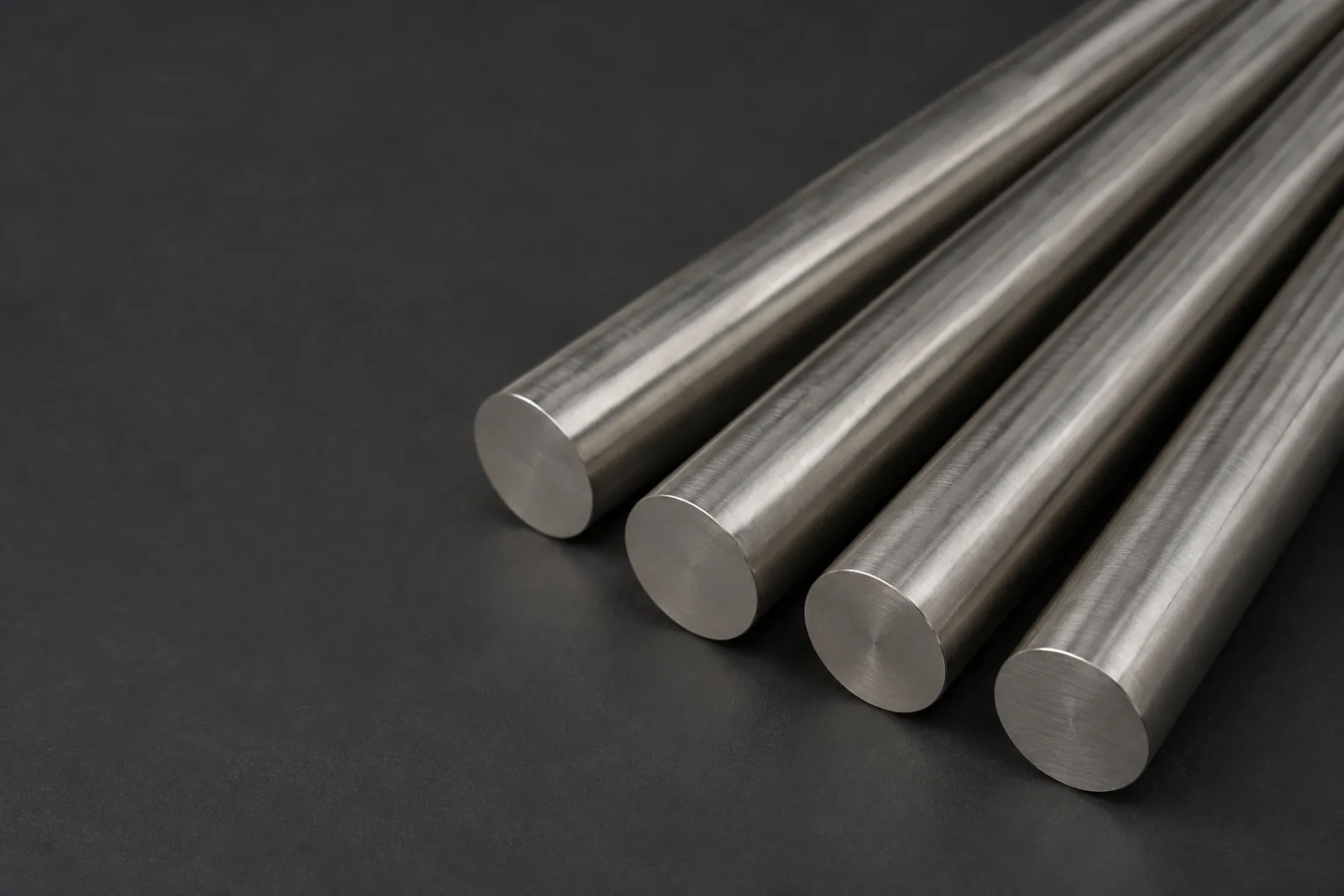
Materials Supply / Nickel, Cobalt & High-Temperature Alloys
Inconel 718 Nickel Alloy
Precipitation-hardenable nickel-iron-chromium alloy | UNS N07718 | W.Nr. 2.4668
Inconel 718 is a precipitation-hardenable nickel-iron-chromium alloy containing niobium, molybdenum, titanium and aluminium. Solution treatment followed by controlled ageing precipitates strengthening gamma-prime and gamma-double-prime phases; supplied condition is critical to performance.
Used for gas-turbine rings, casings, formed structural parts, aerospace fasteners and energy equipment, it combines high strength with useful corrosion resistance and resistance to postweld cracking. Fatigue, creep and rupture performance depend on processing, section size, grain structure and service conditions.
INCONEL® is a trademark of the Special Metals Corporation group of companies. Quest Engineering does not own this trademark.
Raw & semi-finished materials
Available material forms
Producer-listed forms only; availability depends on specification, dimensions, condition and supplier confirmation. No stock or universal form/specification availability is implied.
- Round Bar
- Flat Bar
- Hexagon Bar
- Plate
- Sheet
- Strip
- Pipe
- Tube
- Wire
- Forging Stock
- Extruded Section
- Cut-to-Size Material
Material overview
Inconel 718 Nickel Alloy
Age-hardenable nickel alloy for high-strength aerospace and industrial components, with condition-specific tensile, fatigue and stress-rupture performance.
- Specify the exact product standard and revision, form, dimensions and supplied heat-treatment condition.
- AMS 5662 solution-treated material is not the same supplied condition as AMS 5663 solution-and-precipitation-treated material; AMS 5664 uses the higher solution-treatment route.
- The producer associates the lower solution route with strong fatigue and rupture performance; the higher route improves transverse ductility in heavy sections but can cause notch brittleness in stress rupture.
Designations and product specifications
| Designation / specification | Product form / scope | Notes |
|---|---|---|
| UNS N07718 | Alloy identification | Producer introductory designation; not a product specification. |
| W.Nr. 2.4668 | European material number | Producer-listed Werkstoff number; not a blanket EN product-standard equivalence. |
| ASTM B637 | Rod, bar, forgings and forging stock | Precipitation-hardening nickel alloys; grade, condition and ordered revision govern. |
| ASTM B670 | Plate, sheet and strip | Rolled N07718 in annealed condition; subsequent precipitation-hardened test requirements do not mean supplied aged stock. |
| ASTM B906 | Plate, sheet and strip: general requirements | Companion general requirements, not an independent 718 grade specification. |
| AMS 5662 | Bars, forgings, flash-welded rings and stock | 5662P abstract: solution heat treated, precipitation-hardenable; 1775°F (968°C) title. Finished product ≤254 mm nominal diameter/maximum thickness and ≤503 cm² nominal area; stock for forging, ring or heading may be any size. Not supplied aged under this designation. |
| AMS 5663 | Bars, forgings, flash-welded rings and stock | 5663P abstract: solution AND precipitation heat treated; 1775°F (968°C) solution title. Finished product ≤254 mm nominal diameter/maximum thickness and ≤503 cm² nominal area; forging/ring stock may be any size. Not interchangeable with 5662. |
| AMS 5664 | Bars, forgings, flash-welded rings and stock; G title also names extrusions | 5664G: 1950°F (1066°C) solution heat treated, precipitation-hardenable, not necessarily supplied aged. Public abstract limits finished product to ≤254 mm diameter/maximum thickness and ≤503 cm² area; forging/ring stock any size. Extrusions appear in title but not abstract: confirm full scope before ordering. |
| AMS 5596 | Sheet, strip and plate | Lower-temperature solution-treatment route; producer p. 3 shows properties after ageing, not automatically supplied aged. |
| AMS 5597 | Sheet, strip and plate | Higher-temperature solution-treatment route; distinguish supplied condition from aged test properties. |
| AMS 5589 | Seamless tubing | Lower solution route; producer aged-property table has outside-diameter and wall limits. |
| AMS 5590 | Seamless tubing | 1950°F solution-treatment route; confirm ordered condition and dimensions. |
| AMS 5914 | Rod/bar/wire/forging-stock group in producer listing | Individual form and condition scope not independently verified; do not assume all group forms covered. |
| AMS 5962 | Round bars and wire | Public A abstract: work-strengthened, precipitation-hardenable, nominal diameter ≤38 mm; not conventional annealed stock. |
| AMS 5950 | Sheet for superplastic forming | Producer identifies special 718SPF sheet; do not transfer its fine-grain processing data to conventional 718. |
Producer associations cross-checked against public ASTM and SAE-published abstracts where accessible, including standards distributors. Full current standards were not available. The 2007 bulletin is not current certification evidence. AMS 5832 and AWS A5.14 ERNiFeCr-2 concern welding filler only and are excluded from parent-metal equivalences. Confirm each ordered revision; NACE suitability requires application-specific qualification. Reference associations only: no equivalence, stock availability, aerospace approval or certified conformity is established by this page. Specify the ordered revision, product form, dimensions, manufacture/melt route, delivery condition and acceptance tests; obtain matching supplier confirmation and inspection documents.
Specification review
Technical verification requirements
Designations / ordered product condition
Solution-only and aged properties must remain linked to their own producer specimen cycles; obtain controlled AMS condition, section and acceptance requirements. Existing cautions do not prove conformity; no allegation that every listed scope is wrong. Obtain the ordered revision and map each cited specification to form, dimensions, manufacture, delivery condition and acceptance tests.
Obtain licensed ordered editions and issue a material-specific form/condition/size compliance matrix; retain existing caveats pending approval.
Engineering reference
Technical data
| Element | Mass % |
|---|---|
| Nickel + cobalt | 50.00–55.00 |
| Chromium | 17.00–21.00 |
| Iron | Balance |
| Niobium + tantalum | 4.75–5.50 |
| Molybdenum | 2.80–3.30 |
| Titanium | 0.65–1.15 |
| Aluminium | 0.20–0.80 |
| Cobalt | ≤1.00 |
| Carbon | ≤0.08 |
| Manganese | ≤0.35 |
| Silicon | ≤0.35 |
| Phosphorus | ≤0.015 |
| Sulfur | ≤0.015 |
| Boron | ≤0.006 |
| Copper | ≤0.30 |
Table 1 producer limiting composition, mass %. Nickel includes cobalt; cobalt also has its own maximum. Nb + Ta remains combined. Balance means predominantly iron, not exclusively iron. Ordered specification and certified heat analysis govern.
| Property | Value | Basis |
|---|---|---|
| Density, annealed | 8193 kg/m³ | Table 2; temperature not specified |
| Density, annealed + aged | 8221 kg/m³ | Table 2; temperature not specified |
| Melting range | 1260–1336°C | Table 2 |
| Specific heat | 435 J/(kg·K) | 21°C |
| Young’s modulus | 200 GPa | 21°C; aged hot-rolled flat, Table 4 |
| Thermal conductivity, annealed / aged | 11.1 / 11.4 W/(m·K) | 21°C; Table 5 |
| Electrical resistivity, annealed / aged | 1.252 / 1.205 µΩ·m | 21°C; Table 5 |
| Mean linear CTE | 13.16 × 10⁻⁶ K⁻¹ | 21–93°C; aged, Table 5 |
| Mean linear CTE | 14.56 × 10⁻⁶ K⁻¹ | 21–538°C; aged, Table 5 |
| Mean linear CTE | 16.04 × 10⁻⁶ K⁻¹ | 21–760°C; aged, Table 5 |
Typical values, not specification limits. SI conversions rounded from Tables 2, 4 and 5. Conductivity/resistivity: anneal 982°C/1 h; aged material additionally 718°C/8 h, furnace cool 11.1°C/h to 621°C, hold to 18 h total ageing. Modulus uses this cycle with air cooling after anneal; dynamic measurement. CTE: anneal 954°C/1 h, age 718°C/8 h, furnace cool to 621°C/8 h, air cool. Values depend on composition and condition.
Solution annealed at 954°C — unaged
| Property | Value | Basis |
|---|---|---|
| Ultimate tensile strength | 965 MPa | Measured example |
| 0.2% offset yield strength | 572 MPa | Measured example |
| Elongation | 45% | Gauge length not specified in Table 8 |
| Reduction of area | 49% | Longitudinal specimen |
| Hardness | 99 HRB | As reported; no scale conversion |
Table 8, first 0.625 in (15.875 mm) diameter hot-rolled bar example; longitudinal tests. 1750°F (954°C)/1 h, no ageing. Representative producer results, not specification minima or guaranteed values for other sections. Table 8 represents five separate heats overall; only the first bar dataset is reproduced here. Cooling after solution treatment is not stated in this table.
Solution annealed at 1066°C — unaged
| Property | Value | Basis |
|---|---|---|
| Ultimate tensile strength | 810 MPa | Measured example |
| 0.2% offset yield strength | 334 MPa | Measured example |
| Elongation | 58% | Gauge length not specified in Table 8 |
| Reduction of area | 64% | Longitudinal specimen |
| Hardness | 85 HRB | As reported; no scale conversion |
Table 8, first 0.625 in (15.875 mm) diameter hot-rolled bar example; longitudinal tests. 1950°F (1066°C)/1 h, no ageing. Representative producer results, not specification minima or guaranteed values for other sections. Table 8 represents five separate heats overall; only the first bar dataset is reproduced here. Cooling after solution treatment is not stated in this table.
954°C solution treated + aged
| Property | Value | Basis |
|---|---|---|
| Ultimate tensile strength | 1434 MPa | Measured example |
| 0.2% offset yield strength | 1241 MPa | Measured example |
| Elongation | 21% | Gauge length not specified in Table 8 |
| Reduction of area | 39% | Longitudinal specimen |
| Hardness | 46 HRC | As reported; no scale conversion |
Table 8, first 0.625 in (15.875 mm) diameter hot-rolled bar example; longitudinal tests. 1750°F (954°C)/1 h; age 1325°F (718°C)/8 h, furnace cool to 1150°F (621°C), hold for 18 h total ageing time. Representative producer results, not specification minima or guaranteed values for other sections. Table 8 represents five separate heats overall; only the first bar dataset is reproduced here. Cooling after solution treatment is not stated in this table.
1066°C solution treated + aged
| Property | Value | Basis |
|---|---|---|
| Ultimate tensile strength | 1338 MPa | Measured example |
| 0.2% offset yield strength | 1082 MPa | Measured example |
| Elongation | 23% | Gauge length not specified in Table 8 |
| Reduction of area | 34% | Longitudinal specimen |
| Hardness | 45 HRC | As reported; no scale conversion |
Table 8, first 0.625 in (15.875 mm) diameter hot-rolled bar example; longitudinal tests. 1950°F (1066°C)/1 h; age 1400°F (760°C)/10 h, furnace cool to 1200°F (649°C), hold for 20 h total ageing time. Representative producer results, not specification minima or guaranteed values for other sections. Table 8 represents five separate heats overall; only the first bar dataset is reproduced here. Cooling after solution treatment is not stated in this table.
Elevated-temperature suitability depends on loading, temperature, exposure duration, atmosphere and required service life; there is no single maximum temperature rating.
Elevated-temperature tensile — solution treated + aged hot-rolled round
| Temperature °C | UTS MPa | Yield MPa | Elongation % |
|---|---|---|---|
| 649 | 1151 | 1051 | 13.0 |
Table 9: 4 in (101.6 mm) diameter hot-rolled round, solution annealed 1750°F (954°C)/1 h, air cooled; aged 1325°F (718°C)/8 h, furnace cooled to 1150°F (621°C), held for total ageing time 18 h. Representative test results, not minima or design allowables. Longitudinal specimen; yield is 0.2% offset. Gauge length not stated.
Stress rupture — solution treated + aged hot-rolled round
| Temperature °C | Stress MPa | Rupture life h |
|---|---|---|
| 704 | 517 | 68.2 |
Table 9: 4 in (101.6 mm) diameter hot-rolled round, solution annealed 1750°F (954°C)/1 h, air cooled; aged 1325°F (718°C)/8 h, furnace cooled to 1150°F (621°C), held for total ageing time 18 h. Representative test results, not minima or design allowables. Table 9 footnote reports rupture elongation 10.0% and reduction of area 13.0%; rupture specimen orientation and geometry not separately stated.
Do not extrapolate a single tensile or rupture result to a fatigue limit, allowable stress or long-term service life. Oxidation and creep strength are separate considerations; no unsupported numerical oxidation rating is supplied.
Lower solution route and two-step ageing
Solution anneal 1700–1850°F (927–1010°C), rapidly cool, usually in water; age at 1325°F (718°C) for 8 h, furnace cool to 1150°F (621°C), hold at that temperature until total ageing time is 18 h, then air cool. The 18 h includes the first hold and cooling, not an additional 18 h hold.
Higher solution route and two-step ageing
Solution anneal 1900–1950°F (1038–1066°C), rapidly cool, usually in water; age at 1400°F (760°C) for 10 h, furnace cool to 1200°F (649°C), hold until total ageing time is 20 h, then air cool. The 20 h is total ageing time, not a second hold duration.
Producer general schedules, pp. 2–3; no solution hold duration is specified for these general routes. Gamma-prime and gamma-double-prime precipitation requires the hardening constituents first to be in solution. Lower route favours rupture/notch-rupture properties and fatigue strength; higher route improves heavy-section transverse ductility and impact properties but may promote notch brittleness in stress rupture. Neither general schedule substitutes for a licensed current AMS procedure or part-specific qualification.
Material selection
Corrosion resistance & performance
The producer describes alloy 718 as corrosion resistant; this is not immunity in every process fluid or atmosphere.
For sour oil and gas duty, the bulletin discusses specially controlled oil-tool heat treatments and hardness. Conventional aerospace-aged material must not be assumed compliant with NACE requirements.
Confirm fluid chemistry, contaminants, temperature, stress, exposure time and surface condition for the intended service; corrosion resistance alone does not establish creep or fatigue suitability.
Typical applications
Engineering applications
- Aircraft and land-based gas-turbine rings, casings and formed sheet-metal structural parts
- Liquid-fuel rocket components
- Cryogenic tankage
- Aerospace fasteners and instrumentation parts
- High-strength shafts and energy-equipment components where drawing, heat treatment and service qualification permit
Subsequent manufacturing
Machining & processing
Machinability and supplied condition
Annealed material machines more easily and gives longer tool life. Age-hardened material can give a slightly better finish and improved chip action with chipbreaker tools; it is not equally easy to machine.
Work hardening and tooling
Account for high strength and work hardening in tool-material selection, edge geometry, rigidity and coolant delivery. Avoid rubbing and dwell; establish feeds and speeds by operation, condition and tooling trials rather than a universal cutting speed.
Welding
Producer reports good weldability and resistance to postweld cracking. Use a qualified welding procedure, controlled cleanliness and compatible filler; INCONEL Filler Metal 718, AWS A5.14 ERNiFeCr-2, and AMS 5832 are filler references, not parent-metal supply specifications. Coordinate postweld heat treatment with the ordered part condition.
Forming
Usually fabricate in mill-annealed or stress-relieved condition before final heat treatment. Cold work raises strength and changes subsequent response; bendability depends on thickness, edge preparation and surface condition. Do not transfer 718SPF superplastic-forming parameters to ordinary 718.
Distortion control
Plan machining allowances, fixturing, process sequence and final heat treatment around dimensional tolerances. Verify dimensions after thermal processing; no distortion-free guarantee is implied.
Finishing
Agree surface finish and removal of scale or machining damage with the supplier. Prevent contamination and preserve identification through cutting and finishing.
Inspection
Specify dimensional inspection, surface acceptance and any non-destructive examination on the order. Confirm final condition through the required heat-treatment records and mechanical or hardness tests; PMI does not verify heat treatment or full specification compliance.
Material certification & testing
Request documentation and inspection appropriate to the ordered specification, product form and application.
Conformity must be demonstrated against the ordered specification, revision, form and condition. These documents and tests are options to agree at quotation, not automatic inclusions or blanket aerospace approval.
- EN 10204 3.1 material certificates
- Certificates of Conformity
- Heat/batch traceability
- Chemical analysis
- Mechanical testing
- Heat-treatment records
- Hardness testing
- Positive Material Identification (PMI)
- Ultrasonic testing where applicable
- Additional aerospace or customer-specific inspection requirements
Material enquiry
Request a material quotation
Inconel 718 Nickel Alloy supplied to your material form, dimensions and specification.