Materials Supply / Nickel, Cobalt & High-Temperature Alloys
Inconel 600 Nickel Alloy
Nickel-Chromium-Iron Alloy | UNS N06600 | W.Nr. 2.4816
Inconel 600 is an austenitic solid-solution nickel-chromium-iron alloy used where corrosion resistance and elevated-temperature performance are required. Nickel supports resistance to many organic and inorganic compounds and to chloride-ion stress-corrosion cracking; chromium contributes oxidation resistance.
Strength and ductility depend on product form, cold work and heat treatment. The alloy cannot be precipitation hardened: cold work provides strengthening, while annealing restores softness. Furnace-atmosphere resistance must not be confused with load-bearing creep strength or an unconditional temperature rating.
INCONEL® is a trademark of the Special Metals Corporation group of companies, as attributed in the cited producer bulletin. Quest Engineering does not own this trademark.
Raw & semi-finished materials
Available material forms
The producer lists these standard product forms; cutting is subject to enquiry. Availability depends on specification, dimensions and supplier confirmation. No Quest Engineering stock is implied.
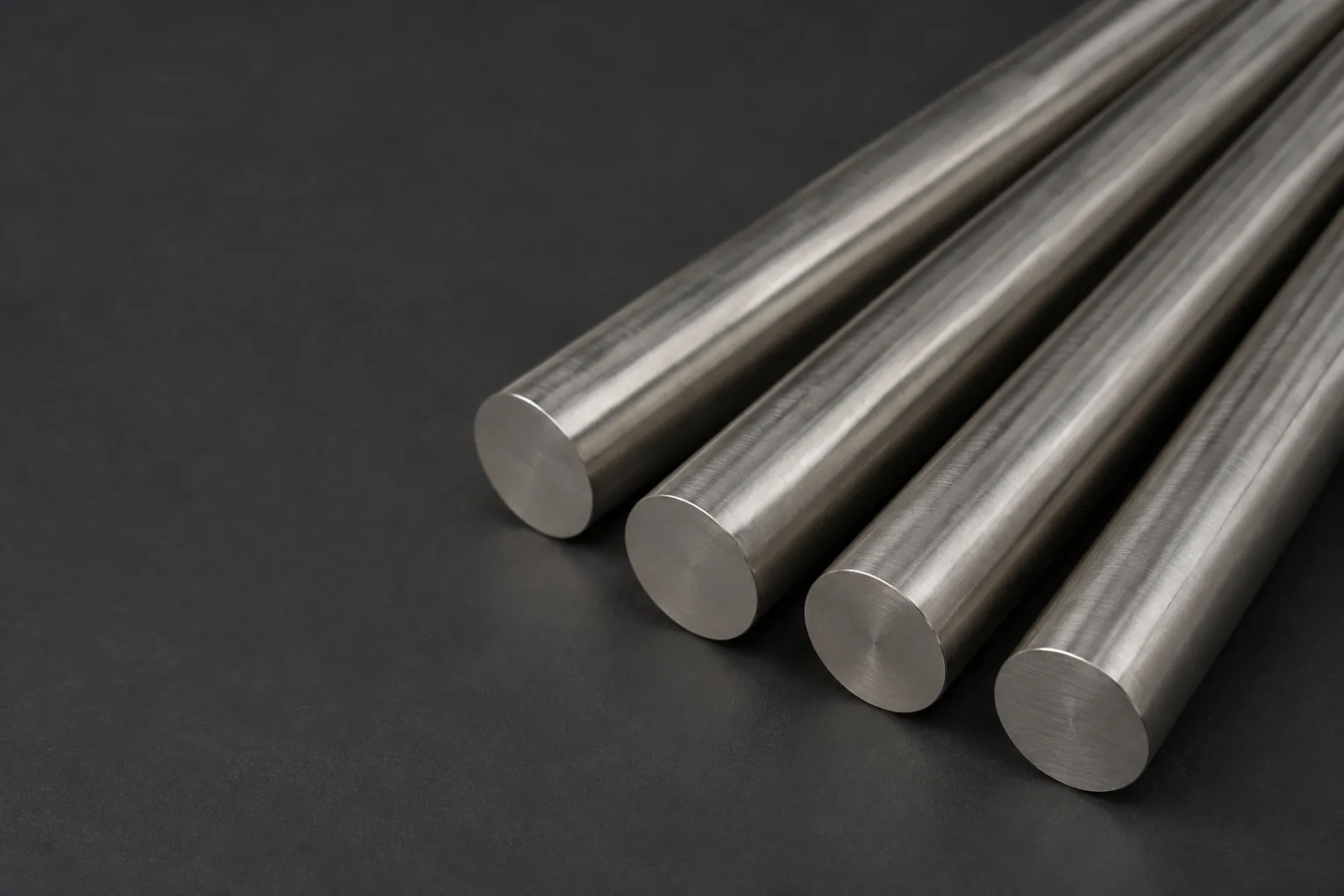
- Round Bar
- Flat Bar
- Hexagon Bar
- Plate
- Sheet
- Strip
- Wire
- Tube
- Pipe
- Forging Stock
- Extruded Section
- Cut-to-Size Material
Material overview
Inconel 600 Nickel Alloy
A non-precipitation-hardenable nickel-chromium-iron alloy combining corrosion resistance, oxidation resistance and good fabrication characteristics for chemical-processing and thermal equipment.
- UNS N06600 and W.Nr. 2.4816 are the producer-listed alloy identifiers; product specifications are separate ordering requirements.
- Annealed material offers ductility for fabrication; cold working raises strength and hardness.
- Typical uses include furnace internals, heat-treatment fixtures and chemical-process equipment. Select condition, inspection and certification for the actual service.
Material designations and product specifications
| Designation / specification | Product form / scope | Notes |
|---|---|---|
| UNS N06600 | Alloy identifier | Not a product specification. |
| W.Nr. 2.4816 | European material number | Producer-listed identifier; not automatic EN certification. |
| EN 10095 | Heat-resisting steels and nickel alloys | Listed by the bulletin under plate, sheet and strip; current full scope and requirements not accessed. |
| ASTM B166 | Rod, bar and wire | Specify form and ordered condition. Producer-listed; current full standard not accessed. |
| ASTM B564 | Nickel-alloy forgings | Not a general bar specification; confirm forging requirements. Producer-listed; current full standard not accessed. |
| ASTM B168 | Plate, sheet and strip | Confirm ordered condition and dimensional limits. Producer-listed; current full standard not accessed. |
| ASTM B906 | General requirements for flat-rolled nickel-alloy products | Supplementary general requirements, not a stand-alone grade specification. Producer-listed; current full standard not accessed. |
| ASTM B167 | Seamless pipe and tube | Not welded tube. Producer-listed; current full standard not accessed. |
| ASTM B163 | Seamless condenser and heat-exchanger tubes | Specialised tube scope, not all pipe. Producer-listed; current full standard not accessed. |
| ASTM B516 | Welded tube | Do not substitute seamless requirements. Producer-listed; current full standard not accessed. |
| ASTM B517 | Welded pipe | Do not substitute tube requirements. Producer-listed; current full standard not accessed. |
| ASTM B751 | General requirements for welded tube | Use with the applicable product standard. Producer-listed; current full standard not accessed. |
| ASTM B775 | General requirements for welded pipe | Use with the applicable product standard. Producer-listed; current full standard not accessed. |
| ASTM B829 | General requirements for seamless pipe and tube | Use with the applicable product standard. Producer-listed; current full standard not accessed. |
| ASTM B366 | Factory-made wrought nickel-alloy fittings | Fittings scope, not straight pipe or tube. Producer-listed; current full standard not accessed. |
| AMS 5665 | Bars, forgings and rings; annealed | Producer-listed parent-metal specification; confirm revision, dimensions and condition before ordering. Full current standard not accessed. |
| AMS 5687 | Wire; annealed | Producer-listed parent-metal specification; confirm revision, dimensions and condition before ordering. Full current standard not accessed. |
| AMS 5540 | Sheet, strip and plate; annealed | Producer-listed parent-metal specification; confirm revision, dimensions and condition before ordering. Full current standard not accessed. |
| AMS 5580 | Seamless tubing; annealed | Producer-listed parent-metal specification; confirm revision, dimensions and condition before ordering. Full current standard not accessed. |
References are not interchangeable or evidence of certification. Product-form scopes distinguish principal specifications from general requirements. Only the AMS 5665 public SAE title was independently retrieved; other scopes are indicative and require confirmation against the ordered edition. Full current ASTM, AMS and EN standards were not accessible; no full verification is claimed. Reference associations only: no equivalence, stock availability, aerospace approval or certified conformity is established by this page. Specify the ordered revision, product form, dimensions, manufacture/melt route, delivery condition and acceptance tests; obtain matching supplier confirmation and inspection documents.
Specification review
Technical verification requirements
Designations / ordered product condition
Table 9 plate examples are explicitly typical and tied to 22 mm plate; confirm current AMS 5665/5687/5540/5580 and ASTM form-specific requirements, not universal acceptance minima. Existing cautions do not prove conformity; no allegation that every listed scope is wrong. Obtain the ordered revision and map each cited specification to form, dimensions, manufacture, delivery condition and acceptance tests.
Obtain licensed ordered editions and issue a material-specific form/condition/size compliance matrix; retain existing caveats pending approval.
Engineering reference
Technical data
| Element | Mass % |
|---|---|
| Nickel + cobalt | 72.0 min. |
| Chromium | 14.0–17.0 |
| Iron | 6.00–10.00 |
| Carbon | 0.15 max. |
| Manganese | 1.00 max. |
| Sulfur | 0.015 max. |
| Silicon | 0.50 max. |
| Copper | 0.50 max. |
Single source: Special Metals SMC-027, September 2008, Table 1 limiting chemical composition. Nickel includes cobalt. No separate limits are supplied here for unlisted elements. The ordered specification governs acceptance.
| Property | Value | Temperature / basis |
|---|---|---|
| Density | 8470 kg/m³ | Table 2; temperature not stated |
| Melting range | 1354–1413°C | Table 2 |
| Specific heat | 444 J/(kg·K) | 20°C |
| Electrical resistivity | 1.03 μΩ·m | 20°C |
| Thermal conductivity | 14.9 W/(m·K) | 20°C |
| Young’s modulus | 214 GPa | 22°C |
| Shear modulus | 80.8 GPa | 22°C |
| Specific heat | 465 J/(kg·K) | 100°C |
| Thermal conductivity | 15.9 W/(m·K) | 100°C |
| Mean linear thermal expansion | 13.3 μm/(m·K) | 21–100°C |
| Specific heat | 502 J/(kg·K) | 300°C |
| Thermal conductivity | 19.0 W/(m·K) | 300°C |
| Mean linear thermal expansion | 14.2 μm/(m·K) | 21–300°C |
| Specific heat | 536 J/(kg·K) | 500°C |
| Thermal conductivity | 22.1 W/(m·K) | 500°C |
| Mean linear thermal expansion | 14.9 μm/(m·K) | 21–500°C |
| Specific heat | 595 J/(kg·K) | 700°C |
| Thermal conductivity | 25.7 W/(m·K) | 700°C |
| Mean linear thermal expansion | 15.8 μm/(m·K) | 21–700°C |
| Specific heat | 611 J/(kg·K) | 800°C |
| Thermal conductivity | 27.5 W/(m·K) | 800°C |
| Mean linear thermal expansion | 16.1 μm/(m·K) | 21–800°C |
| Young’s modulus | 180 GPa | 600°C |
| Young’s modulus | 143 GPa | 1000°C |
Special Metals Tables 2–4; typical, not specification limits. SI values copied from the bulletin; density converted from 8.47 Mg/m³. CTE values are mean coefficients from 21°C to the stated temperature, not instantaneous values.
Hot-rolled plate — as-rolled
| Property | Value | Basis |
|---|---|---|
| Ultimate tensile strength | 682.6 MPa | Typical producer test value |
| 0.2% yield strength | 346.1 MPa | Typical producer test value |
| Elongation | 42.0% | Typical producer test value |
| Hardness | 87 HRB | Typical producer test value |
| Reduction of area | 55.5% | Typical producer test value |
Special Metals Table 9, 22 mm (0.875 in.) thick hot-rolled plate. Typical values, not specification minima; annealed specimens air cooled. Specimen orientation and elongation gauge length are not stated. Do not transfer to other sections or product forms.
Hot-rolled plate — annealed 980°C / 1 h, air cooled
| Property | Value | Basis |
|---|---|---|
| Ultimate tensile strength | 639.2 MPa | Typical producer test value |
| 0.2% yield strength | 199.3 MPa | Typical producer test value |
| Elongation | 49.0% | Typical producer test value |
| Hardness | 75 HRB | Typical producer test value |
| Reduction of area | 63.0% | Typical producer test value |
Special Metals Table 9, 22 mm (0.875 in.) thick hot-rolled plate. Typical values, not specification minima; annealed specimens air cooled. Specimen orientation and elongation gauge length are not stated. Do not transfer to other sections or product forms.
Service suitability depends on loading, temperature, exposure duration, atmosphere and required life. No single maximum service temperature is a rating. Oxidation resistance does not establish creep or stress-rupture design strength.
Stress-rupture — hot-rolled material, annealed 899°C / 2 h
| Temperature °C | Stress MPa | Rupture life h | Condition |
|---|---|---|---|
| 732 | 137.9 | 10 | Hot rolled; annealed 899°C / 2 h |
| 732 | 93.1 | 100 | Hot rolled; annealed 899°C / 2 h |
| 732 | 63.4 | 1000 | Hot rolled; annealed 899°C / 2 h |
| 871 | 55.8 | 10 | Hot rolled; annealed 899°C / 2 h |
| 871 | 36.5 | 100 | Hot rolled; annealed 899°C / 2 h |
| 982 | 30.3 | 10 | Hot rolled; annealed 899°C / 2 h |
| 982 | 19.3 | 100 | Hot rolled; annealed 899°C / 2 h |
| 982 | 12.4 | 1000 | Hot rolled; annealed 899°C / 2 h |
Special Metals Table 21, selected non-bold (not marked extrapolated) values only. Product identified as hot rolled; exact geometry, section, specimen and cooling method are not specified for this block. Typical stress-to-rupture data, not allowable design stresses or guaranteed lives; do not extrapolate.
Oxidation performance
- The bulletin’s Figure 11 reports cyclic oxidation testing at 980°C with 15 minutes heating and 5 minutes cooling in air, on a plotted exposure axis extending to 1000 h. It illustrates protective-scale retention under that cycle; no numerical weight-change values have been digitised and no continuous-service rating is inferred.
Elevated-temperature parent-metal tensile results appear as curves in Figures 1, 4 and 5, not an exact numerical table; no graph readings or invented tensile rows are supplied. Table 22 concerns room-temperature tests after creep exposure, not elevated-temperature tensile tests. Table 21 bold extrapolations are excluded. Component assessment requires the ordered material condition and a qualified design basis.
Soft annealing
The bulletin gives approximately 1010°C for 15 minutes as a general treatment producing soft material. Actual temperature and time depend on prior cold work, grain size, composition and dimensions; qualify the cycle for the product.
Solution treatment for creep and rupture strength
Treatment for 1–2 hours at 1090–1150°C dissolves carbides and increases grain size. The bulletin identifies this as beneficial for maximum creep and rupture strength, with different corrosion and room-temperature property considerations from fine-grain material.
Cooling and sensitisation control
Cooling rate has little effect on mechanical properties, but rapid cooling through 540–760°C is advised when pickling or service requires freedom from sensitisation.
Stress relief for severe caustic service
For high-temperature, high-strength caustic alkalies, the bulletin recommends full stress relief at 900°C for 1 hour or 790°C for 4 hours and keeping operating stresses low.
Producer guidance, not an approved component heat-treatment procedure. Alloy 600 is not precipitation hardenable; no alloy 718 ageing schedule applies. Ordered specification, section and service requirements govern.
Material selection
Corrosion resistance & performance
The high nickel content supports resistance in many reducing media and alkaline solutions; chromium improves resistance relative to commercially pure nickel under oxidising conditions. Resistance is not universal.
The bulletin describes virtual immunity to chloride-ion stress-corrosion cracking; this is not a guarantee against every form of chloride corrosion or every stressed service environment.
Resistance to strongly oxidising acids is only fair. Dissolved air alone does not assure complete passivity in air-saturated mineral acids or certain concentrated organic acids.
High-temperature concentrated caustic alkalies and elevated-temperature mercury can cause stress-corrosion cracking. Stress relief and control of operating stresses are important.
Exposure at 540–760°C can sensitise the alloy to intergranular attack in some aggressive media through grain-boundary carbide precipitation.
Table 24 reports carburisation weight gains after 100 h in hydrogen / 2% methane: 2.66 mg/cm² at 925°C and 12.30 mg/cm² at 1095°C, with 5% argon also present in the higher-temperature test. These are test-specific observations, not universal corrosion rates.
Sulfur compounds can be resisted at moderate temperatures, but high-temperature sulfur-containing environments can cause sulfidation. The bulletin advises against molybdenum-disulfide lubricant if subsequent exposure exceeds 427°C.
Typical applications
Engineering applications
- Industrial furnace retorts, muffles and roller hearths
- Heat-treatment baskets, trays and high-temperature fixtures
- Nitriding containers and furnace wire belts
- Chemical-process heaters, stills, bubble towers and condensers for fatty acids
- Evaporator tubes, tube sheets and flaking trays in sodium-sulfide production
- Aeronautical exhaust liners, turbine seals and lockwire
Subsequent manufacturing
Machining & processing
Machinability
The producer rates alloy 600 slightly more machinable than Type 304 stainless steel and slightly less than Type 303 free-machining stainless steel. Select parameters for actual condition, section and operation; no universal cutting speed is specified.
Work hardening and tooling
Cold forming work hardens the alloy faster than mild steel but slower than Type 304 stainless steel. Use heavy-duty equipment and large, rigid tools that withstand load and dissipate heat; keep cutting edges sharp and use suitable geometry.
Hot and cold forming
The bulletin gives a normal hot-working range of 870–1230°C, with heavy work at 1040–1230°C. Avoid working at 650–870°C because ductility is low. Standard steel and stainless-steel cold-forming processes are applicable, allowing for work hardening.
Welding
Conventional processes are applicable. Producer-listed consumables include INCONEL Welding Electrode 182 for shielded metal-arc welding and INCONEL Filler Metal 82 for GTAW/GMAW; submerged-arc welding uses Filler Metal 82 with INCOFLUX 4. These are fillers/flux, not parent-metal specifications. Electrode 182 welds may lose ductility after extended exposure at 540–760°C; qualify consumables and procedure for service.
Distortion and dimensional control
Agree machining allowances, fixturing and dimensional checks around forming, welding and heat treatment. These are fabrication-planning considerations, not producer-guaranteed distortion limits; the bulletin provides no numerical distortion allowance.
Heating and finishing
Clean before heating and use a sulfur-free atmosphere; slightly reducing conditions limit oxidation during forging or open annealing. Bright heating requires very dry hydrogen or vacuum; otherwise pickling may be required. Account for sensitisation when selecting cooling and pickling procedures.
Inspection
Agree dimensional, surface and any weld or volumetric inspection with the customer and supplier. Verify condition and heat traceability after processing; the bulletin does not establish a universal inspection plan or acceptance criteria.
Material certification & testing
Certification and inspection options can be discussed at enquiry stage, subject to the ordered requirements and supplier confirmation.
Conformity must be demonstrated against the ordered specification, product form and material condition. Tests and documents are not included automatically; agree the inspection scope, acceptance criteria and certification before ordering.
- EN 10204 3.1 material certificates
- Certificates of Conformity
- Heat/batch traceability
- Chemical analysis
- Mechanical testing
- Heat-treatment records
- Hardness testing
- Positive Material Identification (PMI)
- Ultrasonic testing where applicable
- Additional aerospace or customer-specific inspection
Material enquiry
Request a material quotation
Inconel 600 Nickel Alloy supplied to your material form, dimensions and specification.