Materials Supply / Nickel, Cobalt & High-Temperature Alloys
Inconel 601 Nickel Alloy
Nickel-chromium-iron alloy with aluminium | UNS N06601 | W.Nr. 2.4851
Inconel 601 is a face-centred-cubic solid-solution nickel-chromium-iron alloy containing aluminium, which enhances its resistance to high-temperature oxidation. Its protective scale and resistance to scale spalling make it useful for appropriate thermally cycled industrial equipment.
Oxidation resistance is not a measure of load-bearing creep strength. Product condition, section size, atmosphere and service stresses must be assessed together; no unconditional maximum service temperature is implied.
INCONEL® is a trademark of Special Metals Corporation, as stated in the producer bulletin. It is not owned by Quest Engineering.
Raw & semi-finished materials
Available material forms
Producer-listed standard forms; availability depends on specification, dimensions, condition and supplier confirmation. No Quest Engineering stock is implied. Cut-to-size supply is subject to agreement.
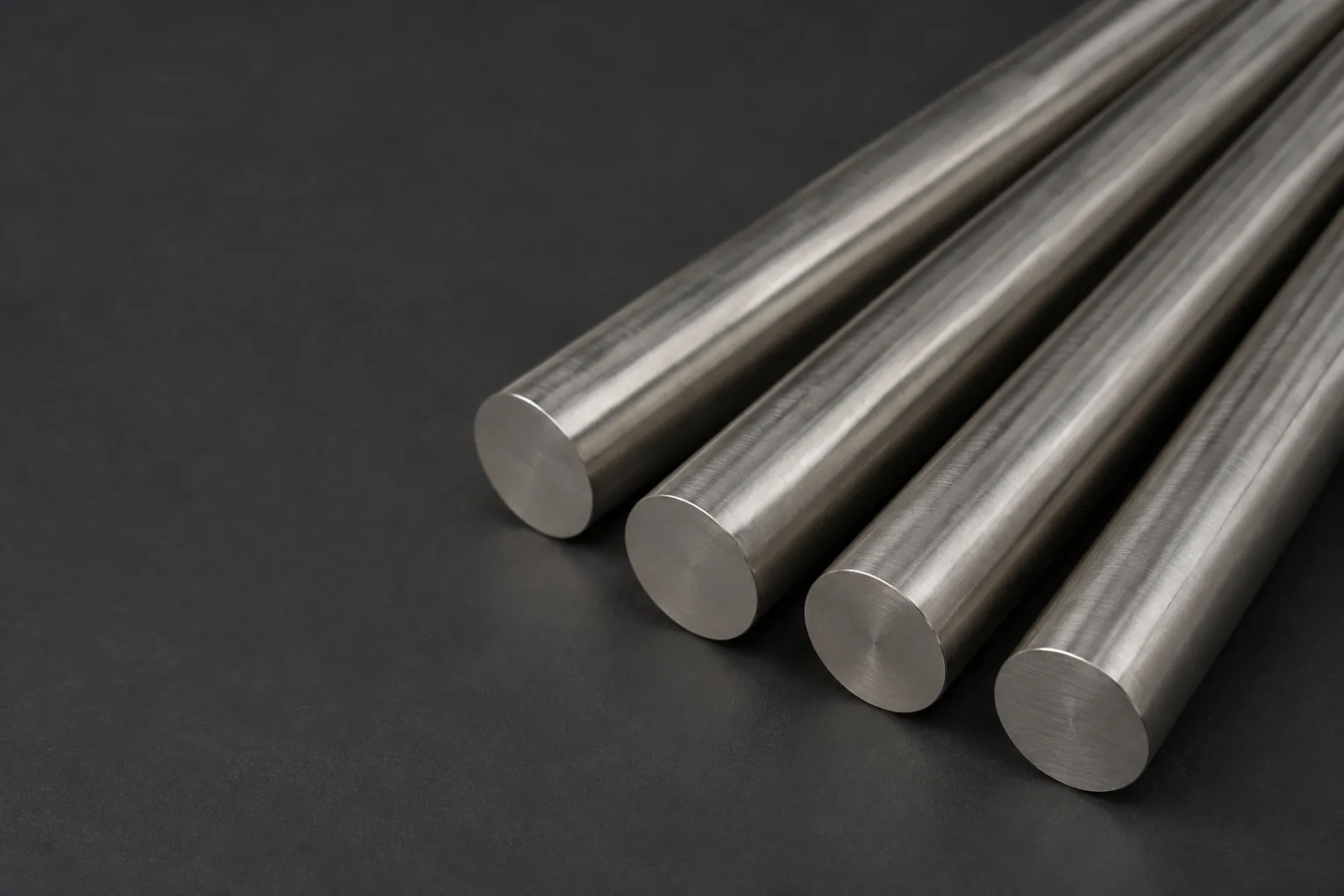
- Round Bar
- Flat Bar
- Hexagon Bar
- Plate
- Sheet
- Strip
- Wire
- Tube
- Pipe
- Forging Stock
- Cut-to-Size Material
Material overview
Inconel 601 Nickel Alloy
An aluminium-containing nickel-chromium-iron alloy for oxidation-resistant furnace, thermal-processing and combustion components.
- Solid-solution alloy; not strengthened by precipitation-ageing heat treatment.
- Aluminium and chromium promote protective oxide formation; atmosphere-specific corrosion assessment remains necessary.
- Annealed and solution-treated product have different strength/ductility and elevated-temperature performance.
- Technical data are producer reference information, not design allowables or evidence of compliance for a particular heat.
Material specifications & designations
| Designation / specification | Product form / scope | Notes |
|---|---|---|
| UNS N06601 | Alloy identification | Producer designation, not a product specification. |
| W.Nr. 2.4851 | European material number | Producer-confirmed identity; not blanket EN compliance. |
| EN 10095 | Heat-resisting plate, sheet, strip, bars, rods and sections | Producer-listed; full current EN grade and delivery requirements not independently verified. |
| ASTM B166 | Hot-finished/cold-worked rod and bar; cold-worked wire | N06601 included in public ASTM scope; not a finished-forging specification. Ordered condition/revision to be confirmed. |
| ASTM B168 | Rolled plate, sheet and strip | N06601 included in ASTM abstract; ordered condition and thickness requirements must be checked. |
| ASTM B167 | Seamless pipe and tube | Producer association supported by ASTM B829 public referenced-specification list; not welded product. |
| ASTM B751 | General requirements for nickel-alloy welded tube | Public ASTM scope corrects the bulletin’s seamless-and-welded description. Not standalone N06601 product qualification. |
| ASTM B775 | General requirements for nickel-alloy welded pipe | Public ASTM scope corrects the bulletin’s seamless-and-welded description. Requires applicable product standard; no N06601 welded-pipe compliance claimed. |
| ASTM B829 | General requirements for nickel-alloy seamless pipe and tube | Applies with relevant product specification such as B167; not independent alloy acceptance. |
| AMS 5715 | Annealed bars, forgings, flash-welded rings and stock for forging/rings | ATI grade association; distributor abstract for revision H limits finished forms to 101.6 mm diameter/least nominal cross-section, stock any size. Direct SAE abstract unavailable; full requirements unverified. |
| AMS 5870 | Solution-heat-treated sheet, strip and plate | ATI grade association and published G title support scope/condition. Direct SAE abstract unavailable; chemistry includes titanium in title and must be checked against ordered revision, not inferred from this bulletin composition. |
Each specification is separate and product-form-specific. Full current ASTM, AMS and EN standards were not accessible; public abstracts establish scope only. No blanket aerospace or pressure-code approval. Bulletin filler reference AWS A5.14/ERNiCrFe-11 concerns welding consumables only and is not a parent-metal specification. See research notes for additional scope sources. Reference associations only: no equivalence, stock availability, aerospace approval or certified conformity is established by this page. Specify the ordered revision, product form, dimensions, manufacture/melt route, delivery condition and acceptance tests; obtain matching supplier confirmation and inspection documents.
Specification review
Technical verification requirements
Designations / ordered product condition
Six condition tables distinguish annealed and solution-treated datasets; Table 8 at 1180°C must remain separate from 1150°C rupture specimens. Current form-specific standards remain unverified. Existing cautions do not prove conformity; no allegation that every listed scope is wrong. Obtain the ordered revision and map each cited specification to form, dimensions, manufacture, delivery condition and acceptance tests.
Obtain licensed ordered editions and issue a material-specific form/condition/size compliance matrix; retain existing caveats pending approval.
Engineering reference
Technical data
| Element | Mass % |
|---|---|
| Nickel (Ni) | 58.0–63.0 |
| Chromium (Cr) | 21.0–25.0 |
| Iron (Fe) | Remainder |
| Aluminium (Al) | 1.0–1.7 |
| Carbon (C) | ≤0.10 |
| Manganese (Mn) | ≤1.0 |
| Sulphur (S) | ≤0.015 |
| Silicon (Si) | ≤0.50 |
| Copper (Cu) | ≤1.0 |
Table 1 limiting composition, mass %. One producer basis only. Elements not listed by this table, including Ti, P, Mo, Co and Nb/Ta, are not assigned invented limits; verify the ordered specification separately.
| Property | Value | Temperature / basis |
|---|---|---|
| Density | 8110 kg/m³ | Table 2; temperature not stated |
| Melting range | 1360–1411 °C | Table 2 |
| Specific heat | 448 J/(kg·K) | 21 °C, Table 2; calculated from composition |
| Electrical resistivity | 1.180 μΩ·m | 20 °C |
| Electrical resistivity | 1.247 μΩ·m | 600 °C |
| Thermal conductivity | 11.2 W/(m·K) | 20 °C |
| Thermal conductivity | 21.0 W/(m·K) | 600 °C |
| Thermal conductivity | 27.8 W/(m·K) | 1000 °C |
| Mean linear CTE | 13.75 μm/(m·K) | 27–100 °C |
| Mean linear CTE | 15.62 μm/(m·K) | 27–600 °C |
| Mean linear CTE | 17.82 μm/(m·K) | 27–1000 °C |
| Tensile elastic modulus | 206.5 GPa | 20 °C |
| Tensile elastic modulus | 170.8 GPa | 600 °C |
| Tensile elastic modulus | 124.7 GPa | 1000 °C |
Tables 2–4, typical annealed-material reference data, not specification limits. Conductivity calculated from resistivity; modulus measured dynamically. Density converted from 8.11 Mg/m³. CTE values are interval means, not instantaneous coefficients.
Hot-finished rod and bar
| Property | Value | Basis |
|---|---|---|
| Ultimate tensile strength | 585–825 MPa | Rod and bar, hot-finished |
| 0.2% yield strength | 240–690 MPa | Rod and bar, hot-finished |
| Elongation | 15–60% | Rod and bar, hot-finished |
| Hardness | 65–95 HRB | Rod and bar, hot-finished |
Table 5 nominal room-temperature ranges, composites across product sizes, not specification minima or guaranteed properties. Elongation endpoints reordered ascending. Section dimensions, gauge length and orientation not stated for these composite rows. Reduction of area not reported. Do not pair independent endpoints as a single tested specimen.
Annealed rod and bar
| Property | Value | Basis |
|---|---|---|
| Ultimate tensile strength | 550–790 MPa | Rod and bar, annealed |
| 0.2% yield strength | 205–415 MPa | Rod and bar, annealed |
| Elongation | 40–70% | Rod and bar, annealed |
| Hardness | 60–80 HRB | Rod and bar, annealed |
Table 5 nominal room-temperature ranges, composites across product sizes, not specification minima or guaranteed properties. Elongation endpoints reordered ascending. Section dimensions, gauge length and orientation not stated for these composite rows. Reduction of area not reported. Do not pair independent endpoints as a single tested specimen.
Annealed plate
| Property | Value | Basis |
|---|---|---|
| Ultimate tensile strength | 550–690 MPa | Plate, annealed |
| 0.2% yield strength | 205–310 MPa | Plate, annealed |
| Elongation | 45–65% | Plate, annealed |
| Hardness | 60–75 HRB | Plate, annealed |
Table 5 nominal room-temperature ranges, composites across product sizes, not specification minima or guaranteed properties. Elongation endpoints reordered ascending. Section dimensions, gauge length and orientation not stated for these composite rows. Reduction of area not reported. Do not pair independent endpoints as a single tested specimen.
Annealed sheet and strip
| Property | Value | Basis |
|---|---|---|
| Ultimate tensile strength | 585–690 MPa | Sheet and strip, annealed |
| 0.2% yield strength | 205–345 MPa | Sheet and strip, annealed |
| Elongation | 35–55% | Sheet and strip, annealed |
| Hardness | 65–80 HRB | Sheet and strip, annealed |
Table 5 nominal room-temperature ranges, composites across product sizes, not specification minima or guaranteed properties. Elongation endpoints reordered ascending. Section dimensions, gauge length and orientation not stated for these composite rows. Reduction of area not reported. Do not pair independent endpoints as a single tested specimen.
Cold-rolled sheet and strip
| Property | Value | Basis |
|---|---|---|
| Ultimate tensile strength | 790–1310 MPa | Sheet and strip, cold-rolled |
| 0.2% yield strength | 690–1205 MPa | Sheet and strip, cold-rolled |
| Elongation | 2–20% | Sheet and strip, cold-rolled |
| Hardness | Not reported | Sheet and strip, cold-rolled |
Table 5 nominal room-temperature ranges, composites across product sizes, not specification minima or guaranteed properties. Elongation endpoints reordered ascending. Section dimensions, gauge length and orientation not stated for these composite rows. Reduction of area not reported. Do not pair independent endpoints as a single tested specimen.
Solution-treated — all forms composite
| Property | Value | Basis |
|---|---|---|
| Ultimate tensile strength | 515–760 MPa | All forms, solution-treated |
| 0.2% yield strength | 160–380 MPa | All forms, solution-treated |
| Elongation | 40–75% | All forms, solution-treated |
| Hardness | 55–95 HRB | All forms, solution-treated |
Table 5 nominal room-temperature ranges, composites across product sizes, not specification minima or guaranteed properties. Elongation endpoints reordered ascending. Section dimensions, gauge length and orientation not stated for these composite rows. Reduction of area not reported. Do not pair independent endpoints as a single tested specimen.
Suitability depends on loading, temperature, exposure duration, atmosphere and required service life. Oxidation resistance and load-bearing creep strength must be evaluated separately; no single maximum temperature rating applies.
Elevated-temperature tensile — annealed hot-finished rod
| Temperature °C | UTS MPa | Yield MPa | Elongation % |
|---|---|---|---|
| 20 | 741 | 290 | 47 |
| 100 | 701 | 250 | 44 |
| 200 | 687 | 236 | 43 |
| 300 | 674 | 221 | 46 |
| 400 | 654 | 219 | 45 |
| 500 | 640 | 203 | 45 |
Table 9, annealed at 1090 °C; yield at 0.2% offset. Producer reference data, not acceptance minima. Table 9 does not state section size, hold time, specimen orientation or gauge length; do not assume unrestricted section applicability. SI rows transcribed as published.
Source: Special Metals SMC-028, February 2005. Creep/rupture results are graphical (Figures 5–7), for material treated at 1150 °C/1 h/air cooled. No numerical stress–rupture table is reproduced because exact tabulated temperature/stress/life values with product-form basis were not available; curves have not been digitised or extrapolated. Oxidation plots are not converted into a service rating.
Annealing
The bulletin reports annealed hot-finished rod examples at 980 °C and 1090 °C, with annealing time dependent on section size (Table 6). Table 11 uses 980 °C for 1 h followed by air cooling; these are test conditions, not universal shop instructions.
Solution treatment
For creep/rupture tests the producer used 1150 °C for 1 h followed by air cooling. Table 8 separately reports solution-treated tensile specimens treated at 1180 °C. These datasets must not be treated as the same heat-treatment condition.
Condition selection
The producer generally associates annealed material with tensile-limited duties below about 540 °C and solution-treated material with rupture-limited duties at about 540 °C and above. This is condition-selection guidance, not a service rating or design allowable.
601 is not strengthened by heat treatment; strength and hardness can be varied by cold work and annealing. No 718 precipitation-ageing schedule applies. Establish the production cycle, cooling and distortion allowances for the ordered form, section and specification.
Material selection
Corrosion resistance & performance
The producer reports resistance to many aqueous corrosive media from the nickel/chromium base; this is not universal resistance to acids, chlorides, pitting, crevices or stress-corrosion cracking. Qualify actual chemistry, temperature, stress and surface condition.
Protective oxide formation and resistance to spalling are important in thermal cycling, but oxidising-test performance does not establish suitability in reducing, carburising or sulphur-bearing atmospheres.
The bulletin includes carburisation, carbonitriding and sulfidation comparisons. Sulphur-bearing service needs particular review; the producer requires low-sulphur heating atmospheres during fabrication. Do not infer general sulphidation immunity.
Typical applications
Engineering applications
- Furnace baskets, trays and heat-treatment fixtures
- Radiant tubes, muffles and retorts
- Furnace flame shields, burner nozzles and thermal-processing equipment
- Combustor components and combustion-can liners
- Thermocouple protection tubes and furnace-atmosphere generators
- High-temperature ducting proposals subject to design and supplier qualification
- Catalyst grid supports and process heaters
- Superheater tube supports and ash-handling systems
Subsequent manufacturing
Machining & processing
Machinability
The producer states that alloy 601 can be machined by standard methods used for high-nickel alloys. Establish parameters for the actual condition, section and operation; no universal cutting speeds are specified.
Work hardening and tooling
Allow for work hardening during cutting and forming. Use rigid setups, sharp suitable tooling and controlled engagement; avoid rubbing and validate tool life and coolant practice on the actual material.
Welding
The bulletin reports good weldability by conventional processes. Select filler for the service atmosphere and temperature, not merely nominal alloy identity; qualify procedure, heat input and weld inspection. Welding-consumable properties are not parent-metal properties.
Forming
Hot and cold forming are possible. Forming history and section size influence annealing requirements and final strength; agree intermediate annealing and final condition with the processor.
Distortion
Plan fixtures, balanced machining allowances and final dimensional checks around forming, welding and heat treatment. Cooling and residual-stress relaxation can change dimensions; do not assume a distortion-free cycle.
Finishing and cleanliness
Remove oil, grease, paint and shop soil before heating. The bulletin requires low-sulphur heating and describes oxide removal by pickling; use qualified surface-treatment procedures with appropriate safety controls.
Inspection
Agree dimensional, surface and weld examination, hardness and any volumetric inspection before ordering. Preserve heat traceability through cutting and finishing; PMI alone does not establish heat treatment or full specification conformity.
Material certification & testing
Certification and inspection options are subject to customer requirements and supplier confirmation.
Conformity must be demonstrated against the ordered specification, product form and material condition. Tests and documents are not included automatically; agree scope and acceptance criteria at quotation.
- EN 10204 3.1 material certificates
- Certificates of Conformity
- Heat/batch traceability
- Chemical analysis
- Mechanical testing
- Heat-treatment records
- Hardness testing
- Positive Material Identification (PMI)
- Ultrasonic testing where applicable
- Additional aerospace or customer-specific inspection requirements
Material enquiry
Request a material quotation
Inconel 601 Nickel Alloy supplied to your material form, dimensions and specification.