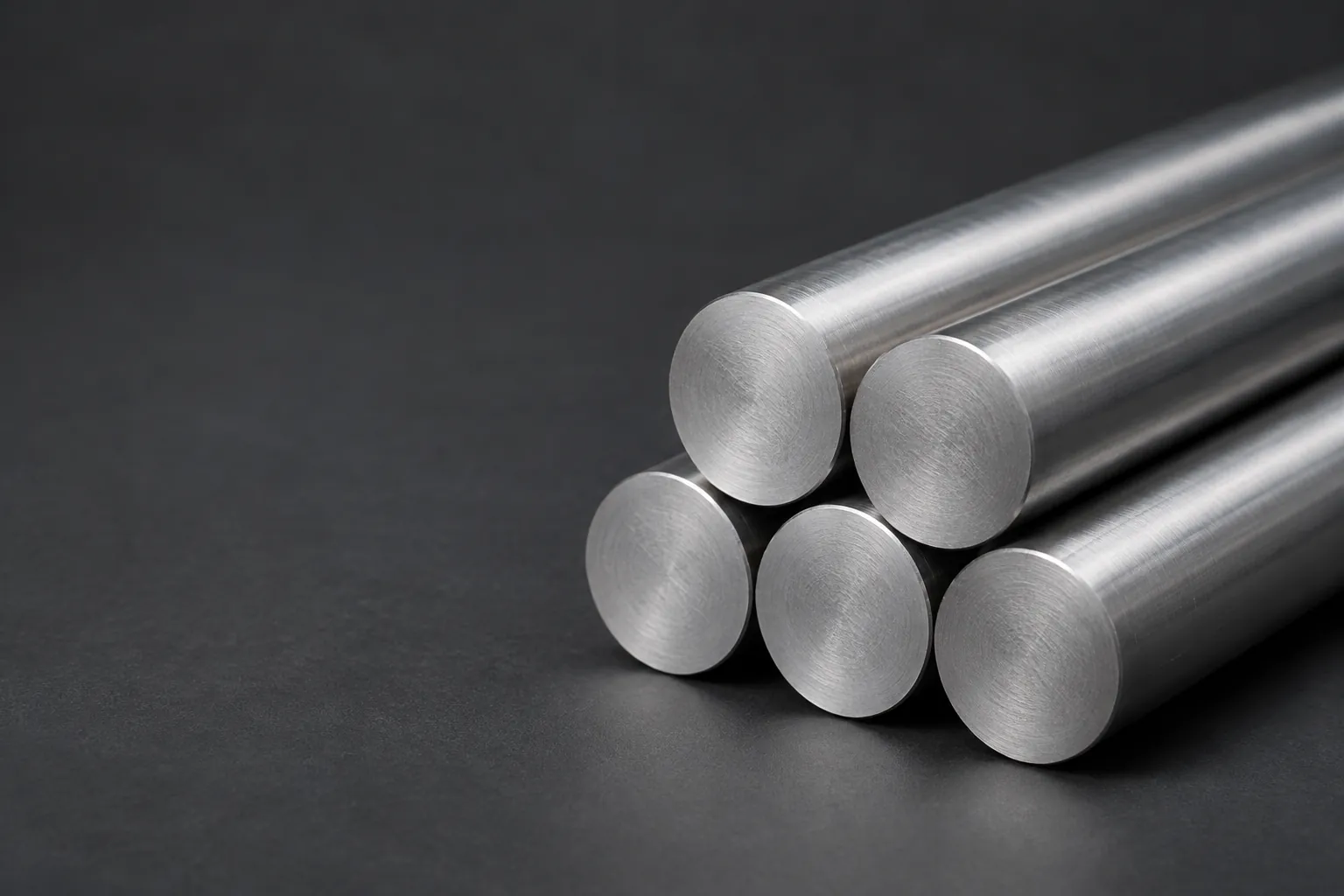
Materials Supply / Stainless Steels
310 Stainless Steel
Austenitic Stainless Steel | AISI 310 | UNS S31000
310 (UNS S31000) is a chromium-nickel austenitic stainless steel with approximately 25% chromium and 20% nickel. Its alloy content provides strong oxidation resistance for furnace and heat-treatment equipment.
Type 310 is distinct from the related low-carbon grade 310S (UNS S31008), normally associated with EN 1.4845. Neither 310S nor EN 1.4841 is presented as an exact equivalent of S31000. Confirm the required grade and product specification before ordering.
Elevated-temperature suitability depends on atmosphere, thermal cycling, creep and mechanical load. Oxidation resistance alone is not a safe design-temperature limit, and severe carburising atmospheres or repeated liquid-quench thermal shock can require another alloy.
Raw & semi-finished materials
Available material forms
Potential supply forms are subject to supplier availability, size, product specification and quotation confirmation; this is not a statement of held stock.
- Round Bar
- Flat Bar
- Plate
- Sheet
- Seamless Tube
- Hollow Bar
- Forgings
- Cut-to-Size Material
Material overview
310 Stainless Steel
High-chromium, high-nickel austenitic stainless steel for oxidation-resistant furnace and heat-treatment applications; grade variant must be specified.
- High chromium and nickel content supports elevated-temperature oxidation resistance.
- Type 310 carbon limit differs from low-carbon 310S; dual certification must be evidenced.
- Good austenitic ductility and weldability; cold work increases hardness.
- Service assessment must include sensitisation, embrittlement and atmosphere, not just scaling resistance.
Material specifications & designations
| Designation | Reference |
|---|---|
| AISI | 310 |
| UNS | S31000 |
| EN comparison — not an exact equivalent | EN 1.4845 / X8CrNi25-21 normally denotes 310S (UNS S31008), not Type 310 (S31000). EN 1.4841 is also a distinct chemistry; confirm the required grade. |
| ASTM A276 | Type 310 bars and shapes; confirm the Type 310 chemistry, not 310S |
| ASTM A240/A240M — variant distinction | The reviewed A240/A240M-23a Table 1 lists 310S / S31008, not Type 310 / S31000. Its flat-product requirements are not the basis of this page’s Type 310 tables. |
| Other product-form standards | Pressure bar, pipe, tubing and forgings require separate verification of grade, product scope and revision. |
| EN heat-resistant grades | EN 10095 is a relevant heat-resistant steel reference for EN grades; do not assume an EN 10088 equivalent for S31000. |
| AMS references — variant check required | AMS 5521 and AMS 5651 commonly reference low-carbon 310-family supply. Not presented here as verified S31000 supply specifications. |
Confirm the purchased standard revision, product form, dimensions and supply condition at quotation stage. EN and UNS comparisons are not contractual equivalence; specifications are not interchangeable. Reference associations only: no equivalence, stock availability, aerospace approval or certified conformity is established by this page. Specify the ordered revision, product form, dimensions, manufacture/melt route, delivery condition and acceptance tests; obtain matching supplier confirmation and inspection documents.
Specification review
Technical verification requirements
designations / product forms
Public grade associations do not establish revision-specific acceptance for every listed standard and offered form. Each row remains subject to contractual form, grade, process and delivery-condition checking; pipe is not generic tube, forging stock is not a finished forging, and long-product AMS is not flat product approval. This is an evidence gap, not a finding that all listed mappings are wrong.
Obtain ordered revisions; sign off each listed row against grade, form, size, melt route, condition and any slash designation; document offered tube specification separately where relevant.
mechanical / physical / certification
Published reference data are not a Quest certified delivery envelope. Some tables explicitly lack orientation, specimen size or test temperature; preserve those caveats. Conditional certificate/PMI/UT availability is not evidence of actual supplier capability or aerospace approval.
Retain typical-versus-minimum distinctions; confirm actual purchase-order test orientation, dimensions, temperature and certificate/test acceptance requirements before publication or supply.
composition / mechanical
Underlying edition unstated and actual Ferrobend source blocked (406). Accessible Austral Wright/AZoM 310/310S article is a distinct secondary reference and not proof of those A276 acceptance limits.
Obtain controlled A276 table and retain distinction between 310 C≤0.25 and 310S C≤0.08; check residual nitrogen treatment.
Engineering reference
Technical data
| Element | Minimum % | Maximum % |
|---|---|---|
| Carbon | — | 0.25 |
| Chromium | 24.0 | 26.0 |
| Nickel | 19.0 | 22.0 |
| Manganese | — | 2.0 |
| Silicon | — | 1.50 |
| Phosphorus | — | 0.045 |
| Sulphur | — | 0.030 |
| Iron | Balance | Balance |
Main composition basis: ASTM A276/A276M Type 310 / UNS S31000 bar and shape requirements as transcribed by Ferrobend; underlying standard edition is not stated. Values are mass percentages (wt. %); a dash means no minimum specified, iron is the balance, and this reference gives no nitrogen limit. Carbon maximum 0.25% belongs to Type 310, not the related low-carbon 310S grade (0.08%). Confirm the purchased ASTM edition before technical publication or supply; this is not an A240/A240M-23a flat-product table.
| Property | Reference value | Basis |
|---|---|---|
| Ultimate tensile strength | 515 MPa min. | Reference specification minimum; hot-finished bar |
| 0.2% proof strength | 205 MPa min. | Reference specification minimum; hot-finished bar |
| Elongation (50 mm or 4D) | 40% min. | Reference specification minimum; hot-finished bar |
| Hardness | Not specified in cited bar table | No numerical acceptance limit asserted |
Single basis: ASTM A276/A276M Type 310 / S31000, annealed (Condition A), hot-finished bar, all sizes in the cited supplier transcription. Underlying edition and exact test conditions require confirmation against the purchased standard. These are reference specification minimums, not typical values or creep design data. Cold-finished and small-diameter bar can have different requirements and are not included. The former historic plate hardness of 95 HRB is removed: the selected bar table specifies no numerical hardness limit. Do not apply 310S plate or mixed product-form limits.
| Property | Indicative value | Condition |
|---|---|---|
| Density | ≈ 8,000 kg/m³ | Nominal ambient reference; exact test temperature not stated |
| Elastic modulus | ≈ 200 GPa | At 20°C |
| Thermal conductivity | ≈ 14.2 W/(m·K) | At 100°C |
| Mean thermal expansion coefficient | ≈ 15.9 × 10⁻⁶/K | Mean over 0–100°C |
| Electrical resistivity | ≈ 780 nΩ·m | At 25°C |
Typical 310/310S reference values from Austral Wright Metals, not acceptance limits. Resistivity converted from 0.78 μΩ·m to 780 nΩ·m. Confirm the supply condition and temperature-dependent data before engineering design; no 310S specification limits are used as S31000 chemistry.
Material selection
Corrosion resistance & performance
High chromium and nickel support resistance to oxidation and scaling in suitable high-temperature atmospheres. Published oxidation-temperature guidance is not a permissible design limit.
Severe carburisation, reducing or sulphur-bearing atmospheres, and repeated liquid quenching require specialist assessment. Supplier references differ in atmosphere guidance; no universal suitability is claimed.
310 remains susceptible to chloride pitting, crevice corrosion and stress-corrosion cracking. It is not a universal marine alloy.
Higher carbon than 310S increases the potential for sensitisation and intergranular corrosion after thermal exposure. Prolonged elevated-temperature exposure may also cause embrittlement; consider subsequent aqueous exposure.
Verify creep strength, phase stability, thermal cycling and weld condition for the actual service duty. 310, 310S and 310H are not automatically interchangeable.
Typical applications
Engineering applications
- Furnace components
- Heat-treatment baskets and fixtures
- Burners and combustion chambers
- Retorts and annealing covers
- Thermowells
- Refractory anchors
- Radiant tubes subject to duty assessment
- Petrochemical furnace supports
Subsequent manufacturing
Machining & processing
Machinability
Machine with sharp tooling, suitable feeds and coolant. The austenitic structure requires care with heat generation and tool wear.
Work hardening
Cold work increases hardness. Avoid dwelling cuts and accommodate stock condition when setting machining allowances.
Formability
Bending, drawing and forming are possible; room-temperature forming is generally preferred, with annealing where deformation requires it.
Welding
Fusion welding is feasible with a qualified procedure and suitable high-alloy filler. Verify hot-cracking risk, service atmosphere and the exact 310-family variant.
Heat treatment
Conventional heat treatment does not harden this austenitic grade. Agree solution-annealing and cooling requirements for the product specification and service duty.
Surface finishing
Specify scale removal, pickling or other cleaning appropriate to furnace stock and welds. Prevent iron contamination and avoid assuming a polished finish establishes high-temperature suitability.
Material certification & testing
Material may be supplied with documentation and testing according to customer requirements, including:
All documentation and additional testing are subject to quotation and confirmation. Specify the required certificates, tests and acceptance criteria; no approval or testing capability is implied.
- EN 10204 3.1 material test certificates
- Manufacturer certificates of conformity
- Heat/batch traceability
- Chemical analysis
- Mechanical test reports
- Positive Material Identification (PMI)
- Ultrasonic testing where applicable
Material enquiry
Request a material quotation
310 Stainless Steel supplied to your material form, dimensions and specification.