Materials Supply / Alloy & High-Strength Steels
4140 Chromium-Molybdenum Steel
SAE / AISI 4140 | UNS G41400 | Quenched-and-tempered Cr–Mo steel
4140 is a medium-carbon chromium–molybdenum low-alloy steel used for quenched-and-tempered shafts, gears and other engineering components. Strength and machinability depend on the supplied hardness and subsequent treatment.
Ovako physical and processing data are identified as 42CrMo4-family values, including particular variants stated to meet SAE 4140; they are not universal requirements for every 4140 product. NASA mechanical results are separate measured bar data.
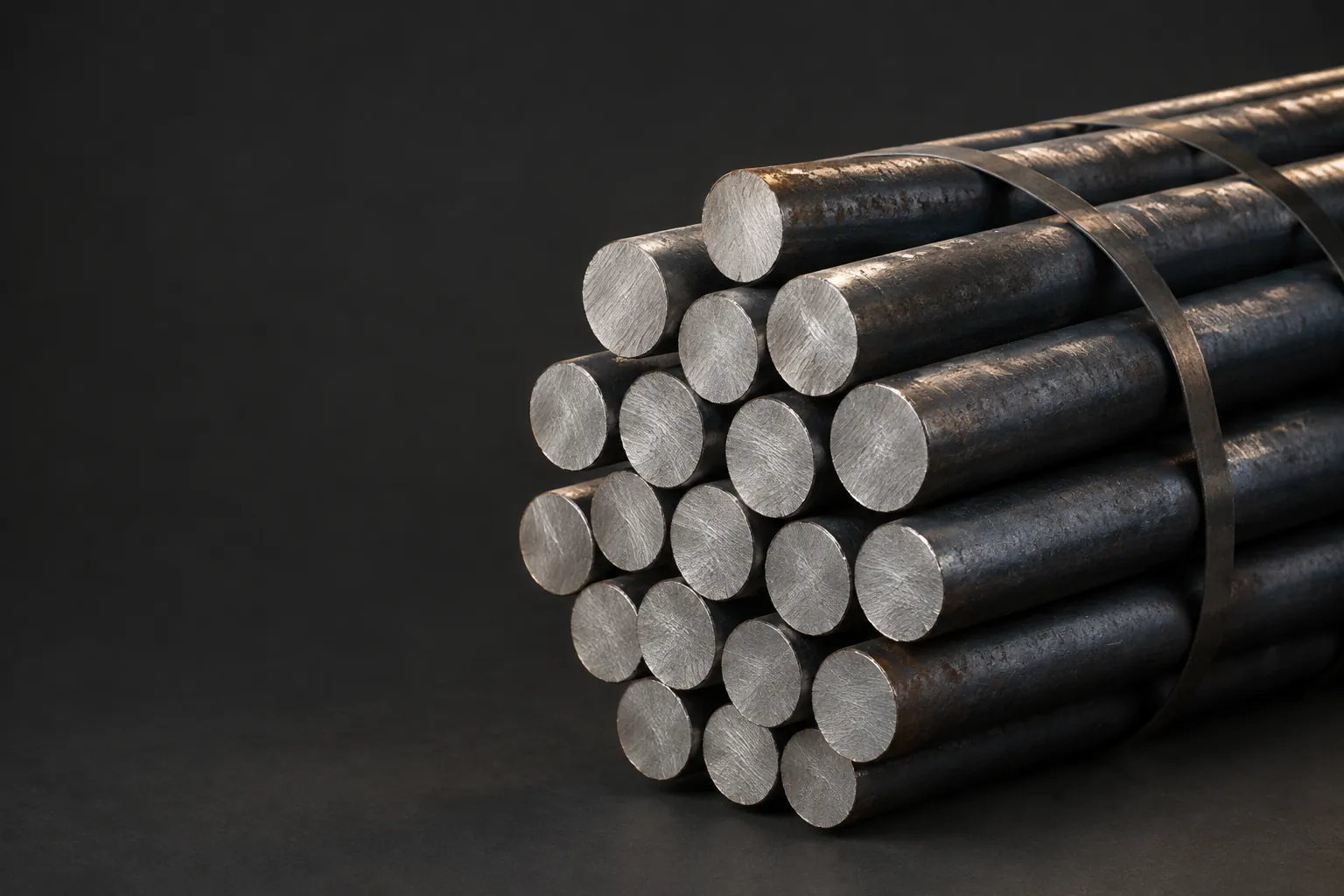
Imagery is illustrative steel product forms, not certified 4140 stock or evidence of Quest stockholding.
Raw & semi-finished materials
Available material forms
AMS6382 verifies annealed bars, forgings, rings and stock; AMS6381 covers mechanical tubing. Flat-product supply and current AMS6395 requirements need confirmation. Metallus lists 4140 in its grade portfolio; dimensions, hardness and stock remain subject to enquiry.
- Bar and forging stock
- Forgings and flash-welded rings
- Mechanical tubing
- Sheet, strip and plate — specification enquiry
Material overview
4140 Chromium-Molybdenum Steel
A nominally 0.40% carbon chromium–molybdenum steel for heat-treated engineering components; prehard is a supply condition, not a separate grade or universal hardness.
- Relative to 4130, 4140 has higher carbon and manganese reference ranges. It can develop higher hardness and strength, but welding and heat-affected-zone control become more demanding.
- Ovako identifies variants 6115 and 326C as meeting SAE 4140 within its 42CrMo4 family. Generic 42CrMo4 or EN 1.7225 equivalence is not assumed for every supplier.
- “4140 prehard” describes supplied condition, not a separate chemistry or one guaranteed hardness. Machine to the actual stock hardness and final heat-treatment plan.
- ASTM A193 B7 and ASTM A320 L7 are bolting material requirements, not aliases that automatically apply to any 4140 bar.
Designations and product specifications
| Designation / standard | Scope and qualification |
|---|---|
| SAE / AISI | 4140 |
| UNS | G41400 — official registry entry not directly inspected |
| 42CrMo4 / EN 1.7225 | Near-equivalent family, not a blanket alias; only identified Ovako variants are stated to meet SAE 4140 |
| AMS6382S (2023) | Aircraft-quality annealed bars, forgings, flash-welded rings and associated stock |
| AMS6381 | Aircraft-quality mechanical tubing; SAE history lists 6381K (2022). Not a general bar-and-forging specification |
| AMS6395 | Sheet, strip and plate reference; official current revision and condition requirements require confirmation |
| ASTM A322-24 | Hot-wrought standard-grade alloy bars; verify grade-table and purchase requirements |
| ASTM A519/A519M-24a | Hot- or cold-finished seamless carbon and alloy mechanical tubing; confirm grade and dimensions |
| SAE J404 | Chemical-composition reference only; not a complete product or mechanical acceptance specification |
Specifications are not interchangeable across product form and condition. Public abstracts and reseller listings do not establish every current clause. Confirm full revision, hardness, section and testing before certification or bolting-material claims.
ANSI / SAE — AMS6382S (2023), annealed 4140 bars, forgings, rings and stock
Specification review
Technical verification requirements
Producer-family data
Physical and processing values are Ovako 42CrMo4-family typical/guidance data, not universal SAE 4140 requirements.
Confirm the actual producer variant and obtain exact-grade, condition-specific supply data before design use.
Specifications and mechanics
Current full flat-product and tubing clauses remain unverified; numerical mechanics are historical NASA averages.
Obtain controlled standards and supplier acceptance data for the ordered form, section and condition.
Grade selection
4130, 4140 and 8740 — selection distinctions
| Aspect | 4130 | 4140 | 8740 |
|---|---|---|---|
| Alloy system | Chromium–molybdenum | Chromium–molybdenum | Nickel–chromium–molybdenum |
| Carbon reference range | 0.28–0.33% | 0.38–0.43% | 0.38–0.43% |
| Manganese reference range | 0.40–0.60% | 0.75–1.00% | 0.75–1.00% |
| Nickel reference range | 0.25% maximum residual note | 0.25% maximum residual note | 0.40–0.70% deliberate addition |
| Chromium / molybdenum | 0.80–1.10% / 0.15–0.25% | 0.80–1.10% / 0.15–0.25% | 0.40–0.60% / 0.20–0.30% |
| Fabrication starting point | Lower-carbon Cr–Mo grade; welding still requires qualification | Higher-carbon Cr–Mo grade; preheat and post-weld assessment are more demanding | Not a routine welded-fabrication substitute for 4130 |
Reference chemistry from the TimkenSteel handbook, not a merged acceptance specification. The NASA results on each page are measured at different tempers and do not establish a universal strength or toughness ranking. Compare actual section, condition, orientation and ordered tests. 8740 is not 4340: its nickel range is much lower.
Engineering reference
Technical data
| Element | Minimum mass % | Maximum mass % |
|---|---|---|
| Carbon | 0.38 | 0.43 |
| Manganese | 0.75 | 1.00 |
| Silicon | 0.15 | 0.35 |
| Chromium | 0.80 | 1.10 |
| Nickel — residual note | — | 0.25 |
| Molybdenum | 0.15 | 0.25 |
| Phosphorus — general note | — | 0.035 |
| Sulphur — general note | — | 0.040 |
| Iron | Balance | Balance |
TimkenSteel Practical Data for Metallurgists, 18th edition, printed pages 6–7 and table general notes. Reference limits, not a typical heat analysis or universal AMS/ASTM acceptance table. Ovako 42CrMo4 and modified variants may use different chemistry and cleanliness controls; confirm the exact producer and ordered specification.
| Property | Typical value | Temperature / basis |
|---|---|---|
| Density | 7,800 kg/m³ | Temperature not expressly stated |
| Young’s modulus | 210 GPa | Condition not specified |
| Shear modulus | 80 GPa | Condition not specified |
| Poisson’s ratio | 0.30 | Condition not specified |
| Mean thermal expansion | 12 × 10⁻⁶/K | 20–300°C |
| Specific heat | 460–480 J/(kg·K) | 50/100°C |
| Thermal conductivity | 40–45 W/(m·K) | Ambient |
| Electrical resistivity | 0.20–0.25 µΩ·m | Ambient |
Ovako 42CrMo4, All, PDF revision 3 February 2026, Other properties. Typical producer-family values, not universal SAE 4140 acceptance requirements. The block does not identify specimen dimensions, orientation or heat-treatment condition; Ovako states the data are general recommendations and valid only for its material.
NASA 25.4 mm bar — 33 HRC — 566°C temper
| Property | Measured average | Test / condition basis |
|---|---|---|
| Hardness | 33 HRC | Measured after the stated treatment |
| Ultimate tensile strength | 1,074 MPa | Average of five smooth longitudinal specimens |
| 0.2% offset yield strength | 985 MPa | Average of five smooth longitudinal specimens |
| Elongation | 19.4% | 50.8 mm (2.0 in) gauge length |
| Reduction of area | 62.5% | Longitudinal round tensile specimen |
| Charpy V impact energy | 95.2 J | Mean; 4 room-temperature tests; MIL-STD-151 specimen |
NASA TM X-64791 (1973), Tables II–VII. Approximately 25.4 mm (1.0 in) diameter bar; longitudinal specimens tested at 26.7°C (80°F). Treatment: normalized 899°C, austenitized 851°C, tempered 566°C; oil quenched before tempering. Soak times and Charpy notch orientation were not resolved. Historical measured averages, not producer guarantees, specification minima or design allowables.
NASA TM X-64791 — Low Temperature Mechanical Properties of Several Alloy Steels (November 1973), Tables II–VII
NASA 25.4 mm bar — 44 HRC — 385°C temper
| Property | Measured average | Test / condition basis |
|---|---|---|
| Hardness | 44 HRC | Measured after the stated treatment |
| Ultimate tensile strength | 1,509 MPa | Average of five smooth longitudinal specimens |
| 0.2% offset yield strength | 1,372 MPa | Average of five smooth longitudinal specimens |
| Elongation | 12.6% | 50.8 mm (2.0 in) gauge length |
| Reduction of area | 49.9% | Longitudinal round tensile specimen |
| Charpy V impact energy | 17.9 J | Mean; 4 room-temperature tests; MIL-STD-151 specimen |
NASA TM X-64791 (1973), Tables II–VII. Approximately 25.4 mm (1.0 in) diameter bar; longitudinal specimens tested at 26.7°C (80°F). Treatment: normalized 899°C, austenitized 851°C, tempered 385°C; oil quenched before tempering. Soak times and Charpy notch orientation were not resolved. Historical measured averages, not producer guarantees, specification minima or design allowables.
NASA TM X-64791 — Low Temperature Mechanical Properties of Several Alloy Steels (November 1973), Tables II–VII
Ovako soft annealing — family guidance
680–720°C, followed by slow cooling at 15°C/h to 600°C. This is producer 42CrMo4-family guidance, not a universal SAE 4140 cycle.
Ovako quench and temper — family guidance
Austenitize at 840–880°C, quench in oil or water, then temper at 540–680°C. Water quenching requires section-specific distortion and cracking assessment.
NASA experimental conditions
For the reported 25.4 mm bar: normalize 899°C, austenitize 851°C, oil quench, then temper at 566°C or 385°C. Soak times were not supplied.
Section sensitivity
Ovako states through-hardening after oil quenching up to approximately 60 mm bar diameter for its 42CrMo4 family; larger sections may not be fully martensitic. Do not use this as a universal 4140 size guarantee.
Use a qualified procedure for the exact producer variant, ruling section and required properties. Induction hardening and stress relief require their own specified cycles. NASA and Ovako schedules are different evidence bases and are not merged.
Typical applications
Engineering applications
- Shafts, axles and spindles
- Gears and connecting components
- Tooling and high-strength engineering parts
- Appropriately specified bolting and fasteners
Subsequent manufacturing
Machining & processing
Machining
Machine in annealed or specified prehardened condition, selecting tooling and parameters for the actual hardness. Calcium-treated machinability variants are producer-specific and not assumed.
Welding
Assess preheat, interpass temperature, low-hydrogen consumables and post-weld treatment. Do not promise retention of prehard properties across a weld or unrestricted repair welding in the hardened condition.
Through hardening
Ruling section affects hardenability and final properties. Ovako’s approximate 60 mm oil-quench statement applies only to its family guidance and does not replace ordered tests.
Bolting specifications
ASTM A193 B7 and A320 L7 require their own processing, testing and certification. A raw 4140 bar is not automatically certified to either bolting requirement.
Material certification & testing
Documentation and inspection must be agreed for the actual grade name, specification revision, melting route, product form, ruling section and delivery condition.
No certificate, test, aerospace approval or grade equivalence is automatic. The short names 4330V and 4330M are not sufficient procurement specifications; quotation controls remain disabled.
- EN 10204 3.1 material certificate, where agreed with the supplier
- Certificate of Conformity
- Heat / batch traceability to the producing mill
- Chemical analysis and mechanical test reports to the ordered specification
- Heat-treatment records identifying the complete cycle and load, where required
- Melting / remelting-route evidence, ultrasonic inspection, PMI or customer-specific testing only where agreed
Material enquiry
Request a material quotation
4140 Chromium-Molybdenum Steel supplied to your material form, dimensions and specification.