Materials Supply / Alloy & High-Strength Steels
52100 High-Carbon Chromium Bearing Steel
SAE / AISI 52100 | UNS G52986 | Through-hardening bearing steel
52100 is a high-carbon chromium bearing steel hardened throughout its section, not by carburising. It is supplied spheroidise annealed for machining and hardened and low-temperature tempered for service.
Similar European grade 100Cr6 (1.3505) is listed by producers as similar, not unconditionally equivalent. Clean-steel and remelted qualities are specified separately.
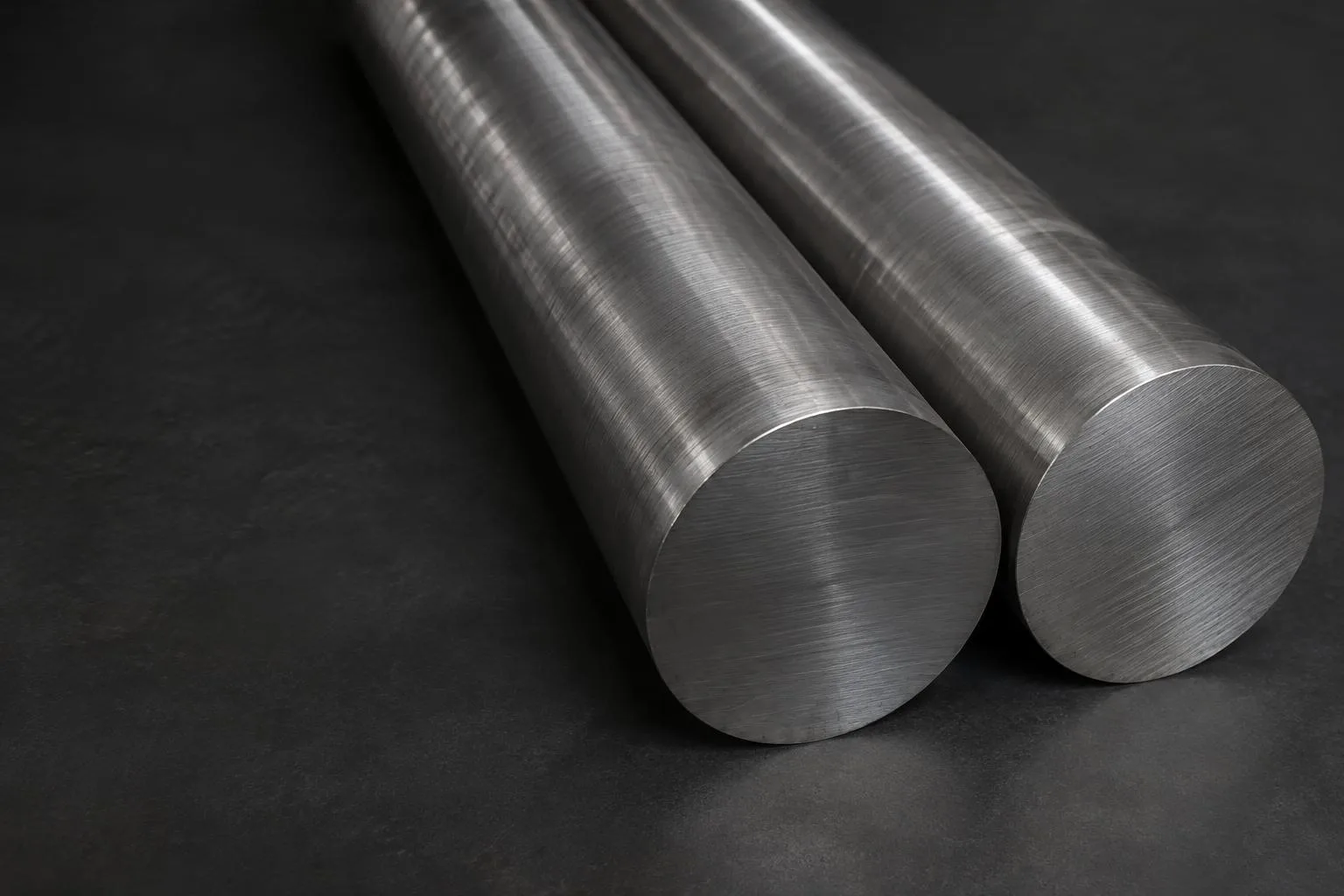
Imagery is illustrative steel product forms, not certified 52100 stock or evidence of Quest stockholding.
Raw & semi-finished materials
Available material forms
Carpenter lists round bar, billet and wire; AMS6444 covers bars, forgings, mechanical tubing and forging stock (not wire or plate). Producer scopes are not Quest stock; confirm all forms, sizes and quality levels at enquiry.
- Round bar and billet
- Forgings and forging stock
- Mechanical tubing
- Wire — specification enquiry
Material overview
52100 High-Carbon Chromium Bearing Steel
A 1% carbon, 1.4% chromium through-hardening steel used for rolling bearings — not a carburising steel.
- Ovako gives approximate hardenability corresponding to a ring of maximum 17 mm wall thickness; this is not a universal maximum bar diameter.
- No universal hardness-to-strength conversion is offered; mechanical data are shown only for their published conditions.
- ASTM A485 covers high-hardenability bearing-steel modifications and is not ordinary 52100.
Designations and product specifications
| Designation / standard | Scope and qualification |
|---|---|
| SAE / AISI | 52100 (E52100) |
| UNS | G52986 (Carpenter) |
| AMS6440 | Aircraft-quality bars, forgings, tubing and stock for bearing applications; T (2021) reported superseded by U (September 2026) — U not directly verified |
| AMS6444P (May 2021) | Premium aircraft-quality, consumable electrode vacuum remelted bars, forgings, tubing and stock |
| ASTM A295/A295M-14(2020) | High-carbon anti-friction bearing steel; annealing only when ordered |
| ASTM A485-17(2022) | High-hardenability bearing-steel modifications (grades 1–4, B2–B8) — not ordinary 52100 |
| ASTM A519/A519M-24a | Seamless mechanical tubing — product form only, not bearing quality |
| European similar grade | 100Cr6 / 1.3505 (EN ISO 683-17) |
Historical AMS6444J used 0.98–1.10% C; revision P uses 0.93–1.05% C. Do not mix chemistry across revisions. Carpenter’s VIM-VAR practice is producer-specific; AMS6444 alone does not mandate VIM.
SAE AMS6444P — 52100 premium aircraft-quality, consumable electrode vacuum remelted (4 May 2021)
Specification review
Technical verification requirements
Chemistry and specifications
Acceptance chemistry from A295, J404 or AMS6440/6444 not accessed; AMS6440U not directly verified; cleanliness requirements (AMS2300/2301) not verified.
Obtain the ordered specification revision and cleanliness requirements.
Mechanical evidence
Producer tensile data lack orientation and test-method detail; Ovako “24 < 190” notation and Q/T test basis unclear.
Obtain mill test reports and clarify Ovako dimension notation.
Grade selection
8620, 9310 and 52100 — different hardening principles
| Aspect | 8620 | 9310 | 52100 |
|---|---|---|---|
| Hardening principle | Case carburising | Case carburising (premium aerospace routes common) | Through hardening — not a carburising steel |
| Carbon basis used here | 0.18–0.23% (SSAB plate limits) | 0.07–0.13% (Liberty AMS-referenced limits) | 1.00% (Carpenter nominal) |
| Nickel basis used here | 0.40–0.70% | 3.00–3.50% | Not a deliberate addition (Ovako variants ≤0.25%) |
| Chromium basis used here | 0.40–0.60% | 1.00–1.40% | 1.40% (Carpenter nominal) |
| Key aerospace specifications | AMS6274 air melt; AMS6276 / AMS6277 remelted | AMS6260; AMS6265 VAR; AMS6267 ESR or VAR | AMS6440; AMS6444 VAR; ASTM A295 |
| Published property basis on these pages | Supply hardness; one carburised research specimen | Typical core properties after pseudo-carburising | Annealed-bar tensile data; tempering-hardness response |
Each value retains its own source basis; producer typical figures and specification-referenced limits are not interchangeable. 9315 (AMS6263) is a different grade from 9310. No universal fatigue, wear or toughness ranking is inferred; substitution requires engineering approval against the full specification, melt route, section, heat treatment and tests.
Engineering reference
Technical data
| Element | Nominal mass % | Basis |
|---|---|---|
| Carbon | 1.00 | Producer nominal |
| Manganese | 0.30 | Producer nominal |
| Silicon | 0.25 | Producer nominal |
| Chromium | 1.40 | Producer nominal |
| Iron | Balance | Producer nominal |
Nominal values, not acceptance limits; no P, S or residual limits published here. Ovako 100Cr6 803J limits for comparison: C 0.95–1.00, Si 0.20–0.35, Mn 0.25–0.40, Cr 1.35–1.60, P ≤0.025, S ≤0.013. Use the ordered specification for acceptance.
| Property | Typical value | Temperature basis as published |
|---|---|---|
| Density | 7800 kg/m³ | Not specified |
| Young’s modulus | 210 GPa | Not specified |
| Shear modulus | 80 GPa | Not specified |
| Poisson’s ratio | 0.3 | Not specified |
| Mean coefficient of thermal expansion | 12 µm/(m·K) | 20–300°C |
| Specific heat capacity | 460–480 J/(kg·K) | Printed as 50/100°C |
| Thermal conductivity | 40–45 W/(m·K) | Ambient |
| Electrical resistivity | 0.20–0.25 µΩ·m | Ambient |
Ovako values apply to Ovako material. Carpenter separately publishes density 0.2830 lb/in³, modulus 29.0 × 10³ ksi, shear modulus 12.0 × 10³ ksi and expansion 6.90 × 10⁻⁶ in/in/°F (interval unstated).
Spheroidise annealed bar — 25.4 mm round, turned and polished — typical
| Property | Producer typical | Basis |
|---|---|---|
| 0.2% yield strength | 427 MPa (62 ksi) | Typical |
| Ultimate tensile strength | 651 MPa (94.4 ksi) | Typical |
| Elongation | 27% | 2 in (50.8 mm) gauge length |
| Reduction of area | 62.5% | Typical |
| Hardness | 179 HB | Brinell |
Carpenter VIM-VAR 52100, typical mechanical properties of spheroidised annealed bars. Cold-drawn and cold-worked rows are not simply soft-annealed stock. Orientation, sampling position and test temperature not stated. Typical values, not specification minima.
Spheroidise annealed bar — 25.4 mm round, cold drawn — typical
| Property | Producer typical | Basis |
|---|---|---|
| 0.2% yield strength | 603 MPa (87.5 ksi) | Typical |
| Ultimate tensile strength | 738 MPa (107 ksi) | Typical |
| Elongation | 17% | 2 in (50.8 mm) gauge length |
| Reduction of area | 54.9% | Typical |
| Hardness | 229 HB | Brinell |
Carpenter VIM-VAR 52100, typical mechanical properties of spheroidised annealed bars. Cold-drawn and cold-worked rows are not simply soft-annealed stock. Orientation, sampling position and test temperature not stated. Typical values, not specification minima.
Spheroidise annealed bar — 11.1 mm round, 13% cold work — typical
| Property | Producer typical | Basis |
|---|---|---|
| 0.2% yield strength | 629 MPa (91.2 ksi) | Typical |
| Ultimate tensile strength | 723 MPa (104.8 ksi) | Typical |
| Elongation | 25% | 2 in (50.8 mm) gauge length |
| Reduction of area | 57.0% | Typical |
| Hardness | 229 HB | Brinell |
Carpenter VIM-VAR 52100, typical mechanical properties of spheroidised annealed bars. Cold-drawn and cold-worked rows are not simply soft-annealed stock. Orientation, sampling position and test temperature not stated. Typical values, not specification minima.
Spheroidise annealed bar — 11.1 mm round, 26% cold work — typical
| Property | Producer typical | Basis |
|---|---|---|
| 0.2% yield strength | 731 MPa (106 ksi) | Typical |
| Ultimate tensile strength | 855 MPa (124 ksi) | Typical |
| Elongation | 16% | 2 in (50.8 mm) gauge length |
| Reduction of area | 50.0% | Typical |
| Hardness | 262 HB | Brinell |
Carpenter VIM-VAR 52100, typical mechanical properties of spheroidised annealed bars. Cold-drawn and cold-worked rows are not simply soft-annealed stock. Orientation, sampling position and test temperature not stated. Typical values, not specification minima.
Hardened and tempered — Carpenter tempering hardness response
| Tempering temperature | Water quenched | Oil quenched |
|---|---|---|
| As hardened | 66 HRC | 64 HRC |
| 149°C | 64 HRC | 62 HRC |
| 204°C | 61 HRC | 60 HRC |
| 260°C | 60 HRC | 58 HRC |
| 316°C | 57 HRC | 57 HRC |
| 371°C | 54 HRC | 54 HRC |
| 427°C | — | 51 HRC |
| 482°C | — | 48 HRC |
Expected hardness response, not a guarantee. Specimen size, sampling location and exact austenitising conditions not stated. No tensile strength is inferred from hardness.
Ovako 100Cr6 803J — +SA / martensitic / bainitic — published
| Condition | Rp0.2 minimum | Tensile (typical) | Elongation A5 | Hardness (typical) |
|---|---|---|---|---|
| +SA spheroidise annealed, “24 < 190” mm | 410 MPa | 700 MPa | 27% | 210 HB |
| +Q/T(m) martensitic | 1700 MPa | 2300 MPa | 2% | 61 HRC |
| +Q/T(b) bainitic | 2000 MPa | 2200 MPa | 7% | 59 HRC |
Ovako 100Cr6 variant 803J; similar to, not certified as, SAE 52100. Dimension notation retained as printed. Q/T specimen size, orientation and exact thermal cycle not given. Not a universal strength–hardness correlation.
Normalising
927°C, air cool.
Annealing
Heat uniformly to 775°C, furnace cool slowly; 223 HB maximum with spheroidised structure.
Hardening — sections up to 25.4 mm
832–843°C, oil quench.
Hardening — sections over 25.4 mm
802–816°C, water quench (Carpenter suggests interrupted water-to-oil quench).
Tempering
Temper to the required hardness; see the tempering response table. Ovako recommends 160–500°C, tempering within 2 h of quenching.
Bainitic route (Ovako)
850–875°C for 10–60 min, then salt bath 220–250°C for 3–7 h.
Carpenter recommendations, with Ovako routes noted. The water-quench advice is producer guidance, not a universally approved procedure. Ovako heat-treatment graphs are theoretical-model outputs. Qualify a section-specific procedure.
Typical applications
Engineering applications
- Rolling-element bearing balls, rollers and rings
- Bearing races and precision wear components
- Aircraft-quality bearing components to AMS6440/6444, where approved
Subsequent manufacturing
Machining & processing
Machining
Machine in the spheroidise annealed condition; finish by grinding after hardening.
Not for carburising
Already high in carbon; it is through hardened rather than case carburised.
Welding
High carbon content makes welding impractical for bearing applications without specialist qualification.
Application evidence
Listed applications are established selection categories, not claims of stock or component approval.
Material certification & testing
Documentation and inspection must be agreed for the actual grade, specification revision, melting route, product form, ruling section and delivery condition.
No certificate, test, aerospace approval or grade equivalence is automatic. Case depth and case/core properties belong to the finished heat-treated component, not to the grade name; quotation controls remain disabled.
- EN 10204 3.1 material certificate, where agreed with the supplier
- Certificate of Conformity
- Heat / batch traceability to the producing mill
- Chemical analysis and mechanical test reports to the ordered specification
- Carburising, hardening and tempering records, case-depth and hardness-traverse reports where required
- Melting-route, cleanliness, ultrasonic, PMI or customer-specific testing only where agreed
Material enquiry
Request a material quotation
52100 High-Carbon Chromium Bearing Steel supplied to your material form, dimensions and specification.