Materials Supply / Aluminium Alloys
Aluminium Alloy 6082
Heat-treatable aluminium–magnesium–silicon–manganese alloy
6082 develops strength through Mg–Si precipitation during ageing. Its deliberate manganese addition helps control grain structure; it is not simply European 6061.
Compare certified product form, section size, temper, specification and test basis rather than declaring either 6082 or 6061 universally stronger.
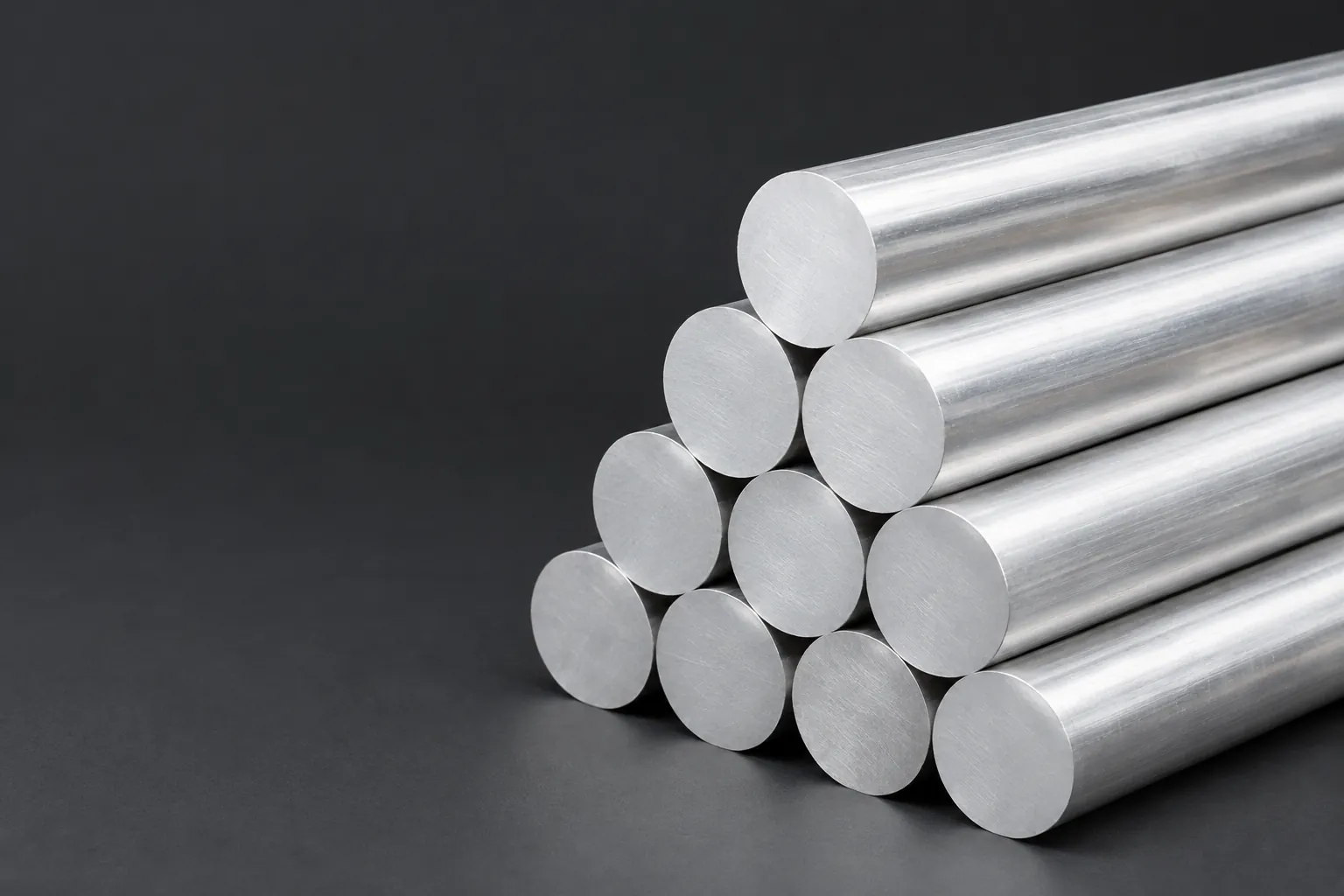
Illustrative aluminium materials and fabricated components, not certified alloy stock or evidence of Quest stockholding.
Raw & semi-finished materials
Available material forms
Product families are supported by Hydro and thyssenkrupp literature; not every form is available in every temper or dimension. ALPLAN evidence is specific to rolled precision plate. No forging supply or forging properties are asserted.
- Plate
- Sheet — availability by enquiry
- Round bar
- Flat bar
- Extruded profiles
- Tube
- Cut-to-size stock — by enquiry
Material overview
Aluminium Alloy 6082
A structural 6000-series alloy widely specified in European engineering, with form- and temper-specific strength and good machinability.
- Relatively high strength within commonly used structural extrusion alloys, with good corrosion resistance and useful machining performance in aged conditions.
- 6082 contains intentional Mn; 6061 instead specifies intentional Cr and Cu ranges. Both can contain Mn and Cr: neither is accurately described as containing only one of these elements. Different compositions, product availability and specification routes prevent automatic substitution.
- European engineering use is not evidence of critical aerospace approval. Drawings, approved material lists and purchaser specifications control acceptance.
Designations and product-specific specification basis
| Reference | Scope / limitation |
|---|---|
| 6082 / EN AW-6082 / AlSi1MgMn | Alloy identity; chemistry alone does not define a deliverable. |
| EN 573-3:2013 | Chemistry basis explicitly cited by Hydro European datasheet; agree contractual edition. |
| EN 755-2:2016 | Mechanical-property basis for the cited European extruded profiles, not rolled plate. |
| EN 515:1993 | Temper-definition edition cited by this Hydro datasheet; confirm current purchase requirements. |
| EN 485-2 | ALPLAN rolled-plate mechanical basis; source does not state edition. |
| ASTM B221 / ASTM B241 | Hydro North America lists T6 and T6511 in these extrusion / seamless pipe and tube routes; verify exact product and contractual edition. Not blanket equivalence with EN. |
ALPLAN plate basis: https://www.alucmic.com/wp-content/uploads/2019/08/Fiche-technique-5.pdf . ASTM evidence: https://www.hydro.com/globalassets/01-products--services/extruded-profiles/americas/ena-resources/alloy-data-sheets/hydro_2019_data_sheet_6082_revise_1.pdf . No AMS, forging standard, legacy designation equivalence or aerospace approval is inferred.
Specification review
Technical verification requirements
Designations / form / temper / dimensions
Product scopes were reviewed row by row. Recorded cross-references do not establish every current revision, ordered form, temper and dimensional limit; EN/UNS registries and complete controlled AMS/ASTM/EN texts were not inspected.
Obtain applicable controlled specification and producer confirmation; submit to technical review.
Mechanical conditions / gauge / orientation
Every selector/table was read. Typical, supplier minima and producer limits must remain distinct. Resolve missing orientation, specimen/gauge length, temperature, exact boundary inclusivity and test basis in the quoted notes; do not extend a specimen diameter to stock thickness or to other forms.
Produce a condition-by-condition acceptance matrix with form, thickness interval, tensile orientation, elongation basis, test temperature and source revision; omit unavailable values rather than infer them.
Grade selection
6061, 6063 and 6082 compared
| Aspect | 6061 | 6063 | 6082 |
|---|---|---|---|
| Registered Mg / Si, mass % | Mg 0.8–1.2 / Si 0.40–0.8 | Mg 0.45–0.9 / Si 0.20–0.6 | Mg 0.6–1.2 / Si 0.7–1.3 |
| Principal additional elements | Cu 0.15–0.40%; Cr 0.04–0.35%; Mn ≤0.15% | Cu, Cr and Mn each ≤0.10% | Mn 0.40–1.0%; Cr ≤0.25%; Cu ≤0.10% |
| Metallurgical classification | Precipitation-hardenable Al-Mg-Si-Cu-Cr | Precipitation-hardenable Al-Mg-Si | Precipitation-hardenable Al-Mg-Si-Mn |
| Common temper distinctions | T4 natural ageing; T6 artificial ageing; T651/T6511 include specified stress relief | T5 cooling from shaping then artificial ageing; T6 separate solution heat treatment and artificial ageing | T4/T6 and stress-relieved product conditions depend on mill and product specification |
| Strength selection | Engineering strength depends on form, section and temper | Often selected for extrusion quality rather than maximum strength | Structural strength depends on form, section and temper; not universally stronger than 6061 |
| Extrudability and surface finish | Structural and precision extrusion products | Good extrudability and surface finish; anodising quality still requires surface/process control | Structural extrusions; surface expectations require mill confirmation |
| Machinability | Aged tempers suited to machining; stress-relieved stock can reduce movement | Softer tempers require chip and finish control | Aged structural products suited to machining; residual stress still matters |
| Welding and forming | Welding can soften aged HAZ; softer conditions improve forming | Good weldability; HAZ and joint strength are not parent T5/T6 strength | Welding can soften aged HAZ; qualify joint properties |
| Corrosion protection | Good general resistance, not universal seawater immunity | Often selected for corrosion resistance and anodised finish | Good general resistance; coastal suitability remains environment-specific |
| Typical product focus | Sheet/plate, bar and extrusions subject to ordered requirements | Extruded profiles, bar and tube | European structural plate, bar and extrusions |
| Engineering uses | Machined parts, fixtures and structural fittings | Frames, enclosures, profiles and finished extrusions | Structural and transport components and machined equipment |
| Specification substitution | Commercial designation is not aerospace AMS approval | Extrusion-specific requirements are not plate requirements | Cannot automatically replace 6061 on an AMS-controlled drawing |
Qualitative selection guide, using registered AA chemistry and the grade-specific producer references on these pages. No numerical strength ranking: temper, product form, section size and test basis are not matched. No alloy or temper is automatically interchangeable; confirm the drawing and ordered specification.
The Aluminum Association — Teal Sheets, December 2025; fabrication references on each grade page
Engineering reference
Technical data
| Element | Mass % | Limit |
|---|---|---|
| Si | 0.7–1.3 | Range |
| Fe | 0.50 | Maximum |
| Cu | 0.10 | Maximum |
| Mn | 0.40–1.0 | Range |
| Mg | 0.6–1.2 | Range |
| Cr | 0.25 | Maximum |
| Zn | 0.20 | Maximum |
| Ti | 0.10 | Maximum |
| Other elements, each | 0.05 | Maximum |
| Other elements, total | 0.15 | Maximum |
| Al | Remainder | Balance |
Registered AA limits, not nominal or certified heat analysis. Ranges show minimum–maximum; all other numeric entries are maxima. AA other-element provisions apply. EN requirements are not independently merged into this table; agree the governing chemistry standard and mill certificate. Separately registered suffix alloys are not included.
The Aluminum Association — Teal Sheets, December 2025
| Property | Value | Basis |
|---|---|---|
| Density | 2.71 g/cm³ | Typical, 20 °C; temper unspecified |
| Elastic modulus | 70 GPa | Typical, 20 °C; temper unspecified |
| Shear modulus | 26 GPa | Typical, 20 °C; temper unspecified |
| Specific heat | 897 J/(kg·K) | Typical, 20 °C; temper unspecified |
| Linear expansion coefficient | 23.1 × 10⁻⁶ K⁻¹ | Source room-temperature basis; averaging interval unstated |
| Thermal conductivity | 150 / 172 W/(m·K) | T4 / T6 respectively; typical, 20 °C |
| Electrical resistivity | 41 / 39 nΩ·m | T4 / T6 respectively; typical, 20 °C |
| Melting range | 575–650 °C | Source reported range; not a service-temperature rating |
Hydro cites MNC Handbok nr 12, version 2, SIS, 1989; typical room-temperature properties at 20 °C. Not guaranteed procurement limits; do not combine with plate-specific values from other sources.
T4 — extruded profile, EN 755-2
| Product / section size | Rp0.2 (MPa) | Rm (MPa) | Elongation minimum | Test basis |
|---|---|---|---|---|
| Profile; t ≤ 25 mm | 110 min | 205 min | A 14%; A50mm 12% | Orientation and tensile-test temperature unstated in source. |
EN 755-2:2016 minima. Source reports A and A50mm separately; proportional A gauge formula is unstated. Properties may be obtained by press quenching. For mixed wall thicknesses use the lowest specified property set for the whole profile.
T6 — extruded open / hollow profile, EN 755-2
| Product / section size | Rp0.2 (MPa) | Rm (MPa) | Elongation minimum | Test basis |
|---|---|---|---|---|
| Open profile; t ≤ 5 mm | 250 min | 290 min | A 8%; A50mm 6% | Orientation and tensile-test temperature unstated in source. |
| Open profile; 5 < t ≤ 25 mm | 260 min | 310 min | A 10%; A50mm 8% | Orientation and tensile-test temperature unstated in source. |
| Hollow profile; t ≤ 5 mm | 250 min | 290 min | A 8%; A50mm 6% | Orientation and tensile-test temperature unstated in source. |
| Hollow profile; 5 < t ≤ 15 mm | 260 min | 310 min | A 10%; A50mm 8% | Orientation and tensile-test temperature unstated in source. |
EN 755-2:2016 minima; A gauge formula unstated. Press quenching may achieve these properties. Mixed-wall sections take the lowest specified property set for the whole section; do not apply these profile limits to plate or bar.
T651 — ALPLAN precision rolled plate, EN 485-2
| Product / section size | Rp0.2 (MPa) | Rm (MPa) | Elongation minimum | Test basis |
|---|---|---|---|---|
| 9.9 < t ≤ 12.5 mm | 255 min | 300 min | A50 9% (50 mm) | Orientation and tensile-test temperature unstated in source. |
| 12.5 < t ≤ 60 mm | 240 min | 295 min | A50 8% (50 mm) | Orientation and tensile-test temperature unstated in source. |
| 60 < t ≤ 100 mm | 240 min | 295 min | A50 7% (50 mm) | Orientation and tensile-test temperature unstated in source. |
| 100 < t ≤ 140 mm | 240 min | 275 min | A50 6% (50 mm) | Orientation and tensile-test temperature unstated in source. |
Published minimum values for this branded, double-face-milled rolled plate only, not a current stock guarantee. Source heading specifies more than / up to thickness intervals; advertised availability 10–140 mm. EN 485-2 edition unstated. Do not substitute typical values for minima.
T6511 — extrusion, Hydro AA limits
| Product / section size | Rp0.2 (MPa) | Rm (MPa) | Elongation minimum | Test basis |
|---|---|---|---|---|
| 0.200–0.750 in (source: 5.00–20.00 mm) | 260 min | 310 min | 6%; 2 in or 4 × specimen diameter | Orientation and tensile-test temperature unstated in source. |
| 0.751–6.000 in (source: 20.00–150.00 mm) | 260 min | 310 min | 8%; 2 in or 4 × specimen diameter | Orientation and tensile-test temperature unstated in source. |
| 6.001–8.000 in (source: 150.00–200.00 mm) | 240 min | 280 min | 6%; 2 in or 4 × specimen diameter | Orientation and tensile-test temperature unstated in source. |
AA property limits, not EN profile limits. Source inch and rounded metric bands are reproduced without silently reconciling their shared metric endpoints; specify controlling units and limits at order. Thickness is that of the cross-section from which the tensile specimen is taken. Elongation is not required where a standard specimen cannot be taken, or shapes are thinner than 0.062 in. Source lists these limits jointly for T6 and T6511; this selector intentionally isolates T6511.
Strengthening mechanism
Solution treatment dissolves age-hardening solute; quenching retains a supersaturated state. Natural or artificial ageing develops Mg–Si clusters and precipitates that impede dislocation motion. Composition, prior processing, cooling rate and section geometry change the response.
O and T4
O is annealed to obtain the lowest-strength temper. T4 is solution heat treated and naturally aged. No numeric O condition is published here because the reviewed Hydro North America reference contains a questionable T4 maximum-strength entry alongside O; do not infer or repair standard limits.
T5 versus T6
T5 is cooled from an elevated-temperature shaping process and artificially aged. T6 is solution heat treated and artificially aged. They are not interchangeable process definitions; Hydro notes that the cited European T4 and T6 profile properties may be obtained by press quenching.
T651 and T6511
T651 denotes solution heat treatment, stress relief by stretching and artificial ageing; it is not merely another name for T6. T6511 is a stress-relieved stretched extrusion temper allowing minor straightening to meet tolerances; it is not the rolled-plate T651 designation.
Residual stress and section size
Stretching reduces residual stress but does not guarantee zero distortion after machining. Quench severity and section geometry affect through-section response. Hydro cautions that T6 may not be available for certain thin-wall sections because of quenching limitations.
Conceptual descriptions only, not furnace instructions. No universal solution temperature, soak time, quench delay or ageing schedule is supplied. The Hydro example ageing curves apply to a particular profile and must not become a general treatment schedule. AA Technical Committee interpretations dated 22 April 2019 and 8 November 2023 distinguish product/process-specific T651 and T6511 and permit corrective minor straightening for T_511 without specifying a numerical permanent-set range. No automatic temper substitution is acceptable.
Material selection
Corrosion resistance & performance
Good general corrosion resistance is reported by Hydro. ALPLAN literature reports excellent normal-atmosphere and good marine-atmosphere performance, not immunity in all seawater exposures.
For chloride exposure, crevices and dissimilar-metal contact, qualify the joint and surface protection for the actual environment. Avoid a blanket marine-service approval.
Hydro European literature rates decorative anodising suitability below common architectural extrusion alloys. Technical anodising can be useful, but finish and colour require product-specific trials.
Pitting, intergranular attack and stress-corrosion suitability require exposure-, temper- and product-specific assessment. Anodising or conversion coatings and galvanic isolation should be selected for the actual environment; these pages give no universal seawater or corrosion-life guarantee.
Typical applications
Engineering applications
- Structural beams and engineering profiles
- Scaffolding, bumper rails and train-floor components
- Valve blocks and machined engineering components
- Precision rolled-plate machine components
- Welded structural fabrications subject to joint design and HAZ strength assessment
Subsequent manufacturing
Machining & processing
Machining
T6 and T651 stock machines well; use chip-control tooling and appropriate drilling strategies. Stretching and balanced material removal help manage distortion, without guaranteeing dimensional stability.
Welding
Hydro reports good weldability but reduced strength in the weld region. The heat-affected zone can lose precipitation-hardened strength; parent T6 or T651 values are not guaranteed as-welded joint values. Select filler, welding procedure and design allowables for the actual assembly. No full-strength recovery or post-weld treatment schedule is promised.
Forming and surface finish
Hydro recommends O or T4 for bending/forming. Confirm bend geometry and final strength requirements. Complex thin-wall extrusions and decorative finishes can be more difficult than with other extrusion alloys.
Specification and certification
Order by alloy, product form, dimensions, temper, governing standard and revision, orientation and test requirements. Generic commercial stock does not automatically satisfy an aerospace procurement specification.
Thermal exposure and dimensional control
Natural and artificial ageing, quench rate and section thickness affect precipitate development and residual stress. Prolonged heating may overage the material; no maximum service temperature or numerical high-temperature design allowable is asserted. Plan machining, clamping and welding sequences to control distortion; post-weld heat treatment must be qualified rather than assumed to restore parent strength.
Material certification & testing
Request mill-origin traceability and certification appropriate to the actual purchase specification; literature tables are not a certificate.
No certificate or test is automatically included. Alloy designation alone does not establish drawing compliance; confirm specification, revision, temper, product form, dimensions and inspection requirements.
- Mill identity, heat/cast or lot identification and traceability through cutting
- Certified chemistry against the agreed alloy standard
- Certified temper, product standard and section-specific tensile properties
- Agreed specimen orientation, gauge length and test temperature
- Inspection document type and any independent witnessing agreed before order
- Additional NDT, dimensional, surface or aerospace requirements only by explicit agreement
- Certificate of Conformity where agreed
- Heat-treatment records and hardness testing where specified
- Customer-specific chemical analysis, mechanical tests and ultrasonic inspection where applicable and agreed
Material enquiry
Request a material quotation
Aluminium Alloy 6082 supplied to your material form, dimensions and specification.