Materials Supply / Nickel, Cobalt & High-Temperature Alloys
Haynes 188 Cobalt-Based Superalloy
Solid-solution strengthened | UNS R30188
Haynes 188 is a solid-solution-strengthened cobalt-nickel-chromium-tungsten alloy developed for elevated-temperature strength and oxidation resistance. It is not a conventional precipitation-hardening alloy.
HAYNES® is a registered trademark of Haynes International, Inc. Quest Engineering does not manufacture or own the alloy trademark.
Raw & semi-finished materials
Available material forms
Producer-listed wrought forms; specification, dimensions and supply availability require confirmation. No stockholding is implied.
- Sheet
- Plate
- Strip
- Billet
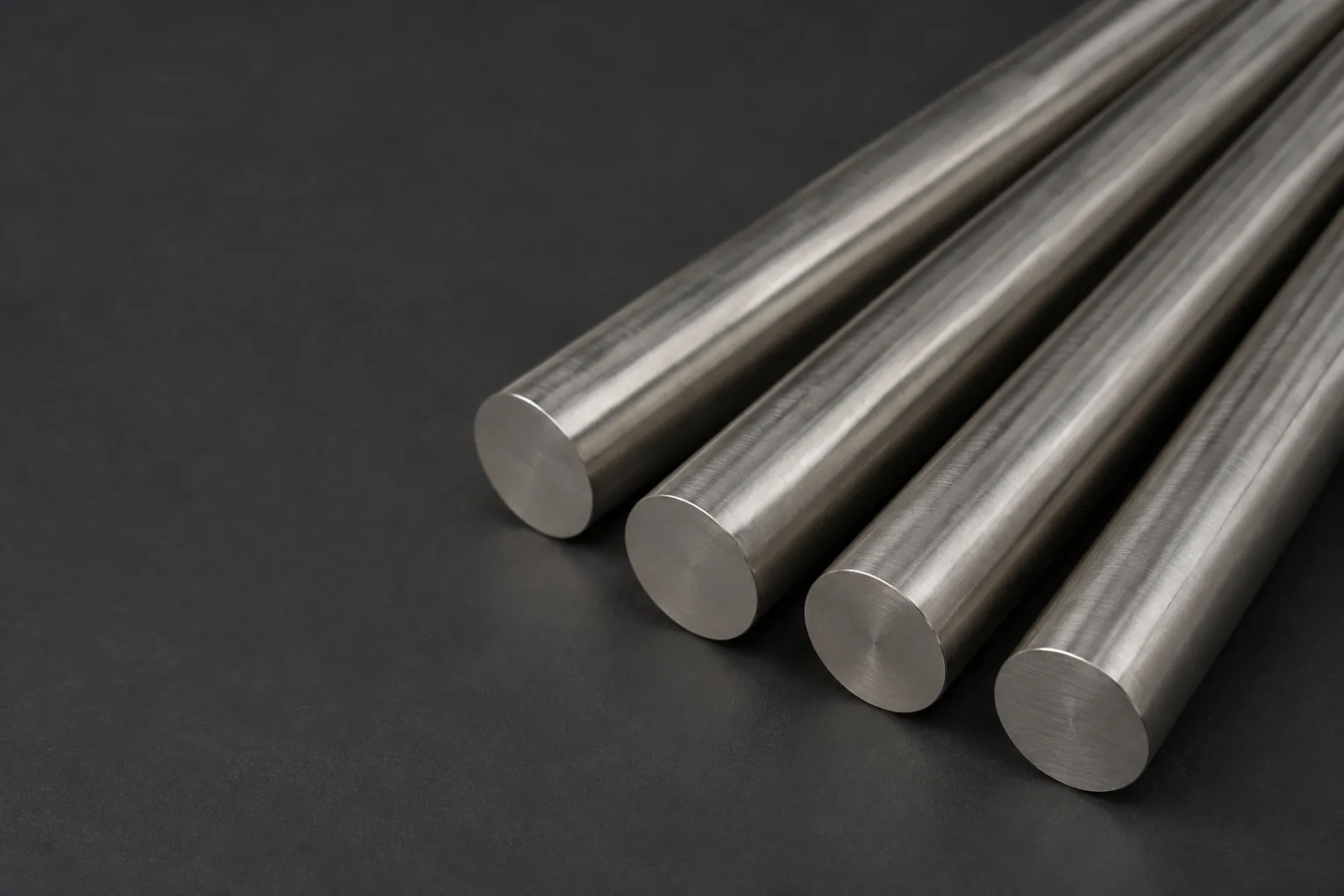
- Rod and bar
- Forgings
Material overview
Haynes 188 Cobalt-Based Superalloy
Cobalt-nickel-chromium-tungsten superalloy for elevated-temperature strength, oxidation resistance and fabricated combustion components.
- Good room-temperature fabricability accompanies useful high-temperature tensile, creep and stress-rupture strength. Solution annealing and rapid cooling restore the preferred property balance after working.
- Oxidation test temperatures are not permissible load-bearing service limits. Long-term thermal exposure can reduce ductility and impact resistance through Co2W Laves-phase formation.
Designations and product specifications
| Designation / standard | Scope / condition / limitation |
|---|---|
| UNS | R30188 |
| AMS 5608 | 188 alloy sheet, plate and strip; wrought material normally supplied solution heat treated. Ordered revision governs acceptance. |
| AMS 5772 | 188 alloy billet, rod, bar and forgings; wrought material normally supplied solution heat treated. Verify product-specific requirements in the ordered revision. |
Producer listing does not establish equivalence or current revision. AMS 5801 covers 188 welding wire, not wrought base metal; it is excluded from this wrought-material table. No ASTM, ASME or EN designation is asserted. Reference associations only: no equivalence, stock availability, aerospace approval or certified conformity is established by this page. Specify the ordered revision, product form, dimensions, manufacture/melt route, delivery condition and acceptance tests; obtain matching supplier confirmation and inspection documents.
Specification review
Technical verification requirements
Specifications / product form
Producer listings and historic references support alloy association but not every listed standard’s current revision, individual form, section-size, melt-route, heat-treatment tolerances or acceptance requirements. Existing qualification wording is appropriate, not proof of conformity.
Obtain controlled ordered-standard and producer confirmation before technical release.
Engineering reference
Technical data
| Element | Mass % | Basis |
|---|---|---|
| Co | 39 | Approximate balance |
| Ni | 22 | Nominal |
| Cr | 22 | Nominal |
| W | 14 | Nominal |
| Fe | 3 | Maximum |
| Mn | 1.25 | Maximum |
| Si | 0.35 | Nominal |
| C | 0.10 | Nominal |
| La | 0.03 | Nominal |
| B | 0.015 | Maximum |
Single producer nominal-composition table, not certified specification limits. No minima or unlisted Mo, P or S limits inferred.
| Property | Temperature / interval | Typical value |
|---|---|---|
| Density | Room temperature | 8980 kg/m³ |
| Melting range | — | 1315–1410°C |
| Thermal conductivity | Room temperature | 10.4 W/(m·K) |
| Thermal conductivity | 600°C | 21.1 W/(m·K) |
| Mean thermal expansion | 25–100°C | 12.1 × 10⁻⁶ K⁻¹ |
| Mean thermal expansion | 25–1000°C | 16.5 × 10⁻⁶ K⁻¹ |
| Dynamic elastic modulus | Room temperature | 232 GPa |
| Specific heat | 100°C | 423 J/(kg·K) |
Typical producer data; density converted from 8.98 g/cm³. Suspect room-temperature specific-heat and resistivity unit entries in the brochure are deliberately omitted.
Sheet — solution annealed
| Property | Typical value |
|---|---|
| Ultimate tensile strength | 982 MPa |
| 0.2% yield strength | 483 MPa |
| Elongation | 50.9 % |
| Hardness | 98 HRB |
Producer test results, not specification minima. Cold-rolled sheet. Hardness is separately tabulated for solution-annealed material of the same form; no gauge length or tensile orientation stated.
Plate — solution annealed
| Property | Typical value |
|---|---|
| Ultimate tensile strength | 991 MPa |
| 0.2% yield strength | 483 MPa |
| Elongation | 50.6 % |
| Hardness | 98 HRB |
Producer test results, not specification minima. Hot-rolled plate. Hardness is separately tabulated for solution-annealed material of the same form; no gauge length or tensile orientation stated.
Published solution-annealed sheet and plate data are kept separate. Creep/rupture stress and oxidation loss describe different damage mechanisms.
Sheet — solution annealed — elevated-temperature tensile
| Test temperature (°C) | 0.2% yield (MPa) | UTS (MPa) | Elongation (%) |
|---|---|---|---|
| 538 | 309 | 809 | 58.8 |
| 649 | 309 | 821 | 58.6 |
| 760 | 302 | 563 | 81.8 |
| 871 | 261 | 324 | 103.9 |
| 982 | 125 | 175 | 81 |
| 1093 | 59 | 85 | 49.7 |
Published typical test values, not design allowables. Cold-rolled sheet.
Plate — solution annealed — elevated-temperature tensile
| Test temperature (°C) | 0.2% yield (MPa) | UTS (MPa) | Elongation (%) |
|---|---|---|---|
| 538 | 315 | 832 | 60.3 |
| 649 | 311 | 838 | 62.8 |
| 760 | 301 | 580 | 85.6 |
| 871 | 256 | 341 | 97.9 |
| 982 | 132 | 188 | 102.6 |
| 1093 | 66 | 96 | 87.1 |
Published typical test values, not design allowables. Hot-rolled plate.
Sheet — solution annealed — creep and rupture
| Temperature (°C) | Stress for 1% creep, 100 h (MPa) | Stress for 1% creep, 1000 h (MPa) | Rupture stress, 100 h (MPa) | Rupture stress, 1000 h (MPa) |
|---|---|---|---|---|
| 760 | 128 | 92 | 221 | 159 |
| 816 | 87 | 61 | 150 | 103 |
| 871 | 58 | 39 | 99 | 65 |
| 982 | 25 | 14 | 37 | 21 |
| 1038 | 15 | 9.7 | 22 | 14 |
| 1093 | 9.7 | 6.2 | 14 | 8.3 |
Approximate initial stresses published for solution-annealed sheet. Only unstarred values selected; values marked significant extrapolation in the brochure are omitted. Not guaranteed limits.
Cyclic burner-rig oxidation — 188 alloy
| Test temperature (°C) | Duration (h) | Metal loss (µm) | Average metal affected (µm) | Maximum metal affected (µm) |
|---|---|---|---|---|
| 980 | 1000 | 28 | 81 | 99 |
No. 2 fuel oil combustion products; air:fuel about 50:1, gas velocity about Mach 0.3. Samples removed every 30 minutes, fan-cooled near ambient, then reinserted. Metal affected includes penetration; not a service-life prediction.
Oxidation performance
- The producer describes very good oxidation resistance for prolonged exposures up to 1095°C, but this is environmental guidance, not an unconditional operating-temperature rating.
- Weekly cycled exposure to air plus 20% water vapour at 982°C for 1008 h gave 5 µm metal loss and 38 µm average metal affected.
- The brochure includes low-cycle fatigue curves. No fatigue life or endurance limit has been read from graphs; thermal gradients, restraint and cycle severity require component-specific assessment.
Long-term exposure can precipitate Co2W Laves phase and impair tensile ductility and impact strength. The producer considers stability better than Haynes 25 but recommends considering Haynes 230 where stability is important. No graph-derived values or new extrapolations are used.
Solution annealing
Producer range 1163–1191°C, followed by rapid cooling or water quenching. The fabrication section gives a normal final treatment of 1175°C, with time commensurate with section thickness; no universal holding time is specified.
After hot or cold working
Anneal and rapidly cool worked parts to restore the preferred property balance. Lower-temperature intermediate anneals may assist forming, but final solution treatment is needed for optimum properties and structure.
Not a precipitation-ageing schedule
Sub-solution-temperature annealing can precipitate carbides and alter properties. No conventional precipitation-hardening treatment is specified for 188.
The brochure applies the general treatment guidance to wrought material, not different fixed sheet, plate and bar schedules. Its five-minute sheet processing experiments are not a universal production soak recommendation.
Material selection
Corrosion resistance & performance
Good resistance to sulfate-deposit hot corrosion and gaseous sulfidation is reported; performance depends on atmosphere, deposits and cycling.
At 900°C, a 1000 h burner-rig test with No. 2 fuel oil containing 0.4% sulfur, air:fuel 30:1 and injected seawater equivalent to 5 ppm salt gave 20 µm metal loss and 69 µm average metal affected. Gas velocity was 4 m/s, with hourly cooling near ambient.
Oxidation resistance does not establish resistance to every process chemical or molten salt; validate the actual environment.
Typical applications
Engineering applications
- Gas-turbine combustion cans and aerospace combustion-chamber fabrications
- Gas-turbine transition ducts
- Afterburner components and associated hot exhaust-path sheet-metal assemblies
Subsequent manufacturing
Machining & processing
Forming and hot working
Good ductility permits cold forming, but rapid work hardening may require intermediate anneals. For forging or hot working, the producer advises heating to 1175°C for sufficient time to bring the entire piece to temperature.
Welding
TIG, MIG, shielded metal arc, electron-beam and resistance welding are supported. Clean joints and adjacent surfaces thoroughly. Submerged-arc welding is not recommended because high heat input and slow cooling can promote restraint cracking. Use qualified filler and procedures.
Machining
The brochure refers to separate producer high-temperature-alloy machining guidance rather than tabulating 188-specific cutting conditions. Account for rapid work hardening; confirm tooling, feeds, speeds and coolant with the processor. No unsupported cutting schedule is specified.
Material certification & testing
Specify product form, dimensions, ordered standard and revision, supply condition and required inspection documentation with each enquiry.
Certification and availability require supplier confirmation. Typical brochure values are not certified minima or design allowables; different forms and specifications are not automatically interchangeable.
- Request material certification and heat/lot traceability to the supplied product.
- Confirm chemistry, mechanical testing and heat-treatment records against the ordered product-form specification.
- Agree any additional inspection, origin or aerospace customer requirements before supply.
Material enquiry
Request a material quotation
Haynes 188 Cobalt-Based Superalloy supplied to your material form, dimensions and specification.