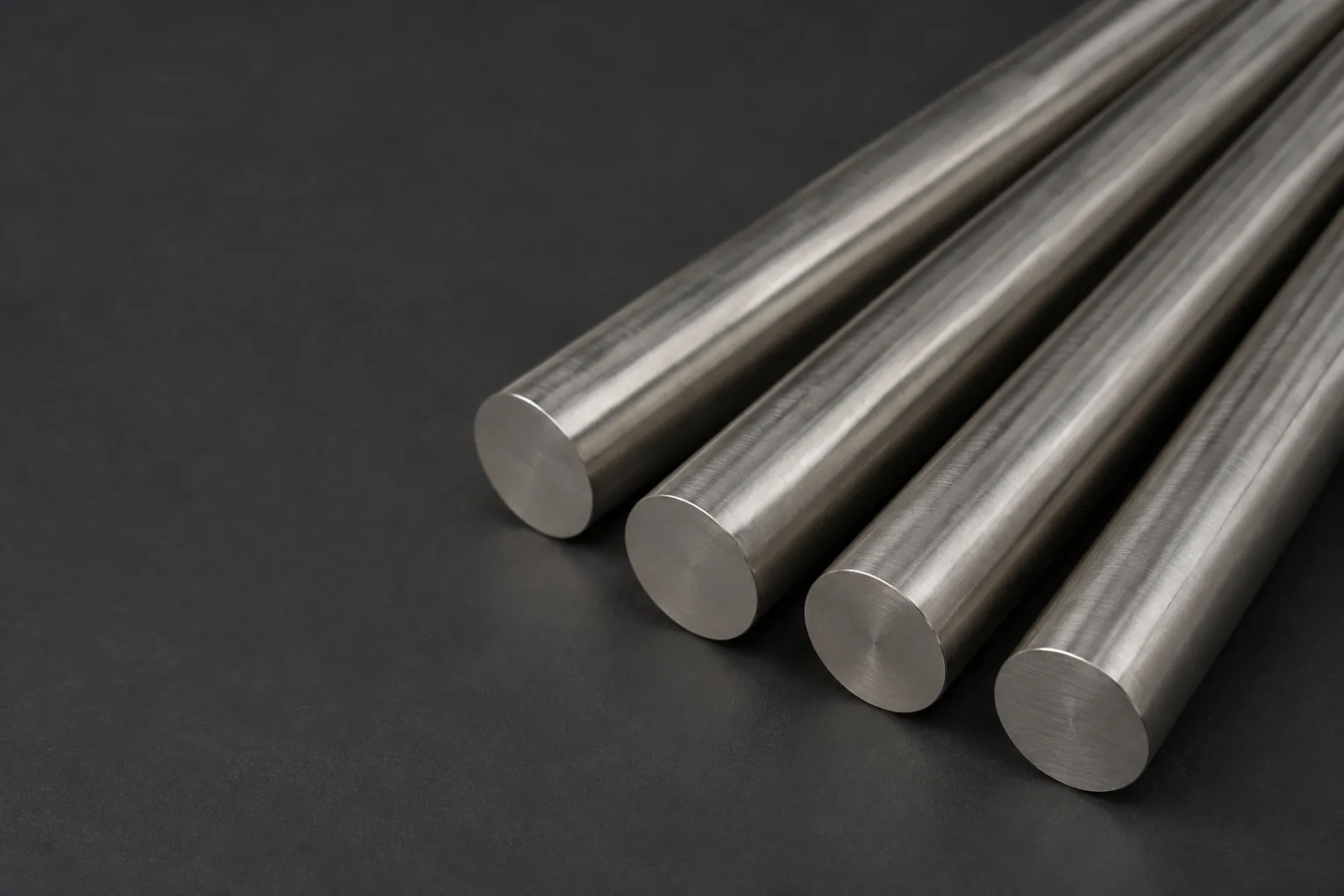
Materials Supply / Nickel, Cobalt & High-Temperature Alloys
Haynes 25 / L-605 Cobalt-Based Superalloy
Solid-solution strengthened | UNS R30605
Haynes 25, also commonly known as L-605, is a solid-solution-strengthened cobalt-chromium-tungsten-nickel alloy combining high-temperature strength with oxidation, sulfidation and metal-galling resistance.
These recognised names identify the same underlying alloy family, subject to the actual ordered specification. Product-form specifications and supply conditions are not automatically interchangeable.
HAYNES® is a registered trademark of Haynes International, Inc. Quest Engineering does not manufacture or own the alloy trademark.
Raw & semi-finished materials
Available material forms
Producer-listed forms; dimensions, specification and availability require supplier confirmation. Welding consumables are not interchangeable with structural wrought products. No stockholding is implied.
- Sheet
- Plate
- Strip
- Billet
- Rod and bar
- Forgings
- Bare welding rod and wire
- Coated welding electrodes
Material overview
Haynes 25 / L-605 Cobalt-Based Superalloy
Cobalt-chromium-tungsten-nickel alloy for elevated-temperature strength, oxidation resistance and demanding aerospace components.
- Strength is primarily derived from solid-solution strengthening, not conventional precipitation hardening. Cold work increases strength and hardness separately from solution annealing.
- Typical producer data are not design allowables or purchase acceptance minima. Elevated-temperature capability depends on stress, duration, environment, fabrication and thermal history.
Designations and product specifications
| Designation / standard | Product form, condition and scope |
|---|---|
| UNS | R30605 |
| AMS 5537 | Sheet, plate and strip; confirm solution-treatment and acceptance requirements in the ordered revision. |
| AMS 5759 | Billet, rod, bar and forgings; confirm product-specific treatment and acceptance requirements. |
| AMS 5796 | Bare welding rods and wire; welding filler, not a structural-bar supply specification. |
| AMS 5797 | Coated welding electrodes; not interchangeable with bare wire. |
| ASTM F90 | Medical: wrought cobalt-20chromium-15tungsten-10nickel alloy for surgical implant applications (UNS R30605). Not an aerospace qualification; form, condition and testing must meet the ordered medical standard. |
AMS product-form mappings and UNS are producer-brochure listings. ASTM F90 is separately corroborated by producer TOKKIN: https://www.tokkin.com/search/superalloys/cobalt-alloys/l605/ . Current editions and full condition requirements require purchase review; no equivalence or medical-device approval implied. Reference associations only: no equivalence, stock availability, aerospace approval or certified conformity is established by this page. Specify the ordered revision, product form, dimensions, manufacture/melt route, delivery condition and acceptance tests; obtain matching supplier confirmation and inspection documents.
Specification review
Technical verification requirements
Specifications / product form
Producer listings and historic references support alloy association but not every listed standard’s current revision, individual form, section-size, melt-route, heat-treatment tolerances or acceptance requirements. Existing qualification wording is appropriate, not proof of conformity.
Obtain controlled ordered-standard and producer confirmation before technical release.
Engineering reference
Technical data
| Element | Mass % | Basis |
|---|---|---|
| Co | 51 | Approximate balance |
| Cr | 20 | Nominal |
| W | 15 | Nominal |
| Ni | 10 | Nominal |
| Mn | 1.5 | Nominal |
| C | 0.1 | Nominal |
| Fe | 3 | Maximum |
| Mo | 1 | Maximum |
| Si | 0.4 | Maximum |
Single producer nominal-composition table. Only explicitly stated maxima are limits; no minima or unlisted sulphur/phosphorus limits inferred. Certified chemistry must meet the ordered specification.
| Property | Temperature / interval | Value |
|---|---|---|
| Density | RT | 9070 kg/m³ |
| Melting range | — | 1330–1410 °C |
| Electrical resistivity | RT | 0.886 µΩ·m |
| Thermal conductivity | 25 °C | 10.5 W/(m·K) |
| Specific heat | 25 °C | 403 J/(kg·K) |
| Mean thermal expansion coefficient | 25–100 °C | 12.8 µm/(m·K) |
| Dynamic elastic modulus | RT | 225 GPa |
Producer metric table; density and resistivity converted to SI-compatible units. RT = room temperature. Dynamic modulus is not a tensile-test static modulus.
Sheet — solution annealed
| Property | Typical value |
|---|---|
| 0.2% offset yield strength | 476 MPa |
| Ultimate tensile strength | 996 MPa |
| Elongation | 54.7 % |
| Hardness | 97 HRB |
Brochure tensile and solution-annealed hardness tables. Not guaranteed minima. Sheet and bar tensile data are limited; bar is hot-rolled and solution annealed at 1230 °C. Hardness is separately tabulated by form, not necessarily the same test lot.
Plate — solution annealed
| Property | Typical value |
|---|---|
| 0.2% offset yield strength | 474 MPa |
| Ultimate tensile strength | 1000 MPa |
| Elongation | 58.8 % |
| Hardness | 99 HRB |
Brochure tensile and solution-annealed hardness tables. Not guaranteed minima. Sheet and bar tensile data are limited; bar is hot-rolled and solution annealed at 1230 °C. Hardness is separately tabulated by form, not necessarily the same test lot.
Bar — solution annealed
| Property | Typical value |
|---|---|
| 0.2% offset yield strength | 505 MPa |
| Ultimate tensile strength | 1015 MPa |
| Elongation | 60 % |
| Hardness | 98 HRB |
Brochure tensile and solution-annealed hardness tables. Not guaranteed minima. Sheet and bar tensile data are limited; bar is hot-rolled and solution annealed at 1230 °C. Hardness is separately tabulated by form, not necessarily the same test lot.
Sheet — 10% cold reduced
| Property | Typical value |
|---|---|
| 0.2% offset yield strength | 850 MPa |
| Ultimate tensile strength | 1255 MPa |
| Elongation | 37.1 % |
| Hardness | 36 HRC |
Brochure Formability table: cold reductions taken on 2.8 mm sheet; no subsequent anneal; duplicate tests. Test temperature is not expressly stated in this table. Do not combine with the separate 1.3 mm cold-work tensile dataset or extrapolate to other forms.
Sheet — 15% cold reduced
| Property | Typical value |
|---|---|
| 0.2% offset yield strength | 1025 MPa |
| Ultimate tensile strength | 1230 MPa |
| Elongation | 27.7 % |
| Hardness | 40 HRC |
Brochure Formability table: cold reductions taken on 2.8 mm sheet; no subsequent anneal; duplicate tests. Test temperature is not expressly stated in this table. Do not combine with the separate 1.3 mm cold-work tensile dataset or extrapolate to other forms.
Sheet — 20% cold reduced
| Property | Typical value |
|---|---|
| 0.2% offset yield strength | 1040 MPa |
| Ultimate tensile strength | 1335 MPa |
| Elongation | 18.2 % |
| Hardness | 42 HRC |
Brochure Formability table: cold reductions taken on 2.8 mm sheet; no subsequent anneal; duplicate tests. Test temperature is not expressly stated in this table. Do not combine with the separate 1.3 mm cold-work tensile dataset or extrapolate to other forms.
Sheet — 25% cold reduced
| Property | Typical value |
|---|---|
| 0.2% offset yield strength | 1270 MPa |
| Ultimate tensile strength | 1605 MPa |
| Elongation | 14.6 % |
| Hardness | 44 HRC |
Brochure Formability table: cold reductions taken on 2.8 mm sheet; no subsequent anneal; duplicate tests. Test temperature is not expressly stated in this table. Do not combine with the separate 1.3 mm cold-work tensile dataset or extrapolate to other forms.
Published tensile and time-dependent properties are distinct. Oxidation resistance alone does not establish allowable load or service life.
Sheet — solution annealed tensile
| Test temperature (°C) | 0.2% yield (MPa) | UTS (MPa) | Elongation (%) |
|---|---|---|---|
| RT | 476 | 996 | 54.7 |
| 538 | 268 | 820 | 63.4 |
| 649 | 256 | 823 | 54.2 |
| 760 | 245 | 569 | 33.9 |
| 871 | 231 | 319 | 97.8 |
| 982 | 128 | 178 | 94.1 |
| 1093 | 62 | 92 | 63.0 |
Typical solution heat-treated sheet; not specification minima. RT = room temperature. Limited data.
Plate — solution annealed tensile
| Test temperature (°C) | 0.2% yield (MPa) | UTS (MPa) | Elongation (%) |
|---|---|---|---|
| RT | 474 | 1000 | 58.8 |
| 538 | 265 | 842 | 71 |
| 649 | 230 | 852 | 64.3 |
| 760 | 237 | 593 | 45.7 |
| 871 | 221 | 333 | 104.7 |
| 982 | 129 | 188 | 113.7 |
| 1093 | 64 | 100 | 97.5 |
Typical solution heat-treated plate; not specification minima. RT = room temperature.
Bar — solution annealed tensile
| Test temperature (°C) | 0.2% yield (MPa) | UTS (MPa) | Elongation (%) |
|---|---|---|---|
| RT | 505 | 1015 | 60 |
| 538 | 295 | 780 | 63 |
| 649 | 295 | 725 | 49 |
| 760 | 285 | 620 | 29 |
| 871 | 235 | 370 | 29 |
| 982 | 130 | 195 | 41 |
Typical solution heat-treated bar; not specification minima. RT = room temperature. Limited data; hot rolled and annealed at 1230 °C. Historical tests used strain rate 0.005 min⁻¹ through yield and normalised crosshead speed 0.5 min⁻¹ thereafter, versus 0.05 min⁻¹ thereafter in the producer-described current method. Do not equate these results to modern-rate tests.
Sheet — solution annealed stress rupture
| Temperature (°C) | 100 h stress (MPa) | 1000 h stress (MPa) |
|---|---|---|
| 649 | 476 | 393 |
| 704 | 345 | 262 |
| 760 | 248 | 179 |
| 816 | 170 | 125 |
| 871 | 121 | 83 |
| 927 | 81 | 50 |
| 982 | 50 | 28 |
Approximate initial stress to cause rupture; limited data. Selected published columns avoid values flagged by the producer as significant extrapolations. Not design allowables.
Bar — solution annealed stress rupture
| Temperature (°C) | 10 h stress (MPa) | 100 h stress (MPa) | 1000 h stress (MPa) |
|---|---|---|---|
| 732 | 293 | 252 | 209 |
| 760 | 270 | 217 | 166 |
| 816 | 207 | 152 | 117 |
| 871 | 159 | 114 | 83 |
| 927 | 117 | 83 | 58 |
| 982 | 79 | 52 | 34 |
Approximate initial stress to rupture; limited data. Not interchangeable with sheet results.
Sheet — solution annealed creep
| Temperature (°C) | Creep strain (%) | 10 h stress (MPa) | 100 h stress (MPa) |
|---|---|---|---|
| 649 | 0.5 | 427 | 328 |
| 649 | 1 | 490 | 372 |
| 760 | 0.5 | 193 | 134 |
| 760 | 1 | 221 | 148 |
| 871 | 0.5 | 94 | 68 |
| 871 | 1 | 105 | 83 |
| 982 | 0.5 | 47 | 31 |
| 982 | 1 | 61 | 39 |
Approximate initial stresses to produce specified creep; limited data. Only tabulated values without the significant-extrapolation marker are reproduced; no graph reading or new extrapolation.
Oxidation performance
- The producer describes good resistance to oxidizing environments to approximately 980 °C for prolonged exposure; this is environmental guidance, not an unconditional maximum operating temperature.
- Very good sulfidation resistance is reported, but atmosphere chemistry and exposure cycle remain application-specific.
Prolonged intermediate-temperature exposure can precipitate Co2W Laves phase and reduce subsequent room-temperature ductility. The producer identifies 188 and especially 230 as more thermally stable alternatives. Fatigue life and thermal-cycling design limits are not established by these tensile or rupture tables.
Final solution annealing
Normally 1175–1230 °C, followed by rapid cooling or water quenching. Hold time must be commensurate with section thickness; no universal soak duration is given. The producer normally supplies solution-treated material unless otherwise specified. Bar tensile data explicitly use 1230 °C; the sheet and plate tensile tables do not specify individual schedules.
Intermediate fabrication annealing
Lower-temperature intermediate anneals may assist forming, but carbide precipitation can affect properties. A subsequent final solution treatment is needed for the optimum structure and balance of properties.
Cold work and optional subsequent ageing
Cold reduction is mechanical processing, not a heat treatment. The brochure separately tabulates limited 1.3 mm sheet data after 15% or 20% cold work plus Age A (370 °C for 1 hour), and 20% cold work plus Age B (595 °C for 2 hours). These give modest additional strengthening of cold-worked material, not a general precipitation-hardening route from the annealed condition.
Use a qualified procedure tied to product form, section and ordered standard. Do not substitute these illustrative ageing schedules for solution annealing or transfer them between forms. Final annealing removes the intended cold-worked supply condition.
Material selection
Corrosion resistance & performance
Good oxidation and very good sulfidation resistance are producer-reported; confirm suitability for the actual gas composition, contaminants, temperature and duration.
Excellent metal-galling and cavitation resistance is supported by producer tests, including matching-material room-temperature pin-on-disc and ASTM G32 water cavitation tests. This is not a universal wear-life guarantee.
Do not infer blanket aqueous acid resistance or medical suitability from high-temperature oxidation performance.
Typical applications
Engineering applications
- Established military and commercial gas turbine engine components
- High-temperature aerospace components and formed sheet-metal assemblies, subject to design approval
- Bearing balls and races where the specified condition and contact environment are suitable
Subsequent manufacturing
Machining & processing
Forming and hot working
Good forming characteristics, but very rapid work hardening can require frequent intermediate anneals. For hot working the producer specifies heating to 1205 °C long enough for the entire piece to reach temperature. Anneal and rapidly cool worked parts for the optimum annealed balance of properties unless a qualified cold-worked condition is required.
Welding
GTAW, GMAW, SMAW, electron-beam and resistance welding are supported. Submerged arc is not recommended. Clean joints thoroughly, avoid copper contamination, use an appropriate qualified filler and maintain interpass temperature below 93 °C. Post-weld heat treatment is not generally required by the producer; ordered fabrication requirements govern.
Machining
Rapid work hardening requires a process qualified for cobalt-base high-temperature alloys. The grade brochure directs machining practice to the Haynes Welding and Fabrication guide; no unsupported cutting speeds, feeds or tooling-life claims are specified here.
Material certification & testing
Agree the alloy designation, ordered specification and revision, form, dimensions and supply condition before procurement.
Certification and testing are subject to supplier confirmation, not automatic claims of approval or availability. This record is draft technical content; publication, quotation submission and file uploads must remain disabled in the host application.
- Request material certification and heat/lot traceability to the ordered requirements.
- Confirm chemical analysis, mechanical testing, heat treatment and any cold-reduction history required by the purchase order.
- Agree any EN 10204 3.1 certificate, independent inspection or additional testing before order acceptance.
- Treat ASTM F90 medical supply as a separate qualification route, not aerospace equivalence.
Material enquiry
Request a material quotation
Haynes 25 / L-605 Cobalt-Based Superalloy supplied to your material form, dimensions and specification.