Materials Supply / Nickel, Cobalt & High-Temperature Alloys
MP35N High-Strength Cobalt-Nickel Alloy
Cold-work strengthened and ageable | UNS R30035
MP35N is a nonmagnetic cobalt-nickel-chromium-molybdenum alloy whose strength is developed by mechanical working followed, where required, by ageing. Solution annealing alone does not produce its highest strength.
MP35N is primarily selected for high-strength, corrosion-resistant mechanical components. It is not a direct substitute for Haynes 188 or Haynes 25 / L-605 in prolonged high-temperature structural or furnace service.
MP35N® is a registered trademark of SPS Technologies, Inc. Quest Engineering does not manufacture or own the alloy trademark.
Raw & semi-finished materials
Available material forms
Forms listed by Carpenter; dimensions, ordered specification and supply condition require supplier confirmation. No Quest Engineering stockholding is implied.
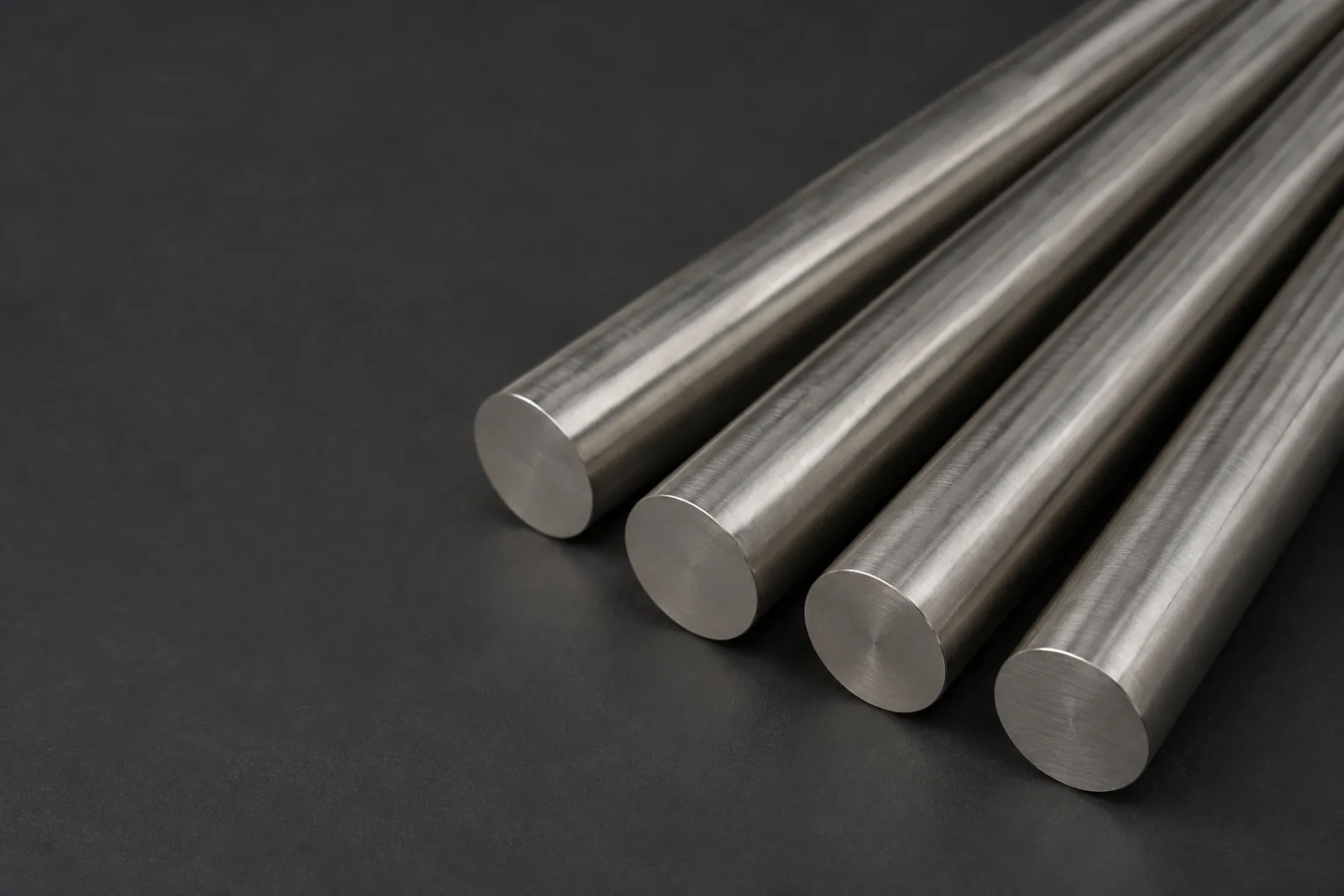
- Round bar
- Billet
- Strip
- Wire
- Wire rod
Material overview
MP35N High-Strength Cobalt-Nickel Alloy
Cobalt-nickel-chromium-molybdenum alloy combining high mechanical strength with excellent corrosion resistance in appropriately processed conditions.
- Carpenter describes vacuum induction melting followed by vacuum arc remelting. Work hardening, deformation-related phase transformation and subsequent ageing develop the characteristic strength; strength and ductility depend on the processing history.
- The condition tables are separate producer examples, not interchangeable specification minima. Specify product form, dimensions, degree of cold reduction, heat treatment and acceptance tests on the purchase order.
Designations and product specifications
| Designation / standard | Product form, condition and limitations |
|---|---|
| UNS | R30035 |
| AMS 5758 | MP35N bars, solution heat treated for subsequent work strengthening; VIM plus consumable-electrode vacuum remelted. Not a fully strengthened supply condition. |
| AMS 5844 | MP35N bar, solution heat treated and cold drawn / work strengthened, not finally aged; historically centreless ground. Verify ordered revision, dimensions and ageing-capability requirements. |
| AMS 5845 | MP35N round bar, solution heat treated, cold drawn / work strengthened and aged. Final aged supply condition; do not apply its acceptance requirements to unaged AMS 5844 material. |
| ASTM F562 — medical | Wrought UNS R30035 bar and wire for manufacture of surgical implants; work-strengthened and aged strength conditions depend on the ordered requirements. Separate medical specification, not automatic aerospace equivalence or finished-device approval. |
Carpenter verifies UNS and lists these four specifications. Public standards scope references are documented in the research notes. Full ordered standards govern revision, size, melting, processing and testing; no cross-specification equivalence or universal minimum strength is asserted. Reference associations only: no equivalence, stock availability, aerospace approval or certified conformity is established by this page. Specify the ordered revision, product form, dimensions, manufacture/melt route, delivery condition and acceptance tests; obtain matching supplier confirmation and inspection documents.
Specification review
Technical verification requirements
Specifications / product form
Producer listings and historic references support alloy association but not every listed standard’s current revision, individual form, section-size, melt-route, heat-treatment tolerances or acceptance requirements. Existing qualification wording is appropriate, not proof of conformity.
Obtain controlled ordered-standard and producer confirmation before technical release.
Mechanical properties / product basis
These are separate processing examples, not matched-reduction comparisons, guaranteed AMS property sets or transferable wire/strip/bar requirements. Page already warns that form, diameter and gauge length are unspecified; significant product-basis gap remains.
Obtain producer condition/property data for each offered form, diameter and ordered AMS/ASTM edition; retain explicit example-only labels.
Engineering reference
Technical data
| Element | Mass % | Limit basis |
|---|---|---|
| Cobalt | Balance | Balance |
| Nickel | 33.0–37.0 | Range |
| Chromium | 19.0–21.0 | Range |
| Molybdenum | 9.0–10.5 | Range |
| Iron | 1.0 | Maximum |
| Titanium | 1.0 | Maximum |
| Carbon | 0.025 | Maximum |
| Manganese | 0.15 | Maximum |
| Silicon | 0.15 | Maximum |
| Phosphorus | 0.015 | Maximum |
| Sulfur | 0.010 | Maximum |
| Boron | 0.015 | Maximum |
One primary chemistry source: Fort Wayne Metals table labelled ASTM F562 / UNS R30035. Ranges and maxima are as published, not nominal target percentages. Verify the ordered edition and heat analysis; no tungsten or other unlisted limits inferred.
| Property | Value | Basis |
|---|---|---|
| Density | 8410 kg/m³ | Producer value at 22 °C |
| Elastic modulus | 233 GPa | Producer value at 22 °C |
| Thermal conductivity | 11.2 W/(m·K) | Producer value at 22 °C |
| Thermal expansion coefficient | 12.8 × 10⁻⁶ K⁻¹ | Producer reference at 22 °C; interval not stated |
Fort Wayne Metals typical physical data; not certified requirements. Processing condition is not specified. Density is converted from 8.41 g/cm³. Do not infer elevated-temperature structural performance from these values.
Solution annealed
| Property | Typical value |
|---|---|
| Cold reduction | 0% |
| Ultimate tensile strength | 931 MPa |
| 0.2% yield strength | 414 MPa |
| Elongation | 70% |
| Reduction of area | 70% |
Unaged 0% cold-reduction baseline in Carpenter’s work-strengthening table, used here as the annealed reference. The table does not identify specimen product form, diameter, gauge length or the actual annealing cycle for this row. Not an AMS 5758 acceptance table; confirm properties for the ordered form. No low-range HRC value is reproduced.
Cold worked
| Property | Typical value |
|---|---|
| Cold reduction | 55% |
| Ultimate tensile strength | 1827 MPa |
| 0.2% yield strength | 1413 MPa |
| Elongation | 12% |
| Reduction of area | 50% |
| Hardness | 47 HRC |
Unaged, 55% cold-reduction row only. Carpenter does not specify product form, diameter or elongation gauge length for this table. This is a processing example, not an AMS 5844 guaranteed property set. Do not transfer these values to wire, strip or other reductions without verification.
Cold worked and aged
| Property | Typical value |
|---|---|
| Cold reduction before ageing | 53% |
| Ageing treatment | 538 °C for 4 h; air cooled |
| Ultimate tensile strength | 2068 MPa |
| 0.2% yield strength | 1999 MPa |
| Elongation | 10% |
| Reduction of area | 48% |
| Hardness | 50 HRC |
53% cold reduction followed by ageing at 538 °C for 4 h, air cooled. Product form, diameter and elongation gauge length are not specified in this producer table. Not an AMS 5845 acceptance table or a matched-reduction comparison with the unaged 55% example. For a form-specific example, Carpenter p5 separately reports 21.59 mm bar aged at 565 °C for 4 h; those properties are not merged here.
Solution annealing
Carpenter recommends annealing at 1038–1066 °C for 1–4 h followed by air cooling. This restores a comparatively soft condition for processing; it is not the final high-strength treatment. The actual ordered product specification and section size govern the approved cycle.
Cold working before ageing
Strengthening is primarily achieved mechanically, by processes including drawing, rolling and swaging. Record the accumulated cold reduction and final dimensions. Increasing reduction generally increases strength and hardness while reducing ductility; there is no single universal cold-reduction requirement for all forms and strength levels.
Ageing after cold work
Carpenter gives an ageing response range of 538–649 °C after work strengthening. Its specific recommendation for optimum mechanical properties is 538–593 °C for 4 h, followed by air cooling. Its tabulated 53% cold-reduction example uses 538 °C for 4 h, air cooled; its 21.59 mm bar example uses 565 °C for 4 h, air cooled. Do not extend the 4 h optimum recommendation to every temperature in the wider response range without the ordered specification.
Sequence and limitations
Use solution annealing → controlled cold working → specified ageing where an aged condition is required. Carpenter states that ageing annealed material gives no strength increase. Do not substitute nickel-superalloy precipitation-ageing schedules. Welding can remove prior cold work locally and compromise subsequent age strengthening.
Producer guidance, not a furnace work instruction. Confirm form, section size, reduction, final strength, hardness and environmental requirements against the ordered standard before processing. The published mechanical table does not identify the annealing history or product dimensions of its cold-reduction series.
Material selection
Corrosion resistance & performance
Carpenter reports excellent resistance to saline solutions, most mineral acids, pitting, crevice corrosion and stress-corrosion cracking, including at high strength levels. Suitability still depends on temperature, concentration, pH, stress, surface condition and exposure; these statements are not universal immunity guarantees.
Carpenter reports resistance to hydrogen embrittlement and sulfidation. Hydrogen charging, cathodic protection and sour-service exposure still require condition-specific engineering assessment; no blanket hydrogen-service approval is implied.
Sour-service acceptance must be checked against the applicable NACE MR0175 / ISO 15156 requirements for the exact condition and hardness. Aerospace maximum-strength conditions are not automatically qualified for sour service.
MP35N is relatively noble and may promote galvanic attack of less noble coupled metals. Assess isolation and the full assembly rather than the alloy alone. Source: Carpenter MP35N datasheet, p2.
Typical applications
Engineering applications
- Aerospace fasteners and high-strength springs
- Precision instrument parts and nonmagnetic electrical components
- Pump shafts, valve stems and pressure housings for corrosion-resistant mechanical service
- Oil and gas mechanical components, subject to condition-specific environmental qualification
- Medical implant bar and wire under ASTM F562, with separate device qualification and regulatory requirements
Subsequent manufacturing
Machining & processing
Machining
Carpenter describes MP35N as difficult to machine in any heat-treated condition and suggests parameters similar to Waspaloy. Plan machining and final ageing together; the supplied cold-work level and any later material deformation affect the final properties.
Forming and fabrication
Carpenter lists drawing, rolling, extrusion, forging, swaging, pilgering and flowforming as strengthening routes. Product geometry and deformation history determine the achievable uniformity; do not assume a bar schedule transfers to wire or strip.
Joining
TIG welding is possible with controlled low heat input and matching-composition filler where needed. Carpenter reports highest joint efficiency when welded annealed. Welding can erase prior cold work in and near the heat-affected zone, so parent-metal strength and age response cannot simply be assigned to the joint.
Fatigue
Carpenter p5 publishes room-temperature R.R. Moore bending-fatigue data for cold-drawn and aged material at two distinct strength levels. Fatigue performance must be assessed for the actual strength condition, surface finish, geometry, environment and loading; those results are not a universal endurance limit for all MP35N forms.
Material certification & testing
Define the ordered standard, revision, product form, dimensions and final material condition before procurement.
Producer typical values are not purchase acceptance criteria. Certification availability and compliance must be confirmed for each order; no approval, accreditation, stockholding or finished-device suitability is implied.
- Request heat / cast identification and traceability through processing to the supplied product.
- Request chemical analysis, tensile results and hardness appropriate to the ordered standard; record cold reduction and ageing history where required.
- Specify EN 10204 inspection documentation requirements contractually, subject to supplier confirmation.
- Identify ASTM F562 medical requirements separately from AMS aerospace requirements; no automatic dual certification.
- Agree additional fatigue, corrosion, hydrogen or sour-service qualification tests where the application requires them.
Material enquiry
Request a material quotation
MP35N High-Strength Cobalt-Nickel Alloy supplied to your material form, dimensions and specification.