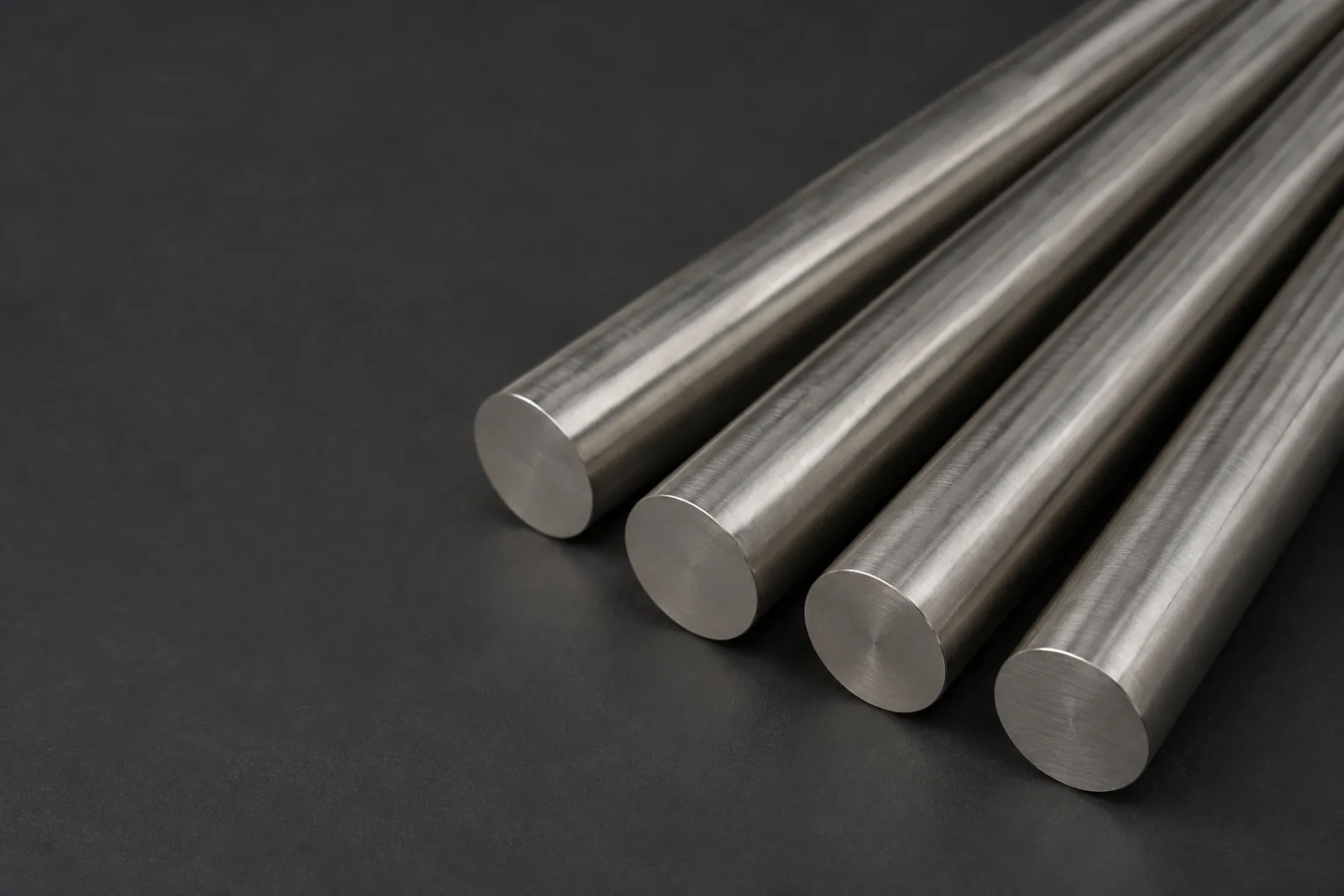
Materials Supply / Nickel, Cobalt & High-Temperature Alloys
Alloy 800H Nickel-Iron-Chromium Alloy
Austenitic Nickel-Iron-Chromium Alloy | UNS N08810 | W.Nr. 1.4958
Controlled-carbon nickel-iron-chromium alloy with coarse-grain annealing for elevated-temperature creep and rupture resistance.
Also known commercially as INCOLOY® alloy 800H. INCOLOY and 800HT are trademarks of the Special Metals Corporation group of companies. Quest Engineering does not own these trademarks.
Alloy 800, 800H and 800HT are separate grades. Selection requires assessment of chemistry, grain size, treatment, product form and the applicable specification; no automatic substitution is implied.
Raw & semi-finished materials
Available material forms
Producer-listed potential forms only. Availability depends on specification, dimensions, condition and supplier confirmation; no stock or immediate availability is implied.
- Round Bar
- Plate
- Sheet
- Strip
- Pipe
- Tube
- Wire
- Forging Stock
- Cut-to-Size Material
Material overview
Alloy 800H Nickel-Iron-Chromium Alloy
Controlled-carbon nickel-iron-chromium alloy with coarse-grain annealing for elevated-temperature creep and rupture resistance.
- Controlled-carbon nickel-iron-chromium alloy with coarse-grain annealing for elevated-temperature creep and rupture resistance.
- Typical producer properties are not guaranteed minima or design allowables.
- Confirm the service environment and ordered product specification before selection.
Material specifications & designations
| Designation / specification | Product form / scope | Notes |
|---|---|---|
| UNS | N08810 | Grade-specific identifier |
| W.Nr. / EN | 1.4958 | SMC-047 lists 1.4876, 1.4958 and 1.4959 collectively without a one-to-one mapping. VDM H/HP designation table supports 1.4958 for H and 1.4959 for HP/N08811; 1.4876 is also an H reference under EN 10095. Not universal equivalence. |
| Alternative commercial name | INCOLOY® alloy 800H | Special Metals trademark; not a separate generic specification |
| ASTM B408 | Hot-/cold-worked rod and bar | Public B408-22 scope explicitly includes N08810 |
| ASTM B409 | Rolled plate, sheet and strip | Public B409-01 scope includes N08810; historical reference. ASTM WK100195 proposes removal of N08800/N08810/N08811 from B409-22; verify current revision. |
| ASTM B407 | Cold-worked and hot-finished annealed seamless pipe and tube | Public B407-04 scope explicitly includes N08810 |
| ASTM B564 | Forgings | Producer-listed; current grade/condition requirements need full-standard review |
| ASTM B163 | Seamless condenser and heat-exchanger tubes | Producer-listed; not a general pipe specification |
| ASTM B514 | Welded pipe | Producer-listed; verify ordered grade and condition |
| ASTM B515 | Welded tube | Producer-listed; verify ordered grade and condition |
| ASTM B366 | Wrought fittings | Producer-listed; verify exact grade and fitting requirements |
| ASME SB 408 | Rod and bar | Producer-listed; verify adopted Code edition, grade, condition and design rules; ASTM and ASME revisions are not automatically identical. |
| ASME SB 409 | Plate, sheet and strip | Producer-listed; verify adopted Code edition, grade, condition and design rules; ASTM and ASME revisions are not automatically identical. |
| ASME SB 407 | Seamless pipe and tube | Producer-listed; verify adopted Code edition, grade, condition and design rules; ASTM and ASME revisions are not automatically identical. |
| ASME SB 564 | Forgings | Producer-listed; verify adopted Code edition, grade, condition and design rules; ASTM and ASME revisions are not automatically identical. |
| ASME SB 163 | Seamless condenser/heat-exchanger tube | Producer-listed; verify adopted Code edition, grade, condition and design rules; ASTM and ASME revisions are not automatically identical. |
| ASME SB 514 | Welded pipe | Producer-listed; verify adopted Code edition, grade, condition and design rules; ASTM and ASME revisions are not automatically identical. |
| ASME SB 515 | Welded tube | Producer-listed; verify adopted Code edition, grade, condition and design rules; ASTM and ASME revisions are not automatically identical. |
| ASME SB 366 | Fittings | Producer-listed; verify adopted Code edition, grade, condition and design rules; ASTM and ASME revisions are not automatically identical. |
Grade associations are producer-listed, not a claim of certification. Public ASTM abstracts verify selected scopes only. Full current ASTM/ASME/AMS standards were not accessible. General-requirement companions B829/B906/B775/B751 are not standalone grade specifications. No filler-metal specification is represented as parent metal. No AMS parent-metal specification is independently established for this grade here. Reference associations only: no equivalence, stock availability, aerospace approval or certified conformity is established by this page. Specify the ordered revision, product form, dimensions, manufacture/melt route, delivery condition and acceptance tests; obtain matching supplier confirmation and inspection documents.
Specification review
Technical verification requirements
Designations / ordered product condition
N08810 requires carbon and grain-size control; confirm ordered product standard, grain-size evidence and solution treatment, not chemistry alone. Existing cautions do not prove conformity; no allegation that every listed scope is wrong. Obtain the ordered revision and map each cited specification to form, dimensions, manufacture, delivery condition and acceptance tests.
Obtain licensed ordered editions and issue a material-specific form/condition/size compliance matrix; retain existing caveats pending approval.
Grade selection
Alloy 800, 800H and 800HT compared
| Requirement | Alloy 800 (N08800) | Alloy 800H (N08810) | Alloy 800HT (N08811) |
|---|---|---|---|
| C, mass % | ≤0.10 | 0.05–0.10 | 0.06–0.10 |
| Al, mass % | 0.15–0.60 | 0.15–0.60 | 0.25–0.60 |
| Ti, mass % | 0.15–0.60 | 0.15–0.60 | 0.25–0.60 |
| Al+Ti, mass % | 0.30–1.20 | 0.30–1.20 | 0.85–1.20 |
| Grain size | Not specified in general comparison | ASTM No. 5 or coarser | ASTM No. 5 or coarser |
| Solution anneal | Ordinary annealing; not the H/HT creep-strength treatment | Producer normally uses 1150–1200°C to develop coarse grain | 1149°C minimum stated; basic practice normally 1150–1200°C |
| Typical use | Heat exchangers, process equipment, furnace fixtures | Long-term elevated-temperature creep duty | More restricted chemistry for elevated-temperature creep/rupture duty |
SMC-047 pp. 1–2, 10. General producer requirements, not a transcription of every current product standard. Special-order chemistry/grain limits can differ. Dual/triple certification depends on actual chemistry, processing, testing and the ordered specification; chemistry overlap alone does not establish conformity or interchangeability.
Engineering reference
Technical data
| Element | Mass % |
|---|---|
| Nickel | 30.0–35.0 |
| Chromium | 19.0–23.0 |
| Iron | ≥39.5 |
| Carbon | 0.05–0.10 |
| Aluminium | 0.15–0.60 |
| Titanium | 0.15–0.60 |
| Aluminium + titanium | 0.30–1.20 |
SMC-047 Table 1, general requirements, N08810 column only. This table does not publish Mn, Si, S, Cu or P limits; none have been imported from another grade or source. Obtain the full ordered specification and heat analysis.
| Property | Value | Temperature / basis |
|---|---|---|
| Density | 7940 kg/m³ | Temperature not stated |
| Melting range | 1357–1385°C | Melting interval |
| Specific heat | 460 J/(kg·K) | 0–100°C |
| Tensile modulus | 196.5 GPa | 20°C; dynamic method |
| Electrical resistivity | 0.989 µΩ·m | 20°C |
| Thermal conductivity | 11.5 W/(m·K) | 20°C |
| Thermal conductivity | 21.1 W/(m·K) | 600°C |
| Mean coefficient of thermal expansion | 14.4 × 10⁻⁶/K | 21–100°C |
| Mean coefficient of thermal expansion | 17.1 × 10⁻⁶/K | 21–600°C |
| Mean coefficient of thermal expansion | 18.0 × 10⁻⁶/K | 21–800°C |
SMC-047 Tables 2–4 explicitly state no significant physical/thermal differences between 800H/800HT and 800. Typical informational values, not specification limits; other condition details are not supplied. Density converted from 7.94 g/cm³.
Annealed plate
| Property | Value | Basis |
|---|---|---|
| Ultimate tensile strength | 536 MPa | SMC-047 Table 5: 20.7 mm annealed plate at 27°C; source explicitly reports jointly for 800H/800HT, not separate heat-specific tests. Gauge length/orientation and exact annealing cycle not stated. |
| 0.2% yield strength | 150 MPa | SMC-047 Table 5: 20.7 mm annealed plate at 27°C; source explicitly reports jointly for 800H/800HT, not separate heat-specific tests. Gauge length/orientation and exact annealing cycle not stated. |
| Elongation | Not reported | SMC-047 Table 5: 20.7 mm annealed plate at 27°C; source explicitly reports jointly for 800H/800HT, not separate heat-specific tests. Gauge length/orientation and exact annealing cycle not stated. |
| Hardness | 126 BHN | SMC-047 Table 5: 20.7 mm annealed plate at 27°C; source explicitly reports jointly for 800H/800HT, not separate heat-specific tests. Gauge length/orientation and exact annealing cycle not stated. |
| Reduction of area | Not reported | SMC-047 Table 5: 20.7 mm annealed plate at 27°C; source explicitly reports jointly for 800H/800HT, not separate heat-specific tests. Gauge length/orientation and exact annealing cycle not stated. |
Typical producer measurements, not specification minima. Do not combine properties from other specimens, forms or conditions. SMC-047 Table 5: 20.7 mm annealed plate at 27°C; source explicitly reports jointly for 800H/800HT, not separate heat-specific tests. Gauge length/orientation and exact annealing cycle not stated.
Suitability depends on loading, temperature, exposure duration, atmosphere and service life; no single maximum service-temperature rating is implied.
Elevated-temperature tensile — annealed plate, Alloy 800H
| Temperature °C | UTS MPa | Yield MPa | Elongation % |
|---|---|---|---|
| 425 | 465 | 130 | Not reported |
| 540 | 432 | 90 | Not reported |
| 650 | 378 | 93 | Not reported |
| 705 | 329 | 109 | Not reported |
| 760 | 236 | 90 | Not reported |
SMC-047 Table 5, annealed 20.7 mm plate; the producer jointly labels these data 800H/800HT. Elongation is not tabulated; no graph values have been estimated. Typical measurements, not design allowables; yield is 0.2% offset.
Parent-metal creep/rupture performance is presented graphically in the bulletin; no numerical stress–rupture table is transcribed without validated extraction. Weld-metal rupture tables are not parent-metal data. Controlled chemistry and coarse-grain annealing improve creep/rupture strength over standard 800; do not equate 800H and 800HT design stresses.
High-temperature solution anneal
Producer basic practice normally uses 1150–1200°C, with time adjusted for section and furnace to achieve ASTM No. 5 or coarser, avoiding excessive grain growth.
800H chemistry and grain control
Controlled carbon 0.05–0.10% and average ASTM No. 5 or coarser are both required in the producer general basis. Do not infer that an ordinary 800 anneal qualifies as 800H.
Cooling and post-fabrication treatment
After hot working, air cool or faster; rapid cooling through 540–760°C is important when sensitisation is a concern. Stress relief is not automatically equivalent to solution annealing; assess cold strain, component restraint and service conditions.
Producer guidance only, not a qualified shop schedule. Holding time, cooling, final grain size and verification require product-specific agreement; no precipitation-ageing condition is implied.
Material selection
Corrosion resistance & performance
Chromium contributes resistance to oxidation and nickel contributes resistance to carburisation and selected corrosive environments; performance depends on atmosphere, contaminants and thermal cycling.
Sensitisation and carbide precipitation can affect intergranular corrosion behaviour. Assess the final fabrication and thermal history for the actual aqueous or high-temperature duty.
Resistance to chloride stress-corrosion cracking is not immunity to pitting, crevice attack or every chloride environment. No universal corrosion approval is implied.
Typical applications
Engineering applications
- Steam/hydrocarbon reformer catalyst and convection tubing
- Petrochemical furnace pigtails and outlet manifolds
- Ethylene convection and cracking tubes
- Furnace radiant tubes, muffles, retorts and fixtures
- Steam superheating tubing and high-temperature heat exchangers
Subsequent manufacturing
Machining & processing
Machinability and tooling
Use rigid setups, sharp tools, suitable coolant and sustained cuts. Producer guidance includes coated carbide and high-speed-steel tooling; select for interrupted cuts and actual condition. No universal cutting speed is specified.
Work hardening and forming
Austenitic material work-hardens during cold deformation. Allow for springback, tool loads and intermediate annealing. For H/HT creep duty, restore and verify the required grain structure after substantial fabrication strain.
Welding
Use a qualified procedure and service-appropriate filler. Clean joints and control heat input and interpass conditions. Weld-metal strength and corrosion behaviour require separate assessment; matching parent-metal chemistry is not proof of weld creep performance.
Distortion and residual stress
Plan weld sequence, restraint and machining allowances to manage distortion. Highly strained or restrained parts can crack during reheating; agree any post-fabrication treatment with the design authority.
Finishing
Remove oil, grease and contaminants before heating; use controlled low-sulfur heating practice. Qualify descaling/pickling for nickel alloys and avoid embedded ferrous contamination.
Inspection
Verify grade identity, dimensions, surface condition and heat-treatment traceability. Where specified, assess grain size, weld quality and NDT acceptance against the ordered form and standard.
Material certification & testing
Documentation and inspection options are subject to order agreement and supplier confirmation:
Conformity must be demonstrated against the ordered specification, revision, product form and condition. Tests and certificates are not automatic; no blanket aerospace or pressure-code approval is implied.
- EN 10204 3.1 material certificates
- Certificates of Conformity
- Heat/batch traceability
- Chemical analysis
- Mechanical testing
- Heat-treatment records
- Hardness testing
- Positive Material Identification (PMI)
- Ultrasonic testing where applicable
- Additional aerospace or customer-specific inspection requirements
Material enquiry
Request a material quotation
Alloy 800H Nickel-Iron-Chromium Alloy supplied to your material form, dimensions and specification.