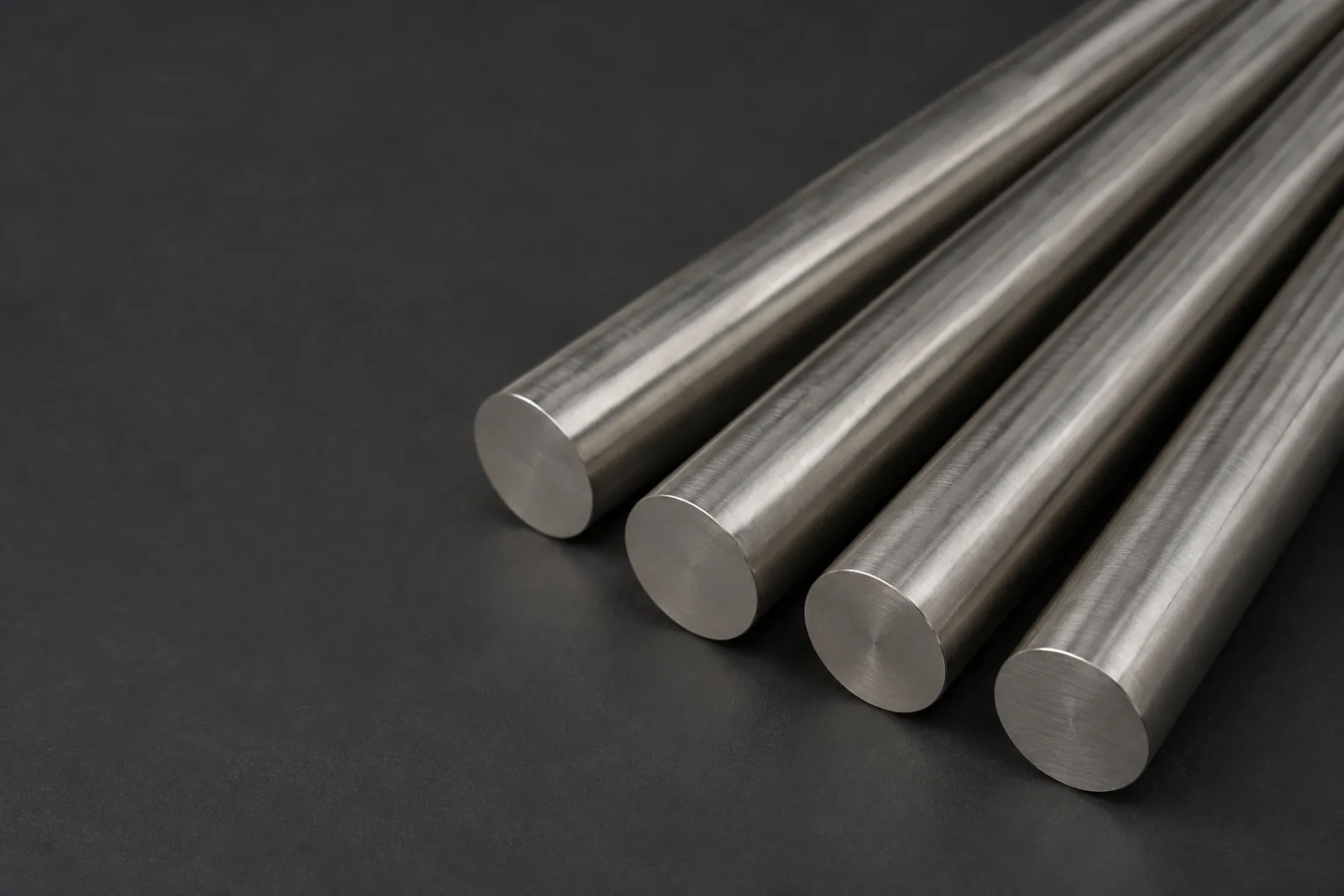
Materials Supply / Nickel, Cobalt & High-Temperature Alloys
Alloy 825 Nickel-Iron-Chromium Alloy
Corrosion-resistant nickel-iron-chromium alloy | UNS N08825 | W.Nr. 2.4858
Alloy 825 contains molybdenum, copper and titanium to support resistance to general and localised corrosion in a range of reducing and oxidising environments. Selection requires assessment of the actual process chemistry, temperature and fabrication condition.
INCOLOY® alloy 825 is a recognised alternative commercial name. INCOLOY and INCONEL are trademarks of the Special Metals Corporation group of companies; Quest Engineering does not own these trademarks.
Unlike Alloy 800, 800H and 800HT, Alloy 825 is selected primarily for corrosion resistance, not high-temperature creep strength. Its mechanical and heat-treatment data must not be substituted for those grades.
Raw & semi-finished materials
Available material forms
Availability depends on specification, dimensions, material condition and supplier confirmation; no stock is implied.
- Round Bar
- Flat Bar
- Hexagon Bar
- Plate
- Sheet
- Strip
- Wire
- Tube
- Pipe
- Forging Stock
- Cut-to-Size Material
Material overview
Alloy 825 Nickel-Iron-Chromium Alloy
Nickel-iron-chromium alloy with molybdenum, copper and titanium for demanding chemical and process environments.
- Titanium stabilisation with appropriate heat treatment supports resistance to sensitisation and intergranular corrosion.
- Cold work can substantially increase strength; property values depend on product form and condition.
- Producer data are representative information, not purchase-specification acceptance limits.
Designations and specifications
| Designation / specification | Product form / scope | Notes |
|---|---|---|
| UNS N08825 | Alloy identity | Producer-confirmed; not a product specification. |
| W.Nr. 2.4858 | European material number | Producer p. 1 and p. 3; no independent current EN specification equivalence asserted. |
| INCOLOY® alloy 825 | Alternative commercial name | Special Metals Corporation group trademark. |
| ASTM B425 | Hot-finished and cold-drawn rod/bar: rounds, squares, hexagons and rectangles | Public ASTM scope explicitly includes N08825. |
| ASTM B424 | Rolled plate, sheet and strip | Public ASTM scope explicitly includes N08825. |
| ASTM B423 | Cold-worked and hot-finished seamless pipe and tube for general corrosive service | Public ASTM abstract explicitly includes N08825. |
| ASTM B564 | Nickel-alloy forgings | Public ASTM scope explicitly includes N08825; not a generic bar specification. |
| ASTM B163 | Seamless condenser and heat-exchanger tubes | Producer-listed; full current grade/size/condition requirements not reviewed. |
| ASTM B704 | Welded tube | Producer-listed; full current requirements not reviewed. |
| ASTM B705 | Welded pipe | Producer-listed; full current requirements not reviewed. |
| ASTM B751 | General requirements for welded tube | Supplementary general requirements, not a standalone Alloy 825 product specification. |
| ASTM B775 | General requirements for welded pipe | Supplementary general requirements, not a standalone Alloy 825 product specification. |
| ASTM B829 | General requirements for seamless pipe and tube | Public ASTM scope links B423 and B163; not standalone grade certification. |
| ASTM B906 | General requirements for flat-rolled nickel alloys | Producer-listed supplementary requirements; not standalone grade certification. |
| ASTM B366 | Factory-made wrought nickel-alloy fittings | Producer-listed; full current grade/class requirements not reviewed. |
| ASME SB425 | Hot-finished and cold-drawn rod/bar: rounds, squares, hexagons and rectangles | Listed by producer as ASME counterpart; current Code edition, permitted condition and design rules require confirmation. |
| ASME SB424 | Rolled plate, sheet and strip | Listed by producer as ASME counterpart; current Code edition, permitted condition and design rules require confirmation. |
| ASME SB423 | Cold-worked and hot-finished seamless pipe and tube for general corrosive service | Listed by producer as ASME counterpart; current Code edition, permitted condition and design rules require confirmation. |
| ASME SB564 | Nickel-alloy forgings | Listed by producer as ASME counterpart; current Code edition, permitted condition and design rules require confirmation. |
| ASME SB163 | Seamless condenser and heat-exchanger tubes | Listed by producer as ASME counterpart; current Code edition, permitted condition and design rules require confirmation. |
| ASME SB704 | Welded tube | Listed by producer as ASME counterpart; current Code edition, permitted condition and design rules require confirmation. |
| ASME SB705 | Welded pipe | Listed by producer as ASME counterpart; current Code edition, permitted condition and design rules require confirmation. |
| ASME SB751 | General requirements for welded tube | Listed by producer as ASME counterpart; current Code edition, permitted condition and design rules require confirmation. |
| ASME SB775 | General requirements for welded pipe | Listed by producer as ASME counterpart; current Code edition, permitted condition and design rules require confirmation. |
| ASME SB829 | General requirements for seamless pipe and tube | Listed by producer as ASME counterpart; current Code edition, permitted condition and design rules require confirmation. |
| ASME SB906 | General requirements for flat-rolled nickel alloys | Listed by producer as ASME counterpart; current Code edition, permitted condition and design rules require confirmation. |
| ASME SB366 | Factory-made wrought nickel-alloy fittings | Listed by producer as ASME counterpart; current Code edition, permitted condition and design rules require confirmation. |
Producer p. 3; public ASTM abstracts checked for B425, B424, B423, B564 and B829. No applicable parent-metal AMS specification verified; none asserted. Current full ASTM/ASME standards were not accessible. Do not infer that every listed standard covers every form or condition. Filler metals are not parent-metal specifications. Reference associations only: no equivalence, stock availability, aerospace approval or certified conformity is established by this page. Specify the ordered revision, product form, dimensions, manufacture/melt route, delivery condition and acceptance tests; obtain matching supplier confirmation and inspection documents.
Specification review
Technical verification requirements
Designations / ordered product condition
Annealed corrosion-resistant material and typical mechanical examples do not establish universal SCC immunity or current ASTM/AMS acceptance; verify ordered condition and stabilisation. Existing cautions do not prove conformity; no allegation that every listed scope is wrong. Obtain the ordered revision and map each cited specification to form, dimensions, manufacture, delivery condition and acceptance tests.
Obtain licensed ordered editions and issue a material-specific form/condition/size compliance matrix; retain existing caveats pending approval.
Engineering reference
Technical data
| Element | Mass % |
|---|---|
| Nickel | 38.0–46.0 |
| Iron | 22.0 min. |
| Chromium | 19.5–23.5 |
| Molybdenum | 2.5–3.5 |
| Copper | 1.5–3.0 |
| Titanium | 0.6–1.2 |
| Carbon | 0.05 max. |
| Manganese | 1.0 max. |
| Sulfur | 0.03 max. |
| Silicon | 0.5 max. |
| Aluminium | 0.2 max. |
Table 1 limiting mass percentages, one producer source only. Elements without stated limits are not assigned invented values.
| Property | Value | Temperature / basis |
|---|---|---|
| Density | 8140 kg/m³ | Table 2; reference temperature not stated |
| Melting range | 1370–1400 °C | Table 2 |
| Specific heat | 440 J/(kg·K) | Table 2; reference temperature not stated |
| Young’s modulus | 196 GPa | 20 °C; hot-rolled and annealed plate, dynamic measurement |
| Young’s modulus | 168 GPa | 500 °C; hot-rolled and annealed plate |
| Thermal conductivity | 11.1 W/(m·K) | 25 °C |
| Thermal conductivity | 18.2 W/(m·K) | 500 °C |
| Electrical resistivity | 1.13 μΩ·m | 25 °C |
| Electrical resistivity | 1.26 μΩ·m | 500 °C |
| Mean linear thermal expansion | 14.1 × 10⁻⁶ K⁻¹ | 27–100 °C |
| Mean linear thermal expansion | 14.8 × 10⁻⁶ K⁻¹ | 27–200 °C |
| Mean linear thermal expansion | 15.3 × 10⁻⁶ K⁻¹ | 27–300 °C |
| Mean linear thermal expansion | 15.6 × 10⁻⁶ K⁻¹ | 27–400 °C |
| Mean linear thermal expansion | 15.8 × 10⁻⁶ K⁻¹ | 27–500 °C |
| Mean linear thermal expansion | 16.0 × 10⁻⁶ K⁻¹ | 27–600 °C |
| Mean linear thermal expansion | 16.7 × 10⁻⁶ K⁻¹ | 27–700 °C |
| Mean linear thermal expansion | 17.3 × 10⁻⁶ K⁻¹ | 27–800 °C |
Tables 2–4. Typical informational values, not specification limits. Density converted exactly from 8.14 Mg/m³; unspecified reference temperatures are not assumed.
Annealed — tubing
| Property | Value | Basis |
|---|---|---|
| Ultimate tensile strength | 772 MPa | Typical, room temperature |
| 0.2% proof/yield strength | 441 MPa | Typical, room temperature |
| Elongation | 36% | Typical; gauge length not stated |
| Hardness | Not reported | No value provided in Table 5 |
| Reduction of area | Not reported | No value provided in Table 5 |
Producer p. 2 Table 5, typical room-temperature values, not guaranteed minima. Table 5 does not specify section dimensions, elongation gauge length or annealing schedule; do not transfer the separate Figure 1 rod condition to these data.
Cold drawn — tubing
| Property | Value | Basis |
|---|---|---|
| Ultimate tensile strength | 1000 MPa | Typical, room temperature |
| 0.2% proof/yield strength | 889 MPa | Typical, room temperature |
| Elongation | 15% | Typical; gauge length not stated |
| Hardness | Not reported | No value provided in Table 5 |
| Reduction of area | Not reported | No value provided in Table 5 |
Producer p. 2 Table 5, typical room-temperature values, not guaranteed minima. Table 5 does not specify section dimensions, elongation gauge length or annealing schedule; do not transfer the separate Figure 1 rod condition to these data.
Annealed — bar
| Property | Value | Basis |
|---|---|---|
| Ultimate tensile strength | 690 MPa | Typical, room temperature |
| 0.2% proof/yield strength | 324 MPa | Typical, room temperature |
| Elongation | 45% | Typical; gauge length not stated |
| Hardness | Not reported | No value provided in Table 5 |
| Reduction of area | Not reported | No value provided in Table 5 |
Producer p. 2 Table 5, typical room-temperature values, not guaranteed minima. Table 5 does not specify section dimensions, elongation gauge length or annealing schedule; do not transfer the separate Figure 1 rod condition to these data.
Annealed — plate
| Property | Value | Basis |
|---|---|---|
| Ultimate tensile strength | 662 MPa | Typical, room temperature |
| 0.2% proof/yield strength | 338 MPa | Typical, room temperature |
| Elongation | 45% | Typical; gauge length not stated |
| Hardness | Not reported | No value provided in Table 5 |
| Reduction of area | Not reported | No value provided in Table 5 |
Producer p. 2 Table 5, typical room-temperature values, not guaranteed minima. Table 5 does not specify section dimensions, elongation gauge length or annealing schedule; do not transfer the separate Figure 1 rod condition to these data.
Annealed — sheet
| Property | Value | Basis |
|---|---|---|
| Ultimate tensile strength | 758 MPa | Typical, room temperature |
| 0.2% proof/yield strength | 421 MPa | Typical, room temperature |
| Elongation | 39% | Typical; gauge length not stated |
| Hardness | Not reported | No value provided in Table 5 |
| Reduction of area | Not reported | No value provided in Table 5 |
Producer p. 2 Table 5, typical room-temperature values, not guaranteed minima. Table 5 does not specify section dimensions, elongation gauge length or annealing schedule; do not transfer the separate Figure 1 rod condition to these data.
Suitability depends on loading, temperature, exposure duration, atmosphere and service life; no single maximum service-temperature rating is implied.
Producer p. 2 warns that exposure above about 540 °C may cause phase formation that significantly lowers ductility and impact strength. Alloy 825 is not normally used where creep-rupture properties govern design. Figure 1 gives elevated-temperature tensile curves for 19 mm cold-drawn rod annealed at 940 °C for 1 h; no numerical curve values have been estimated. No tabulated stress-rupture or atmosphere/temperature/duration oxidation data are provided, so none are asserted. Source: Special Metals SMC-030, September 2004, https://www.specialmetals.com/documents/technical-bulletins/incoloy/incoloy-alloy-825.pdf
Fabrication annealing and stabilisation
Producer recommends subsequent anneals at 930–980 °C followed by rapid air cooling or water quenching. The lower end is acceptable for stabilisation; the upper end may be preferred for softness and grain structure for forming and deep drawing. No universal holding time is stated.
Section and subsequent fabrication
Quenching is usually unnecessary for thin sheet, strip and wire, but may be desirable in heavier sections to avoid sensitisation. A stabilising anneal restores corrosion resistance after hot working; it is required where subsequent welding or thermal treatment is followed by service in media capable of causing intergranular corrosion, regardless of hot-working cooling rate.
Producer p. 3. Mill treatment balances stabilisation, corrosion resistance, mechanical properties and formability. Agree the actual procedure and cooling method for the ordered form and specification; this is not a precipitation-ageing alloy schedule.
Material selection
Corrosion resistance & performance
Nickel supports resistance to chloride-ion stress-corrosion cracking; resistance is not immunity under every stress, temperature or chloride condition.
Nickel with molybdenum and copper supports resistance to reducing environments, including sulfuric and phosphoric acids. Chromium supports resistance to oxidising substances including nitric acid, nitrates and oxidising salts.
Molybdenum aids pitting and crevice-corrosion resistance. Actual localised-corrosion performance depends on chemistry, temperature, deposits and crevice geometry; no universal chloride limit is asserted.
Titanium with appropriate heat treatment stabilises against sensitisation and intergranular attack; heavy-section cooling and subsequent thermal cycles require attention.
Producer identifies sulfur-containing flue gases, sour oil/gas wells and seawater among useful environments. Sour-service acceptance requires assessment against the ordered current requirements; a historical NACE MR0175 listing is not blanket approval.
Typical applications
Engineering applications
- Chemical processing and acid-handling equipment
- Sulfuric and phosphoric acid production and pickling operations
- Pollution-control equipment
- Oil and gas recovery equipment
- Seawater and industrial process equipment, subject to environment-specific assessment
- Heat-exchanger tubing and corrosion-resistant process piping, subject to the ordered product specification
- Nuclear fuel reprocessing and radioactive-waste handling equipment
Subsequent manufacturing
Machining & processing
Machinability and tooling
Producer reports standard machining operations are practicable and optimum machining behaviour normally occurs in the annealed temper. Use tooling and procedures appropriate to Special Metals Group C alloys; establish parameters for the actual tool, rigidity, section and condition rather than universal cutting speeds.
Work hardening and cold forming
Work-hardening rate is relatively high although below common austenitic stainless steels. Use strongly built, adequately powered forming equipment and account for increasing yield strength with deformation.
Hot forming
Producer hot-working range is 870–1180 °C; final hot working at 870–980 °C is recommended for optimum corrosion resistance. Cool in air or faster; heavy sections may require stabilising annealing.
Welding
Producer reports good weldability by conventional processes. It identifies INCONEL Welding Electrode 112 and Filler Metal 625 for many applications, and INCO-WELD 686CPT products where higher corrosion resistance is required. These are welding consumables, not Alloy 825 parent-metal specifications; qualify filler and procedure for the actual service.
Distortion control
Plan restraint, weld sequence, machining allowance and cooling to control distortion; verify dimensions after welding and thermal treatment. No universal distortion allowance is supported.
Finishing and inspection
Specify surface preparation, pickling and finishing compatible with the intended process environment. Agree surface acceptance, dimensional inspection and any weld or volumetric examination in the purchase order; do not assume all tests are automatic.
Material certification & testing
Certification and inspection options are subject to customer requirements and supplier confirmation.
Conformity must be demonstrated against the ordered specification, product form and condition. Tests and documents are not automatic; agree acceptance criteria, sampling and inspection scope before ordering.
- EN 10204 3.1 material certificates
- Certificates of Conformity
- Heat/batch traceability
- Chemical analysis
- Mechanical testing
- Heat-treatment records
- Hardness testing
- Positive Material Identification (PMI)
- Ultrasonic testing where applicable
- Additional aerospace or customer-specific inspection requirements
Material enquiry
Request a material quotation
Alloy 825 Nickel-Iron-Chromium Alloy supplied to your material form, dimensions and specification.