Materials Supply / Titanium & Titanium Alloys
Ti-10-2-3 / Ti-10V-2Fe-3Al Titanium Alloy
Near-beta high-strength forging alloy | UNS R56410 | Solution treated and aged
Ti-10-2-3 is a high-strength near-beta titanium alloy containing nominally 10% vanadium, 2% iron and 3% aluminium, balance titanium. Vanadium and iron are beta stabilisers; aluminium is an alpha stabiliser.
TIMET developed the alloy as TIMETAL® 10-2-3. TIMETAL® is a registered trademark of Titanium Metals Corporation.
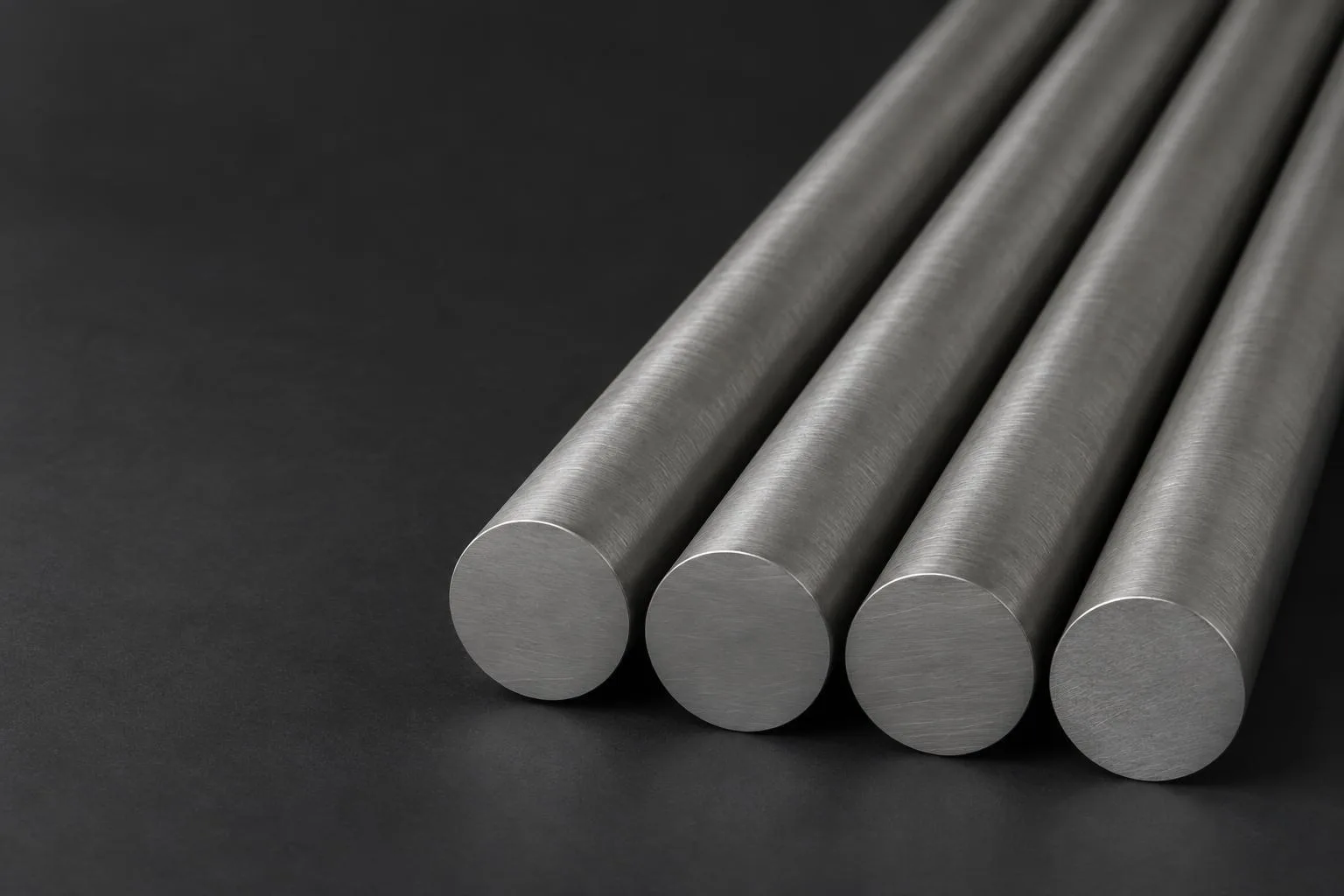
Imagery is illustrative only; it does not identify a certified grade, product condition or available stock.
Raw & semi-finished materials
Available material forms
TIMET presents Ti-10-2-3 as a forging alloy, with data for hand and die forgings. Supply remains subject to ordered specification, dimensions and supplier confirmation; no Quest stockholding is implied.
- Forgings
- Billet
- Round bar
Material overview
Ti-10-2-3 / Ti-10V-2Fe-3Al Titanium Alloy
High-strength, deep-hardenable near-beta titanium forging alloy with nominally 10% vanadium, 2% iron and 3% aluminium.
- TIMET describes the alloy as a high-strength, deep-hardenable forging alloy for airframes and engines, metallurgically near-beta, suited to near-net-shape forging and offering excellent strength–toughness combinations.
- TIMET states it has very high fatigue life and is well suited to safe-life designs. Strength and toughness trade against each other: higher ageing temperatures give lower strength and higher fracture toughness.
- Properties depend on section size and ageing temperature, so the three AMS strength levels are shown as separate conditions. No single universal strength value applies.
Designations and product specifications
| Designation / standard | Scope / status |
|---|---|
| UNS | R56410 |
| AMS 4984 | Solution treated and aged, aged 482–510°C, sections to 76 mm (TIMET Table 3). Current revision not accessed. |
| AMS 4986 | Solution treated and aged, aged 510–538°C, sections to 102 mm (TIMET Table 3). Current revision not accessed. |
| AMS 4987 | Solution treated and aged, aged 566–593°C, sections to 102 mm (TIMET Table 3). Current revision not accessed. |
UNS R56410 is widely used for this alloy but was not confirmed in the producer datasheet; confirm on the ordered specification. No European material number verified.
Specification review
Technical verification requirements
Specification revision / product-form acceptance
Producer and historical references support much of the page; they do not establish all current ordered editions, product-form scope, treatment, section limits and acceptance provisions. This is a verification dependency, not evidence that these references are wrong.
Obtain ordered editions and record form/condition/thickness/orientation/test-temperature coverage separately for every listed specification; retain historical-data caveats.
Chemistry / AMS mechanical scope
Excluding a printed limit merely because unusually low leaves chemistry incomplete; producer confirmation required. Mechanical numbers match historical Table3, but current AMS product form, orientation and toughness testing applicability are not established.
Verify residual total, UNS R56410 and current AMS form/condition/toughness acceptance. Do not describe old producer table as present contractual guarantee.
Grade selection
Ti-10-2-3 compared with Ti-5553
| Property | Ti-10-2-3 | Ti-5553 |
|---|---|---|
| UNS | R56410 | Not verified from an authoritative source |
| Nominal composition | Ti-10V-2Fe-3Al | Ti-5Al-5Mo-5V-3Cr (producer heading; composition block conflicts: V 2.00) |
| Classification (producer) | Near-beta (TIMET) | Quasi-beta (Aubert & Duval) |
| Beta transus (producer) | 800°C | 860°C |
| Density (producer) | 4650 kg/m³ | 4.64 (unit and temperature not stated; no verified SI conversion) |
| Heat-treatment routes (producer) | Solution treat below beta transus, then age 482–593°C for 8 h | STA, or BASCA (beta anneal, slow cool and age) |
| Typical applications | Landing gear, fittings, fasteners, actuators, flap tracks, rotor heads (TIMET) | Structural parts and landing gear (Aubert & Duval) |
Qualitative and physical producer comparison only. The two producer documents give strength on different bases (Ti-10-2-3 AMS guaranteed minimums by section; Ti-5553 typical ranges without section size), so no numerical strength comparison is shown. The alloys are not interchangeable.
Engineering reference
Technical data
| Element | Mass % | Limit |
|---|---|---|
| Ti | Balance | Remainder |
| V | 9.0–11.0 | Range |
| Fe | 1.6–2.2 | Range |
| Al | 2.6–3.4 | Range |
| O | 0.13 | Maximum |
| C | 0.05 | Maximum |
| N | 0.05 | Maximum |
| H | 0.015 | Maximum |
| Residual elements, each | 0.10 | Maximum |
Producer Table 1 limits, one source. The printed residual-elements total (0.13%) is not adopted because it is unusually low and may be a misprint; obtain it from the ordered specification. Iron segregation control is important in this alloy; confirm melting-practice requirements in the AMS document.
| Property | Value | Temperature / basis |
|---|---|---|
| Density | 4650 kg/m³ | Temperature not stated |
| Beta transus | 800°C | Producer value |
| Mean thermal expansion | 9.7 × 10⁻⁶ K⁻¹ | 24–427°C |
| Tensile modulus | 109.6 GPa | Temperature not stated |
| Compressive modulus | 112.3 GPa | Temperature not stated |
| Shear modulus | 42.1 GPa | Temperature not stated |
| Poisson’s ratio | 0.32 | Temperature not stated |
Producer values, not acceptance limits. Thermal conductivity, specific heat, resistivity and melting range not given in this source and omitted.
Solution treated and aged — AMS 4984 minimum
| Property | Requirement |
|---|---|
| Ageing temperature (8 h) | 482–510°C |
| Maximum section thickness | 76 mm |
| Ultimate tensile strength, minimum | 1193 MPa |
| 0.2% yield strength, minimum | 1103 MPa |
| Elongation in 50 mm, minimum | 4% |
| Reduction of area, minimum | Not stated |
| Fracture toughness K1c, minimum | 44 MPa√m |
Guaranteed minimums as tabulated by TIMET (Table 3) for solution treated material aged 8 hours; room temperature. The current AMS revision was not accessed — confirm product form, orientation and any revised values in the ordered specification.
Solution treated and aged — AMS 4986 minimum
| Property | Requirement |
|---|---|
| Ageing temperature (8 h) | 510–538°C |
| Maximum section thickness | 102 mm |
| Ultimate tensile strength, minimum | 1103 MPa |
| 0.2% yield strength, minimum | 998 MPa |
| Elongation in 50 mm, minimum | 6% |
| Reduction of area, minimum | 10% |
| Fracture toughness K1c, minimum | 60 MPa√m |
Guaranteed minimums as tabulated by TIMET (Table 3) for solution treated material aged 8 hours; room temperature. The current AMS revision was not accessed — confirm product form, orientation and any revised values in the ordered specification.
Solution treated and aged — AMS 4987 minimum
| Property | Requirement |
|---|---|
| Ageing temperature (8 h) | 566–593°C |
| Maximum section thickness | 102 mm |
| Ultimate tensile strength, minimum | 965 MPa |
| 0.2% yield strength, minimum | 896 MPa |
| Elongation in 50 mm, minimum | 8% |
| Reduction of area, minimum | 20% |
| Fracture toughness K1c, minimum | 88 MPa√m |
Guaranteed minimums as tabulated by TIMET (Table 3) for solution treated material aged 8 hours; room temperature. The current AMS revision was not accessed — confirm product form, orientation and any revised values in the ordered specification.
TIMET typical elevated-temperature tensile properties after solution treatment and ageing at 510°C for 8 hours.
Typical tensile vs temperature — STA (aged 510°C / 8 h)
| Test temperature (°C) | UTS (MPa) | 0.2% YS (MPa) | Elongation (%) | RA (%) |
|---|---|---|---|---|
| 24 | 1214 | 1145 | 12 | 25 |
| 204 | 1117 | 1048 | 13 | 33 |
| 316 | 1103 | 979 | 13 | 42 |
Typical producer values; product form not stated. Not minimums or design allowables.
No creep or long-term exposure data verified. No maximum service temperature is stated.
Solution treatment
28–56°C (50–100°F) below the beta transus for a minimum of 30 minutes, then water quench. Air cooling may be used for parts under 25 mm (1 in) thick. Producer beta transus: 800°C.
Ageing
482–593°C (900–1100°F) for 8 hours, air cool. The ageing temperature selects the strength level (see the AMS 4984/4986/4987 conditions).
TIMET producer schedules specific to Ti-10-2-3; not copied from Ti-6Al-4V or Ti-5553. Ageing precipitates alpha in the retained beta matrix; lower ageing temperatures give higher strength and lower toughness. No stress-relief schedule is given in the producer source.
Material selection
Corrosion resistance & performance
The producer source used here gives stress-corrosion fracture toughness (K1SCC) results for STA forgings — for example K1c 82 MPa√m with K1SCC 79 MPa√m — but no general corrosion data. Assess the actual environment, galvanic coupling and hydrogen absorption.
Typical applications
Engineering applications
- Landing gear components
- Aircraft structural fittings
- Fasteners
- Actuators
- Flap tracks
- Helicopter rotor heads
Subsequent manufacturing
Machining & processing
Forging
TIMET highlights suitability for near-net-shape forging. Forging temperature relative to the low beta transus strongly affects microstructure; follow the ordered specification.
Welding
TIMET references electron-beam weldability studies. Shield the weld pool, trailing hot metal and root with inert gas (or weld in a chamber) to prevent oxygen, nitrogen and hydrogen pick-up. Qualify the procedure and any post-weld heat treatment for the ordered condition.
Machining
High-strength beta-rich titanium concentrates heat at the cutting edge and can gall. Use rigid set-ups, sharp tools, positive feed without rubbing and generous coolant. Qualify speeds and feeds for the actual condition; no universal cutting speed is given.
Fatigue
TIMET publishes smooth and notched (Kt = 3) S/N curves for STA (AMS 4984) forgings graphically only; values are not read off here.
Material certification & testing
Agree documentation and inspection at enquiry stage for the actual alloy, specification, form, section size and condition.
Not every test or certificate is automatically included. Aerospace use requires the applicable specification and documented acceptance; these records do not confer approval.
- EN 10204 3.1 material certificate, where agreed with the supplier
- Certificate of Conformity
- Heat / batch and forging traceability to the mill certificate
- Heat-treatment records identifying solution and ageing temperatures and section size
- Mechanical tests (and fracture toughness where specified) to the ordered specification
- Ultrasonic, PMI, aerospace-specific or customer-specific testing only where applicable and agreed
Material enquiry
Request a material quotation
Ti-10-2-3 / Ti-10V-2Fe-3Al Titanium Alloy supplied to your material form, dimensions and specification.