Materials Supply / Titanium & Titanium Alloys
Titanium Grade 5 / Ti-6Al-4V
Alpha–beta titanium alloy | UNS R56400 | Annealed and solution treated and aged
Ti-6Al-4V is an alpha–beta titanium alloy containing nominally 6% aluminium and 4% vanadium, widely used for its high strength-to-weight ratio, fatigue performance and corrosion resistance.
TIMET identifies TIMETAL® 6-4 with ASTM Grade 5. The trade name alone is not proof of conformity to any ordered ASTM, AMS or customer specification. TIMETAL® is a registered trademark of Titanium Metals Corporation.
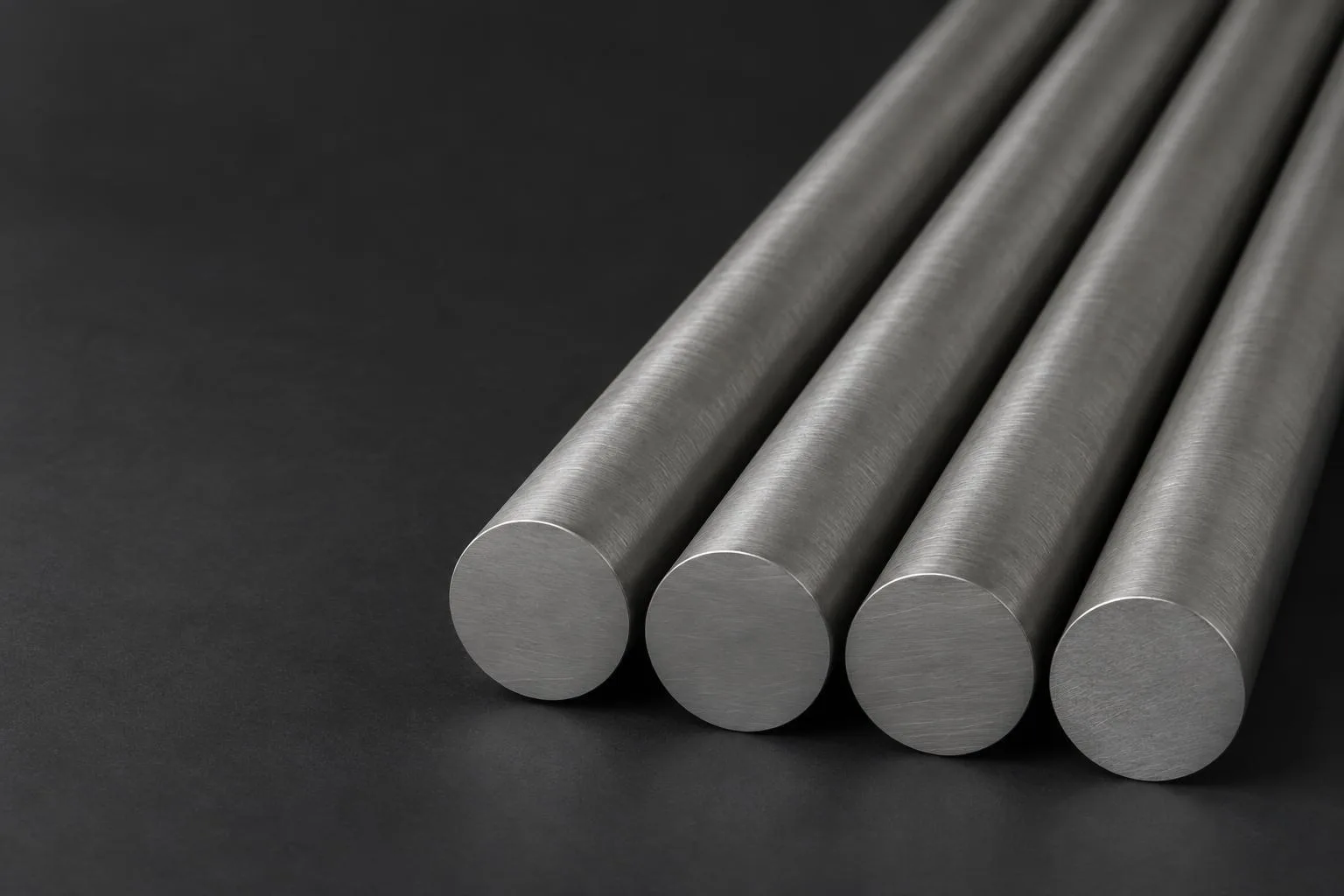
Imagery is illustrative only; it does not identify a certified grade, product condition or available stock.
Raw & semi-finished materials
Available material forms
TIMET lists billet, bar, wire, plate and sheet; ASTM B381 forging coverage per TIMET handbook Table 2. Grade 5 is not covered by the ASTM B337/B338 welded pipe and tube specifications in that table. Supply remains subject to ordered specification, dimensions and supplier confirmation; no Quest stockholding is implied.
- Round bar
- Billet
- Plate
- Sheet
- Strip
- Wire
- Forgings
Material overview
Titanium Grade 5 / Ti-6Al-4V
Alpha–beta titanium alloy with nominally 6% aluminium and 4% vanadium, used for its high strength-to-weight ratio, fatigue performance and corrosion resistance.
- Aluminium stabilises the alpha phase and vanadium the beta phase, giving a two-phase alpha–beta structure. TIMET notes that most properties depend on the microstructure produced by the thermomechanical history.
- The alloy can be strengthened by solution treatment and ageing; TIMET states it is hardenable in sections up to about 25 mm (1.0 in). Annealed and solution-treated-and-aged properties are shown as separate conditions below and must not be combined.
- TIMET states reasonable properties are retained up to about 350°C. This is a producer statement, not a design limit for any specific component.
Designations and product specifications
| Designation / standard | Scope / status |
|---|---|
| UNS | R56400 |
| ASTM B265 | Grade 5; strip, sheet and plate; B265-20a basis. |
| ASTM B348 | Grade 5; bars and billets; listed in TIMET datasheet Table 3; current revision unverified. |
| ASTM B381 | Grade F-5 forgings; TIMET handbook Table 2 confirms coverage; confirm current edition. |
| AMS 4911, 4928, 4965, 4967 | Listed for TIMETAL 6-4 in the TIMET alloy chart; scope, product form and condition of each must be confirmed from the current SAE document. |
| MIL-T-9047G | Historical/cancelled: MIL-T-9047G cancelled by Notice 3, 10 February 2005. TIMET quotations are historical reference data, not current procurement acceptance. The notice points to SAE-AMS-T-9047; verify subsequent supersession and the application-specific replacement before ordering. |
| Werkstoff (engineering) | 3.7164 / 3.7165; TIMET alloy chart reference, not a purchase-specification substitute. |
Full current AMS documents were not accessed. Listing a specification here does not mean every form or condition is available to it.
Specification review
Technical verification requirements
Specification revision / product-form acceptance
Producer and historical references support much of the page; they do not establish all current ordered editions, product-form scope, treatment, section limits and acceptance provisions. This is a verification dependency, not evidence that these references are wrong.
Obtain ordered editions and record form/condition/thickness/orientation/test-temperature coverage separately for every listed specification; retain historical-data caveats.
Designations / mechanical selector
Cancellation is established by notice text, but page does not identify historical/cancelled procurement status prominently. Existing caveat avoids claiming current validity; this is missing status, not proof the historical numbers are wrong.
Add cancelled/historical status in subsequent controlled correction; determine contractual revision and application-specific replacement, not blanket equivalence.
Grade selection
Titanium Grades 5, 7, 9 and 12 compared
| Property | Grade 5 | Grade 7 | Grade 9 | Grade 12 |
|---|---|---|---|---|
| UNS | R56400 | R52400 | R56320 | R53400 |
| Nominal alloying | Ti-6Al-4V | Ti-0.12–0.25Pd | Ti-3Al-2.5V | Ti-0.3Mo-0.8Ni |
| Metallurgical classification | Alpha–beta alloy | Palladium-modified commercially pure (alpha) titanium | Alpha–beta alloy | Lean near-alpha alloy (TIMET description) |
| Tensile strength, min MPa | 895 | 345 | 620 | 483 |
| 0.2% yield strength, min MPa | 828 | 275 | 483 | 345 |
| Elongation in 50 mm, min % | 10 | 20 | 15 | 18 |
| Relative formability | Lowest of the four at room temperature | High (similar to Grade 2) | Intermediate; cold formable | Good |
| Corrosion emphasis | Seawater and general corrosion | Reducing acids and crevice conditions where Pd benefit is established | Close to CP titanium | Crevice corrosion in hot brines; improved acid resistance over unalloyed grades |
| Typical applications | Aerospace structures, fasteners, engine and high-performance components | Chemical-process equipment, heat exchangers, piping | Aerospace hydraulic tubing, honeycomb, pressure piping | Chemical-process and brine heat exchangers, vessels, piping |
Numerical rows are ASTM B265-20a annealed strip, sheet and plate minimums only; they are not typical values and must not be applied to bar, tube, forgings or heat-treated conditions. Qualitative rows come from TIMET producer literature. The grades are not interchangeable; select against the ordered specification and the actual service duty.
Engineering reference
Technical data
| Element | Mass % | Limit |
|---|---|---|
| Ti | Balance | Remainder |
| Al | 5.50–6.75 | Range |
| V | 3.50–4.50 | Range |
| Fe | 0.40 | Maximum |
| O | 0.20 | Maximum |
| C | 0.08 | Maximum |
| N | 0.05 | Maximum |
| H | 0.015 | Maximum |
| Residual elements, each | 0.10 | Maximum |
| Residual elements, total | 0.40 | Maximum |
Single specification basis: ASTM B265-20a heat-analysis limits for strip, sheet and plate, reproduced through ASME SB-265. These are specification limits, not nominal values and not certified analysis. Other product-form specifications (bar, tube, pipe, forgings, AMS) can carry different hydrogen or interstitial limits; check the ordered specification. Product-analysis tolerances are separate. The same limits appear in TIMET datasheet Table 1.
| Property | Value | Temperature / basis |
|---|---|---|
| Density | 4420 kg/m³ | 22°C |
| Beta transus | 996 ± 14°C | Producer value |
| Melting (liquidus) | 1650–1660°C | Producer value |
| Thermal conductivity | 6.6 W/(m·K) | 20°C, mill annealed |
| Thermal conductivity | 17.5 W/(m·K) | 650°C, mill annealed |
| Specific heat | 580 J/(kg·K) | 20°C |
| Electrical resistivity | 1.68 µΩ·m | 0°C |
| Mean thermal expansion | 9.0 × 10⁻⁶ K⁻¹ | 0–100°C |
| Mean thermal expansion | 9.7 × 10⁻⁶ K⁻¹ | 20–650°C |
| Young’s modulus | 107–122 GPa | 20°C; depends on texture and heat treatment |
| Poisson’s ratio | 0.31 | 20°C |
Producer reference values, not acceptance limits. Density converted from 4.42 g/cm³.
Annealed — ASTM B265 sheet/plate minimum
| Property | Requirement |
|---|---|
| Ultimate tensile strength, minimum | 895 MPa |
| 0.2% yield strength, minimum | 828 MPa |
| Elongation, minimum | 10% in 50 mm |
Specification minimums, not typical values. TIMET quotes 0.025–1.000 in (0.64–25.4 mm) sheet and plate, longitudinal and long-transverse, at 20°C. Elongation below 0.635 mm thickness is by negotiation (B265 footnote E). Hardness and reduction of area not specified.
Annealed — ASTM B348 bar minimum
| Property | Requirement |
|---|---|
| Ultimate tensile strength, minimum | 895 MPa |
| 0.2% yield strength, minimum | 828 MPa |
| Elongation, minimum | 10% |
| Reduction of area, minimum | 25% |
As quoted in TIMET Table 3 for annealed bar under 3.00 in (76 mm) round or thickness, longitudinal, at 20°C, citing ASTM B348. Current B348 edition not accessed. Do not apply to sheet or forgings.
Solution treated and aged — historical bar reference (cancelled MIL-T-9047G)
| Section size | UTS min | 0.2% YS min | Elongation min | RA min |
|---|---|---|---|---|
| ≤ 12.7 mm (0.500 in) | 1137 MPa | 1068 MPa | 10% | 20% |
| > 12.7–25.4 mm | 1103 MPa | 1034 MPa | 10% | 20% |
| > 25.4–38.1 mm | 1068 MPa | 999 MPa | 10% | 20% |
Historical reference only: MIL-T-9047G is cancelled (Notice 3, 10 February 2005). These quoted values are not current procurement acceptance limits; confirm the ordered replacement specification, form, condition, section and tests. Partial MIL-T-9047G requirements as quoted by TIMET at 20°C. Strength falls with increasing section because hardenability is limited. TIMET STA basis: solution treat 900–970°C (1650–1775°F) for 2–120 min, water quench, then age 480–690°C (900–1275°F) for 2–8 h, air cool. Larger-section values must be confirmed. Not applicable to annealed material.
TIMET publishes a typical tensile-strength-versus-temperature curve for TIMETAL 6-4 (datasheet Figure 1) and states reasonable properties are retained to about 350°C.
Elevated-temperature strength is published graphically only, so no values have been read off or tabulated. No creep, rupture or long-term stability table has been verified here; no maximum service temperature is stated.
Stress relieving
TIMET handbook typical range: 480–650°C (900–1200°F) for 1–4 hours, air cool.
Annealing
TIMET handbook typical range: 730–845°C (1350–1550°F) for 1–8 hours, air or furnace cool. The datasheet B265 annealed basis is 705°C (1300°F) for 1 hour, air cool or slower.
Solution treatment and ageing
TIMET STA basis for MIL-T-9047G bar: 900–970°C for 2–120 minutes, water quench; age 480–690°C for 2–8 hours, air cool. Response depends on section size.
Typical producer ranges, not a universal schedule for every product form or specification. Use the treatment, cooling rate and test requirements of the ordered specification. Clean parts before heating; avoid hydrogen or cracked-ammonia atmospheres and long exposures above 649°C that cause contamination and require scale removal.
Material selection
Corrosion resistance & performance
TIMET describes TIMETAL 6-4 as highly resistant to general corrosion in seawater. Resistance in chemical-process media differs from the commercially pure and palladium grades; assess the actual environment.
Reducing acids, hot concentrated chlorides, crevices and fluoride-containing media require specific assessment. Hydrogen absorption can occur under cathodic or galvanic coupling conditions; do not assume immunity.
Typical applications
Engineering applications
- Aerospace airframe structures and fittings, where specified and approved
- Jet engine and rocket components (per TIMET)
- High-strength fasteners
- Precision machined components
- Pressure vessels and geothermal-well casings (per TIMET)
- Motorsport, automotive and sports equipment
Subsequent manufacturing
Machining & processing
Machining
Titanium has low thermal conductivity, concentrates heat at the cutting edge and can gall. Use rigid set-ups, sharp tools, positive feed without rubbing and generous coolant. Qualify speeds and feeds for the actual grade and condition; no universal cutting speed is given. Grade 5 is generally more demanding to machine than the commercially pure grades.
Forming
TIMET handbook gives minimum bend radii of 9T (under 1.8 mm) and 10T (1.8–4.75 mm) for annealed TIMETAL 6-4 sheet at room temperature; hot forming is commonly used. Springback is significant.
Welding
TIMET states the alloy is weldable by various methods when the joint area is clean; inert gas or vacuum environments are required for most methods. Use clean, dedicated preparation and qualified procedures. Shield the weld pool, trailing hot metal and root with inert gas (or weld in a chamber) to prevent oxygen, nitrogen and hydrogen pick-up; discoloured or contaminated welds require assessment against the ordered acceptance criteria.
Inspection
Confirm microstructure, condition and test requirements of the ordered specification; aerospace parts may require additional ultrasonic and metallographic inspection.
Material certification & testing
Agree documentation and inspection at enquiry stage for the actual grade, specification, form and condition.
Not every test or certificate is automatically included. PMI alone does not establish interstitial chemistry or grade conformity. Aerospace or pressure-equipment use requires the applicable specification and documented acceptance; these records do not confer approval.
- EN 10204 3.1 material certificate, where agreed with the supplier
- Certificate of Conformity
- Heat / batch traceability to the mill certificate
- Chemical analysis including aluminium, vanadium and interstitial elements, with the delivered condition (annealed or STA) stated
- Mechanical tests and heat-treatment records to the ordered specification
- Hardness, PMI, ultrasonic or additional aerospace inspection only where applicable and agreed
Material enquiry
Request a material quotation
Titanium Grade 5 / Ti-6Al-4V supplied to your material form, dimensions and specification.