Materials Supply / Titanium & Titanium Alloys
Titanium Grade 9 / Ti-3Al-2.5V
Alpha–beta titanium alloy | UNS R56320 | Annealed and cold worked stress relieved
Grade 9 is an alpha–beta titanium alloy containing nominally 3% aluminium and 2.5% vanadium, offering a useful combination of strength, formability and corrosion resistance.
TIMET identifies TIMETAL® 3-2.5 with ASTM Grade 9. TIMETAL® is a registered trademark of Titanium Metals Corporation.
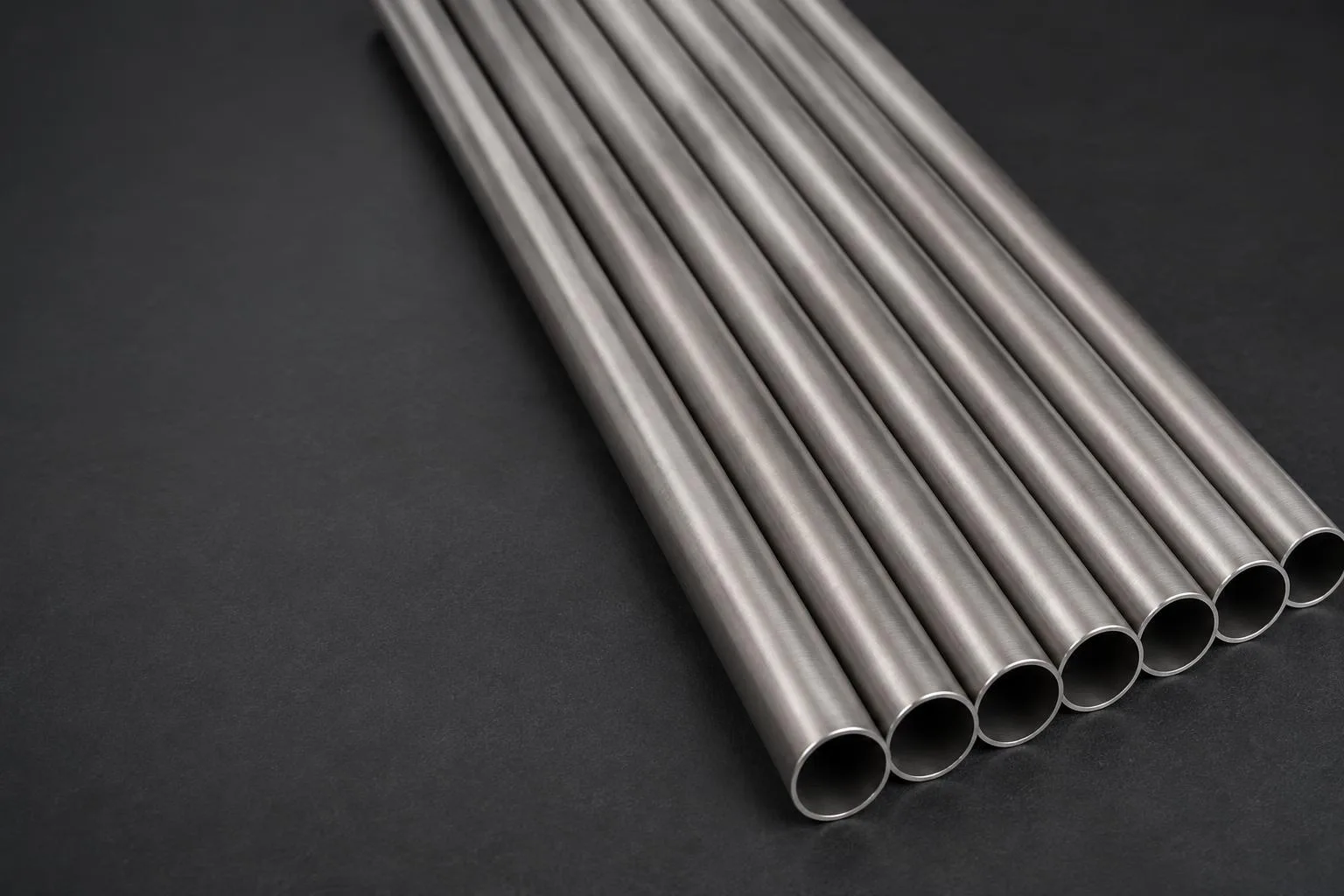
Imagery is illustrative only; it does not identify a certified grade, product condition or available stock.
Raw & semi-finished materials
Available material forms
TIMET lists billet, bar, plate, sheet, strip, tubing and pipe. Tubing specifications (e.g. AMS 4944 seamless hydraulic tubing) are separate from sheet/plate and bar specifications and their properties are not interchangeable. Supply remains subject to ordered specification, dimensions and supplier confirmation; no Quest stockholding is implied.
- Seamless tube
- Welded tube
- Pipe
- Sheet
- Strip
- Plate
- Bar and billet
Material overview
Titanium Grade 9 / Ti-3Al-2.5V
Alpha–beta titanium alloy with nominally 3% aluminium and 2.5% vanadium, combining useful strength, cold formability and corrosion resistance.
- TIMET describes Grade 9 as an intermediate-strength, heat-treatable alpha–beta alloy with excellent fabricability, cold formable and readily welded much like commercially pure titanium, with nearly double the strength of TIMETAL 50A (Grade 2).
- Compared with Grade 5, Grade 9 contains about half the aluminium and vanadium, giving lower strength but greater room-temperature cold formability, which is why it is used for hydraulic tubing and thin foil. This is not a claim that it is universally easier to manufacture.
- Tubing is commonly supplied cold worked and stress relieved (CWSR); those properties must not be applied to bar, sheet or plate.
Designations and product specifications
| Designation / standard | Scope / status |
|---|---|
| UNS | R56320 |
| ASTM B265 | Grade 9; strip, sheet and plate; B265-20a basis. |
| ASTM B338 | Welded tubing (TIMET handbook Table 2); current revision unverified. |
| ASTM B337 | Welded pipe in TIMET handbook; current pipe standards B861/B862 coverage to be confirmed. |
| ASTM B348 | Bars and billets (TIMET handbook Table 2). |
| ASTM B381 | Grade F-9 forgings, specification coverage only (TIMET handbook Table 2). |
| AMS 4944 | Seamless hydraulic tubing, cold worked and stress relieved; current revision AMS4944N (March 2025). Full document not accessed. |
Other AMS tubing specifications are cited by distributors but have not been verified from SAE or producer sources here. No European material number verified.
Specification review
Technical verification requirements
Specification revision / product-form acceptance
Producer and historical references support much of the page; they do not establish all current ordered editions, product-form scope, treatment, section limits and acceptance provisions. This is a verification dependency, not evidence that these references are wrong.
Obtain ordered editions and record form/condition/thickness/orientation/test-temperature coverage separately for every listed specification; retain historical-data caveats.
Cold-worked selector / form
Values reproduce TIMET Table3, but cannot be certified for unspecified form or assigned automatically to welded/seamless tube. Page caveat correctly bars transfer to bar/sheet/plate; selector still needs qualified product binding.
Confirm tube route, diameter/wall, orientation and ordered AMS requirements; runtime-test form/condition quote mapping.
Grade selection
Titanium Grades 5, 7, 9 and 12 compared
| Property | Grade 5 | Grade 7 | Grade 9 | Grade 12 |
|---|---|---|---|---|
| UNS | R56400 | R52400 | R56320 | R53400 |
| Nominal alloying | Ti-6Al-4V | Ti-0.12–0.25Pd | Ti-3Al-2.5V | Ti-0.3Mo-0.8Ni |
| Metallurgical classification | Alpha–beta alloy | Palladium-modified commercially pure (alpha) titanium | Alpha–beta alloy | Lean near-alpha alloy (TIMET description) |
| Tensile strength, min MPa | 895 | 345 | 620 | 483 |
| 0.2% yield strength, min MPa | 828 | 275 | 483 | 345 |
| Elongation in 50 mm, min % | 10 | 20 | 15 | 18 |
| Relative formability | Lowest of the four at room temperature | High (similar to Grade 2) | Intermediate; cold formable | Good |
| Corrosion emphasis | Seawater and general corrosion | Reducing acids and crevice conditions where Pd benefit is established | Close to CP titanium | Crevice corrosion in hot brines; improved acid resistance over unalloyed grades |
| Typical applications | Aerospace structures, fasteners, engine and high-performance components | Chemical-process equipment, heat exchangers, piping | Aerospace hydraulic tubing, honeycomb, pressure piping | Chemical-process and brine heat exchangers, vessels, piping |
Numerical rows are ASTM B265-20a annealed strip, sheet and plate minimums only; they are not typical values and must not be applied to bar, tube, forgings or heat-treated conditions. Qualitative rows come from TIMET producer literature. The grades are not interchangeable; select against the ordered specification and the actual service duty.
Engineering reference
Technical data
| Element | Mass % | Limit |
|---|---|---|
| Ti | Balance | Remainder |
| Al | 2.5–3.5 | Range |
| V | 2.0–3.0 | Range |
| Fe | 0.25 | Maximum |
| O | 0.15 | Maximum |
| C | 0.08 | Maximum |
| N | 0.03 | Maximum |
| H | 0.015 | Maximum |
| Residual elements, each | 0.10 | Maximum |
| Residual elements, total | 0.40 | Maximum |
Single specification basis: ASTM B265-20a heat-analysis limits for strip, sheet and plate, reproduced through ASME SB-265. These are specification limits, not nominal values and not certified analysis. Other product-form specifications (bar, tube, pipe, forgings, AMS) can carry different hydrogen or interstitial limits; check the ordered specification. Product-analysis tolerances are separate. Aerospace tubing specifications may apply tighter interstitial limits; check the ordered AMS document.
| Property | Value | Temperature / basis |
|---|---|---|
| Density | 4480 kg/m³ | Room temperature (20–25°C) |
| Beta transus | 935 ± 15°C | Producer value |
| Melting (liquidus) | 1700°C | Producer value |
| Thermal conductivity | 8.3 W/(m·K) | Room temperature |
| Electrical resistivity | 1.27 µΩ·m | Room temperature |
| Mean thermal expansion | 9.61 × 10⁻⁶ K⁻¹ | Room temperature to 95°C |
| Young’s modulus | 95–105 GPa | Room temperature |
| Young’s modulus | 75–85 GPa | 230°C |
| Poisson’s ratio | 0.30 (typical) | Room temperature |
Producer reference values, not acceptance limits. Specific heat not given in this source and omitted.
Annealed — ASTM B265 sheet/plate minimum
| Property | Requirement |
|---|---|
| Ultimate tensile strength, minimum | 620 MPa |
| 0.2% yield strength, minimum | 483 MPa |
| Elongation, minimum | 15% in 50 mm |
B265 specification minimums. For continuous-rolled and annealed strip from coil, elongation is 12% longitudinal and 8% transverse minimum (footnote F). TIMET quotes 30% reduction of area for the annealed condition without identifying product form. Not applicable to tubing.
Cold worked and stress relieved — TIMET producer minimum
| Property | Value |
|---|---|
| Ultimate tensile strength, minimum | 862 MPa |
| 0.2% yield strength, minimum | 724 MPa |
| Elongation, minimum | 10% |
TIMET datasheet Table 3 producer minimums; product form and specification are not identified. CWSR is typically associated with tubing, but AMS 4944 requirements vary with size and were not accessed. Do not apply to bar, sheet or plate.
TIMET typical elevated-temperature tensile properties for the annealed condition.
Typical elevated-temperature tensile properties — annealed
| Test temperature (°C) | UTS (MPa) | 0.2% YS (MPa) |
|---|---|---|
| 93 | 669 | 531 |
| 316 | 545 | 380 |
| 427 | 490 | 345 |
Typical producer values; product form not stated. Not specification minimums or design allowables.
Short-time tensile data only. No creep or long-term exposure data verified; hydraulic-tubing service use does not establish structural creep capability. No maximum service temperature is stated.
Stress relieving
TIMET typical: 316–649°C (600–1200°F) for 0.5–3 hours, air cool.
Annealing
TIMET typical: 649–760°C (1200–1400°F) for 1–3 hours, air cool.
Solution treatment and ageing
TIMET typical: solution treat 871–927°C (1600–1700°F) for 0.25–1 hour, water quench; age 482–538°C (900–1000°F) for 2–8 hours, air cool. TIMET quotes aged minimums of 828 MPa UTS / 690 MPa YS / 8% without identifying product form, so no aged condition is offered here.
Grade 9 schedules are specific to this alloy and are not the Grade 5 STA schedule. Use the condition and treatment required by the ordered specification.
Material selection
Corrosion resistance & performance
TIMET states corrosion resistance very close to commercially pure titanium, with complete resistance to seawater and excellent resistance to general, crevice, pitting and stress-corrosion cracking in the environments it describes.
Reducing acids, hot crevices and fluoride media require specific assessment. A palladium-bearing variant (Grade 18) exists for enhanced resistance; it is a different grade and not covered by this page.
Consider galvanic coupling and hydrogen absorption in cathodic conditions.
Typical applications
Engineering applications
- Aerospace hydraulic tubing, to the applicable AMS specification
- Lightweight honeycomb structures and foil
- Pressure vessels and piping (ASME code approved, per TIMET)
- Precision tubular assemblies
- Corrosion-resistant mechanical components
- High-performance sporting equipment such as bicycle tubing
Subsequent manufacturing
Machining & processing
Forming
Cold formable; TIMET quotes a 5–6T bend radius for the annealed condition. Tube bending and flaring requirements are set by the ordered tubing specification.
Welding
TIMET states it is easily welded. Use clean, dedicated preparation and qualified procedures. Shield the weld pool, trailing hot metal and root with inert gas (or weld in a chamber) to prevent oxygen, nitrogen and hydrogen pick-up; discoloured or contaminated welds require assessment against the ordered acceptance criteria. TIMET lists ERTi-3Al-2.5V filler.
Machining
Titanium has low thermal conductivity, concentrates heat at the cutting edge and can gall. Use rigid set-ups, sharp tools, positive feed without rubbing and generous coolant. Qualify speeds and feeds for the actual grade and condition; no universal cutting speed is given.
Inspection
For tubing, confirm dimensional, flaring, flattening, ultrasonic and texture requirements from the ordered AMS or ASTM specification.
Material certification & testing
Agree documentation and inspection at enquiry stage for the actual grade, specification, form and condition.
Not every test or certificate is automatically included. PMI alone does not establish interstitial chemistry or grade conformity. Aerospace or pressure-equipment use requires the applicable specification and documented acceptance; these records do not confer approval.
- EN 10204 3.1 material certificate, where agreed with the supplier
- Certificate of Conformity
- Heat / batch traceability to the mill certificate
- Chemical analysis including aluminium, vanadium and interstitial elements, with the delivered condition (annealed or CWSR) stated
- Mechanical tests and heat-treatment records to the ordered specification
- Hardness, PMI, ultrasonic or additional aerospace inspection only where applicable and agreed
Material enquiry
Request a material quotation
Titanium Grade 9 / Ti-3Al-2.5V supplied to your material form, dimensions and specification.