Materials Supply / Titanium & Titanium Alloys
Ti-6242 / Ti-6Al-2Sn-4Zr-2Mo Titanium Alloy
Near-alpha elevated-temperature titanium alloy | Silicon-bearing TIMET reference chemistry | UNS pending verification | Solution treated and stabilised
Ti-6242 is a near-alpha titanium alloy developed for elevated-temperature aerospace use, containing nominally 6% aluminium, 2% tin, 4% zirconium and 2% molybdenum, with a small silicon addition in the TIMET composition.
TIMET identifies this alloy as TIMETAL® 6-2-4-2. TIMETAL® is a registered trademark of Titanium Metals Corporation.
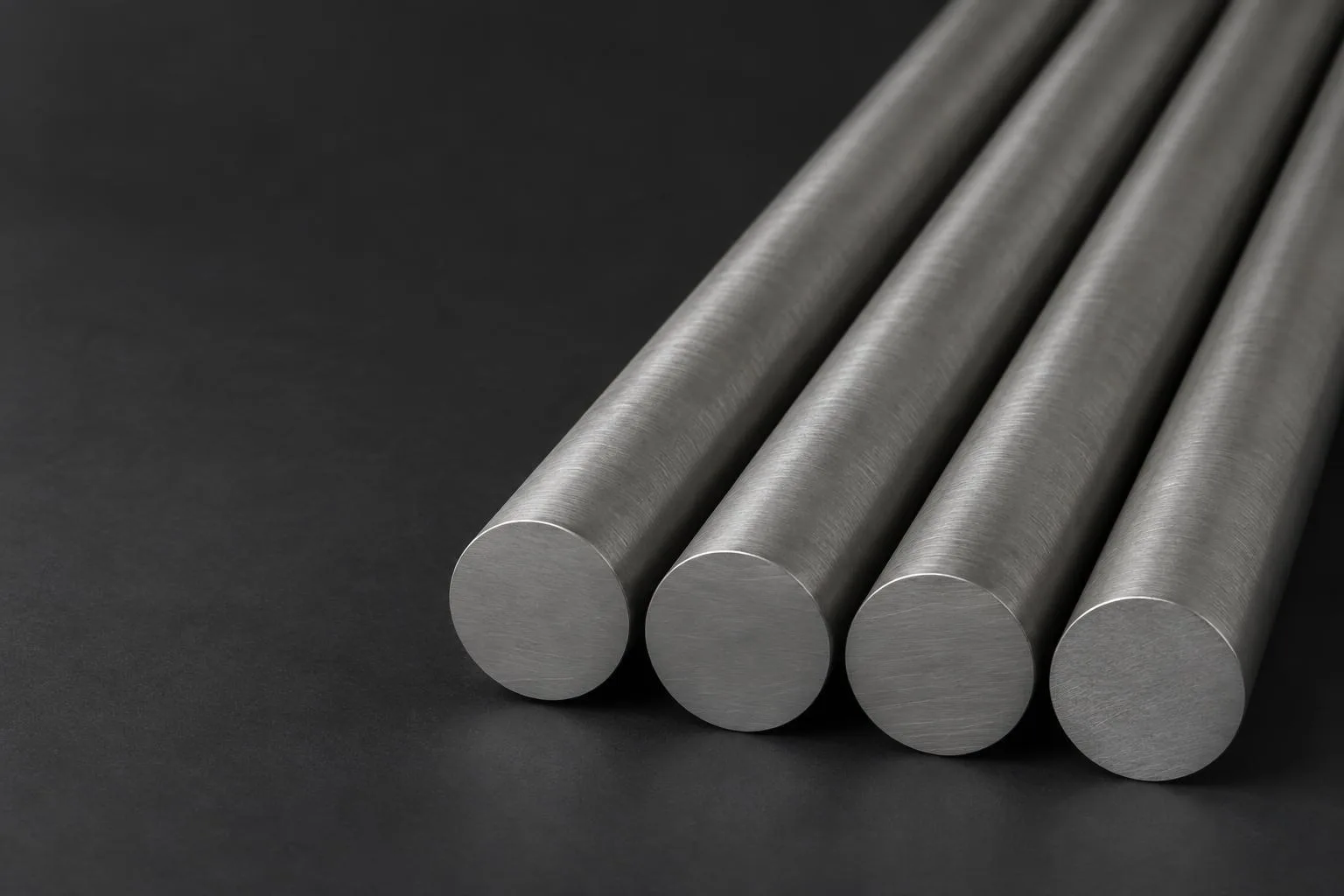
Imagery is illustrative only; it does not identify a certified grade, product condition or available stock.
Raw & semi-finished materials
Available material forms
TIMET describes bar/forging and sheet heat treatments; AMS 4976 covers forgings. Supply remains subject to ordered specification, dimensions and supplier confirmation; no Quest stockholding is implied.
- Round bar
- Billet
- Forgings
- Sheet
- Plate
Material overview
Ti-6242 / Ti-6Al-2Sn-4Zr-2Mo Titanium Alloy
Near-alpha titanium alloy combining tensile strength, creep strength, toughness and high-temperature stability for gas turbine compressor components.
- TIMET states the alloy offers an outstanding combination of tensile strength, creep strength, toughness and high-temperature stability for long-term application at temperatures up to 538°C (1000°F). This is a producer statement, not a design limit for a specific component.
- Its primary application is gas turbine compressor components such as blades, discs and impellers; sheet is used for afterburner structure and hot airframe skins. TIMET states forging and machining characteristics are very similar to Ti-6Al-4V.
- The low molybdenum content keeps the alloy near-alpha. Element-by-element metallurgical roles were not verified in the producer sources used and are not stated here.
Designations and product specifications
| Designation / standard | Scope / status |
|---|---|
| UNS | Not verified for the silicon-bearing reference chemistry; confirm ordered specification and mill designation |
| AMS 4976 | Forgings, 6Al-2Sn-4Zr-2Mo, solution and precipitation heat treated; current revision AMS4976N (September 2025). Full document not accessed. |
| AMS 4975 / AMS 4919 | Bar/wire/rings and duplex-annealed sheet/strip/plate respectively, as cited by distributors; not verified from SAE or producer sources here. |
Identity unresolved: TIMET Table 1 specifies Si 0.06–0.13 mass %. AMS4919H describes 0.08Si and prints “Composition similar to UNS R56420”. Neither that wording nor the existing R54620 association establishes an exact UNS equivalence for this page. Do not substitute R54621 without controlled UNS/specification evidence and mill confirmation. No European material number verified.
SAE International — AMS4976 record (revision N, September 2025)
Specification review
Technical verification requirements
Specification revision / product-form acceptance
Producer and historical references support much of the page; they do not establish all current ordered editions, product-form scope, treatment, section limits and acceptance provisions. This is a verification dependency, not evidence that these references are wrong.
Obtain ordered editions and record form/condition/thickness/orientation/test-temperature coverage separately for every listed specification; retain historical-data caveats.
Identity / UNS / silicon variant
Unqualified base UNS remains alongside mandatory silicon-bearing chemistry. The page itself acknowledges a different UNS in AMS4919 without naming or resolving it. Do not silently substitute R54621: accessible AMS4919H title actually says composition similar to R56420. Identity/specification reconciliation is necessary.
Obtain controlled current UNS and AMS4919/4975/4976 documents and mill designation for Ti6242 versus Ti6242S. Reconcile exact chemistry and form before approving title or equivalence.
Chemistry / source anomalies
Omission is transparent but does not resolve anomalous source. Producer Table6 also has inconsistent18mm rod units, and Table7 450°C row prints56ksi(100MPa); page omits these suspect values appropriately.
Obtain corrected producer sheet and controlled chemistry; keep excluded suspect values excluded.
Grade selection
Ti-6242 compared with Ti-6246
| Property | Ti-6242 | Ti-6246 |
|---|---|---|
| UNS | Not verified for the silicon-bearing reference chemistry; confirm ordered specification and mill designation | R56260 |
| Nominal composition | Ti-6Al-2Sn-4Zr-2Mo (+ Si) | Ti-6Al-2Sn-4Zr-6Mo |
| Molybdenum, mass % | 1.80–2.20 | 5.50–6.50 |
| Classification (TIMET) | Near-alpha, elevated-temperature alloy | Alpha–beta, high-strength intermediate-temperature alloy |
| Strengthening / heat treatment | Annealed, duplex/triplex annealed or solution treated and stabilised | Heat treatable to higher strength in larger sections than Ti-6Al-4V (DA, STA, STOA) |
| Elevated temperature | Producer states long-term application up to 538°C; creep data published | Intermediate-temperature alloy; creep compared graphically with Ti-6Al-4V |
| Typical applications | Gas turbine compressor blades, discs, impellers; afterburner and hot airframe sheet | Intermediate compressor-stage discs and blades, seals, airframe parts |
Qualitative producer comparison only; the two TIMET datasheets do not give tensile data on the same product form, section and heat treatment, so no numerical strength comparison is shown. The alloys are not interchangeable and are covered by different specifications.
Engineering reference
Technical data
| Element | Mass % | Limit |
|---|---|---|
| Ti | Balance | Remainder |
| Al | 5.50–6.50 | Range |
| Sn | 1.80–2.20 | Range |
| Zr | 3.60–4.40 | Range |
| Mo | 1.80–2.20 | Range |
| Si | 0.06–0.13 | Range |
| Fe | 0.25 | Maximum |
| O | 0.15 | Maximum |
| C | 0.08 | Maximum |
| N | 0.05 | Maximum |
| H | 0.0125 | Maximum |
| Residual elements, each | 0.10 | Maximum |
| Residual elements, total | 0.40 | Maximum |
Producer Table 1 limits, one source. The table also prints a hydrogen minimum of 0.010%, which appears anomalous and is not adopted. AMS sheet, bar and forging specifications may set tighter silicon, carbon, oxygen or other limits; use the ordered specification. This is silicon-bearing producer reference chemistry, not verified generic Ti-6242 UNS chemistry or proof of conformity to AMS4919, AMS4975 or AMS4976. Resolve alloy identity and obtain corrected producer hydrogen data before ordering.
| Property | Value | Temperature / basis |
|---|---|---|
| Density | 4540 kg/m³ | 20–25°C |
| Beta transus | 995 ± 15°C | Producer value |
| Melting (liquidus) | ≈1705°C | Producer value |
| Thermal conductivity | 6.92 W/(m·K) | 20–25°C |
| Specific heat | 460 J/(kg·K) | 20–25°C |
| Electrical resistivity | 1.85–1.90 µΩ·m | 20–25°C |
| Mean thermal expansion | 7.7 × 10⁻⁶ K⁻¹ | 0–100°C |
| Modulus of elasticity | 114 GPa | Temperature not stated |
Producer reference values, not acceptance limits.
Solution treated and stabilised bar — TIMET typical
| Rod diameter | 0.2% YS | UTS | Elongation (4D) | RA |
|---|---|---|---|---|
| 38 mm | 895 MPa | 1004 MPa | 19% | 42% |
| 28 mm | 895 MPa | 1018 MPa | 19% | 44% |
Typical producer values at 20°C, not specification minimums or design allowables. TIMET also lists an 18 mm rod, but its strength figures are unit-inconsistent in the datasheet and are omitted.
TIMET tabulated elevated-temperature tensile and creep data for Ti-6242.
Typical tensile at 480°C — bar, 970°C/1 h/AC + 595°C/8 h/AC
| Rod diameter | 0.2% YS (MPa) | UTS (MPa) | Elongation (%) | RA (%) |
|---|---|---|---|---|
| 38 mm | 545 | 716 | 26 | 63 |
| 28 mm | 557 | 723 | 27 | 65 |
| 18 mm | 565 | 735 | 25 | 67 |
Typical producer values at 480°C (896°F); not minimums or design allowables.
Creep — alpha–beta heat treated, air cooled and aged
| Temperature (°C) | Stress (MPa) | Time (h) | Total plastic strain (%) |
|---|---|---|---|
| 500 | 300 | 100 | 0.060 |
| 500 | 300 | 300 | 0.125 |
| 540 | 170 | 100 | 0.178 |
Producer data; product form not stated. The 450°C row is omitted because its ksi and MPa stresses disagree in the datasheet. Post-creep room-temperature tensile at 500°C/300 MPa: 951 MPa YS, 1038 MPa UTS, 18% elongation.
No stress-rupture, oxidation-rate or long-term exposure tables were verified. The 538°C figure is a producer statement, not a guaranteed maximum service temperature. Values are not extrapolated.
Stress relief anneal
482–649°C (900–1200°F), 1–4 hours, air cool.
Mill anneal
704–843°C (1300–1550°F), air cool.
Sheet — duplex anneal
900°C (1650°F), air cool; then 785°C (1450°F), air cool.
Sheet — triplex anneal
900°C for 2 hours, air cool; 785°C, air cool; then 595°C (1100°F) for 2 hours, air cool.
Bar and forgings under 63.5 mm
Anneal 955°C (1750°F) or 900°C (1650°F) for 1 hour, air cool; stabilise 595°C (1100°F) for 8 hours, air cool.
Solution treatment and ageing
Solution treat 15–30°C below beta transus for 1 hour, water quench; age 538–593°C (1000–1100°F) for 8 hours, air cool.
TIMET producer schedules, specific to Ti-6242 and not copied from Ti-6Al-4V. Select the treatment required by the ordered specification and product form. Beta transus 995 ± 15°C (producer).
Material selection
Corrosion resistance & performance
Producer literature used here does not provide grade-specific aqueous corrosion data. Like other titanium alloys it relies on a protective oxide film, but corrosion resistance must be assessed for the actual environment.
At elevated temperature, surface oxygen pick-up (alpha case) and exposure atmosphere must be considered; no oxidation limit is stated.
Typical applications
Engineering applications
- Gas turbine compressor blades, discs and impellers, where specified and approved
- Engine afterburner sheet structures
- Hot airframe skin applications
- High-integrity forged components to the applicable AMS specification
Subsequent manufacturing
Machining & processing
Forging
TIMET: rough forge 1038–1066°C, finish forge 954–982°C. Forging and machining are very similar to Ti-6Al-4V.
Welding
TIMET rates weldability as fair. Shield the weld pool, trailing hot metal and root with inert gas (or weld in a chamber) to prevent oxygen, nitrogen and hydrogen pick-up. Use clean preparation and qualified procedures; assess discoloured welds against the ordered acceptance criteria.
Machining
Titanium concentrates heat at the cutting edge and can gall. Use rigid set-ups, sharp tools, positive feed without rubbing and generous coolant. Qualify speeds and feeds for the actual alloy and condition; no universal cutting speed is given.
Inspection
Rotating engine parts typically require ultrasonic inspection, microstructure and heat-treatment verification to the ordered AMS and customer requirements.
Material certification & testing
Agree documentation and inspection at enquiry stage for the actual alloy, specification, form and condition.
Not every test or certificate is automatically included. PMI alone does not establish interstitial chemistry or grade conformity. Aerospace or medical use requires the applicable specification and documented acceptance; these records do not confer approval.
- EN 10204 3.1 material certificate, where agreed with the supplier
- Certificate of Conformity
- Heat / batch traceability to the mill certificate
- Heat-treatment condition, mechanical test results and product-form traceability to the ordered specification
- Mechanical tests and heat-treatment records to the ordered specification
- Hardness, PMI, ultrasonic, aerospace-specific or customer-specific testing only where applicable and agreed
Material enquiry
Request a material quotation
Ti-6242 / Ti-6Al-2Sn-4Zr-2Mo Titanium Alloy supplied to your material form, dimensions and specification.