Materials Supply / Titanium & Titanium Alloys
Titanium Grade 23 / Ti-6Al-4V ELI
Extra-low-interstitial alpha–beta titanium alloy | UNS R56407 | Annealed
Grade 23 is the extra-low-interstitial (ELI) version of Ti-6Al-4V: an alpha–beta titanium alloy with tighter limits on oxygen, iron, nitrogen and hydrogen than conventional Grade 5.
TIMET identifies TIMETAL® 6-4 ELI with ASTM Grade 23 and offers it for fracture-critical applications. TIMETAL® is a registered trademark of Titanium Metals Corporation.
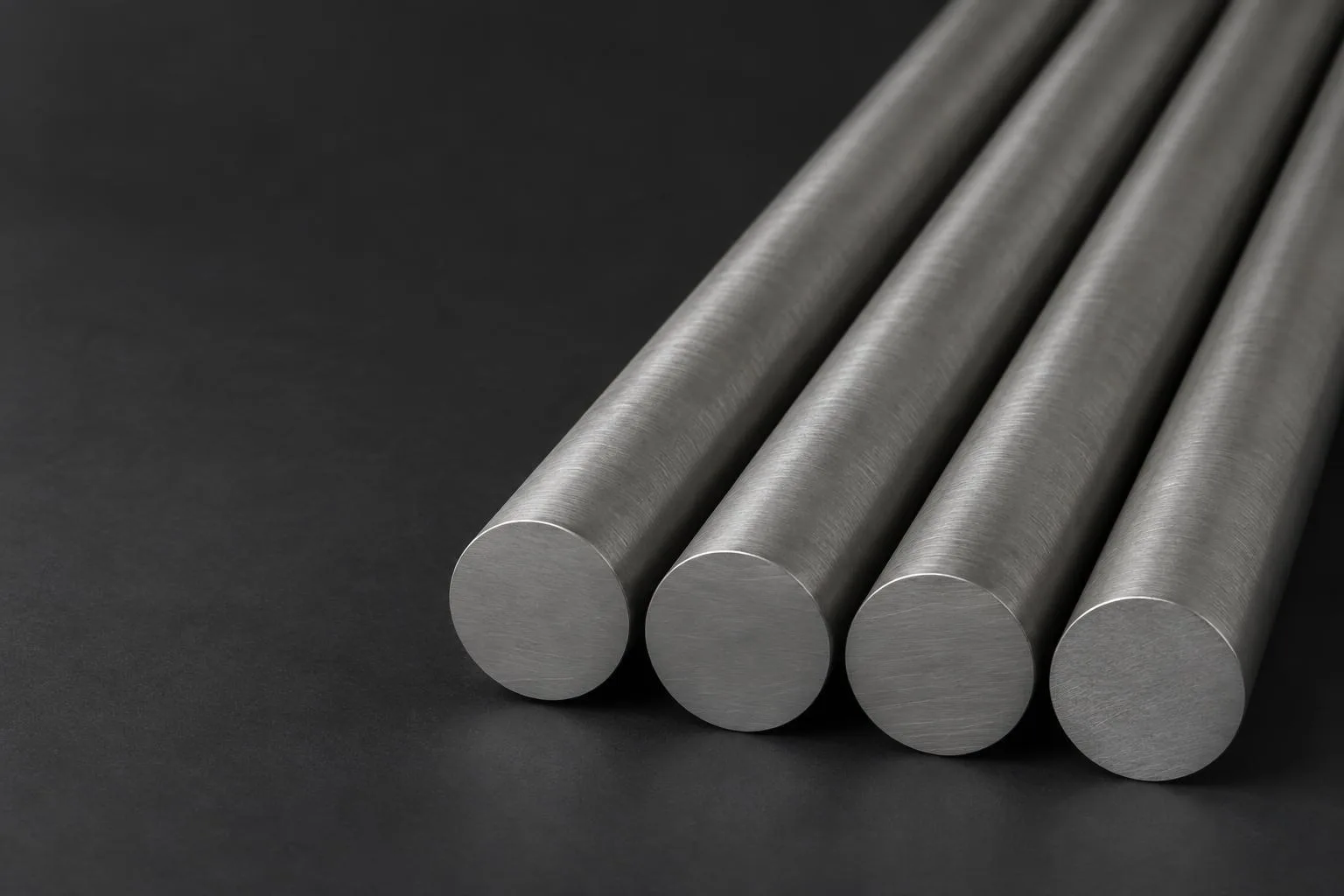
Imagery is illustrative only; it does not identify a certified grade, product condition or available stock.
Raw & semi-finished materials
Available material forms
TIMET lists billet, bar, wire, plate and sheet for the 6-4 family; Grade 23 specification coverage per ASTM B265, B348 and F136 as cited by TIMET. Supply remains subject to ordered specification, dimensions and supplier confirmation; no Quest stockholding is implied.
- Round bar
- Billet
- Plate
- Sheet
- Wire
Material overview
Titanium Grade 23 / Ti-6Al-4V ELI
Extra-low-interstitial version of Ti-6Al-4V with tighter oxygen, iron, nitrogen and hydrogen limits than Grade 5.
- Lower interstitial content, especially oxygen, gives Grade 23 lower minimum strength than Grade 5 in ASTM B265 but is used where improved ductility and fracture-critical performance are required. TIMET positions it for fracture-critical applications.
- Grade 5 mechanical tables are not Grade 23 specification values; the Grade 23 conditions below come from Grade 23 requirements only.
- Medical-implant requirements (ASTM F136) are a medical standard, separate from industrial and aerospace specifications.
Designations and product specifications
| Designation / standard | Scope / status |
|---|---|
| UNS | R56407 |
| ASTM B265 | Grade 23; strip, sheet and plate; B265-20a basis. |
| ASTM B348 | Grade 23; bars and billets; quoted in TIMET datasheet; current revision unverified. |
| ASTM F136 | Medical standard: wrought Ti-6Al-4V ELI for surgical implants (TIMET cites F136-96). Not an aerospace specification. |
No AMS specification for Grade 23 was verified from SAE or producer sources here; none asserted. Grade 5 AMS specifications do not cover Grade 23. No European material number verified.
Specification review
Technical verification requirements
Specification revision / product-form acceptance
Producer and historical references support much of the page; they do not establish all current ordered editions, product-form scope, treatment, section limits and acceptance provisions. This is a verification dependency, not evidence that these references are wrong.
Obtain ordered editions and record form/condition/thickness/orientation/test-temperature coverage separately for every listed specification; retain historical-data caveats.
Medical versus aerospace / F136 selector
Medical versus aerospace distinction is correctly made. However historic F136 values are not evidence of current implant acceptance or aerospace qualification; size-boundary inclusivity and test conditions need ordered-edition verification.
Retain separation; obtain current ordered F136 and applicable aerospace ELI specification separately. Confirm exact 1.75/2.5/4-inch boundaries, RA exceptions and processing requirements.
Grade selection
Grade 23 compared with Grade 5
| Property | Grade 5 / Ti-6Al-4V | Grade 23 / Ti-6Al-4V ELI |
|---|---|---|
| UNS | R56400 | R56407 |
| Aluminium, mass % | 5.50–6.75 | 5.5–6.5 |
| Vanadium, mass % | 3.50–4.50 | 3.5–4.5 |
| Oxygen, max mass % | 0.20 | 0.13 |
| Iron, max mass % | 0.40 | 0.25 |
| Nitrogen, max mass % | 0.05 | 0.03 |
| Hydrogen, max mass % | 0.015 | 0.0125 |
| Tensile strength, min MPa | 895 | 828 |
| 0.2% yield strength, min MPa | 828 | 759 |
| Elongation in 50 mm, min % | 10 | 10 |
| Producer positioning | General-purpose alpha–beta alloy | Variant for fracture-critical applications (TIMET) |
| Specification families | ASTM B265/B348/B381; aerospace AMS | ASTM B265/B348; ASTM F136 (medical implants) |
Chemistry and strength rows are ASTM B265-20a limits for annealed strip, sheet and plate only. Grade 23 has lower minimum strength than Grade 5 in this standard; it is not a stronger grade. No numerical fracture-toughness or fatigue comparison on a common basis was verified, so none is shown. Grade 5 specifications do not automatically cover Grade 23.
Engineering reference
Technical data
| Element | Mass % | Limit |
|---|---|---|
| Ti | Balance | Remainder |
| Al | 5.5–6.5 | Range |
| V | 3.5–4.5 | Range |
| Fe | 0.25 | Maximum |
| O | 0.13 | Maximum |
| C | 0.08 | Maximum |
| N | 0.03 | Maximum |
| H | 0.0125 | Maximum |
| Residual elements, each | 0.10 | Maximum |
| Residual elements, total | 0.40 | Maximum |
ASTM B265-20a heat-analysis limits for strip, sheet and plate; the same limits appear in TIMET datasheet Table 1. Medical (F136) and AMS documents may differ. Specification limits, not nominal values or certified analysis.
Annealed — ASTM B265 sheet/plate minimum
| Property | Requirement |
|---|---|
| Ultimate tensile strength, minimum | 828 MPa |
| 0.2% yield strength, minimum | 759 MPa |
| Elongation, minimum | 10% in 50 mm |
B265 specification minimums, longitudinal and transverse. Hardness, reduction of area, toughness and fatigue are not specified in this table.
Annealed — ASTM B348 bar minimum
| Property | Requirement |
|---|---|
| Ultimate tensile strength, minimum | 828 MPa |
| 0.2% yield strength, minimum | 759 MPa |
| Elongation, minimum | 10% |
| Reduction of area, minimum | 25% |
As quoted by TIMET for annealed bar under 3.00 in (76 mm), longitudinal, at 20°C. Current B348 edition not accessed.
Annealed — ASTM F136 medical bar minimum
| Section | UTS min | 0.2% YS min | Elongation min | RA min |
|---|---|---|---|---|
| < 44.5 mm (1.75 in) | 860 MPa | 795 MPa | 10% | 25% |
| 44.5–63.5 mm | 825 MPa | 760 MPa | 8% | 20% |
| 63.5–101.6 mm | 825 MPa | 760 MPa | 8% | 15% |
Medical-implant standard, quoted by TIMET from ASTM F136-96 (historic edition). Not an aerospace requirement. Reduction of area 25% applies to 4.75–44.5 mm only. Confirm current edition.
Annealing
TIMET B265 annealed basis for the 6-4 family: 705°C (1300°F) for 1 hour, air cool or slower. Confirm the anneal required by the ordered specification.
No Grade 23-specific solution-treatment-and-ageing schedule or STA mechanical requirement was verified, so none is offered. Do not apply Grade 5 STA schedules. Clean before heating and avoid hydrogen-bearing atmospheres.
Material selection
Corrosion resistance & performance
TIMET describes the 6-4 family as highly resistant to general corrosion in seawater. Grade 23 is not a palladium or corrosion-enhanced grade; assess reducing acids, crevices and fluoride media for the actual duty.
Hydrogen absorption can occur under cathodic or galvanic coupling conditions; do not assume immunity.
Typical applications
Engineering applications
- Fracture-critical aerospace components, where specified and approved
- High-integrity precision components
- High-performance fasteners, to the applicable specification
- Medical implants, only to medical standards such as ASTM F136
Subsequent manufacturing
Machining & processing
Welding
TIMET states the 6-4 family is weldable when the joint area is clean, with inert gas or vacuum required for most methods. Shield the weld pool, trailing hot metal and root with inert gas (or weld in a chamber) to prevent oxygen, nitrogen and hydrogen pick-up. Use clean preparation and qualified procedures; assess discoloured welds against the ordered acceptance criteria.
Machining
Titanium concentrates heat at the cutting edge and can gall. Use rigid set-ups, sharp tools, positive feed without rubbing and generous coolant. Qualify speeds and feeds for the actual alloy and condition; no universal cutting speed is given.
Interstitial control
Heat treatment, welding and hot working can raise surface oxygen; maintain clean atmospheres and remove alpha case where the specification requires.
Material certification & testing
Agree documentation and inspection at enquiry stage for the actual alloy, specification, form and condition.
Not every test or certificate is automatically included. PMI alone does not establish interstitial chemistry or grade conformity. Aerospace or medical use requires the applicable specification and documented acceptance; these records do not confer approval.
- EN 10204 3.1 material certificate, where agreed with the supplier
- Certificate of Conformity
- Heat / batch traceability to the mill certificate
- Chemical analysis verifying the ELI interstitial limits (oxygen, iron, nitrogen, carbon, hydrogen)
- Mechanical tests and heat-treatment records to the ordered specification
- Hardness, PMI, ultrasonic, aerospace-specific or customer-specific testing only where applicable and agreed
Material enquiry
Request a material quotation
Titanium Grade 23 / Ti-6Al-4V ELI supplied to your material form, dimensions and specification.