Materials Supply / Aluminium Alloys
Aluminium Alloy 7020
Heat-treatable Al-Zn-Mg alloy for welded structural applications
7020 is an aluminium-zinc-magnesium structural alloy with a low copper limit, rather than a high-copper Al-Zn-Mg-Cu aerospace alloy such as 7075. Its useful weldability does not mean a welded joint retains the unwelded parent-metal tensile properties.
Original European mill literature supports T6 extrusion properties within the specific dimensions shown below. Plate, T4, T5 and T651 are not offered as selectable conditions here because complete original European mill property tables for those combinations were not verified in this research.
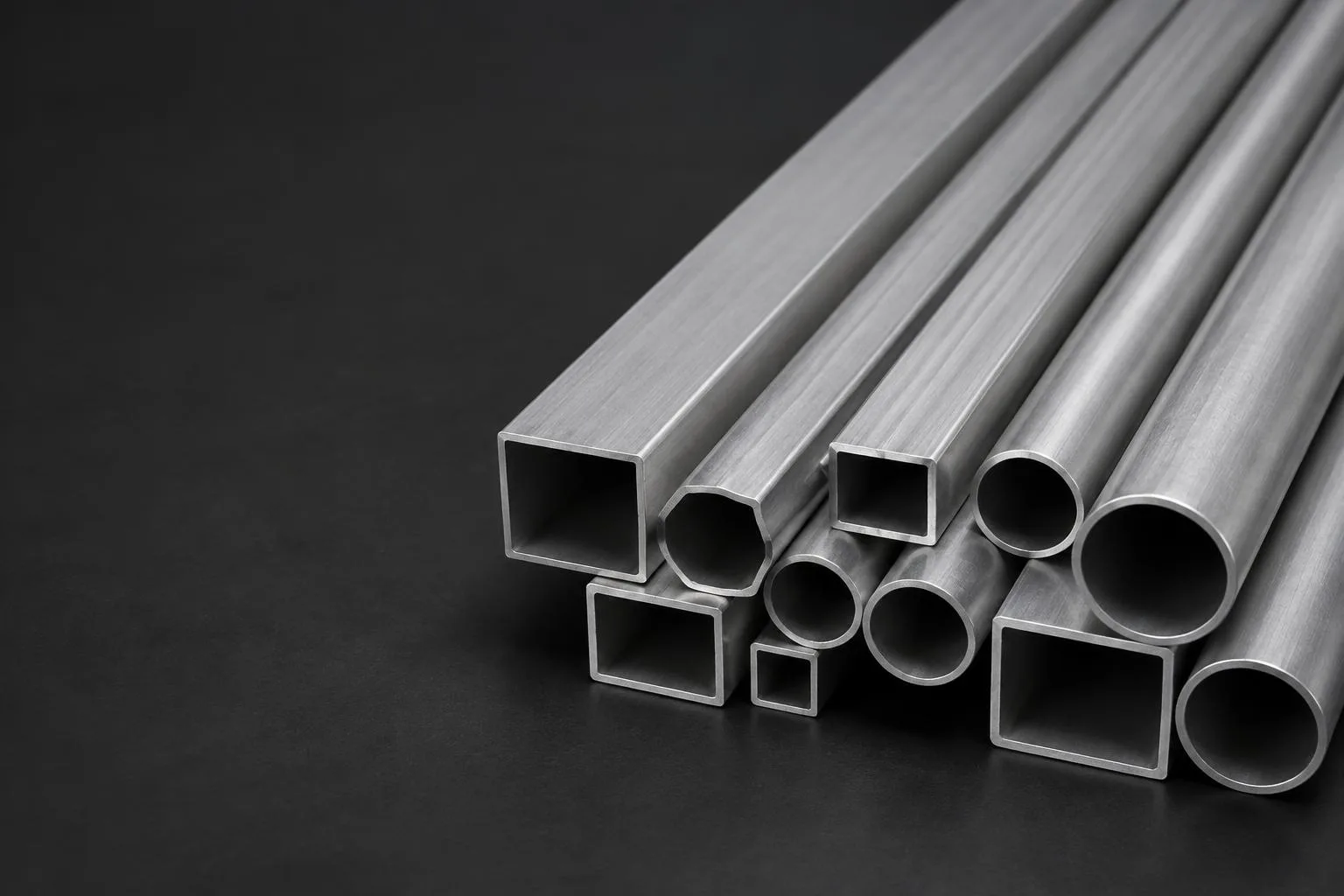
Illustrative aluminium materials and engineered components, not certified alloy stock or evidence of Quest stockholding.
Raw & semi-finished materials
Available material forms
Form listing is not a stock promise. Nedal supports structural extrusions; shape complexity is constrained by relatively low extrudability/formability. Rolled plate and additional tempers require separate mill confirmation and a condition-specific datasheet before quotation.
- Extruded profiles
Material overview
Aluminium Alloy 7020
A low-copper, precipitation-hardening aluminium alloy used for highly loaded welded structures; strength depends on product, section, temper and welding history.
- Zinc and magnesium provide the principal age-hardening response. Solution treatment and quenching establish a supersaturated state, followed by natural or artificial ageing. Chromium, manganese and zirconium additions influence grain/substructure control; this is not a substitute for product-specific toughness or corrosion qualification.
- Section size, quench route and ageing affect properties. Use the selected producer’s exact dimensional scope rather than applying one thin-section value to every extrusion or plate. Fatigue, fracture toughness and welded-joint design allowables were not verified and are deliberately not tabulated.
- The highest parent-metal strength is not automatically the best structural choice. Weld design, heat-affected-zone behaviour, residual stress, corrosion exposure and dimensional stability need independent assessment. No universal post-weld strength recovery percentage is asserted.
Designations and specification scope
| Reference | Scope / qualification |
|---|---|
| 7020 / EN AW-7020 | Alloy designations in the European mill literature; no UNS equivalence asserted. |
| AlZn4.5Mg1 | Chemical designation in Nedal and Metalba literature. |
| EN 573-3 | Composition reference cited by mills; full current standard not accessed. This page uses registered AA composition independently, not the conflicting Nedal zinc row. |
| EN 755-2 | Extruded-product mechanical property reference cited by both mills; full standard and current ordering edition must be obtained. |
| EN 515 | Temper nomenclature reference cited by Nedal; not evidence of availability of every defined temper. |
Standards are identified only within the source’s stated scope, not claimed as unconditional compliance or aerospace approval.
Specification review
Technical verification requirements
Designations / form / temper / dimensions
Product scopes were reviewed row by row. Recorded cross-references do not establish every current revision, ordered form, temper and dimensional limit; EN/UNS registries and complete controlled AMS/ASTM/EN texts were not inspected.
Obtain applicable controlled specification and producer confirmation; submit to technical review.
Mechanical conditions / gauge / orientation
Every selector/table was read. Typical, supplier minima and producer limits must remain distinct. Resolve missing orientation, specimen/gauge length, temperature, exact boundary inclusivity and test basis in the quoted notes; do not extend a specimen diameter to stock thickness or to other forms.
Produce a condition-by-condition acceptance matrix with form, thickness interval, tensile orientation, elongation basis, test temperature and source revision; omit unavailable values rather than infer them.
Grade selection
7020 and 7075 compared
| Aspect | 7020 | 7075 |
|---|---|---|
| Zn / Mg / Cu ranges | Zn 4.0–5.0; Mg 1.0–1.4; Cu ≤0.20 | Zn 5.1–6.1; Mg 2.1–2.9; Cu 1.2–2.0 |
| Other controlled additions | Cr 0.10–0.35; Zr 0.08–0.20; Zr+Ti 0.08–0.25 | Cr 0.18–0.28; Ti ≤0.20 |
| Alloy system | Low-Cu Al-Zn-Mg structural alloy | Cu-containing high-strength Al-Zn-Mg-Cu alloy |
| Weldability | Selected for welded structures; joint/HAZ properties and ageing must be qualified | Not a readily fusion-weldable structural alloy; do not transfer parent strength to joints |
| Strength and tempers | Use producer verified form-specific conditions; no equivalence to 7075 | Peak-aged and overaged conditions are distinct; highest strength is not automatically best |
| Corrosion | Environment and welded condition require assessment; not universal seawater immunity | SCC/exfoliation depend on temper, stress orientation, exposure and protection |
| Typical uses | Loaded construction and transport structures | Specified aerospace fittings, plate and high-strength machined parts |
Qualitative engineering selection only; numeric chemistry is registered mass %. No numerical strength or toughness comparison is made because product form, temper, thickness, orientation and test basis are not matched. Neither material is universally superior or automatically interchangeable on a drawing.
The Aluminum Association — Teal Sheets, December 2025; grade-specific producer references below
Engineering reference
Technical data
| Element | Mass % | Limit |
|---|---|---|
| Si | 0.35 | Maximum |
| Fe | 0.40 | Maximum |
| Cu | 0.20 | Maximum |
| Mn | 0.05–0.50 | Range |
| Mg | 1.0–1.4 | Range |
| Cr | 0.10–0.35 | Range |
| Zn | 4.0–5.0 | Range |
| Zr | 0.08–0.20 | Range |
| Zr + Ti | 0.08–0.25 | Combined range |
| Other elements, each | 0.05 | Maximum |
| Other elements, total | 0.15 | Maximum |
| Al | Remainder | Balance |
Registered AA limits, not nominal chemistry or certified heat analysis. Ranges show minimum–maximum; other numerical entries are maxima. Other-element provisions apply. No EN/producer chemistry is merged into these limits. Unlisted elements are not represented as zero or unrestricted; 7020 has a combined Zr+Ti limit rather than an invented separate Ti maximum. Confirm governing specification and heat certificate.
The Aluminum Association — Teal Sheets, December 2025
| Property | SI value | Temperature / condition |
|---|---|---|
| Density | 2770 kg/m³ | 20 °C; temper not specified |
| Elastic modulus | Approximately 70 GPa | 20 °C; temper not specified |
| Thermal conductivity | 130–160 W/(m·K) | 20 °C; temper not specified |
| Electrical conductivity | 19–23 MS/m | 20 °C; temper not specified |
| Linear thermal expansion coefficient | 23.1 × 10⁻⁶ K⁻¹ | Source table labelled 20 °C; averaging interval and temper not specified |
| Melting interval | 600–650 °C | Phase-change interval, not a 20 °C measurement or heat-treatment recommendation |
Source table is labelled approximate values, 20 °C. No temper is identified. Values are not guaranteed design data. Metalba prints a different density (2710 kg/m³); the two sources have not been averaged.
T6 — Extrusion (Nedal; wall ≤40 mm)
| Wall thickness e (mm) | Rp0.2 (MPa) | Rm (MPa) | A (%) | A50 (%) | HB (indicative) |
|---|---|---|---|---|---|
| ≤40 | 290 | 350 | 10 | 8 | 105 |
Producer-listed EN 755-2 strength and elongation requirements; treat as published requirement values, not typical design allowables or a supply guarantee. Hardness alone is expressly indicative. Test orientation and mechanical test temperature are not stated. A is printed without a gauge-length formula; do not silently identify it with A50 or another gauge. A50 denotes 50 mm gauge length. Full EN 755-2 text was not accessed; specimen selection and applicability must be confirmed against the ordered standard. Unwelded parent metal only.
T6 — Extrusion (Metalba; D, S ≤200 mm)
| Dimensions D, S (mm), as printed | Direction | Rp0.2 (MPa), indicative minimum | Rm (MPa), indicative minimum | A50mm (%), indicative minimum | HBW, typical |
|---|---|---|---|---|---|
| D, S ≤50 | L (longitudinal) | 290 | 350 | 8 | 110 |
| 50 < D, S ≤200 | L (longitudinal) | 275 | 340 | Not stated | 110 |
Source explicitly calls these indicative minimum values and directs complete evaluation to EN 755-2. D and S notation is retained verbatim; geometry-specific applicability must be agreed with the mill. Test temperature is not stated. A50mm uses 50 mm gauge length. A dash in the larger size band is not zero elongation. Do not merge these size bands with Nedal wall-thickness limits. Unwelded parent metal only.
T6 extrusion
Solution heat treatment, quenching and artificial ageing develop precipitation hardening. Nedal states that T6 properties can be achieved by press quenching; press quenching must not automatically be relabelled as T5.
Natural versus artificial ageing
Natural ageing and additional artificial ageing are qualitatively documented routes for post-weld property recovery. The actual response depends on welding conditions, elapsed ageing and joint history. These notes are not evidence for a separately guaranteed T4 or T5 supply condition.
Post-weld qualification
Fusion welding changes the local precipitation state and can soften the heat-affected zone. Nedal describes recovery after prolonged natural ageing or additional artificial ageing, depending on welding conditions. No retained as-welded parent strength, numerical recovery factor or guaranteed recovery is specified here.
Residual stress and alternative tempers
Quenching and welding can introduce residual stresses and distortion. T651 denotes a stress-relieved-by-stretching T6-type condition conceptually, but no verified European mill 7020-T651 property table was obtained for inclusion. Overageing is a strength/corrosion trade-off concept, not a blanket instruction or an offered 7020 temper.
Conceptual guidance only: no treatment temperature, hold time, cooling rate or post-weld ageing schedule is specified. Develop and qualify the actual thermal route with the producer and fabrication authority; do not infer a schedule from a melting interval.
Material selection
Corrosion resistance & performance
Nedal rates general corrosion resistance 2 and marine resistance 4 on a scale from 1 (very good) to 6 (unsuitable). This supports a distinction between general and marine exposure, not an immunity claim or an unrestricted marine recommendation.
Low copper content and weldability do not establish immunity to stress-corrosion cracking or exfoliation. Temper, grain structure, sustained tensile stress, residual stress, joint details and environment require application-specific assessment. No numerical SCC threshold, exfoliation class or guaranteed overaged-condition benefit has been verified for this record.
Select surface protection, drainage, crevice detailing and dissimilar-metal isolation for the actual environment. Nedal rates protective anodising more favourably than decorative/bright/colour anodising; cosmetic appearance should be agreed separately.
Typical applications
Engineering applications
- Highly loaded rail-transport construction parts
- Aircraft storage containers (not a general airframe qualification)
- Pontoon bridges and other highly loaded bridge parts
- Mobile-crane structural components
Subsequent manufacturing
Machining & processing
Welding
Nedal rates MIG 1 and TIG 2 on its 1 (very good) to 6 (unsuitable) scale, while resistance welding is rated 6. Process suitability does not qualify a joint. Agree filler, heat input, thickness range, joint geometry, welding procedure, inspection and final ageing condition with the responsible welding engineer.
Welded structural design
The mechanical tables apply to unwelded parent metal only. Obtain qualified weld-metal and heat-affected-zone design values and validate static strength, fatigue and corrosion for the actual joint. No numerical fatigue limit or joint efficiency is inferred from qualitative structural applications.
Machining
Nedal rates T6 machining 2 and T4 machining 3 on its qualitative scale. This does not add T4 to the verified supply-condition selector. Plan machining sequence and workholding to manage distortion; no tolerance or stress-free condition is guaranteed.
Extrusion and forming
Nedal notes relatively low formability limiting extrudable shape complexity. Confirm profile geometry, wall thickness and forming route with the mill before adopting the tabulated values.
Material certification & testing
Certification and traceability are conditional on the chosen mill, product, specification and purchase order; none is asserted as already held or available from stock.
No certificate or test is automatically included. Alloy designation alone does not establish aerospace drawing compliance: confirm specification/revision, temper, product form, thickness, test orientation and acceptance requirements.
- Request heat/batch traceability and a producer inspection document identifying 7020, temper, product form and dimensions.
- Agree the applicable standard edition, specimen orientation, elongation gauge and test requirements before ordering.
- Request additional corrosion, ultrasonic, fatigue or other acceptance testing only where contractually required and supported by the mill.
- For welded assemblies, agree qualified welding procedures, personnel, inspection and final thermal condition separately from parent-material certification.
- EN 10204 3.1 material certificate and Certificate of Conformity where agreed
- Temper verification, heat-treatment records and hardness testing where specified
- Customer-specific chemical/mechanical testing and aerospace inspection requirements where agreed
Material enquiry
Request a material quotation
Aluminium Alloy 7020 supplied to your material form, dimensions and specification.