Materials Supply / Aluminium Alloys
Aluminium Alloy 7050
High-strength Al–Zn–Mg–Cu aerospace plate
Zinc and magnesium provide the principal precipitation-strengthening system; copper contributes to the high-strength alloy response. Zirconium additions support control of recrystallisation. Chromium is limited rather than the principal dispersoid addition.
Strength alone is not an adequate selection criterion. Short-transverse loading, residual stress, environment, fracture toughness and fatigue crack growth must be assessed for the actual plate thickness and machining orientation.
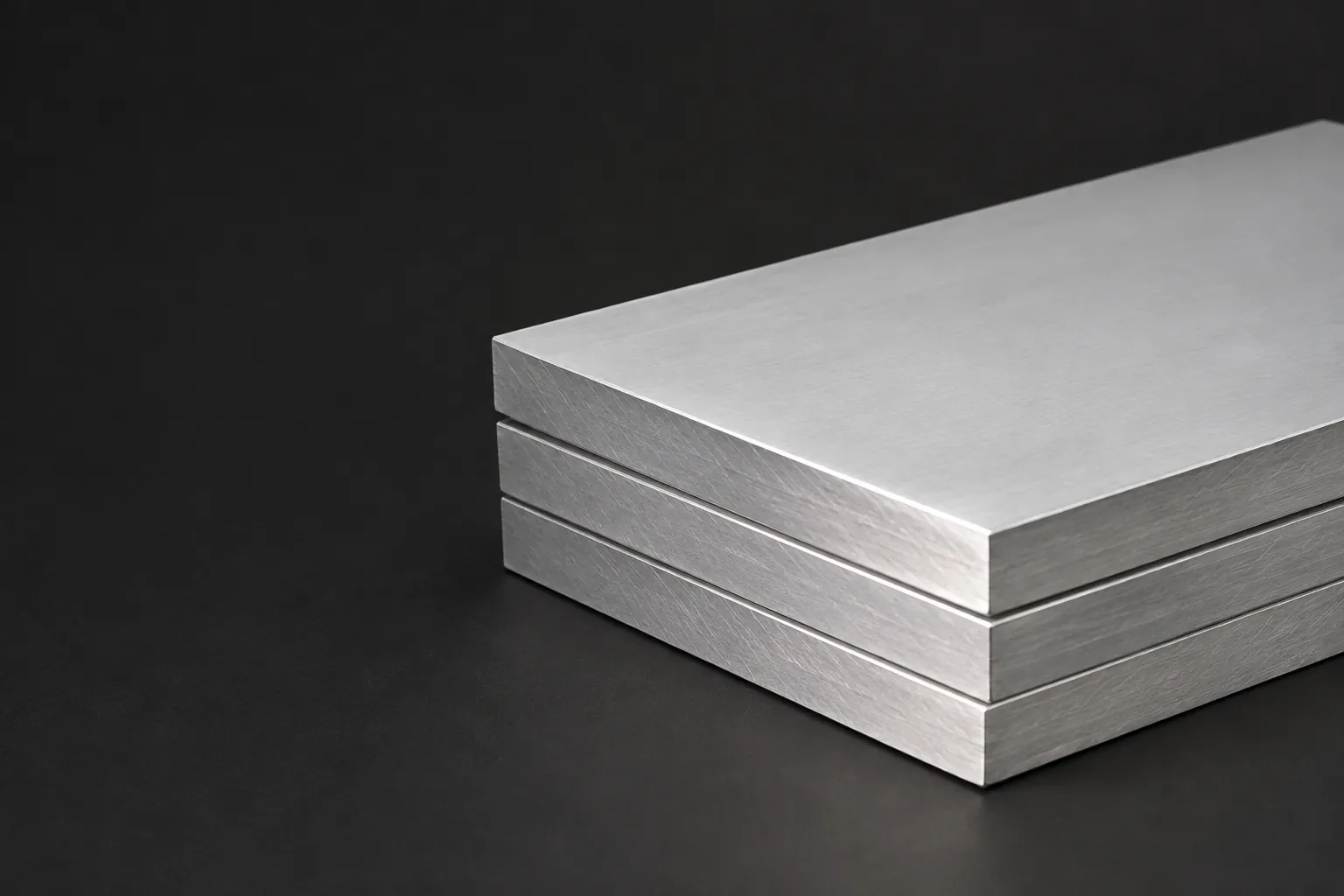
Illustrative aluminium materials and engineered components, not certified alloy stock or evidence of Quest stockholding.
Raw & semi-finished materials
Available material forms
Forms shown are enquiry categories, not a stock commitment. Producer, temper, thickness, mill approval and cut-piece traceability require confirmation.
- Plate
- Cut plate blanks
Material overview
Aluminium Alloy 7050
Heat-treatable aerospace aluminium for highly loaded machined structures; select temper and section thickness for strength, corrosion resistance and damage tolerance.
- Precipitation hardening requires controlled solution treatment, quenching and artificial ageing. Cooling of a heavy plate core is slower than at its surface; thin-plate properties must not be assigned to thick stock.
- Damage tolerance requires orientation-specific toughness and fatigue crack-growth evidence, not just tensile strength. No numerical fatigue allowable or fracture toughness is supplied here: a fully verified test method and complete condition basis were not established in the reviewed producer literature.
- Alcoa describes 7050 as less quench sensitive than most aerospace aluminium alloys and particularly suitable for 3–6 inch plate. This does not mean quench insensitive. Its plate T7651 has higher strength; T7451 sacrifices some strength for improved SCC resistance.
Designation and procurement context
| Reference | Scope / qualification |
|---|---|
| AA 7050 | Registered wrought alloy designation; not a product acceptance specification |
| AMS 4050 | T7451 plate, cited historically by Alcoa |
| AMS 4201 | T7651 plate, cited historically by Alcoa |
Full current standards were not available for review. Historical producer references and public scope information do not verify current revisions, all limits or interchangeability. No specification equivalence is asserted.
Alcoa producer datasheet
Specification review
Technical verification requirements
Designations / form / temper / dimensions
Product scopes were reviewed row by row. Recorded cross-references do not establish every current revision, ordered form, temper and dimensional limit; EN/UNS registries and complete controlled AMS/ASTM/EN texts were not inspected.
Obtain applicable controlled specification and producer confirmation; submit to technical review.
Mechanical conditions / gauge / orientation
Every selector/table was read. Typical, supplier minima and producer limits must remain distinct. Resolve missing orientation, specimen/gauge length, temperature, exact boundary inclusivity and test basis in the quoted notes; do not extend a specimen diameter to stock thickness or to other forms.
Produce a condition-by-condition acceptance matrix with form, thickness interval, tensile orientation, elongation basis, test temperature and source revision; omit unavailable values rather than infer them.
Toughness / thickness / SCC
Historical Alcoa evidence must not become universal current guarantees; preserve temper, thickness and L-T/T-L/S-L distinctions and qualify SCC relative ratings.
Obtain applicable controlled specification and producer confirmation; submit to technical review.
Grade selection
7010 and 7050 compared
| Aspect | 7010 | 7050 |
|---|---|---|
| Zn / Mg / Cu ranges | Zn 5.7–6.7; Mg 2.1–2.6; Cu 1.5–2.0 | Zn 5.7–6.7; Mg 1.9–2.6; Cu 2.0–2.6 |
| Zirconium and impurity limits | Zr 0.10–0.16; Fe ≤0.15; Si ≤0.12 | Zr 0.08–0.15; Fe ≤0.15; Si ≤0.12 |
| Product focus | High-integrity aerospace plate; supplier/product specification controls | Thick aerospace plate and other documented forms; each requires its own specification |
| Ageing and thick sections | Strength and corrosion balance depend on certified ageing and quench history | Producer literature emphasises reduced quench sensitivity and thick-section property balance |
| Toughness and damage tolerance | Verify temper, thickness, test method and crack orientation | Verify temper, thickness, test method and crack orientation |
| Corrosion selection | Overaged plate conditions require their own SCC/exfoliation qualification | T7451 and T7651 have different strength/SCC/exfoliation balances |
| Engineering use | Machined aircraft structural plate components | Fuselage frames, bulkheads and other specified aircraft structural components |
Qualitative engineering selection only; numeric chemistry is registered mass %. No numerical strength or toughness comparison is made because product form, temper, thickness, orientation and test basis are not matched. Neither material is universally superior or automatically interchangeable on a drawing.
The Aluminum Association — Teal Sheets, December 2025; grade-specific producer references below
Engineering reference
Technical data
| Element | Mass % | Limit |
|---|---|---|
| Si | 0.12 | Maximum |
| Fe | 0.15 | Maximum |
| Cu | 2.0–2.6 | Range |
| Mn | 0.10 | Maximum |
| Mg | 1.9–2.6 | Range |
| Cr | 0.04 | Maximum |
| Zn | 5.7–6.7 | Range |
| Ti | 0.06 | Maximum |
| Zr | 0.08–0.15 | Range |
| Other elements, each | 0.05 | Maximum |
| Other elements, total | 0.15 | Maximum |
| Al | Remainder | Balance |
Registered AA limits, not nominal chemistry or certified heat analysis. Ranges show minimum–maximum; other numerical entries are maxima. Other-element provisions apply. No EN/producer chemistry is merged into these limits. Unlisted elements are not represented as zero or unrestricted; 7020 has a combined Zr+Ti limit rather than an invented separate Ti maximum. Confirm governing specification and heat certificate.
The Aluminum Association — Teal Sheets, December 2025
| Property | SI value | Basis |
|---|---|---|
| Density | 2830 kg/m³ | Registered nominal density; reference temperature and temper unstated |
Nominal registry value, not a measured certificate or a design guarantee. Other physical properties omitted where an alloy-specific, sufficiently qualified source was not verified. Mixed-alloy producer tables are not transferred to this alloy.
The Aluminum Association — Teal Sheets, December 2025
T7651 plate — 0.250–1.000 in (6.35–25.40 mm)
| Property | Value | Basis |
|---|---|---|
| Ultimate tensile strength | 524 MPa | Minimum |
| Yield strength (offset unstated) | 455 MPa | Minimum; yield definition not stated |
| Elongation | 8 % | Minimum |
| Orientation | LT (long transverse) | Source declaration |
| Test temperature | Not stated | No room-temperature assumption |
Alcoa guaranteed minimum long-transverse properties. Only selected thickness bands are published; gaps are deliberately not interpolated. Test temperature, tensile test method and elongation gauge length are not stated in this table.
Alcoa Mill Products — Alloy 7050
T7651 plate — 2.001–3.000 in (50.83–76.20 mm)
| Property | Value | Basis |
|---|---|---|
| Ultimate tensile strength | 524 MPa | Minimum |
| Yield strength (offset unstated) | 455 MPa | Minimum; yield definition not stated |
| Elongation | 7 % | Minimum |
| Orientation | LT (long transverse) | Source declaration |
| Test temperature | Not stated | No room-temperature assumption |
Alcoa guaranteed minimum long-transverse properties. Only selected thickness bands are published; gaps are deliberately not interpolated. Test temperature, tensile test method and elongation gauge length are not stated in this table.
Alcoa Mill Products — Alloy 7050
T7451 plate — 0.250–2.000 in (6.35–50.80 mm)
| Property | Value | Basis |
|---|---|---|
| Ultimate tensile strength | 510 MPa | Minimum |
| Yield strength (offset unstated) | 441 MPa | Minimum; yield definition not stated |
| Elongation | 9 % | Minimum |
| Orientation | LT (long transverse) | Source declaration |
| Test temperature | Not stated | No room-temperature assumption |
Alcoa guaranteed minimum long-transverse properties. Only selected thickness bands are published; gaps are deliberately not interpolated. Test temperature, tensile test method and elongation gauge length are not stated in this table.
Alcoa Mill Products — Alloy 7050
T7451 plate — 5.001–6.000 in (127.03–152.40 mm)
| Property | Value | Basis |
|---|---|---|
| Ultimate tensile strength | 483 MPa | Minimum |
| Yield strength (offset unstated) | 414 MPa | Minimum; yield definition not stated |
| Elongation | 4 % | Minimum |
| Orientation | LT (long transverse) | Source declaration |
| Test temperature | Not stated | No room-temperature assumption |
Alcoa guaranteed minimum long-transverse properties. Only selected thickness bands are published; gaps are deliberately not interpolated. Test temperature, tensile test method and elongation gauge length are not stated in this table.
Alcoa Mill Products — Alloy 7050
Solution treatment and quenching
Solution treatment dissolves soluble constituents before rapid cooling retains solute for ageing. Cooling rate through the section controls subsequent response. Quench rate must balance retained properties against distortion, residual stress and cracking; do not improvise a slower quench for dimensional convenience.
Artificial ageing and overageing
Ageing develops strengthening precipitates. Peak-aged T6-type conditions favour strength; T7-type overageing changes the precipitate structure to obtain a different corrosion/strength balance. A higher tensile value does not establish better SCC, exfoliation or fatigue performance.
Stress relief and machining stability
The 51 suffix denotes stress relief by stretching for applicable plate tempers. Stretching reduces, but does not eliminate, quench residual stress. Heavy asymmetric stock removal can redistribute stresses and distort a part.
Approved process control
Use the producer-approved, alloy/product/temper-specific process and verify conductivity, hardness and specified mechanical and corrosion tests as required. Reheating, forming or welding may alter the delivered temper.
T74 versus T76
Alcoa describes T7451 plate as the more demanding stress-corrosion choice and T7651 as a higher-strength/exfoliation-oriented condition with a different SCC balance. They are not the same ageing requirement and neither is immune to SCC. T6/T651 plate and T74 forging properties are not inferred from these plate tables.
Qualitative metallurgy only: no shop heat-treatment temperatures, times or quench schedules are prescribed. Final temper must be supported by the applicable specification and certification.
Alcoa 7050 producer literature
Material selection
Corrosion resistance & performance
Use a qualified protective finish, sealed joints and galvanic isolation where required by the aircraft design. High-strength aluminium is not corrosion-proof. Sustained tensile stresses, grain direction and exposure govern SCC risk.
Alcoa distinguishes good exfoliation/average SCC resistance in T7651 from better SCC and excellent exfoliation resistance in T7451; sustained short-transverse stresses are a particular selection concern.
Corrosion and environmentally assisted cracking are sensitive to gauge, ageing, stress and humidity/temperature. Passing one accelerated screening test does not establish universal immunity in service.
Typical applications
Engineering applications
- Aircraft structural plate
- Highly loaded machined aircraft components
- Fuselage frames and bulkheads; Alcoa cites 2–6 inch sections
Subsequent manufacturing
Machining & processing
Machining and orientation
Maintain rolling-direction identification on the blank and component. Use balanced roughing, appropriate fixturing and staged finishing where required to manage distortion; assess final grain direction against the drawing.
Fusion welding caution
Do not treat this copper-bearing high-strength alloy as a routine fusion-weldable structural grade. Hot-cracking and heat-affected-zone property loss require a specifically qualified procedure and design approval. Delivered plate properties do not apply to a weld or HAZ; friction-stir joining also requires separate qualification.
Forming and surface integrity
High-strength aged plate has limited forming latitude. Any thermal forming or re-heat-treatment route requires approval and requalification. Protect machined surfaces and avoid tool damage or sharp transitions that can compromise fatigue performance.
Material certification & testing
Supply and documentation are subject to order review, mill capability and the drawing-defined specification; no aerospace approval is implied.
No certificate or test is automatically included. Alloy designation alone does not establish aerospace drawing compliance: confirm specification/revision, temper, product form, thickness, test orientation and acceptance requirements.
- Mill test certificate with alloy, temper, heat/lot and thickness traceability, if agreed at order
- Required tensile orientation and specimen location; supplementary ST testing only if ordered and supported
- Ultrasonic inspection, corrosion testing and fracture-toughness testing to explicitly agreed methods, limits and sampling
- Preservation of parent plate identity and rolling direction on cut blanks
- EN 10204 3.1 material certificate and Certificate of Conformity where agreed
- Temper verification, heat-treatment records and hardness testing where specified
- Customer-specific chemical/mechanical testing and aerospace inspection requirements where agreed
Material enquiry
Request a material quotation
Aluminium Alloy 7050 supplied to your material form, dimensions and specification.