Materials Supply / Aluminium Alloys
Aluminium Alloy 7475
Controlled-toughness aluminium–zinc–magnesium–copper sheet and plate
Controlled-toughness aluminium–zinc–magnesium–copper sheet and plate. Strength is developed by precipitation hardening, not by alloy designation alone.
7475 is not simply interchangeable 7075: tighter iron and silicon limits and controlled processing support improved fracture toughness and damage tolerance. Fatigue initiation strength and fatigue crack growth are separate design considerations.
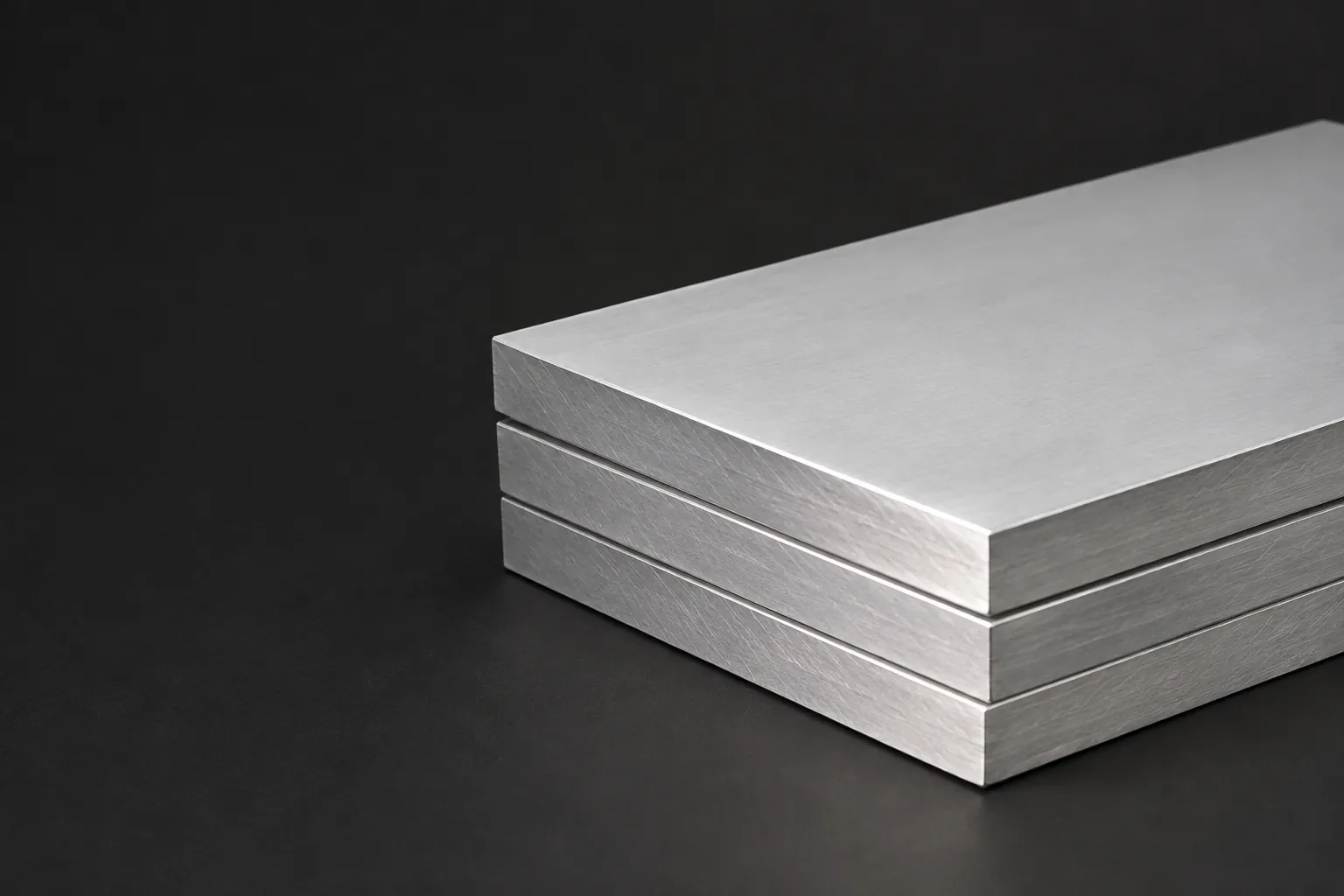
Illustrative aluminium materials and engineered components, not certified alloy stock or evidence of Quest stockholding.
Raw & semi-finished materials
Available material forms
Producer-documented forms, not a stock or current availability commitment. Exact size, surface and temper require enquiry.
- Plate
- Bare sheet
- Alclad sheet
Material overview
Aluminium Alloy 7475
Controlled-toughness aluminium–zinc–magnesium–copper sheet and plate. Temper, section size and orientation govern structural suitability.
- Zinc and magnesium provide the principal precipitation-hardening system; copper contributes to the high-strength response. Chromium influences grain structure and corrosion response. These are chromium-bearing alloys; no zirconium addition is inferred.
- Peak-aged and overaged conditions are not interchangeable. Strength, toughness, SCC, exfoliation resistance, fatigue response and machining stability must be balanced for the actual loading direction and section.
- Solution treatment and quenching establish a supersaturated condition for subsequent ageing. Quench rate varies through thick sections; residual stresses and through-thickness properties require attention. Stretch stress relief reduces, but does not eliminate, machining distortion.
- 7475-T7651 plate is documented in historical producer availability, but the reviewed mixed 7175/7475 typical table does not verify independent 7475 mechanical values, so no numerical T7651 selector is supplied.
Identification and specification basis
| Item | Basis |
|---|---|
| Alloy | 7475; wrought Al–Zn–Mg–Cu–Cr |
| Procurement | Specify product, temper, dimensions, orientation and applicable specification revision; no blanket equivalents asserted. |
| Historical producer references | AMS 4090 (T651 plate); AMS 4089 (T7651 plate); AMS 4202 (T7351 plate); AMS 4084/4085 (bare T61/T761 sheet); AMS 4207/4100 (alclad T61/T761 sheet) |
Current licensed standards have not been reviewed. Historical references are not claims of present compliance or revision currency.
Specification review
Technical verification requirements
Designations / form / temper / dimensions
Product scopes were reviewed row by row. Recorded cross-references do not establish every current revision, ordered form, temper and dimensional limit; EN/UNS registries and complete controlled AMS/ASTM/EN texts were not inspected.
Obtain applicable controlled specification and producer confirmation; submit to technical review.
Mechanical conditions / gauge / orientation
Every selector/table was read. Typical, supplier minima and producer limits must remain distinct. Resolve missing orientation, specimen/gauge length, temperature, exact boundary inclusivity and test basis in the quoted notes; do not extend a specimen diameter to stock thickness or to other forms.
Produce a condition-by-condition acceptance matrix with form, thickness interval, tensile orientation, elongation basis, test temperature and source revision; omit unavailable values rather than infer them.
Toughness / thickness / corrosion
Preserve thickness bands, guaranteed-versus-typical basis and specimen orientation; qualification cannot be transferred between sheet and plate or T7351/T7651.
Obtain applicable controlled specification and producer confirmation; submit to technical review.
Grade selection
7075 and 7475 compared
| Aspect | 7075 | 7475 |
|---|---|---|
| Zn / Mg / Cu ranges | Zn 5.1–6.1; Mg 2.1–2.9; Cu 1.2–2.0 | Zn 5.2–6.2; Mg 1.9–2.6; Cu 1.2–1.9 |
| Iron maximum | 0.50 | 0.12 |
| Silicon maximum | 0.40 | 0.10 |
| Cr / Mn / Ti | Cr 0.18–0.28; Mn ≤0.30; Ti ≤0.20 | Cr 0.18–0.25; Mn ≤0.06; Ti ≤0.06 |
| Damage tolerance | Toughness varies by temper, form and thickness; not inferred from tensile strength | Controlled impurities and producer processing support toughness-oriented plate/sheet; verify actual test basis |
| Temper selection | T6/T651 and overaged T73/T7351/T76/T7651 are not substitutes | Plate and sheet have distinct temper and toughness test routes |
| Fracture test comparison | Do not treat typical values or sheet Kc as guaranteed plate KIc | Only compare equivalent method, thickness, temper and crack orientation |
| Aerospace applications | High-strength structural fittings and machined parts | Fracture-critical skins, spars and bulkheads where the drawing approves the product |
| Fusion welding | Not readily fusion-weldable for structural duty | Not readily fusion-weldable for structural duty |
Qualitative engineering selection only; numeric chemistry is registered mass %. No numerical strength or toughness comparison is made because product form, temper, thickness, orientation and test basis are not matched. Neither material is universally superior or automatically interchangeable on a drawing.
The Aluminum Association — Teal Sheets, December 2025; grade-specific producer references below
Engineering reference
Technical data
| Element | Mass % | Limit |
|---|---|---|
| Si | 0.10 | Maximum |
| Fe | 0.12 | Maximum |
| Cu | 1.2–1.9 | Range |
| Mn | 0.06 | Maximum |
| Mg | 1.9–2.6 | Range |
| Cr | 0.18–0.25 | Range |
| Zn | 5.2–6.2 | Range |
| Ti | 0.06 | Maximum |
| Other elements, each | 0.05 | Maximum |
| Other elements, total | 0.15 | Maximum |
| Al | Remainder | Balance |
Registered AA limits, not nominal chemistry or certified heat analysis. Ranges show minimum–maximum; other numerical entries are maxima. Other-element provisions apply. No EN/producer chemistry is merged into these limits. Unlisted elements are not represented as zero or unrestricted; 7020 has a combined Zr+Ti limit rather than an invented separate Ti maximum. Confirm governing specification and heat certificate.
The Aluminum Association — Teal Sheets, December 2025
| Property | SI value | Basis |
|---|---|---|
| Density | 2810 kg/m³ | Registered nominal density; reference temperature and temper unstated |
Nominal registry value, not a measured certificate or a design guarantee. Other physical properties omitted where an alloy-specific, sufficiently qualified source was not verified. Mixed-alloy producer tables are not transferred to this alloy.
The Aluminum Association — Teal Sheets, December 2025
T651 — plate
| Product / surface | Thickness (mm unless stated) | UTS (MPa unless stated) | Yield (MPa unless stated) | Elongation (%) | Orientation / basis |
|---|---|---|---|---|---|
| Plate | 6.35–12.675 | 538 | 462 | 10 | LT; guaranteed minima |
| Plate | 25.425–38.10 | 538 | 469 | 9 | LT; guaranteed minima |
Only the selected thickness bands published by Alcoa are shown; no intervening bands inferred. Test temperature and elongation gauge length not stated. Historical plate KIc minimum (ASTM E399 compact specimen; test temperature not stated): 31.75–38.10 mm: L–T 33.0 MPa√m; T–L 30.8 MPa√m. This toughness thickness range is independent of the tensile rows; confirm any guarantee contractually.
T7351 — plate
| Product / surface | Thickness (mm unless stated) | UTS (MPa unless stated) | Yield (MPa unless stated) | Elongation (%) | Orientation / basis |
|---|---|---|---|---|---|
| Plate | 25.43–38.10 | 490 | 414 | 9 | LT; guaranteed minima |
| Plate | 50.83–63.50 | 476 | 393 | 8 | LT; guaranteed minima |
| Plate | 76.25–88.90 | 448 | 365 | 8 | LT; guaranteed minima |
Selected bands only. Test temperature and elongation gauge length not stated. Historical plate KIc minimum (ASTM E399 compact specimen; test temperature not stated): 31.75–101.60 mm: L–T 44.0 MPa√m; T–L 36.3 MPa√m. This toughness thickness range is independent of the tensile rows; confirm any guarantee contractually.
T61 — bare sheet
| Product / surface | Thickness (mm unless stated) | UTS (MPa unless stated) | Yield (MPa unless stated) | Elongation (%) | Orientation / basis |
|---|---|---|---|---|---|
| Sheet / Bare | 1.016–6.325 | 517 | 441 | 9 | LT; guaranteed minima |
Test temperature and elongation gauge length not stated. Do not substitute T6 for T61 or T76 for T761.
T61 — alclad sheet
| Product / surface | Thickness (mm unless stated) | UTS (MPa unless stated) | Yield (MPa unless stated) | Elongation (%) | Orientation / basis |
|---|---|---|---|---|---|
| Sheet / Alclad | 1.60–4.75 | 485 | 415 | 9 | LT; guaranteed minima |
Test temperature and elongation gauge length not stated. Do not substitute T6 for T61 or T76 for T761.
T761 — bare sheet
| Product / surface | Thickness (mm unless stated) | UTS (MPa unless stated) | Yield (MPa unless stated) | Elongation (%) | Orientation / basis |
|---|---|---|---|---|---|
| Sheet / Bare | 1.016–6.325 | 490 | 414 | 9 | LT; guaranteed minima |
Test temperature and elongation gauge length not stated. Do not substitute T6 for T61 or T76 for T761.
T761 — alclad sheet
| Product / surface | Thickness (mm unless stated) | UTS (MPa unless stated) | Yield (MPa unless stated) | Elongation (%) | Orientation / basis |
|---|---|---|---|---|---|
| Sheet / Alclad | 1.60–4.75 | 462 | 386 | 9 | LT; guaranteed minima |
Test temperature and elongation gauge length not stated. Do not substitute T6 for T61 or T76 for T761.
Solution treatment and quenching
Dissolve soluble phases and quench to retain supersaturation. Control transfer, cooling uniformity and distortion with a qualified product-specific procedure; thick sections cannot be assigned thin-sheet response.
Artificial ageing
T61 sheet and T651 plate are separately documented strength/toughness conditions for 7475; T61 is not a shorthand for T6.
Overageing
T7351 plate favours SCC resistance; T7651 plate favours exfoliation resistance with improved SCC resistance. T761 sheet is a separate sheet condition.
Stress relief and machining
The 51 suffix identifies stretching stress relief; it does not guarantee freedom from residual stress or distortion. Plan balanced roughing and finishing around section removal.
Forming and re-treatment
Forming in softer O or solution-treated W condition may be appropriate only under qualified handling and re-treatment procedures. Do not improvise ageing or solution-treatment schedules.
Conceptual guidance only: no furnace temperatures, soak times, quench delays or ageing schedules are supplied. For 7475, Alcoa specifically calls for producer-recommended special thermal practices.
Material selection
Corrosion resistance & performance
General corrosion resistance requires protective-system selection; avoid galvanic contact and protect joints, machined edges and faying surfaces. Alcladding is not proof against every corrosion mode.
T7351 is the documented SCC-oriented plate condition; T7651 is exfoliation-oriented with improved SCC response relative to T651. For 7475 sheet, T761 offers improved general and exfoliation resistance compared with T61.
Sustained tensile stress, residual stress, environment, orientation and section thickness govern SCC risk. No universal safe-stress threshold is asserted.
Typical applications
Engineering applications
- Fuselage skins
- Wing skins
- Wing spars
- Fuselage bulkheads
- Fracture-critical aircraft sheet and plate components
Subsequent manufacturing
Machining & processing
Machining
Good machinability is documented for heat-treated products. Use controlled stock removal, rigid support and suitable chip control; stress-relieved plate can still move during machining.
Forming
Heat-treated material has restricted cold formability. Confirm bend radius, direction and any softer-condition forming route with the producer; re-treatment changes the final condition.
Joining
Do not specify conventional fusion welding as a routine structural joining route for these high-strength Al–Zn–Mg–Cu products. Cracking sensitivity, heat-affected-zone strength loss and corrosion changes require application-specific qualification. Resistance or solid-state joining is a separate qualified process, not blanket approval for fusion welding.
Damage tolerance
7475 controls impurities and processing for improved toughness. Fatigue crack-growth response depends on regime: Alcoa reports lower near-threshold growth for T651 than T7351, but lower higher-intensity growth for T7351. No universal fatigue ranking or graph-derived numerical life is supplied.
Material certification & testing
Certification is conditional on the agreed product specification, mill route and purchase order; no blanket aerospace approval or stock certification is implied.
No certificate or test is automatically included. Alloy designation alone does not establish aerospace drawing compliance: confirm specification/revision, temper, product form, thickness, test orientation and acceptance requirements.
- Request heat/lot traceability and chemical analysis.
- Agree temper, thickness band, surface/cladding, orientation, tensile acceptance and elongation basis.
- Specify any ultrasonic inspection, SCC/exfoliation, conductivity or residual-stress requirements before ordering.
- Agree fracture toughness method, specimen geometry, orientation, thickness and guaranteed limits where required; do not infer them from typical data.
- EN 10204 3.1 material certificate and Certificate of Conformity where agreed
- Temper verification, heat-treatment records and hardness testing where specified
- Customer-specific chemical/mechanical testing and aerospace inspection requirements where agreed
Material enquiry
Request a material quotation
Aluminium Alloy 7475 supplied to your material form, dimensions and specification.