Materials Supply / Nickel, Cobalt & High-Temperature Alloys
Alloy 909 Nickel-Iron-Cobalt Alloy
Precipitation-hardenable low-expansion nickel-iron-cobalt alloy | UNS N19909
Alloy 909 is a precipitation-hardenable nickel-iron-cobalt alloy, also known as INCOLOY® alloy 909. Niobium and titanium additions enable precipitation strengthening. Its low thermal expansion supports close control of turbine clearances and dimensional tolerances.
Expansion is not constant over all temperatures: the producer describes approximately 7.7 µm/(m·K) from room temperature to the Curie inflection region, followed by higher coefficients as temperature increases. The Curie temperature depends on chemistry.
The alloy contains no chromium and must not be assigned the corrosion or oxidation resistance of chromium-rich nickel alloys. Protective coatings may be required in oxidising service.
INCOLOY® and INCONEL® are trademarks of the Special Metals Corporation group of companies. Quest Engineering does not own these trademarks.
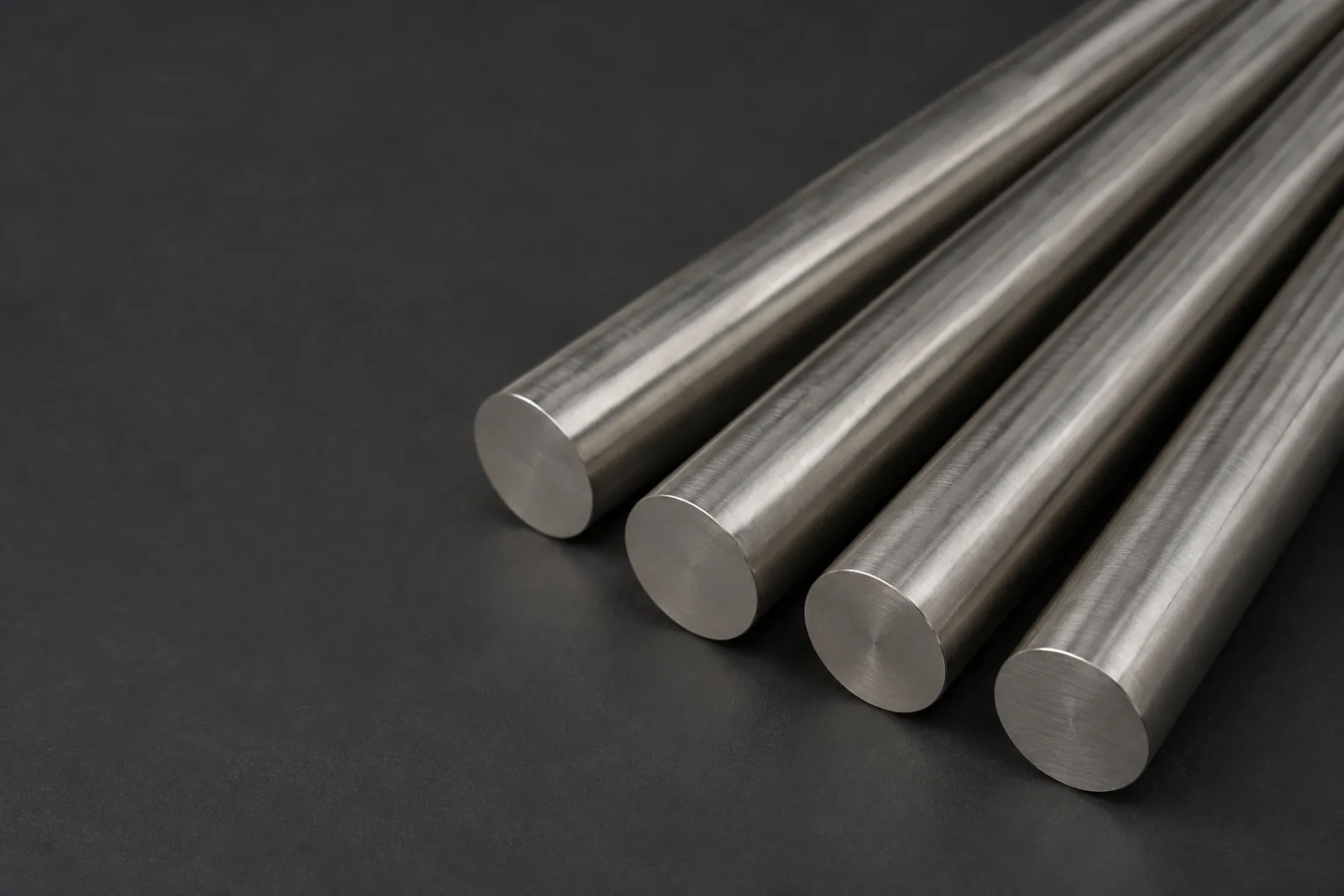
Raw & semi-finished materials
Available material forms
Producer-listed forms; availability depends on specification, dimensions, condition and supplier confirmation. No stock is implied. Wire rod is not a claim for finished wire; tube and pipe are not listed.
- Sheet
- Plate
- Rod
- Bar
- Wire Rod
- Forging Stock
- Hot-Rolled Profile
- Cut-to-Size Material
Material overview
Alloy 909 Nickel-Iron-Cobalt Alloy
High-strength, low-expansion nickel-iron-cobalt alloy for gas-turbine clearances and precision components; environmental protection requires careful assessment.
- Low thermal expansion and high strength are the principal selection drivers, not general corrosion resistance.
- Order against the specific product-form standard, revision and supplied condition; solution-treated precipitation-hardenable material is not necessarily supplied aged.
- The bulletin reverses AMS 5892 and AMS 5893 product-form labels; the independently checked public standard scopes below take precedence.
Designations and product specifications
| Designation / specification | Product form / scope | Notes |
|---|---|---|
| UNS N19909 | Alloy identification | Confirmed by producer; not a product specification. |
| W.Nr. / EN | Not verified | No European material number is given in SMC-077. No unverified equivalence is assigned. |
| INCOLOY® alloy 909 | Alternative commercial name | Trademark of the Special Metals Corporation group of companies. |
| SAE AMS 5884 | Bars, forgings, flash-welded rings and stock for forging, flash-welded rings or heading | SAE public abstract: solution heat treated, precipitation hardenable, multiple melted, high-temperature low-expansion alloy. Bulletin lists billets only, which is narrower than the abstract. |
| SAE AMS 5892 | Sheet and strip | Public AMS5892D catalogue abstract: nominal thickness 6.35 mm and under; solution heat treated, precipitation hardenable, multiple melted. Bulletin incorrectly labels this bars and forgings. |
| SAE AMS 5893 | Bars, forgings, flash-welded rings and stock for forging, flash-welded rings or heading | Public AMS5893D abstract: solution heat treated, short-time precipitation hardenable, multiple melted. Bulletin incorrectly labels this sheet and strip. |
Full current standards were not accessible. Verify ordered revision, size limits, chemistry, treatment and testing before supply. No applicable ASTM, ASME or EN product specification was independently verified; none is assigned. Public abstract URLs and discrepancy details are recorded in the accompanying notes. Reference associations only: no equivalence, stock availability, aerospace approval or certified conformity is established by this page. Specify the ordered revision, product form, dimensions, manufacture/melt route, delivery condition and acceptance tests; obtain matching supplier confirmation and inspection documents.
Specification review
Technical verification requirements
Designations / ordered product condition
Page correctly reverses erroneous producer AMS5892/5893 form assignments; preserve distinction between historical bulletin and public specification scope, obtain controlled editions. Existing cautions do not prove conformity; no allegation that every listed scope is wrong. Obtain the ordered revision and map each cited specification to form, dimensions, manufacture, delivery condition and acceptance tests.
Obtain licensed ordered editions and issue a material-specific form/condition/size compliance matrix; retain existing caveats pending approval.
Specification source provenance
Current page maps AMS5892 to flat product and AMS5893 to long product correctly against public scope. SMC-077 reverses these. Do not revert page to the producer typo, and do not describe public abstracts as complete verification.
Retain current assignments, attach public scope citations directly to rows and obtain controlled editions.
Engineering reference
Technical data
| Element | Mass % |
|---|---|
| Nickel | 35.0–40.0 |
| Cobalt | 12.0–16.0 |
| Niobium | 4.3–5.2 |
| Titanium | 1.3–1.8 |
| Iron | Balance |
| Silicon | 0.25–0.50 |
| Aluminium | 0.15 max. |
| Carbon | 0.06 max. |
Table 1 limiting composition, one producer basis. Balance means iron predominates in the remainder, not exclusive iron. Bulletin specifies niobium alone, not Nb+Ta; no tantalum limit is invented. Chromium, manganese, molybdenum, copper, sulphur and phosphorus limits are not provided.
| Property | Value | Basis |
|---|---|---|
| Density | 8190 kg/m³ | Table 2; temperature not stated |
| Melting range | 1395–1430 °C | Table 2 |
| Curie temperature | 400–455 °C | Chemistry dependent; Table 2 |
| Young’s modulus | 159 GPa | Room-temperature baseline; dynamic method |
| Shear modulus | 59 GPa | Room-temperature baseline; dynamic method |
| Specific heat | 427 J/(kg·K) | 20 °C; Table 3 |
| Electrical resistivity | 0.728 µΩ·m | 20 °C; Table 3 |
| Thermal conductivity | 14.8 W/(m·K) | 20 °C; Table 3; producer-extrapolated value |
| Approximate coefficient of thermal expansion | 7.7 µm/(m·K) | Room temperature to Curie inflection region; see temperature-dependent table below |
Typical producer values, not specification limits. Density converted from 8.19 g/cm³. Temperature-dependent expansion must not be represented by one universal constant.
Solution treated and aged
| Property | Value | Basis |
|---|---|---|
| Ultimate tensile strength | 1276 MPa | 20 °C; Table 5 |
| 0.2% yield strength | 1034 MPa | 20 °C; Table 5 |
| Elongation | 15% | 20 °C; gauge length not stated |
| Hardness | Not reported | No verified producer value |
| Reduction of area | 30% | 20 °C; Table 5 |
Typical, not specification minima. Standard producer solution treatment plus ageing described below. Product form, section size, specimen orientation and gauge length are not stated for Table 5; do not assume universal section-size applicability.
Suitability depends on loading, temperature, exposure duration, atmosphere and required service life; no single maximum service temperature is assigned.
Typical tensile properties — solution treated and aged; product form unspecified
| Temperature °C | UTS MPa | Yield MPa | Elongation % |
|---|---|---|---|
| 20 | 1276 | 1034 | 15 |
| 650 | 1034 | 862 | 25 |
Table 5; 0.2% offset yield; standard treatment on page 3. Typical values, not design allowables or specification minima. Reduction of area is 30% at 20 °C and 60% at 650 °C. Specimen and section limits are not stated.
Thermal expansion behaviour — producer description and Figure 1 context
| Temperature / range | Coefficient / behaviour | Data basis |
|---|---|---|
| Room temperature to Curie inflection region (approximately 425 °C) | Approximately 7.7 µm/(m·K) | Producer page 1 textual approximation; not separate measured values at each temperature |
| Curie transition: 400–455 °C | Inflection varies with composition | Table 2; no unique fixed transition temperature |
| Above the inflection region | Coefficient increases with temperature; numerical values omitted | Figure 1 is graphical only; no digitisation or extrapolation performed |
Temperature-dependent regime table, not a fabricated multipoint dataset. The bulletin does not explicitly define tangent versus mean CTE in the text or Figure 1. Obtain a defined measurement basis and heat-specific expansion data for precision design.
Rupture, creep crack-growth and fatigue results are graphical only and are not digitised. No stress-versus-rupture-life table or fatigue design allowables are invented. Silicon contributes to improved notch-rupture behaviour, but does not establish immunity to environmental cracking. Strengthening loses effectiveness above about 650 °C in the producer discussion; that is not a service rating.
Solution treatment
Producer standard mechanical-data treatment: 980 °C for 1 h, air cool.
Precipitation ageing
720 °C for 8 h, furnace cool at 55 °C/h to 620 °C, hold for 8 h, then air cool.
SMC-077 pages 3 and 6; producer rounded Celsius values retained. This is the Alloy 909 producer schedule, not a claim of compliance with every AMS revision or the short-time route of AMS 5893. No separately verified stabilisation schedule is assigned.
Material selection
Corrosion resistance & performance
No chromium is included because it would increase thermal expansion; absence of chromium increases susceptibility to high-temperature oxidation.
Protective coatings may be necessary to prevent excessive oxidation. Coating chemistry, compatibility, adhesion, inspection and repair must be qualified for the actual component and atmosphere.
The bulletin compares cyclic oxidation at 650 °C using 15-minute heating cycles followed by 5 minutes of cooling; no quantitative mass-change values or atmosphere not explicitly verified here are assigned.
No universal resistance to chlorides, acids, carburisation or chemical-processing media is established. Assess the actual environment rather than borrowing Alloy 825 or chromium-rich Inconel claims.
Typical applications
Engineering applications
- Gas-turbine vanes, casings, shafts and shrouds requiring clearance control
- Rocket-engine thrust chambers
- Springs and steam-turbine bolts
- Gauge blocks and instrumentation requiring dimensional control
- Glass-sealing applications involving differential thermal expansion
Subsequent manufacturing
Machining & processing
Machinability
Use conventional high-strength nickel-alloy machining practices. Producer recommends rough machining in the annealed condition and Group D-2 guidance in its Machining publication.
Work hardening and tooling
Plan tooling rigidity and cutting engagement to control work hardening; qualify tools and parameters for the actual condition. No universal cutting speeds or feeds are specified here.
Forming
Producer hot-forming range is 870–1120 °C. Initial forging follows heating to 1060–1120 °C; intermediate forging uses 25% reduction after heating to 995–1050 °C; finish forging uses 20–25% reduction after heating to 980–1025 °C, with workpiece below 955 °C during most finishing. Air cool, not water quench.
Welding
Producer identifies gas-tungsten-arc welding as suitable. Obtain specific filler, joint preparation and heat-treatment recommendations from the producer and qualify the welding procedure; no filler specification is represented as parent metal.
Distortion
Plan machining allowance, support and dimensional checks around solution treatment and ageing. Producer warns water quenching hot-formed metal can generate high stresses and unfavourable precipitate morphology with reduced tensile properties.
Finishing and surface protection
Define cleanliness and surface finish in the purchase and process specification. Qualify any protective coating for environmental exposure and dimensional tolerances; no universal coating system is established by the bulletin.
Inspection
Confirm identity, heat treatment and dimensions; agree surface and internal inspection, weld inspection and coating checks appropriate to form and service. Inspection methods and acceptance limits are contract-specific.
Material certification & testing
Certification and inspection options are subject to customer requirements and supplier confirmation.
Conformity must be demonstrated against the ordered specification, form and condition. Tests are not automatic; agree scope, acceptance criteria and documentation before ordering.
- EN 10204 3.1 material certificates
- Certificates of Conformity
- Heat/batch traceability
- Chemical analysis
- Mechanical testing
- Heat-treatment records
- Hardness testing
- Positive Material Identification (PMI)
- Ultrasonic testing where applicable
- Additional aerospace or customer-specific inspection requirements
Material enquiry
Request a material quotation
Alloy 909 Nickel-Iron-Cobalt Alloy supplied to your material form, dimensions and specification.