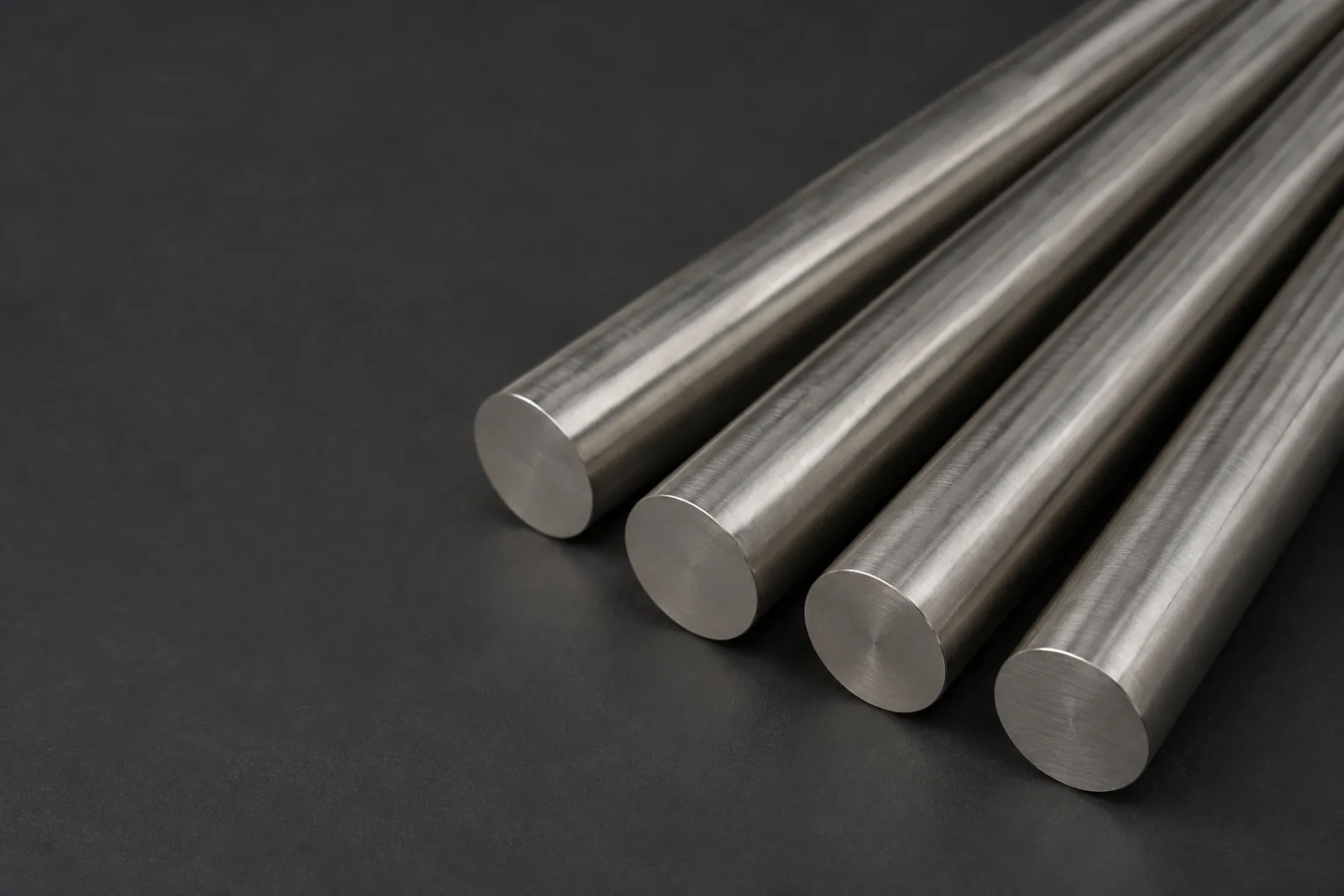
Materials Supply / Nickel, Cobalt & High-Temperature Alloys
Alloy 901 Nickel-Iron-Chromium Alloy
Precipitation-hardenable nickel-iron-chromium alloy | UNS N09901 | W.Nr. 2.4662
Alloy 901 is an age-hardenable Ni-Fe-Cr superalloy. Titanium and aluminium additions support precipitation strengthening during ageing; molybdenum contributes to the alloy’s strength. Solution treatment followed by two ageing stages develops the heat-treated condition.
The primary producer bulletin calls this material NIMONIC® alloy 901, not INCOLOY® alloy 901. INCOLOY® 901 is an alternative commercial name appearing in the AMS 5660N title. NIMONIC is a trademark of the Special Metals Corporation group of companies, as stated in the bulletin. INCOLOY® and INCONEL® are also Special Metals Corporation group trademarks; Quest Engineering does not own these marks.
Melting and refining may involve vacuum induction melting, vacuum arc remelting and electroslag remelting according to the application and customer specification. Neither the alloy designation nor these examples establish aerospace approval.
Raw & semi-finished materials
Available material forms
Producer-listed forms are flat or round bar, extruded section and forging billet. Availability depends on specification, dimensions and supplier confirmation; no stock is implied.
- Round Bar
- Flat Bar
- Extruded Section
- Forging Billet
- Cut-to-Size Material
Material overview
Alloy 901 Nickel-Iron-Chromium Alloy
Age-hardenable nickel-iron-chromium superalloy for high-strength gas-turbine components, with molybdenum, titanium and aluminium additions.
- Precipitation-hardenable nickel-iron-chromium alloy, distinct from corrosion-focused Alloy 825 and the Alloy 800 family.
- Producer applications include gas turbine engine discs, shafts, rings, casings and seals.
- Heat treatment, section size, test orientation and exposure history must be agreed for the intended duty.
Material specifications & designations
| Designation / specification | Product form / scope | Notes |
|---|---|---|
| UNS N09901 | Alloy identification | Verified in producer bulletin. |
| W.Nr. 2.4662 | Werkstoff material number | Producer verified; not an assertion of conformity to a particular EN product standard. |
| NIMONIC® alloy 901 / INCOLOY® 901 | Commercial names | Producer bulletin uses NIMONIC; AMS 5660N title uses Incoloy. |
| AMS 5660 | Bars, forgings and forging stock | AMS 5660N public abstract: bars and forgings ≤127 mm nominal diameter or least distance between parallel sides; forging stock any size. Solution, stabilization and precipitation heat treated. https://doi.org/10.4271/AMS5660N |
| AMS 5661 | Bars, forgings, flash-welded rings and forging/ring stock | Public AMS 5661E abstract verifies these forms and solution, stabilization and precipitation heat-treated title; H revision exists, but full current requirements were not accessible. https://doi.org/10.4271/AMS5661E |
| BR HR 55 | Producer-listed under rod, bar, wire and forging stock | Historical bulletin reference; current scope/status unverified. |
| AECMA PrEN2176 | Producer-listed under rod, bar, wire and forging stock | Draft designation in 2004 bulletin; current EN successor and scope unverified. |
| AECMA PrEN2177 | Producer-listed under rod, bar, wire and forging stock | Draft designation in 2004 bulletin; current EN successor and scope unverified. |
| AECMA PrEN2178 | Producer lists under Others | No specific product scope verified. |
| ISO 9723 | Producer-listed under rod, bar, wire and forging stock | Individual scope and current grade coverage not independently verified. |
| ISO 9725 | Producer-listed under rod, bar, wire and forging stock | Individual scope and current grade coverage not independently verified. |
No ASTM or ASME parent-metal specification was verified for N09901; none is assigned. Do not infer wire coverage from the bulletin’s collective heading for the individual AMS standards. Full current standards were not accessible; verify revision, chemistry, product form, dimensions, condition and acceptance testing against the order. No filler-metal specifications are included. Reference associations only: no equivalence, stock availability, aerospace approval or certified conformity is established by this page. Specify the ordered revision, product form, dimensions, manufacture/melt route, delivery condition and acceptance tests; obtain matching supplier confirmation and inspection documents.
Specification review
Technical verification requirements
Designations / ordered product condition
AMS5661E public title supports solution/stabilisation/precipitation treatment, not solution-only; current H edition section-size limits and numerical acceptance remain unverified. Existing cautions do not prove conformity; no allegation that every listed scope is wrong. Obtain the ordered revision and map each cited specification to form, dimensions, manufacture, delivery condition and acceptance tests.
Obtain licensed ordered editions and issue a material-specific form/condition/size compliance matrix; retain existing caveats pending approval.
Engineering reference
Technical data
| Element | Mass % |
|---|---|
| Nickel | 42.5 nominal |
| Chromium | 12.5 nominal |
| Molybdenum | 5.75 nominal |
| Titanium | 2.9 nominal |
| Cobalt | 1.0 max. |
| Copper | 0.5 max. |
| Manganese | 0.5 max. |
| Silicon | 0.4 max. |
| Aluminium | 0.35 max. |
| Carbon | 0.1 max. |
| Sulfur | 0.03 max. |
| Iron | Balance |
Table 1 is explicitly nominal and not for specification purposes. No minimum limits are supplied; do not treat nominal values as limits. Balance means iron predominates in the remainder, not that the remainder is exclusively iron. Phosphorus, boron and niobium limits are not given; none is inferred from AMS titles.
| Property | Value | Temperature / basis |
|---|---|---|
| Density | 8140 kg/m³ | Table 2; temperature not stated |
| Melting range | 1280–1345 °C | Table 2 |
| Specific heat | 431 J/(kg·K) | 20 °C |
| Electrical resistivity | 1.12 µΩ·m | 20 °C; converted from 112 µΩ·cm |
| Dynamic Young’s modulus | 201 GPa | 20 °C; fully heat-treated cylindrical specimen, flexural vibration |
| Dynamic Young’s modulus | 166 GPa | 600 °C; same basis |
| Mean linear thermal expansion | 13.5 µm/(m·K) | 20–100 °C; fully heat treated |
| Mean linear thermal expansion | 15.0 µm/(m·K) | 20–600 °C; Table 3 endpoint convention |
| Thermal conductivity | Not reported | No numerical value supplied by this bulletin |
Typical physical data, not specification limits. Thermal expansion has approximately ±5% processing-related variation. Table 3 prints 20–100 °C in its first row and endpoints thereafter; later ranges are interpreted from 20 °C. Density temperature is unspecified, not assumed.
Solution treated and two-stage aged
| Property | Value | Basis |
|---|---|---|
| Ultimate tensile strength | Not tabulated | Producer Figure 1 only; not digitised. |
| 0.2% yield strength | Not tabulated | Producer Figure 1 only; not digitised. |
| Elongation | Not tabulated | Producer Figure 1 only; not digitised. |
| Hardness | Not reported | No hardness table in this bulletin. |
| Reduction of area | Not tabulated | Producer Figure 1 only; not digitised. |
Forged-bar heat-treatment condition recommended on p. 1. Figure 1 describes vacuum-refined, extruded and forged bar, but does not explicitly tie the plotted curves to a stated heat-treatment cycle. No numerical room-temperature tensile acceptance values are supplied here. Section dimensions, tensile specimen geometry and orientation are not stated. These missing data are not specification minima; obtain a condition- and size-specific producer test table before publication.
Suitability depends on loading, temperature, exposure duration, atmosphere and service life; there is no single maximum temperature rating applicable to all Alloy 901 components.
Thermal-exposure impact response — circumferential V-notched specimens, tested at room temperature
| Prior soak temperature °C | Soak duration h | Impact energy J |
|---|---|---|
| 600 | 30 | 44 |
| 600 | 1000 | 38 |
| 600 | 10000 | 15 |
| 700 | 30 | 41 |
| 700 | 1000 | 12 |
| 700 | 10000 | 5 |
Selected exact SI entries from Table 5. Product context is forged bar; impact specimen size and initial heat-treatment condition are not explicitly stated. These are impact energies, not fatigue, tensile or rupture design properties.
Elevated-temperature tensile/0.2% proof/elongation data appear only as Figure 1 curves, and creep-rupture data only as Figure 2 Larson–Miller plots for forged bar. No graph values have been estimated; numerical tensile and stress-rupture tables are omitted. The bulletin provides no fatigue curves, creep strain limits or qualified oxidation atmosphere/temperature/duration tests. Impact data do not establish fatigue life; obtain duty-specific fatigue and rupture evidence.
Solution treatment
For forged bar: hold 3 hours at 1090 °C, then water quench.
First ageing stage
Hold 4 hours at 775 °C, then air cool.
Second ageing stage
Hold 24 hours at 705–720 °C, then air cool.
Producer recommended three-stage forged-bar procedure, not a verified current AMS acceptance schedule. Confirm section size, furnace control, quench method and ordered specification; assess distortion. No Inconel 718 schedule is used.
Material selection
Corrosion resistance & performance
The selected producer bulletin does not provide quantified aqueous-corrosion, chloride cracking, pitting, carburisation or oxidation exposure tests. Do not interpret chromium content as universal resistance or transfer Alloy 825 corrosion performance to Alloy 901.
Assess atmosphere, contaminants, surface condition, applied stress and exposure duration for the actual turbine duty; coatings or environmental qualification must be agreed where required.
Typical applications
Engineering applications
- Gas turbine engine discs
- Gas turbine engine shafts
- Gas turbine engine rings
- Gas turbine engine casings
- Gas turbine engine seals
Subsequent manufacturing
Machining & processing
Machinability and work hardening
Plan machining around the ordered heat-treatment condition and work-hardening response. Qualify cutting strategy on representative material; the selected bulletin supplies no condition-specific cutting parameters.
Tooling
Select rigid workholding, suitable tools and coolant through supplier/process trials. No universal cutting speeds or tool-life claims are made.
Forming
Producer forms include extruded sections and forging billet. Obtain qualified hot-working and forming instructions for the actual section; no forging-temperature window is supplied in this bulletin.
Welding
Do not assume weldability or use a filler-metal specification as parent-metal approval. Require a qualified welding procedure and customer agreement on post-weld treatment and inspection; this bulletin supplies no welding schedule.
Heat-treatment distortion
Water quenching and subsequent ageing require an agreed allowance and inspection plan for distortion, dimensions and residual-stress-sensitive features.
Finishing
Agree surface finish, cleaning and scale removal compatible with the component drawing; preserve heat identity through cutting and finishing.
Inspection and fatigue-sensitive surfaces
Specify dimensional inspection, surface integrity and applicable nondestructive testing. Rotating discs and shafts require application-specific fatigue substantiation; neither hardness nor impact energy alone demonstrates fatigue life.
Material certification & testing
Certification and inspection options are subject to the purchase order and supplier confirmation.
Conformity must be demonstrated against the ordered specification, product form and condition; tests and certificates are not automatic. Confirm melting route, heat-treatment history and customer approvals where applicable.
- EN 10204 3.1 material certificates
- Certificates of Conformity
- Heat/batch traceability
- Chemical analysis
- Mechanical testing
- Heat-treatment records
- Hardness testing
- Positive Material Identification (PMI)
- Ultrasonic testing where applicable
- Additional aerospace or customer-specific inspection requirements
Material enquiry
Request a material quotation
Alloy 901 Nickel-Iron-Chromium Alloy supplied to your material form, dimensions and specification.