Materials Supply / Nickel, Cobalt & High-Temperature Alloys
Nickel 200
Commercially pure wrought nickel | UNS N02200 | W.Nr. 2.4060 & 2.4066
Nickel 200 is commercially pure wrought nickel used in chemical processing, caustic handling, food-processing equipment and electrical components. Special Metals describes it as commercially pure (99.6%); its limiting composition specifies nickel plus cobalt at 99.0% minimum, not a guaranteed 99.6% nickel minimum.
Annealed material is ductile and readily fabricated. Cold work increases strength; properties must be selected by product form and condition. Carbon-related graphitisation can compromise properties in elevated-temperature service, so Nickel 200 is not an unrestricted substitute for low-carbon Nickel 201.
Technical data are attributed to Special Metals Corporation, publication SMC-061. The bulletin identifies MONEL, INCONEL and INCOLOY as trademarks of the Special Metals Corporation group of companies; it does not identify Nickel 200 as a registered trademark. Quest Engineering does not own those trademarks.
Raw & semi-finished materials
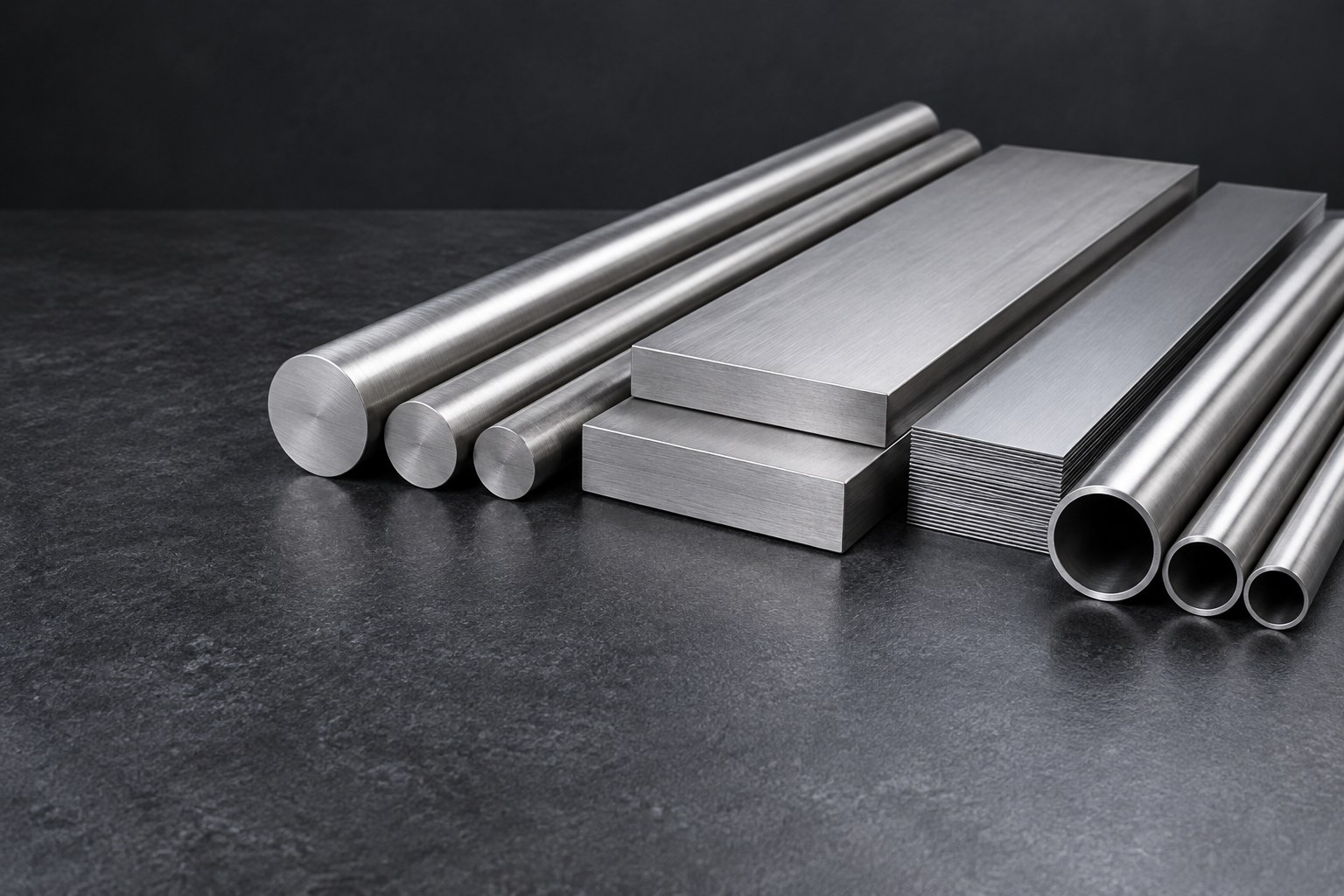
Available material forms
Producer-listed standard forms only; availability depends on ordered specification, dimensions, condition and supplier confirmation. No Quest stock or finished-forging availability is implied.
- Round Bar
- Flat Bar
- Hexagon Bar
- Plate
- Sheet
- Strip
- Pipe
- Tube
- Wire
- Forging Stock
- Cut-to-Size Material
Material overview
Nickel 200
Commercially pure wrought nickel with useful corrosion resistance, ductility and high thermal and electrical conductivity.
- UNS N02200; commercially pure nickel, strengthened by cold work rather than precipitation ageing.
- High thermal and electrical conductivity relative to nickel alloys; magnetic and magnetostrictive characteristics.
- Select corrosion resistance for the actual medium, concentration, contamination, aeration and temperature.
Material specifications & designations
| Designation / specification | Product form / scope | Notes |
|---|---|---|
| UNS N02200 | Nickel 200 parent material | Producer designation. |
| W.Nr. 2.4060 | Producer-listed Nickel 200 material number | Listed separately; applicable European chemistry and form requirements must be checked. |
| W.Nr. 2.4066 | Producer-listed Nickel 200 material number | Not an unconditional interchangeable equivalent to 2.4060 or every N02200 product. |
| ASTM B160 | Rod and bar | N02200: Hot-/cold-worked solid sections; annealed and worked conditions depend on size and ordered requirements. |
| ASTM B161 | Seamless pipe and tube | N02200: Cold-worked, annealed/stress-relieved requirements; hot-worked properties by agreement. |
| ASTM B162 | Rolled plate, sheet and strip | N02200: Temper, drawing quality and dimensions affect requirements. |
| ASTM B163 | Seamless condenser and heat-exchanger tubes | N02200: Not general-purpose welded tubing; confirm ordered alloy, condition and dimensions. |
| ASTM B725 | Welded nickel and nickel-copper alloy pipe | N02200: Producer-listed; ordered condition and current requirements require confirmation. |
| ASTM B730 | Welded nickel tube | N02200: Welded and annealed or welded and stress-relieved; corrosive/mechanical service. |
| ASTM B751 | General requirements for welded nickel-alloy tube | N02200: Supplementary requirements, not a standalone Nickel 200 grade specification. |
| ASTM B775 | General requirements for welded nickel-alloy pipe | N02200: Use with the applicable pipe product specification. |
| ASTM B829 | General requirements for seamless nickel-alloy pipe and tube | N02200: Use with the applicable seamless product specification. |
| ASTM B366/B366M | Factory-made wrought nickel and nickel-alloy fittings | N02200: Producer association; grade/class and condition require verification; excludes cast fittings. |
| ASTM B564 | Nickel-alloy forgings | N02200: Producer-listed N02200 association; public historical scope includes N02200; current acceptance requirements not verified. |
| DIN 17740 | Nickel chemical composition | Producer-listed historical reference; edition and number-specific limits not independently checked. |
| DIN 17750 | Plate, sheet and strip | Producer-listed; confirm ordered revision and condition. |
| DIN 17751 | Pipe and tube | Producer-listed; confirm ordered revision and condition. |
| DIN 17752 | Rod and bar | Producer-listed; confirm ordered revision and condition. |
| DIN 17753 | Wire | Producer-listed; confirm ordered revision and condition. |
| DIN 17754 | Forgings | Producer-listed; confirm ordered revision and condition. |
Producer p.15 associations are not certification. Public ASTM scopes checked where available; full current standards were not accessible. No independently verified SAE AMS parent-metal specification is asserted. European numbers are both stated by the producer, but number-specific equivalence and current EN requirements remain unverified. Welding consumables are not parent-metal specifications. Reference associations only: no equivalence, stock availability, aerospace approval or certified conformity is established by this page. Specify the ordered revision, product form, dimensions, manufacture/melt route, delivery condition and acceptance tests; obtain matching supplier confirmation and inspection documents.
Specification review
Technical verification requirements
Designations / ordered product condition
Nine nominal property conditions are not interchangeable; retain below-315°C service caution and verify current ordered standards and carbon acceptance. Existing cautions do not prove conformity; no allegation that every listed scope is wrong. Obtain the ordered revision and map each cited specification to form, dimensions, manufacture, delivery condition and acceptance tests.
Obtain licensed ordered editions and issue a material-specific form/condition/size compliance matrix; retain existing caveats pending approval.
Engineering reference
Technical data
| Element | Mass % |
|---|---|
| Nickel (plus cobalt) | 99.0 min. |
| Copper | 0.25 max. |
| Iron | 0.40 max. |
| Manganese | 0.35 max. |
| Carbon | 0.15 max. |
| Silicon | 0.35 max. |
| Sulfur | 0.01 max. |
Table 1 limiting composition, mass %. One producer basis only. Nickel plus cobalt is a combined minimum; unspecified minima are not zero requirements.
| Property | Value | Basis |
|---|---|---|
| Density | 8890 kg/m³ | Table 2; temperature not specified |
| Melting range | 1435–1446 °C | Table 2 |
| Specific heat | 456 J/(kg·K) | Table 2; temperature not specified |
| Electrical resistivity | 0.096 μΩ·m | 20 °C; annealed, Table 3 |
| Thermal conductivity | 70.3 W/(m·K) | 20 °C; annealed, Table 3 |
| Thermal conductivity | 66.5 W/(m·K) | 100 °C; annealed, Table 3 |
| Young’s modulus | 205 GPa | 26 °C; annealed, dynamic; Table 4 |
| Young’s modulus | 200 GPa | 100 °C; annealed, dynamic; Table 4 |
| Mean linear thermal expansion | 13.3 μm/(m·K) | 21–100 °C; Table 3 |
| Mean linear thermal expansion | 13.9 μm/(m·K) | 21–200 °C; Table 3 |
| Curie temperature | 360 °C | Table 2; not a service-temperature rating |
Typical informational producer data, not specification limits. Physical-property measurements above normal service temperatures do not establish suitability. Specific heat and density reference temperatures are not supplied.
Hot-finished rod and bar
| Property | Value | Basis |
|---|---|---|
| Ultimate tensile strength | 415–585 MPa | Nominal producer range |
| 0.2% offset yield strength | 105–310 MPa | Nominal producer range |
| Elongation | 55–35% | 51 mm gauge length |
| Hardness | 90–150 Brinell (3000 kg); 45–80 HRB | Nominal producer table |
Table 5, p.2: nominal room-temperature producer ranges, not specification acceptance limits. Elongation in 51 mm; descending ranges retained as printed. Section-size and specimen-orientation limits not stated. Reduction of area not reported in this table.
Cold-drawn rod and bar
| Property | Value | Basis |
|---|---|---|
| Ultimate tensile strength | 450–760 MPa | Nominal producer range |
| 0.2% offset yield strength | 275–690 MPa | Nominal producer range |
| Elongation | 35–10% | 51 mm gauge length |
| Hardness | 140–230 Brinell (3000 kg); 75–98 HRB | Nominal producer table |
Table 5, p.2: nominal room-temperature producer ranges, not specification acceptance limits. Elongation in 51 mm; descending ranges retained as printed. Section-size and specimen-orientation limits not stated. Reduction of area not reported in this table.
Annealed rod and bar
| Property | Value | Basis |
|---|---|---|
| Ultimate tensile strength | 380–520 MPa | Nominal producer range |
| 0.2% offset yield strength | 105–210 MPa | Nominal producer range |
| Elongation | 55–40% | 51 mm gauge length |
| Hardness | 90–120 Brinell (3000 kg); 45–70 HRB | Nominal producer table |
Table 5, p.2: nominal room-temperature producer ranges, not specification acceptance limits. Elongation in 51 mm; descending ranges retained as printed. Section-size and specimen-orientation limits not stated. Reduction of area not reported in this table. Applies to cold-drawn, annealed or hot-finished, annealed rod/bar.
Hot-rolled plate
| Property | Value | Basis |
|---|---|---|
| Ultimate tensile strength | 380–690 MPa | Nominal producer range |
| 0.2% offset yield strength | 140–550 MPa | Nominal producer range |
| Elongation | 55–35% | 51 mm gauge length |
| Hardness | 100–150 Brinell (3000 kg); 55–80 HRB | Nominal producer table |
Table 5, p.2: nominal room-temperature producer ranges, not specification acceptance limits. Elongation in 51 mm; descending ranges retained as printed. Section-size and specimen-orientation limits not stated. Reduction of area not reported in this table.
Hot-rolled, annealed plate
| Property | Value | Basis |
|---|---|---|
| Ultimate tensile strength | 380–550 MPa | Nominal producer range |
| 0.2% offset yield strength | 105–275 MPa | Nominal producer range |
| Elongation | 60–40% | 51 mm gauge length |
| Hardness | 90–140 Brinell (3000 kg); 45–75 HRB | Nominal producer table |
Table 5, p.2: nominal room-temperature producer ranges, not specification acceptance limits. Elongation in 51 mm; descending ranges retained as printed. Section-size and specimen-orientation limits not stated. Reduction of area not reported in this table.
Annealed sheet
| Property | Value | Basis |
|---|---|---|
| Ultimate tensile strength | 380–520 MPa | Nominal producer range |
| 0.2% offset yield strength | 105–210 MPa | Nominal producer range |
| Elongation | 55–40% | 51 mm gauge length |
| Hardness | 70 HRB max. | Nominal producer table |
Table 5, p.2: nominal room-temperature producer ranges, not specification acceptance limits. Elongation in 51 mm; descending ranges retained as printed. Section-size and specimen-orientation limits not stated. Reduction of area not reported in this table.
Annealed strip
| Property | Value | Basis |
|---|---|---|
| Ultimate tensile strength | 380–520 MPa | Nominal producer range |
| 0.2% offset yield strength | 105–210 MPa | Nominal producer range |
| Elongation | 55–40% | 51 mm gauge length |
| Hardness | 64 HRB max. | Nominal producer table |
Table 5, p.2: nominal room-temperature producer ranges, not specification acceptance limits. Elongation in 51 mm; descending ranges retained as printed. Section-size and specimen-orientation limits not stated. Reduction of area not reported in this table.
Annealed tubing
| Property | Value | Basis |
|---|---|---|
| Ultimate tensile strength | 380–520 MPa | Nominal producer range |
| 0.2% offset yield strength | 85–210 MPa | Nominal producer range |
| Elongation | 60–40% | 51 mm gauge length |
| Hardness | 70 HRB max. | Nominal producer table |
Table 5, p.2: nominal room-temperature producer ranges, not specification acceptance limits. Elongation in 51 mm; descending ranges retained as printed. Section-size and specimen-orientation limits not stated. Reduction of area not reported in this table.
Stress-relieved tubing
| Property | Value | Basis |
|---|---|---|
| Ultimate tensile strength | 450–760 MPa | Nominal producer range |
| 0.2% offset yield strength | 275–620 MPa | Nominal producer range |
| Elongation | 35–15% | 51 mm gauge length |
| Hardness | 75–98 HRB | Nominal producer table |
Table 5, p.2: nominal room-temperature producer ranges, not specification acceptance limits. Elongation in 51 mm; descending ranges retained as printed. Section-size and specimen-orientation limits not stated. Reduction of area not reported in this table.
Suitability depends on loading, temperature, exposure duration, atmosphere and required service life; there is no single universal maximum temperature rating.
Special Metals p.5 states: “Nickel 200 is normally limited to service at temperatures below 600°F (315°C).” At higher temperatures graphitization can severely compromise properties, and Nickel 201 is preferred. The carbon content is relevant to graphite precipitation and associated embrittlement. Nickel 201 is not automatically suitable for every higher-temperature duty. Producer figures contain tensile and creep curves; no graph-read numerical tensile or stress-rupture values are invented here. Source: Special Metals — Nickel 200 & 201, SMC-061, September 2006 — https://www.specialmetals.com/documents/technical-bulletins/nickel-200.pdf
Batch annealing
Producer guidance: 705–815 °C for about 30 minutes to 3 hours, depending on cross-section and contained cold work. Cooling rate is not critical; quenching is not required.
Continuous annealing
Producer guidance: 790–955 °C for about 15–45 minutes in the hot zone. Establish the actual cycle by trials to control grain size and properties.
Stress-relieved tubing
The producer lists stress-relieved tubing properties but no dedicated stress-relief schedule is transcribed here. Agree the qualified cycle and required properties for the ordered product.
Fabrication guidance, pp.13–14, not a universal qualified production cycle. Grain growth is rapid at elevated temperature. Remove lubricants, paint and shop contamination before heating; use an appropriate controlled atmosphere. Nickel 200 is not precipitation-age hardened.
Material selection
Corrosion resistance & performance
Useful resistance to many reducing media and caustic alkalies; protective passive films contribute to caustic resistance. Select material for concentration, temperature, impurities and aeration; no universal chemical resistance is implied.
The bulletin reports excellent resistance in distilled and natural waters. Marine atmospheric exposure is not evidence of unrestricted seawater or stagnant-crevice suitability.
Sulfuric-acid use is limited by conditions: aeration and increasing temperature affect resistance. Do not generalise acid resistance to all concentrations or oxidising contaminants.
For environments above 315 °C, the producer prefers Nickel 201. Assess mechanical and carbon-related limitations as well as corrosion. Source for these statements: https://www.specialmetals.com/documents/technical-bulletins/nickel-200.pdf
Typical applications
Engineering applications
- Chemical-processing and industrial process equipment
- Caustic soda production and handling equipment, subject to process qualification
- Food-processing equipment where product purity is important
- Electrical and electronic components
- Chemical shipping drums
- Condenser, evaporator and heat-exchanger tubing within qualified service conditions
Subsequent manufacturing
Machining & processing
Machinability and work hardening
Annealed nickel is soft and ductile, but cold work increases strength. Develop machining practice for the supplied temper; avoid rubbing and local work hardening. No universal cutting speeds are specified.
Tooling
Use sharp tools, rigid support and controlled chip removal; establish tooling, feeds and coolant compatibility by trials. This is fabrication planning guidance, not producer-qualified cutting parameters.
Forming
The producer supports hot and cold forming; soft tempers favour severe drawing. Intermediate anneals may be needed to restore ductility. Control grain size and surface finish.
Welding
Conventional welding, brazing and soldering are supported. Producer recommendations include Nickel Welding Electrode 141 for SMAW and Nickel Filler Metal 61 for GTAW/GMAW. These are consumables, not parent-metal grades. Qualify procedures and remove foreign material.
Distortion control
Plan restraint, sequence and heat input for the component geometry; verify final dimensions after welding or heat treatment. No distortion-free outcome is guaranteed.
Finishing
Remove forming lubricants, marking paints and shop soil before heating. Sulfur and low-melting metal contamination can cause intergranular attack. Use a qualified cleaning/pickling method appropriate to the surface oxide.
Inspection
Agree dimensional, surface and weld inspection requirements before manufacture; confirm any nondestructive examination against the ordered specification and acceptance criteria.
Material certification & testing
Documentation and inspection options must be agreed at quotation and order stage.
Conformity must be demonstrated against the ordered specification, product form and condition. Tests and certificates are not automatic; confirm availability, scope and acceptance criteria. PMI alone does not establish carbon content, heat treatment or full grade conformity.
- EN 10204 3.1 material certificates
- Certificates of Conformity
- Heat/batch traceability
- Chemical analysis
- Mechanical testing
- Heat-treatment records
- Hardness testing
- Positive Material Identification (PMI)
- Ultrasonic testing where applicable
- Additional aerospace or customer-specific inspection requirements
Material enquiry
Request a material quotation
Nickel 200 supplied to your material form, dimensions and specification.