Materials Supply / Nickel, Cobalt & High-Temperature Alloys
Nickel 201
Low-carbon commercially pure nickel | UNS N02201 | W.Nr. 2.4061 / 2.4068
Nickel 201 is the controlled low-carbon version of Nickel 200. Special Metals specifies nickel plus cobalt at 99.0% minimum and carbon at 0.02% maximum. Its ductility, corrosion resistance and high thermal and electrical conductivity support chemical-processing and electronic applications.
The lower carbon content improves resistance to carbon-related graphitisation relative to Nickel 200, subject to avoiding carbonaceous contact and assessing sulfur exposure, creep and the actual service environment. It is not universally suitable for elevated-temperature duty.
Nickel 201 is the producer’s grade designation; the bulletin does not identify it as a registered trademark. MONEL, INCONEL and INCOLOY are trademarks of the Special Metals Corporation group of companies, as stated in the bulletin; Quest Engineering does not own these marks.
Raw & semi-finished materials
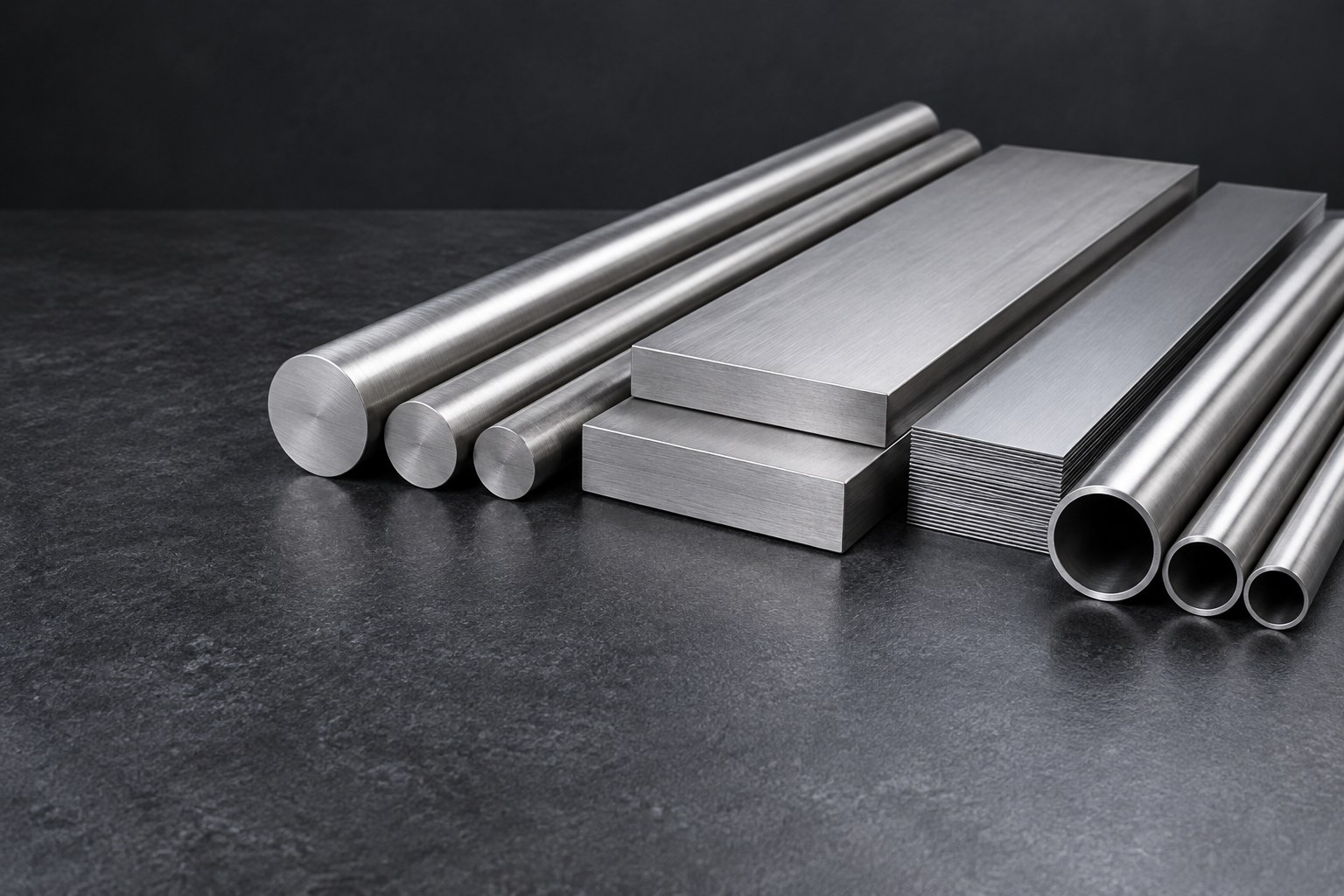
Available material forms
Producer-listed forms only; availability depends on specification, dimensions, condition and supplier confirmation. No stock is implied. Forging stock is not a claim of finished-forging availability.
- Round Bar
- Flat Bar
- Hexagon Bar
- Plate
- Sheet
- Strip
- Pipe
- Tube
- Wire
- Forging Stock
- Cut-to-Size Material
Material overview
Nickel 201
Low-carbon commercially pure nickel for caustic handling, electrical components and qualified elevated-temperature process equipment.
- Low-carbon wrought nickel; carbon 0.02% maximum on the producer composition basis.
- Relatively low work-hardening rate and low base hardness favour spinning and cold forming.
- Cold drawing increases strength; annealed and stress-relieved properties must be specified by product form.
Material specifications & designations
| Designation / specification | Product form / scope | Notes |
|---|---|---|
| UNS N02201 | Nickel 201 parent metal | Low-carbon commercially pure nickel. |
| W.Nr. 2.4061 | Producer-listed European material number | Listed separately from 2.4068; European chemistry and product requirements must be checked. |
| W.Nr. 2.4068 | Producer-listed European material number | Not an unconditional interchangeable designation for 2.4061. |
| ASTM B160 | Rod and bar | N02201; hot-worked/cold-worked and ordered condition; public ASTM scope checked. |
| ASTM B161 | Seamless pipe and tube | N02201; cold-worked, annealed or stress-relieved as ordered; hot-worked properties by agreement. |
| ASTM B162 | Rolled plate, sheet and strip | N02201; temper and special drawing-quality requirements depend on order. |
| ASTM B163 | Seamless condenser and heat-exchanger tubes | Producer association; alloy, condition and dimensional limits require ordered edition. |
| ASTM B725 | Welded pipe | N02201; welded and annealed or welded and stress-relieved. |
| ASTM B730 | Welded tube | N02201; welded and annealed or welded and stress-relieved. |
| ASTM B751 | General requirements for nickel-alloy welded tube | Supplementary requirements, not a standalone grade specification; producer-listed. |
| ASTM B775 | General requirements for nickel-alloy welded pipe | Used with relevant product specification, including B725; not standalone grade approval. |
| ASTM B829 | General requirements for nickel-alloy seamless pipe and tube | Used with product specifications such as B161/B163; not standalone grade approval. |
| ASTM B366 | Factory-made wrought nickel-alloy fittings | Producer-listed fittings reference; exact grade/class and condition must be confirmed. |
| AMS 5553 | Low-carbon nickel sheet and strip, annealed | SAE AMS5553J title and public scope verified; do not extend to plate. Public thickness-unit inconsistency requires checking original standard. |
| DIN 17740 | Chemical composition | Producer-listed; verify ordered grade and edition. |
| DIN 17750 | Plate, sheet and strip | Producer-listed; confirm condition and material number. |
| DIN 17751 | Pipe and tube | Producer-listed. |
| DIN 17752 | Rod and bar | Producer-listed. |
| DIN 17753 | Wire | Producer-listed. |
| DIN 17754 | Forgings | Producer-listed; not ASTM B564 approval. |
| ISO 9725 | Forgings | Producer-listed. |
| ISO 9724 | Wire | Producer-listed. |
| ISO 9723 | Rod and bar | Producer-listed. |
| ISO 6207 | Pipe and tube | Producer-listed. |
| ISO 6208 | Plate, sheet and strip | Producer-listed. |
Bulletin p.19 has an apparent copy error: the Nickel 201 section introduces its list as “Specifications for Nickel 200”. Grade association is corroborated where possible by public ASTM/SAE scopes. Full current standards were not available; no blanket compliance is claimed. ASTM B564 is not asserted for N02201. European numbers are producer associations, not certified equivalences; separate European limits can differ from this composition table. Reference associations only: no equivalence, stock availability, aerospace approval or certified conformity is established by this page. Specify the ordered revision, product form, dimensions, manufacture/melt route, delivery condition and acceptance tests; obtain matching supplier confirmation and inspection documents.
Specification review
Technical verification requirements
Designations / ordered product condition
AMS5553J public scope has inconsistent inch/mm thickness; page correctly withholds a numeric dimension claim, but original controlled text/errata are needed. Existing cautions do not prove conformity; no allegation that every listed scope is wrong. Obtain the ordered revision and map each cited specification to form, dimensions, manufacture, delivery condition and acceptance tests.
Obtain licensed ordered editions and issue a material-specific form/condition/size compliance matrix; retain existing caveats pending approval.
AMS5553 dimensions
Public metadata unit inconsistency is real; page does not itself publish either numeric thickness range. This is an unresolved source defect, not a confirmed wrong website dimension.
Obtain authorised standard and errata; do not silently choose 0.65 or 6.35 mm as the controlling limit.
Engineering reference
Technical data
| Element | Mass % |
|---|---|
| Nickel (plus cobalt) | 99.0 min. |
| Copper | 0.25 max. |
| Iron | 0.40 max. |
| Manganese | 0.35 max. |
| Carbon | 0.02 max. |
| Silicon | 0.35 max. |
| Sulfur | 0.01 max. |
Table 28, p.16: single producer limiting-composition basis. Minimum and maximum limits are marked explicitly; no unreported lower limits are implied. Nickel value includes cobalt, not nickel alone.
| Property | Value | Temperature / basis |
|---|---|---|
| Density | 8890 kg/m³ | Table 29; temperature not specified |
| Specific heat | 456 J/(kg·K) | Table 29; temperature not specified |
| Tensile elastic modulus | 207 GPa | Table 29; temperature not specified |
| Curie temperature | 360°C | Table 29 |
| Thermal conductivity | 79.3 W/(m·K) | 20°C; annealed |
| Thermal conductivity | 56.1 W/(m·K) | 400°C; annealed |
| Thermal conductivity | 69.9 W/(m·K) | 1000°C; annealed |
| Electrical resistivity | 0.085 μΩ·m | 20°C; annealed |
| Electrical conductivity | Approximately 11.8 MS/m | 20°C; calculated as reciprocal of 0.085 μΩ·m |
| Mean linear thermal expansion | 13.2 μm/(m·K) | 25–100°C; annealed |
| Mean linear thermal expansion | 13.9 μm/(m·K) | 25–200°C; annealed |
| Mean linear thermal expansion | 14.4 μm/(m·K) | 25–300°C; annealed |
| Mean linear thermal expansion | 14.9 μm/(m·K) | 25–400°C; annealed |
Tables 29–30, p.16. Typical physical data, not specification limits. Table 29 does not state test temperatures for density, heat capacity or modulus. No Nickel 201 melting range is supplied in these tables; Nickel 200 values have not been silently copied.
Hot-finished / hot-finished annealed rod and bar
| Property | Value | Basis |
|---|---|---|
| Ultimate tensile strength | 345–415 MPa | Nominal producer range |
| 0.2% offset yield strength | 70–170 MPa | Nominal producer range |
| Elongation | 40–60% | In 51 mm (2 in.) |
| Hardness | 75–100 HB | Producer Table 31; not converted between scales |
Table 31, p.17: nominal ambient-temperature properties, not specification acceptance minima. Section size, specimen direction and exact test temperature are not stated. Elongation endpoints are reordered ascending without implying correlation to strength endpoints. Reduction of area is not reported. Hot-finished and hot-finished annealed rod/bar share one producer row; no independent difference is inferred.
Cold-drawn rod and bar
| Property | Value | Basis |
|---|---|---|
| Ultimate tensile strength | 415–690 MPa | Nominal producer range |
| 0.2% offset yield strength | 240–620 MPa | Nominal producer range |
| Elongation | 10–35% | In 51 mm (2 in.) |
| Hardness | 125–200 HB | Producer Table 31; not converted between scales |
Table 31, p.17: nominal ambient-temperature properties, not specification acceptance minima. Section size, specimen direction and exact test temperature are not stated. Elongation endpoints are reordered ascending without implying correlation to strength endpoints. Reduction of area is not reported. Hot-finished and hot-finished annealed rod/bar share one producer row; no independent difference is inferred.
Cold-drawn annealed rod and bar
| Property | Value | Basis |
|---|---|---|
| Ultimate tensile strength | 345–415 MPa | Nominal producer range |
| 0.2% offset yield strength | 70–170 MPa | Nominal producer range |
| Elongation | 40–60% | In 51 mm (2 in.) |
| Hardness | 75–100 HB | Producer Table 31; not converted between scales |
Table 31, p.17: nominal ambient-temperature properties, not specification acceptance minima. Section size, specimen direction and exact test temperature are not stated. Elongation endpoints are reordered ascending without implying correlation to strength endpoints. Reduction of area is not reported. Hot-finished and hot-finished annealed rod/bar share one producer row; no independent difference is inferred.
Hot-rolled plate
| Property | Value | Basis |
|---|---|---|
| Ultimate tensile strength | 345–485 MPa | Nominal producer range |
| 0.2% offset yield strength | 83–240 MPa | Nominal producer range |
| Elongation | 35–60% | In 51 mm (2 in.) |
| Hardness | Not reported | Producer Table 31; not converted between scales |
Table 31, p.17: nominal ambient-temperature properties, not specification acceptance minima. Section size, specimen direction and exact test temperature are not stated. Elongation endpoints are reordered ascending without implying correlation to strength endpoints. Reduction of area is not reported. Hot-finished and hot-finished annealed rod/bar share one producer row; no independent difference is inferred.
Hot-rolled annealed plate
| Property | Value | Basis |
|---|---|---|
| Ultimate tensile strength | 345–485 MPa | Nominal producer range |
| 0.2% offset yield strength | 83–240 MPa | Nominal producer range |
| Elongation | 40–60% | In 51 mm (2 in.) |
| Hardness | Not reported | Producer Table 31; not converted between scales |
Table 31, p.17: nominal ambient-temperature properties, not specification acceptance minima. Section size, specimen direction and exact test temperature are not stated. Elongation endpoints are reordered ascending without implying correlation to strength endpoints. Reduction of area is not reported. Hot-finished and hot-finished annealed rod/bar share one producer row; no independent difference is inferred.
Cold-drawn annealed seamless tube and pipe
| Property | Value | Basis |
|---|---|---|
| Ultimate tensile strength | 345–485 MPa | Nominal producer range |
| 0.2% offset yield strength | 70–195 MPa | Nominal producer range |
| Elongation | 40–60% | In 51 mm (2 in.) |
| Hardness | 62 HRB max. | Producer Table 31; not converted between scales |
Table 31, p.17: nominal ambient-temperature properties, not specification acceptance minima. Section size, specimen direction and exact test temperature are not stated. Elongation endpoints are reordered ascending without implying correlation to strength endpoints. Reduction of area is not reported. Hot-finished and hot-finished annealed rod/bar share one producer row; no independent difference is inferred.
Stress-relieved seamless tube and pipe
| Property | Value | Basis |
|---|---|---|
| Ultimate tensile strength | 415–725 MPa | Nominal producer range |
| 0.2% offset yield strength | 205–585 MPa | Nominal producer range |
| Elongation | 15–35% | In 51 mm (2 in.) |
| Hardness | 70–95 HRB | Producer Table 31; not converted between scales |
Table 31, p.17: nominal ambient-temperature properties, not specification acceptance minima. Section size, specimen direction and exact test temperature are not stated. Elongation endpoints are reordered ascending without implying correlation to strength endpoints. Reduction of area is not reported. Hot-finished and hot-finished annealed rod/bar share one producer row; no independent difference is inferred.
Suitability depends on loading, temperature, exposure duration, atmosphere and required service life; there is no single maximum temperature rating. The bulletin prefers Nickel 201 to Nickel 200 for exposure above 600°F (315°C) because its low carbon content resists graphitisation.
Special Metals pp.16–18: at 600–1400°F (315–760°C) for extended times, Nickel 201 is described as not subject to embrittlement by intergranularly precipitated carbon or graphite PROVIDED carbonaceous materials are not in contact. Sulfur compounds can cause intergranular embrittlement above 600°F (315°C). Figures 12–14 are tensile, rupture and creep curves, not exact tabular data; no digitised values are presented. The historical ASME service statement in the 2006 bulletin is not a current code approval or universal service limit. Source: https://www.specialmetals.com/documents/technical-bulletins/nickel-200.pdf
Annealing
Use the Nickel 200 fabrication procedures with the Nickel 201 adjustment stated on p.19: annealing temperatures 30–55°C (50–100°F) lower, OR times at temperature 10–20% shorter. These are alternative adjustments, not a new universal absolute cycle. Establish the actual cycle for section size, cold work, grain size and required properties.
Stress-relieved tubular condition
Table 31 supplies nominal properties for stress-relieved seamless tube and pipe, but gives no Nickel 201-specific stress-relief temperature/time cycle. Agree the treatment and acceptance requirements with the producer.
Producer pp.13 and 19. No precipitation-ageing treatment is specified. Clean away sulfur-bearing and low-melting-metal contamination before heating; control atmosphere and grain growth. Do not apply Nickel 200 cycles unchanged.
Material selection
Corrosion resistance & performance
Useful resistance to caustic alkalies and many reducing environments; performance depends on concentration, temperature, aeration, impurities and velocity.
Widely used for caustic soda handling. Chlorates accelerate corrosion; sulfur contamination in high-temperature caustic service can cause embrittlement. No universal caustic-service approval is implied.
Hydrofluoric acid resistance depends on retention of the protective fluoride film; flow that removes it, aeration and oxidising chemicals increase corrosion.
Carbonaceous contact can compromise the low-carbon advantage, and sulfur compounds cause high-temperature intergranular embrittlement. Assess the actual environment, weld condition and exposure rather than extrapolating short tests.
Typical applications
Engineering applications
- Caustic evaporators and qualified caustic-handling systems
- Chemical-processing equipment
- Plater bars
- Electrical and electronic components
- Combustion boats and laboratory crucibles
- Qualified furnace and heat-treatment process components
Subsequent manufacturing
Machining & processing
Machinability and work hardening
Use the producer’s Nickel 200 machining approach with allowance for Nickel 201’s lower mechanical properties. Ductile nickel can form gummy chips and work-harden under rubbing; qualify feeds and machining sequence, not universal cutting speeds.
Tooling
Use sharp, rigidly supported tools and effective chip removal and lubrication; validate tool geometry for the form and condition.
Forming
Most commercial forming practices are suitable. Low base hardness and relatively low work-hardening rate favour spinning and cold forming; allow for accumulated cold work and intermediate annealing.
Welding and joining
Generally welded, brazed and soldered using the Nickel 200 procedures, EXCEPT oxyacetylene welding is not applicable to Nickel 201. Qualify the process, filler selection and cleanliness for the ordered application; filler specifications are not parent-metal designations.
Distortion
Plan machining allowances, restraint and welding sequence to manage distortion and residual stress; confirm final dimensions after thermal processing.
Finishing
Remove shop soils and forming lubricants before heating. Qualify pickling and surface finishing against the producer fabrication guidance; avoid sulfur and low-melting-metal contamination.
Inspection
Confirm chemistry, ordered condition, dimensions, surface quality and required weld/NDT acceptance. PMI alone does not demonstrate a low-carbon limit; use appropriate laboratory carbon analysis when required.
Material certification & testing
Request certification and inspection requirements at enquiry; scope depends on the ordered product and specification.
Conformity must be demonstrated against the ordered specification, product form and condition. Tests and documents are not automatic; agree methods, coverage and acceptance criteria before order.
- EN 10204 3.1 material certificates
- Certificates of Conformity
- Heat/batch traceability
- Chemical analysis
- Mechanical testing
- Heat-treatment records
- Hardness testing
- Positive Material Identification (PMI)
- Ultrasonic testing where applicable
- Additional aerospace or customer-specific inspection requirements
Material enquiry
Request a material quotation
Nickel 201 supplied to your material form, dimensions and specification.