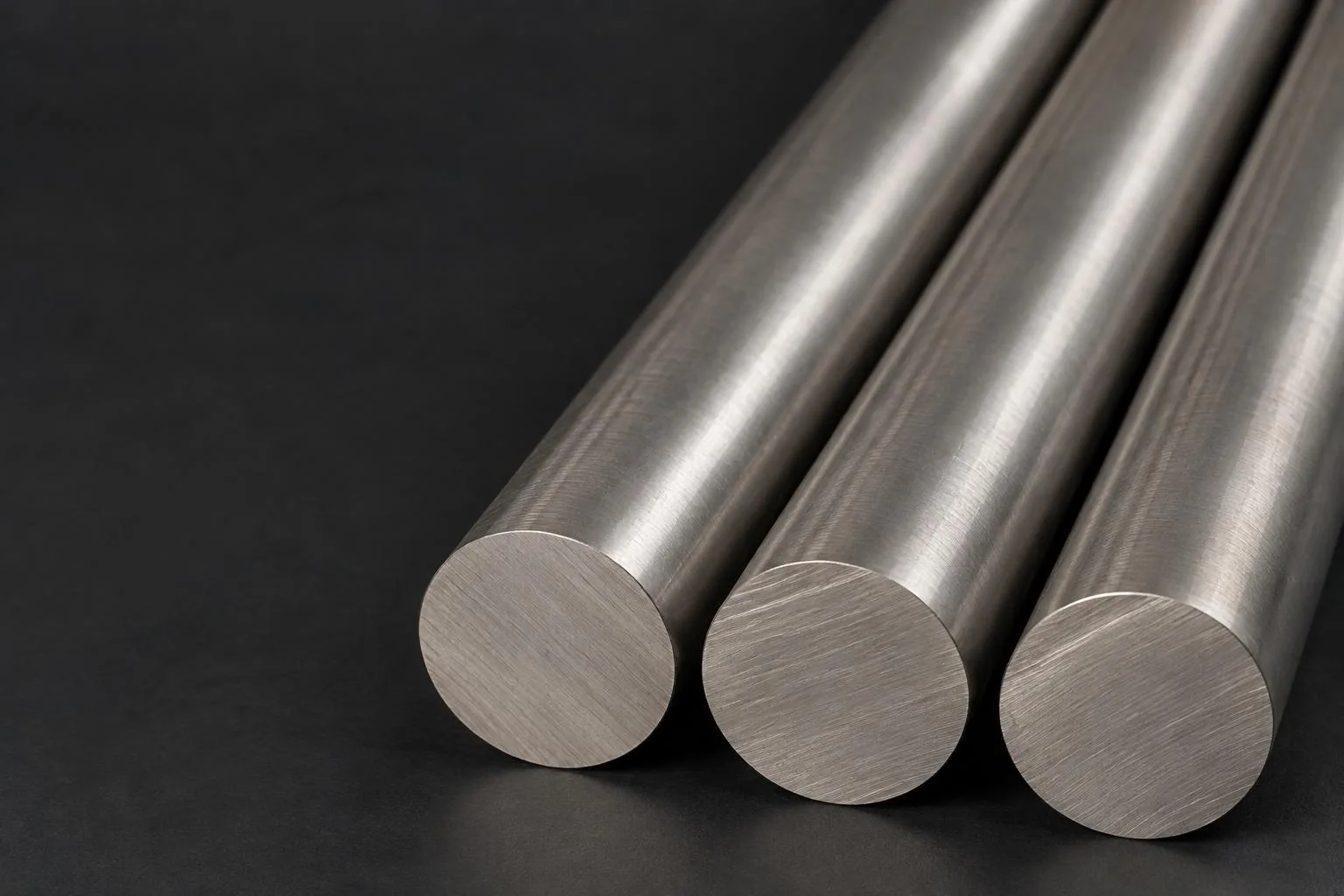
Materials Supply / Nickel, Cobalt & High-Temperature Alloys
Monel K-500
Precipitation-hardenable nickel-copper alloy | UNS N05500 | W.Nr. 2.4375
Monel K-500, also designated Alloy K-500, combines a nickel-copper matrix with aluminium and titanium. Controlled ageing precipitates submicroscopic Ni3(Ti,Al), giving higher strength and hardness than Monel 400 in relevant conditions; cold work also affects the response.
MONEL® is a trademark of the Special Metals Corporation group of companies. Quest Engineering does not own this trademark. Technical data are producer reference information, not design allowables, guaranteed stock properties or a statement of fitness for a particular application.
Raw & semi-finished materials
Available material forms
Producer-listed mill forms only. Availability depends on ordered specification, condition, dimensions and supplier confirmation; no Quest stock is implied.
- Round Bar
- Flat Bar
- Hexagon Bar
- Plate
- Sheet
- Strip
- Wire
- Pipe
- Tube
- Forging Stock
- Cut-to-Size Material
Material overview
Monel K-500
Age-hardenable nickel-copper-aluminium-titanium alloy for high-strength marine and chemical-processing components, subject to service qualification.
- Precipitation hardening and prior cold work determine strength, ductility and hardness.
- Use form-specific specifications and a documented heat-treatment route; Alloy 400 requirements cannot automatically be applied.
- Fatigue performance depends on temper, surface finish, geometry and environment. Producer Tables 21–24 show condition-dependent fatigue performance and the detrimental effect of an oxidised surface; polished laboratory specimens do not establish component design allowables.
Material specifications & designations
| Designation / specification | Product form / scope | Notes |
|---|---|---|
| UNS N05500 | Nickel-copper-aluminium-titanium parent alloy | Producer designation; commercial alias Alloy K-500. |
| W.Nr. 2.4375 | European material number stated by producer | Explicit on bulletin pp. 1 and 19. Not itself a product standard or blanket EN certification. |
| ASTM B865 | N05500 bar, rod, cold-worked wire, forgings and forging stock | Public B865-25 abstract/scope verifies rounds, squares, hexagons and rectangles, hot- or cold-worked; aged/unaged properties. Not sheet, plate, strip or tubing. https://store.astm.org/b0865-25.html |
| SAE AMS 4676 | Hot-finished, precipitation-hardenable bars, forgings and forging stock | Producer lists rod/bar. Broader form scope corroborated by public distributor abstracts for AMS4676F; SAE public page unavailable in this check. Not a wire, sheet or tube specification. Ordered revision and supplied condition require confirmation. |
| BS 3072 NA18 | Sheet and plate | Producer-listed historical reference; current status/requirements not independently established. |
| BS 3073 NA18 | Strip | Producer-listed historical reference; not interchangeability approval. |
| BS 3074 NA18 | Seamless pipe and tube | Producer-listed historical reference. |
| BS 3075 NA18 | Wire | Producer-listed historical reference. |
| BS 3076 NA18 | Rod and bar | Producer-listed historical reference. |
| DIN 17750 | Plate, sheet and strip | Producer-listed scope; revision/status not verified. |
| DIN 17751 | Pipe and tube | Producer-listed scope; revision/status not verified. |
| DIN 17752 | Rod and bar | Producer-listed scope; revision/status not verified. |
| DIN 17753 | Wire | Producer-listed scope; revision/status not verified. |
| DIN 17754 | Forgings | Producer-listed scope; revision/status not verified. |
| DIN 17743 | Chemical composition | Producer-listed chemistry reference, not a complete product acceptance standard. |
| ISO 6208 | Plate, sheet and strip | Producer-listed scope; revision/status not verified. |
| ISO 9723 | Bar | Producer-listed scope; revision/status not verified. |
| ISO 9724 | Wire | Producer-listed scope; revision/status not verified. |
| ISO 9725 | Forgings | Producer-listed scope; revision/status not verified. |
| QQ-N-286 | Rod, bar, wire, forgings, plate, sheet and strip | Historical producer reference; treatment provisions vary with revision. No current compliance inferred. |
| ASME Code Case 1192 | Rod/bar for bolting per producer | Historical bulletin reference only; current Code acceptance and allowable stresses not verified. |
Parent-metal references only. No verified EN product standard asserted. Full current ASTM/AMS texts were not available: confirm revision, chemistry, form, section, condition and tests before ordering. The 2004 bulletin’s NACE listing is not a present sour-service approval. Reference associations only: no equivalence, stock availability, aerospace approval or certified conformity is established by this page. Specify the ordered revision, product form, dimensions, manufacture/melt route, delivery condition and acceptance tests; obtain matching supplier confirmation and inspection documents.
Specification review
Technical verification requirements
Designations / ordered product condition
AMS4676 is a historical/withdrawn reference, not proof of present compliance; ageing route depends on prior cold work and hardness. Existing cautions do not prove conformity; no allegation that every listed scope is wrong. Obtain the ordered revision and map each cited specification to form, dimensions, manufacture, delivery condition and acceptance tests.
Obtain licensed ordered editions and issue a material-specific form/condition/size compliance matrix; retain existing caveats pending approval.
Engineering reference
Technical data
| Element | Mass % |
|---|---|
| Nickel (plus cobalt) | 63.0 min. |
| Copper | 27.0–33.0 |
| Aluminium | 2.30–3.15 |
| Titanium | 0.35–0.85 |
| Carbon | 0.25 max. |
| Manganese | 1.5 max. |
| Iron | 2.0 max. |
| Sulfur | 0.01 max. |
| Silicon | 0.5 max. |
Limiting composition from producer Table 1 only. Nickel includes cobalt; no separate cobalt limit is supplied. Unspecified minima are not zero.
| Property | Value | Basis |
|---|---|---|
| Density | 8440 kg/m³ | Table 2: 8.44 g/cm³; temperature not specified |
| Melting range | 1315–1350°C | Table 2 |
| Young’s modulus | 179 GPa | Table 2 tension: 26.0 × 10³ ksi, converted; temperature not specified |
| Shear modulus | 65.5 GPa | Table 2 torsion: 9.5 × 10³ ksi, converted; temperature not specified |
| Poisson’s ratio | 0.32 | Aged material at room temperature |
| Specific heat | 418.7 J/(kg·K) at 21°C | Table 3; annealed before test |
| Thermal conductivity | 17.2 W/(m·K) at 21°C; 25.4 W/(m·K) at 300°C | Table 3; annealed before test |
| Electrical resistivity | 0.615 μΩ·m at 21°C; 0.640 μΩ·m at 300°C | Table 3; measured on decreasing temperature from 1500°F (816°C) |
| Mean linear expansion coefficient | 13.7 μm/(m·K), 21–100°C; 14.9 μm/(m·K), 21–300°C; 16.4 μm/(m·K), 21–600°C | Table 3; age-hardened material |
Typical/nominal producer data, not specification limits. Electrical resistivity is markedly affected by thermal history. No universal modulus test temperature is assigned where Table 2 does not state one.
Hot-finished rod and bar
| Property | Value | Basis |
|---|---|---|
| Ultimate tensile strength | 621–1069 MPa | Nominal producer range |
| 0.2% offset yield strength | 276–758 MPa | Nominal producer range |
| Elongation | 20–45% | Nominal producer range |
| Hardness | 140–315 HB (3000 kg); 75 HRB–35 HRC | Nominal producer range |
| Reduction of area | Not reported for this range | Not inferred from other specimens |
Table 6, rod/bar: room-temperature reference ranges, composites across various product sizes, explicitly unsuitable for specification purposes. Section limits, specimen orientation and elongation gauge length are not stated. Aged rows represent maximum-property ageing; ranges are not paired endpoint test results.
Hot-finished and aged rod and bar
| Property | Value | Basis |
|---|---|---|
| Ultimate tensile strength | 965–1310 MPa | Nominal producer range |
| 0.2% offset yield strength | 690–1034 MPa | Nominal producer range |
| Elongation | 20–30% | Nominal producer range |
| Hardness | 265–346 HB (3000 kg); 27–38 HRC | Nominal producer range |
| Reduction of area | Not reported for this range | Not inferred from other specimens |
Table 6, rod/bar: room-temperature reference ranges, composites across various product sizes, explicitly unsuitable for specification purposes. Section limits, specimen orientation and elongation gauge length are not stated. Aged rows represent maximum-property ageing; ranges are not paired endpoint test results.
Hot-finished and annealed rod and bar
| Property | Value | Basis |
|---|---|---|
| Ultimate tensile strength | 621–758 MPa | Nominal producer range |
| 0.2% offset yield strength | 276–414 MPa | Nominal producer range |
| Elongation | 25–45% | Nominal producer range |
| Hardness | 140–185 HB (3000 kg); 75–90 HRB | Nominal producer range |
| Reduction of area | Not reported for this range | Not inferred from other specimens |
Table 6, rod/bar: room-temperature reference ranges, composites across various product sizes, explicitly unsuitable for specification purposes. Section limits, specimen orientation and elongation gauge length are not stated. Aged rows represent maximum-property ageing; ranges are not paired endpoint test results.
Hot-finished, annealed and aged rod and bar
| Property | Value | Basis |
|---|---|---|
| Ultimate tensile strength | 896–1138 MPa | Nominal producer range |
| 0.2% offset yield strength | 586–827 MPa | Nominal producer range |
| Elongation | 20–35% | Nominal producer range |
| Hardness | 250–315 HB (3000 kg); 24–35 HRC | Nominal producer range |
| Reduction of area | Not reported for this range | Not inferred from other specimens |
Table 6, rod/bar: room-temperature reference ranges, composites across various product sizes, explicitly unsuitable for specification purposes. Section limits, specimen orientation and elongation gauge length are not stated. Aged rows represent maximum-property ageing; ranges are not paired endpoint test results.
Cold-drawn, as-drawn rod and bar
| Property | Value | Basis |
|---|---|---|
| Ultimate tensile strength | 690–965 MPa | Nominal producer range |
| 0.2% offset yield strength | 483–862 MPa | Nominal producer range |
| Elongation | 13–35% | Nominal producer range |
| Hardness | 175–260 HB (3000 kg); 88 HRB–26 HRC | Nominal producer range |
| Reduction of area | Not reported for this range | Not inferred from other specimens |
Table 6, rod/bar: room-temperature reference ranges, composites across various product sizes, explicitly unsuitable for specification purposes. Section limits, specimen orientation and elongation gauge length are not stated. Aged rows represent maximum-property ageing; ranges are not paired endpoint test results.
Cold-drawn and aged rod and bar
| Property | Value | Basis |
|---|---|---|
| Ultimate tensile strength | 931–1276 MPa | Nominal producer range |
| 0.2% offset yield strength | 655–1103 MPa | Nominal producer range |
| Elongation | 15–30% | Nominal producer range |
| Hardness | 255–370 HB (3000 kg); 25–41 HRC | Nominal producer range |
| Reduction of area | Not reported for this range | Not inferred from other specimens |
Table 6, rod/bar: room-temperature reference ranges, composites across various product sizes, explicitly unsuitable for specification purposes. Section limits, specimen orientation and elongation gauge length are not stated. Aged rows represent maximum-property ageing; ranges are not paired endpoint test results.
Cold-drawn and annealed rod and bar
| Property | Value | Basis |
|---|---|---|
| Ultimate tensile strength | 621–758 MPa | Nominal producer range |
| 0.2% offset yield strength | 276–414 MPa | Nominal producer range |
| Elongation | 25–50% | Nominal producer range |
| Hardness | 140–185 HB (3000 kg); 75–90 HRB | Nominal producer range |
| Reduction of area | Not reported for this range | Not inferred from other specimens |
Table 6, rod/bar: room-temperature reference ranges, composites across various product sizes, explicitly unsuitable for specification purposes. Section limits, specimen orientation and elongation gauge length are not stated. Aged rows represent maximum-property ageing; ranges are not paired endpoint test results.
Cold-drawn, annealed and aged rod and bar
| Property | Value | Basis |
|---|---|---|
| Ultimate tensile strength | 896–1310 MPa | Nominal producer range |
| 0.2% offset yield strength | 586–827 MPa | Nominal producer range |
| Elongation | 20–30% | Nominal producer range |
| Hardness | 250–315 HB (3000 kg); 24–35 HRC | Nominal producer range |
| Reduction of area | Not reported for this range | Not inferred from other specimens |
Table 6, rod/bar: room-temperature reference ranges, composites across various product sizes, explicitly unsuitable for specification purposes. Section limits, specimen orientation and elongation gauge length are not stated. Aged rows represent maximum-property ageing; ranges are not paired endpoint test results.
Cold-drawn, annealed and aged rod — 66.675 mm specimen basis
| Property | Value | Basis |
|---|---|---|
| Ultimate tensile strength | 1051 MPa | 152.5 ksi, converted and rounded |
| 0.2% offset yield strength | 672 MPa | 97.5 ksi, converted and rounded |
| Elongation | 25% | Producer test result |
| Hardness | 28 HRC | Producer test result |
| Reduction of area | 43.0% | Producer test result |
Table 7: room-temperature 2⅝-in. (66.675 mm) diameter rod, cold-drawn, annealed and aged. Single producer specimen basis, not guaranteed minima. Exact ageing cycle, orientation and elongation gauge length not stated. Conversion: 1 ksi = 6.894757 MPa.
Solution annealing
Normally heat hot-finished products to 1800°F and cold-worked products to 1900°F; keep time at temperature to a minimum (normally less than 30 minutes), minimise heating/cooling time and normally water-quench promptly. This dissolves prior precipitates before ageing.
Intermediate process annealing
Typically 1400–1600°F during working. Holding one hour after the part reaches temperature and equalises is normally sufficient; exposure exceeding 1.5 hours is not recommended because TiC formation can impair subsequent hardening. Producer discusses 2050°F for 30 minutes to dissolve TiC after improper processing, with grain-growth and formability penalties; this is not the routine solution cycle.
Ageing — soft material
For 140–180 Brinell / 75–90 HRB: hold 16 hours at 1100–1125°F; furnace-cool at 15–25°F/hour to 900°F. From 900°F to room temperature, furnace-cool, air-cool or quench without a cooling-rate requirement. Applies to as-forged and quenched or annealed forgings, annealed or hot-rolled rods, large cold-drawn rods over 1½ inches diameter, and soft-temper wire and strip.
Ageing — moderately cold-worked material
For 175–250 Brinell / 8–25 HRC: hold 8 hours or longer at 1100–1125°F, then cool to 900°F at a rate stated by the producer as “not to exceed 15° to 25°F per hr”. Up to 16 hours may improve hardness; 175–200 Brinell generally needs the full 16 hours, while material near 250 Brinell may attain full hardness in 8 hours. Applies to cold-drawn rods, half-hard strip, cold-upset pieces and intermediate-temper wire.
Ageing — fully cold-worked material
For 260–325 Brinell / 25–35 HRC: hold 6 hours or longer at 980–1000°F, then cool to 900°F at a rate stated as “not exceeding 15° to 25°F per hr”. Holding 8–10 hours can sometimes give slightly higher hardness, especially near the lower end of the initial hardness range. Applies to spring-temper strip, spring wire and heavily cold-worked pieces such as small cold-formed balls.
Step-cooling alternative and overageing
Producer permits 100°F cooling steps with 4–6 hours at each step; example: 1100°F/16 hours + 1000°F/4–6 hours + 900°F/4–6 hours. The three continuous-cooling procedures usually give higher properties. Appreciable exposure at 1100–1400°F can overage material. Recovery requires solution annealing at 1800–1900°F then re-ageing, losing cold-work strengthening.
Producer pp. 15–16; Fahrenheit retained exactly for process schedules. Select the route by form, section and prior cold work, verify section-representative pilot tests, and comply with the ordered specification/revision. These are not Inconel 718 cycles. For procedures 2/3 the bulletin explicitly specifies cooling to 900°F but does not separately restate the final cooling method. No unstated extension is prescribed here.
Material selection
Corrosion resistance & performance
The producer describes corrosion resistance as substantially equivalent to Monel 400, except that age-hardened K-500 has greater susceptibility to stress-corrosion cracking in some environments. Evaluate the actual medium, stress state and condition.
Very low corrosion rates in high-velocity seawater support marine pump-shaft use. In stagnant or slowly moving seawater, fouling and pitting can occur; general marine resistance is not immunity to localised attack.
The bulletin reports no cracking of age-hardened sheet U-bend specimens (28–40 HRC) after six days in saturated 3500 ppm hydrogen-sulfide solutions at pH 1–11. This limited test and the bulletin’s historical NACE MR-01-75 listing are not universal sour-service qualification.
Hydrogen embrittlement and hydrogen environment-assisted cracking remain relevant, particularly under cathodic protection. Published laboratory research reports intergranular cracking of aged K-500 in cathodically polarised NaCl solution; potentials and thresholds are test-specific, not universal design limits. Source: https://link.springer.com/article/10.1007/s11661-014-2324-z
Qualify the material condition, hardness, microstructure, residual/applied stresses, hydrogen exposure and cathodic-protection conditions for the actual sour or subsea duty. A hardness value alone does not demonstrate immunity or approval.
Typical applications
Engineering applications
- High-strength pump shafts and impellers
- Marine chains, cables, fasteners and springs
- Chemical-processing pump and valve components
- Oil and gas drill collars, instruments, housings, safety lifts and valves, subject to application-specific qualification
- Pulp and paper doctor blades and scrapers
- Low-permeability instrumentation and electronic components
- High-strength mechanical components where the specified condition is appropriate
Subsequent manufacturing
Machining & processing
Machinability and sequencing
The producer recommends heavy machining in the annealed or hot-worked and quenched condition, followed by ageing and finish machining. Aged material can be finish-machined to close tolerances; do not confuse its cutting response with annealed stock.
Work hardening and tooling
Cold work raises hardness and modifies the ageing response. Plan rigid workholding, suitable sharp tooling, controlled feeds and coolant for the actual hardness and operation; establish settings by trials, not a universal cutting speed.
Forming
Annealed K-500 can be cold-worked by standard procedures, with considerable forming power despite useful ductility. Intermediate anneals may be necessary. Control hot-working and cooling to avoid unintended ageing and thermal splitting.
Welding
Use a qualified welding procedure and assess filler choice, heat-affected-zone properties and postweld treatment. A weld is not automatically equivalent to precipitation-aged parent metal. Welding consumables are not parent-metal specifications; no unsupported filler specification or weld-strength guarantee is asserted.
Distortion and finishing
Allow for residual stresses, quenching and ageing dimensional changes when setting machining allowances and inspection stages. Pickling is a producer-described cleaning method; qualify surface treatments for the component. Oxidised surfaces can reduce fatigue resistance relative to polished specimens.
Inspection
Agree dimensional and surface inspection, hardness mapping, heat-treatment records, PMI and applicable nondestructive examination with the purchase specification. Critical shafts and fasteners require application-specific acceptance criteria; these tests are not automatic.
Material certification & testing
Documentation and inspection can be agreed at enquiry stage for the selected product form and supply condition.
Conformity must be demonstrated against the ordered specification, product form and condition. Tests and certification options are not automatic; agree scope and acceptance criteria before order placement. Generic PMI does not establish precipitation-hardening condition.
- EN 10204 3.1 material certificates
- Certificates of Conformity
- Heat/batch traceability
- Chemical analysis
- Mechanical testing
- Heat-treatment records
- Hardness testing
- Positive Material Identification (PMI)
- Ultrasonic testing where applicable
- Additional aerospace or customer-specific inspection requirements
Material enquiry
Request a material quotation
Monel K-500 supplied to your material form, dimensions and specification.