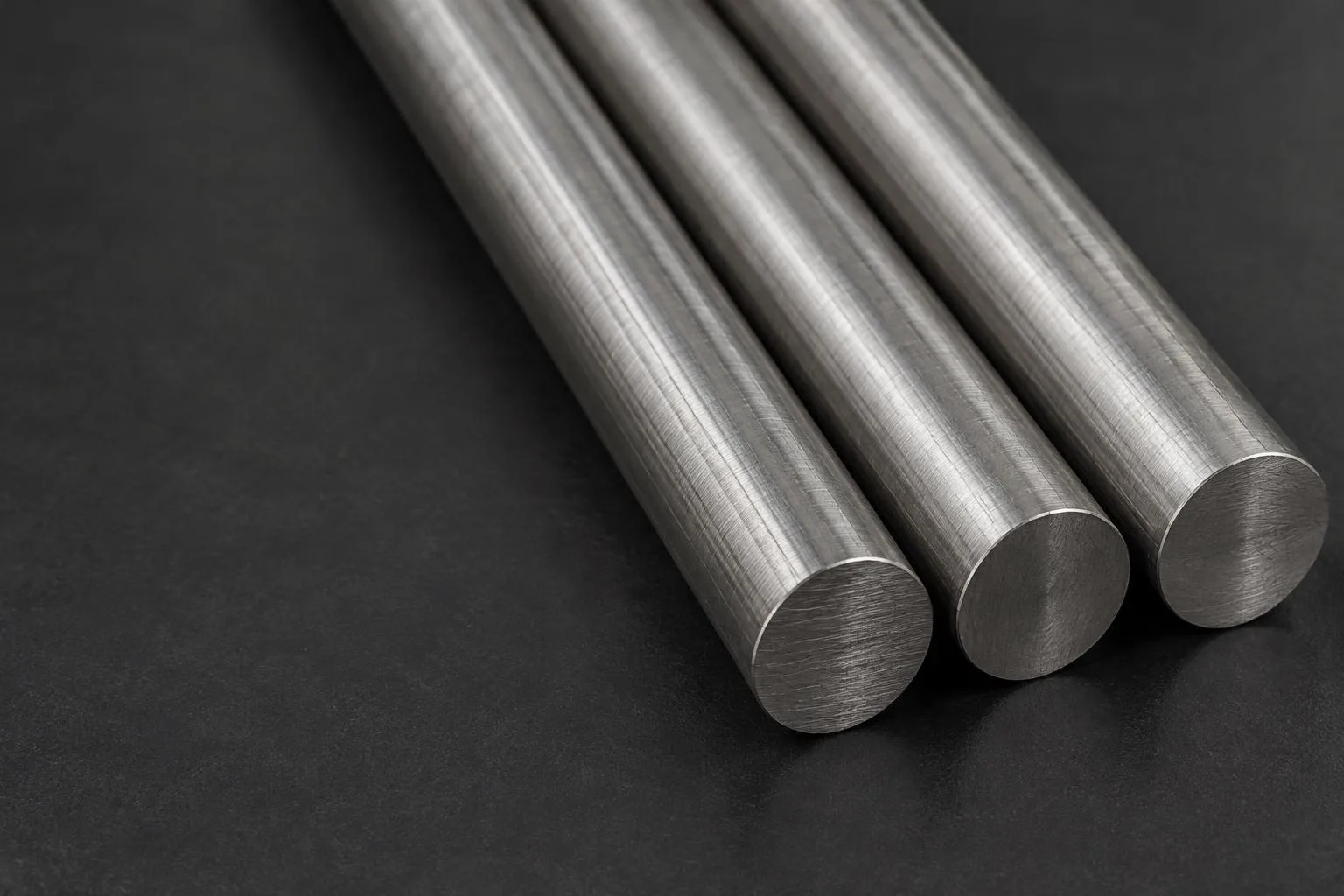
Materials Supply / Stainless Steels
416 Stainless Steel
Martensitic Stainless Steel | AISI 416 | UNS S41600
Sulphur-bearing free-machining martensitic stainless steel for turned components, with reduced corrosion resistance and weldability.
Mechanical properties depend on supply condition, heat treatment and section size. The independently labelled condition tables are reference data, not guaranteed Quest Engineering supply properties.
Raw & semi-finished materials
Available material forms
Potential forms only, subject to supplier confirmation, dimensions, condition and the agreed product specification; no held stock or universal availability is claimed.
- Round Bar
- Cut-to-Size Material
Material overview
416 Stainless Steel
Sulphur-bearing free-machining martensitic stainless steel for turned components, with reduced corrosion resistance and weldability.
- Sulphur-bearing free-machining martensitic stainless steel for turned components, with reduced corrosion resistance and weldability.
- Magnetic martensitic grade; hardening and tempering alter strength, hardness and ductility.
- Select the product form, chemistry and heat-treatment condition together; reference values must not be transferred between conditions.
Material specifications & designations
| Designation | Reference |
|---|---|
| AISI | 416 |
| UNS | S41600 |
| EN comparison — not contractual equivalence | 1.4005 / X12CrS13; compare chemistry and the ordered EN 10088-3 product requirements before substitution |
| ASTM A582 | Type 416 free-machining stainless steel bars; Conditions A and T require edition-specific confirmation |
UNS and EN references are comparison identifiers, not exact contractual equivalence. Current full ASTM, EN and AMS standards were not available for revision-specific verification. No A479, A182 or unverified blanket AMS equivalence is asserted. Reference associations only: no equivalence, stock availability, aerospace approval or certified conformity is established by this page. Specify the ordered revision, product form, dimensions, manufacture/melt route, delivery condition and acceptance tests; obtain matching supplier confirmation and inspection documents.
Specification review
Technical verification requirements
designations / product forms
Public grade associations do not establish revision-specific acceptance for every listed standard and offered form. Each row remains subject to contractual form, grade, process and delivery-condition checking; pipe is not generic tube, forging stock is not a finished forging, and long-product AMS is not flat product approval. This is an evidence gap, not a finding that all listed mappings are wrong.
Obtain ordered revisions; sign off each listed row against grade, form, size, melt route, condition and any slash designation; document offered tube specification separately where relevant.
mechanical / physical / certification
Published reference data are not a Quest certified delivery envelope. Some tables explicitly lack orientation, specimen size or test temperature; preserve those caveats. Conditional certificate/PMI/UT availability is not evidence of actual supplier capability or aerospace approval.
Retain typical-versus-minimum distinctions; confirm actual purchase-order test orientation, dimensions, temperature and certificate/test acceptance requirements before publication or supply.
Engineering reference
Technical data
| Element | Minimum % | Maximum % |
|---|---|---|
| Carbon | — | 0.15 |
| Chromium | 12.0 | 14.0 |
| Manganese | — | 1.25 |
| Silicon | — | 1.00 |
| Phosphorus | — | 0.060 |
| Sulphur | 0.15 | — |
| Molybdenum | — | 0.60 |
| Iron | Balance | Balance |
Single secondary ASTM A582 Type 416 bar reference from Dalsteel / AZoM. Molybdenum is shown as 0.60% maximum in this source; its applicability and any optional-addition provision require verification against the ordered edition. Values are mass percentages (wt. %). A dash means no limit stated on that side, not zero. Do not combine this basis with another product-form specification.
| Property | Indicative value | Condition |
|---|---|---|
| Density | ≈ 7,800 kg/m³ | Nominal ambient; annealed |
| Elastic modulus | ≈ 200 GPa | Nominal ambient; annealed |
| Thermal conductivity | ≈ 24.9 W/(m·K) | At 100°C; annealed |
| Mean thermal expansion coefficient | ≈ 9.9 × 10⁻⁶/K | Mean over 0–100°C; annealed |
Typical indicative values, not specification limits or design guarantees. Nominal ambient values lack an exact measurement temperature in the source. Resistivity is omitted where its test temperature is unsupported.
Annealed — Condition A
| Property | Reference value | Basis |
|---|---|---|
| Ultimate tensile strength | 517 MPa | Typical reference |
| 0.2% proof strength | 275 MPa | Typical reference |
| Elongation (50 mm) | 30% | Typical reference |
| Hardness | 262 HB | Typical reference |
ASTM A582 bar Condition A secondary reference. All displayed values are typical, including hardness (no maximum is identified in the cited annealed row). Test temperature and section size are not stated; do not treat as purchase acceptance limits.
Hardened + tempered — Condition T
| Property | Reference value | Basis |
|---|---|---|
| Ultimate tensile strength | 758 MPa | Typical reference |
| 0.2% proof strength | 586 MPa | Typical reference |
| Elongation (50 mm) | 18% | Typical reference |
| Hardness | 248–302 HB | Reported specification range |
ASTM A582 Condition T bar secondary reference. Strength and elongation are typical only; hardness is a reported specification range. Test temperature, section-size limits and standard edition are not stated; confirm against the ordered standard.
Annealing
Sub-critical annealing guidance: 650–760°C followed by air cooling. The secondary full-anneal cooling-rate wording is ambiguous; no full-anneal time or cooling schedule is reproduced.
Hardening
General guidance: 925–1010°C, oil quench, then temper to the required properties. Section size, cooling rate and final hardness must be agreed with the heat treater.
Tempering limitations
The cited reference advises avoiding tempering at 400–580°C because impact resistance and ductility can be reduced. Condition T properties are not a universal tempering schedule.
General processing guidance and separately labelled producer examples only; not guaranteed material specifications or a qualified production schedule. Confirm furnace control, section size, atmosphere, cooling and acceptance tests with the supplier and heat treater.
Material selection
Corrosion resistance & performance
Corrosion resistance depends on heat treatment, surface finish, exposure and cleanliness. These martensitic grades are not substitutes for the general corrosion resistance of 316 in aggressive environments.
Sulphur inclusions improve machining but lower corrosion resistance relative to 410. 416 is unsuitable for marine or chloride exposure.
No universal chemical compatibility, marine suitability or maximum service temperature is implied. Assess the actual application and subsequent tempering or thermal exposure.
Typical applications
Engineering applications
- Automatic screw-machined components
- Motor and pump shafts
- Gears and studs
- Valve parts in compatible non-chloride service
Subsequent manufacturing
Machining & processing
Machinability
416 is a free-machining grade: manganese sulphide inclusions aid chip breaking. The advantage comes with poorer corrosion resistance, weldability and formability.
Deformation and work hardening
Cold deformation changes hardness and residual stress; these grades do not have the forming behaviour of annealed 304/316. Avoid assuming deep-drawing or extensive cold-forming capability.
Heat treatment and stability
Account for distortion, dimensional movement and cracking during quenching. Specify machining allowance, final condition and hardness checks; agree welding and post-weld treatment separately.
Surface finishing
Use a clean, suitable ground or polished finish and avoid iron contamination. Cleaning and any passivation process must suit the grade, heat treatment and service environment.
Material certification & testing
Documentation and testing may be requested, subject to supplier confirmation:
Confirm certificates, testing, product condition and acceptance criteria at quotation stage. No certification or testing is promised unless specifically agreed.
- EN 10204 3.1 material certificates
- Manufacturer Certificates of Conformity
- Heat/batch traceability
- Chemical analysis
- Mechanical test reports
- Hardness testing
- Additional inspection or testing where applicable
Material enquiry
Request a material quotation
416 Stainless Steel supplied to your material form, dimensions and specification.