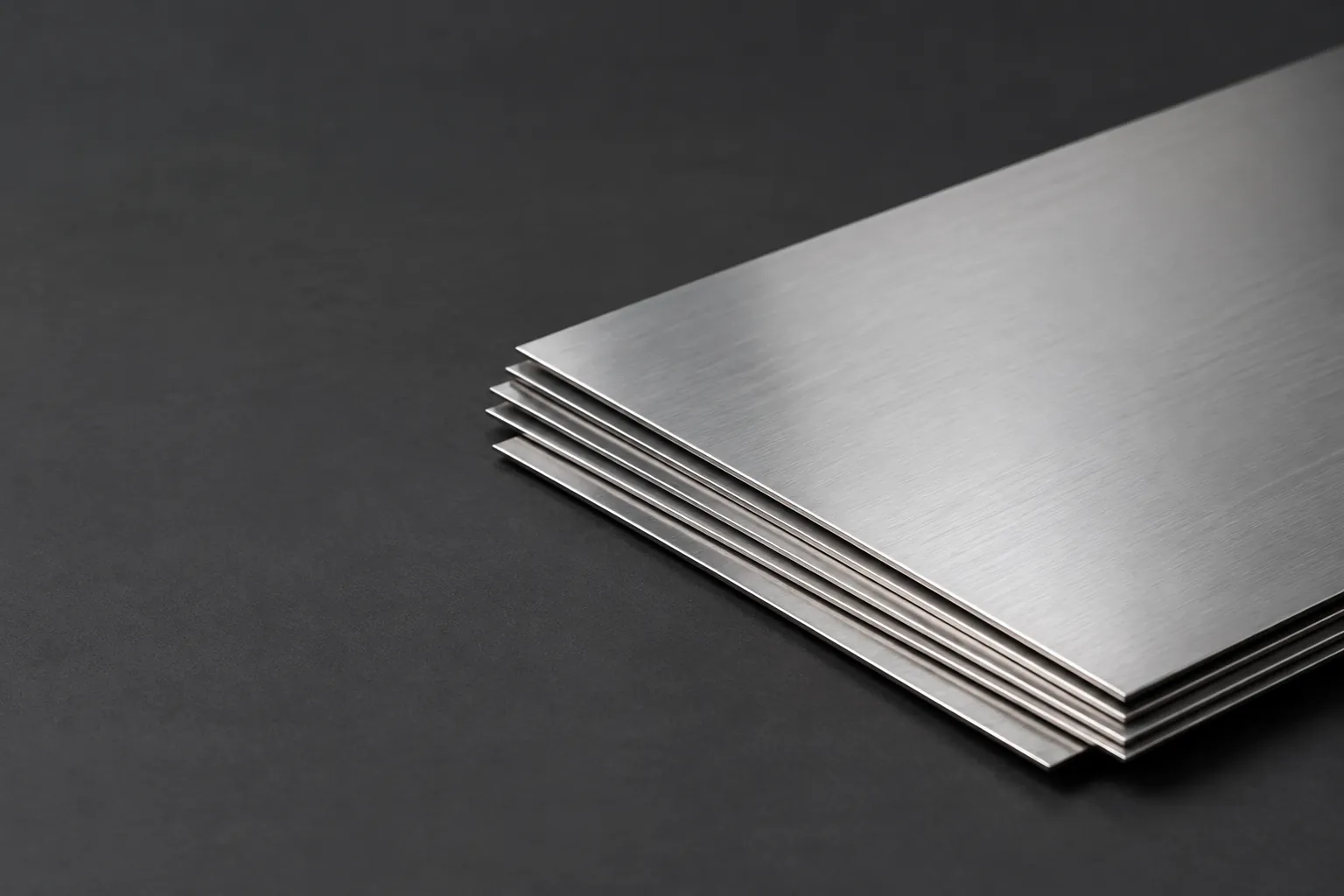
Materials Supply / Stainless Steels
304 Stainless Steel
Austenitic Stainless Steel | AISI 304 | UNS S30400 | EN 1.4301
304 is a chromium-nickel austenitic stainless steel used for general-purpose engineering and fabrication. Its chromium-rich passive surface provides good resistance in many atmospheric, food-processing and mild chemical environments.
Good formability, weldability and toughness make 304 useful for formed parts, heat exchangers and industrial equipment. Exposure in the carbide-precipitation range can reduce subsequent aqueous corrosion resistance.
304 work-hardens during cold forming and machining, but is not hardened by conventional heat treatment. Chloride-rich, crevice-prone and warm marine conditions require careful assessment rather than assuming universal suitability.
Raw & semi-finished materials
Available material forms
Potential supply forms are subject to supplier availability, size, product specification and quotation confirmation; this is not a statement of held stock.
- Round Bar
- Flat Bar
- Plate
- Sheet
- Seamless Tube
- Hollow Bar
- Forgings
- Cut-to-Size Material
Material overview
304 Stainless Steel
General-purpose chromium-nickel austenitic stainless steel for raw and semi-finished engineering material supply.
- Chromium-nickel austenitic grade; no intentional molybdenum addition.
- Good ductility and toughness in the annealed condition.
- Susceptible to sensitisation after unsuitable welding or prolonged thermal exposure.
- Cold working increases strength and hardness and can introduce magnetism.
Material specifications & designations
| Designation | Reference |
|---|---|
| AISI | 304 |
| UNS | S30400 |
| EN Material Number | 1.4301 |
| EN Steel Name | X5CrNi18-10 |
| ASTM A276 | Type 304 stainless steel bars and shapes |
| ASTM A479 | Type 304 bars for pressure applications |
| ASTM A240 | Type 304 plate, sheet and strip |
| ASTM A182 | F304 forged flanges, fittings, valves and parts; not a general sheet or bar specification |
| ASTM A312 | TP304 austenitic stainless steel pipe; tube must have its own agreed product specification |
| EN 10088-2 / EN 10088-3 | Part 2: sheet/plate/strip; Part 3: semi-finished products, bars, rods, wire, sections and bright products for general purposes |
| AMS 5639 | 304 bars and applicable forging products; solution heat treated, precise scope and revision to be agreed Supplier-listed grade/form association, not independently verified current revision acceptance requirements. |
| AMS 5513 | 304 sheet, strip and plate; solution heat treated |
Confirm the purchased standard revision, product form, dimensions and supply condition at quotation stage. EN and UNS comparisons are not contractual equivalence; specifications are not interchangeable. Reference associations only: no equivalence, stock availability, aerospace approval or certified conformity is established by this page. Specify the ordered revision, product form, dimensions, manufacture/melt route, delivery condition and acceptance tests; obtain matching supplier confirmation and inspection documents.
Specification review
Technical verification requirements
designations / product forms
Public grade associations do not establish revision-specific acceptance for every listed standard and offered form. Each row remains subject to contractual form, grade, process and delivery-condition checking; pipe is not generic tube, forging stock is not a finished forging, and long-product AMS is not flat product approval. This is an evidence gap, not a finding that all listed mappings are wrong.
Obtain ordered revisions; sign off each listed row against grade, form, size, melt route, condition and any slash designation; document offered tube specification separately where relevant.
mechanical / physical / certification
Published reference data are not a Quest certified delivery envelope. Some tables explicitly lack orientation, specimen size or test temperature; preserve those caveats. Conditional certificate/PMI/UT availability is not evidence of actual supplier capability or aerospace approval.
Retain typical-versus-minimum distinctions; confirm actual purchase-order test orientation, dimensions, temperature and certificate/test acceptance requirements before publication or supply.
Engineering reference
Technical data
| Element | Minimum % | Maximum % |
|---|---|---|
| Carbon | — | 0.08 |
| Chromium | 18.0 | 20.0 |
| Nickel | 8.0 | 11.0 |
| Manganese | — | 2.0 |
| Silicon | — | 0.75 |
| Phosphorus | — | 0.045 |
| Sulphur | — | 0.030 |
| Nitrogen | — | 0.10 |
| Iron | Balance | Balance |
Main composition basis: ASTM A240/A240M-25a, Table 1, 304 Stainless Steel / S30400, plate, sheet and strip. Values are mass percentages (wt. %); a dash means no minimum specified, and iron is the balance. This is one dated flat-product specification basis, not bar, pipe, forging, EN or AMS chemistry. Verify the edition required by the purchase order and material certificate; ASTM lists A240/A240M-26 as active; its full requirement tables have not been verified in this review. The selected June 2025 edition is not claimed to be the latest.
| Property | Reference value | Basis |
|---|---|---|
| Ultimate tensile strength | 515 MPa min. | Specification minimum |
| 0.2% proof strength | 205 MPa min. | Specification minimum |
| Elongation (50 mm) | 40% min. | Specification minimum |
| Hardness | 201 HBW max. | Specification maximum |
ASTM A240/A240M-25a, Table 2: room-temperature specification limits for annealed plate, sheet and strip, subject to A480/A480M general requirements. These are minimum strength/elongation and maximum hardness limits, not typical measurements or guaranteed Quest properties. Table 2 permits the designated Brinell or Rockwell test; only Brinell limits are shown here. Do not transfer these values to bar, pipe, forgings or AMS supply. Confirm the purchased edition, dimensions and condition; the active A240/A240M-26 tables were not independently verified.
| Property | Indicative value | Condition |
|---|---|---|
| Density | ≈ 7,900 kg/m³ | Nominal ambient; annealed |
| Elastic modulus | ≈ 193 GPa | Nominal ambient; annealed |
| Thermal conductivity | ≈ 16.3 W/(m·K) | At 100°C; annealed |
| Mean thermal expansion coefficient | ≈ 17.2 × 10⁻⁶/K | Mean over 0–100°C; annealed |
Typical annealed reference values, not specification acceptance limits or design guarantees. Density and modulus are nominal ambient reference values; the cited source does not give their exact measurement temperature. Thermal-property temperatures are shown explicitly. Confirm temperature-dependent design data for the application. Electrical resistivity is omitted because this reference does not identify its test temperature.
Material selection
Corrosion resistance & performance
Good general atmospheric corrosion resistance; assess chemical concentration, temperature, cleanliness and surface finish.
Chlorides may cause pitting, crevice corrosion and stress-corrosion cracking. Neither 304 nor 304L is a universal seawater or marine-service material.
Chromium carbide precipitation during welding or prolonged exposure around 425–860°C can cause intergranular corrosion in subsequent aqueous service; consider 304L or a stabilised grade where appropriate.
Oxidation resistance does not establish an allowable service temperature. For elevated-temperature loads, verify creep, strength, sensitisation and cyclic exposure; the H-grade requirements are not interchangeable with this grade.
Typical applications
Engineering applications
- Food-processing equipment
- Heat exchangers
- Chemical containers in compatible media
- Industrial screens
- Pump and valve components
- Instrumentation housings
- Formed engineering parts
- General-purpose fasteners
Subsequent manufacturing
Machining & processing
Machinability
304 is not a free-machining grade. Use sharp tools, positive cutting action, adequate feeds and coolant; improved-machining stock requires a separate specification.
Work hardening
Avoid rubbing cuts and tool dwell. Cold deformation raises strength and hardness; machining plans must account for the stock condition.
Formability
Good ductility supports bending, rolling and drawing. Severe forming may require an agreed intermediate anneal.
Welding
Standard fusion welding is feasible with an appropriate procedure. Heavy welded sections may require post-weld solution treatment for maximum corrosion resistance; consider 304L where that is impractical.
Heat treatment
Cannot be hardened by conventional quench-and-temper treatment. Solution annealing and rapid cooling can restore ductility; agree the cycle to the specification and product dimensions.
Surface finishing
Grinding, polishing, pickling and passivation may be specified. Avoid carbon-steel contamination and remove weld heat tint using a suitable process.
Material certification & testing
Material may be supplied with documentation and testing according to customer requirements, including:
All documentation and additional testing are subject to quotation and confirmation. Specify the required certificates, tests and acceptance criteria; no approval or testing capability is implied.
- EN 10204 3.1 material test certificates
- Manufacturer certificates of conformity
- Heat/batch traceability
- Chemical analysis
- Mechanical test reports
- Positive Material Identification (PMI)
- Ultrasonic testing where applicable
Material enquiry
Request a material quotation
304 Stainless Steel supplied to your material form, dimensions and specification.