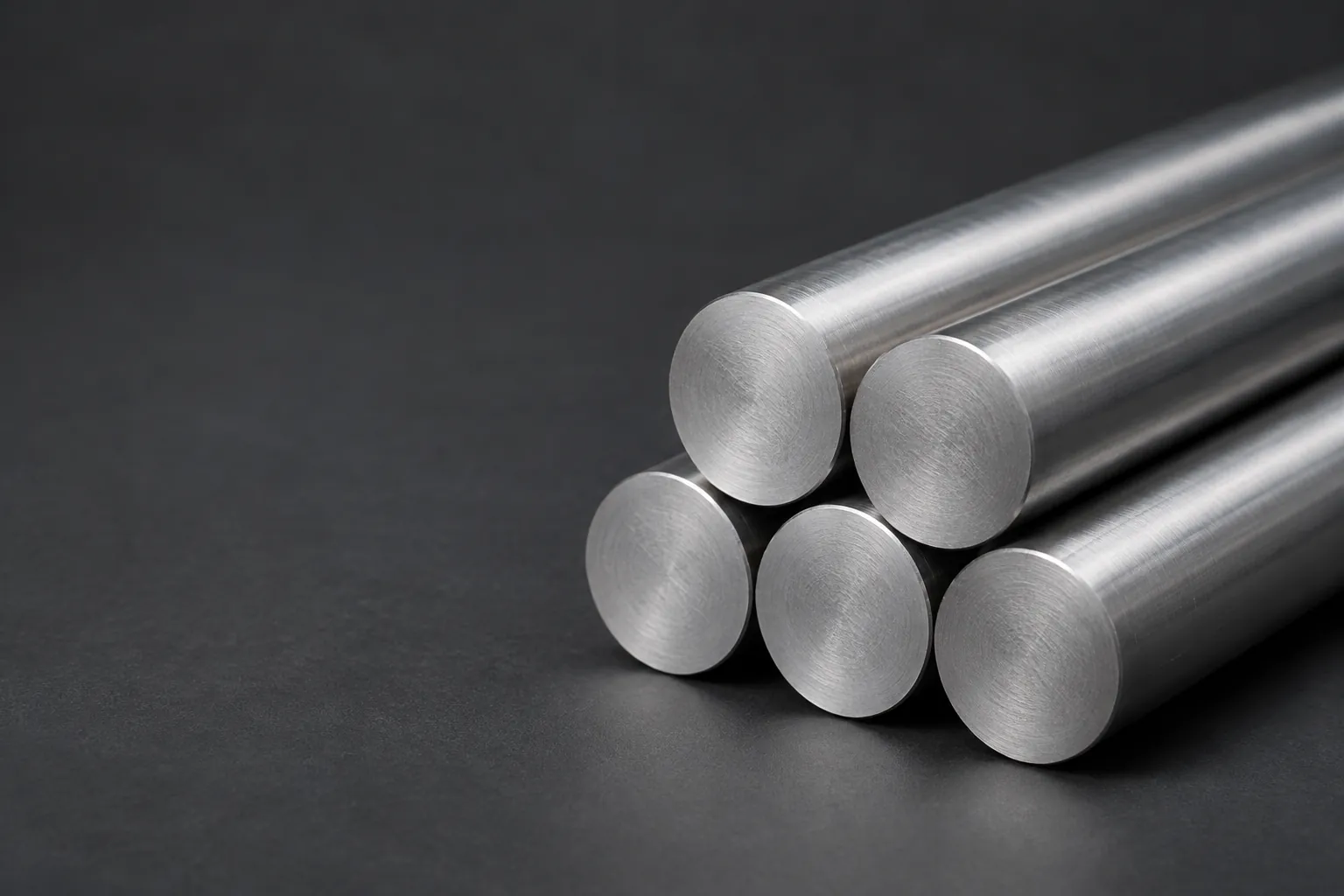
Materials Supply / Stainless Steels
316L Stainless Steel
Austenitic Stainless Steel | AISI 316L | UNS S31603 | EN 1.4404
316L stainless steel is a low-carbon, molybdenum-bearing austenitic stainless steel offering excellent general corrosion resistance, good toughness and improved resistance to sensitisation during welding compared with standard 316 stainless steel.
The low carbon content (maximum 0.03%) reduces the risk of chromium carbide precipitation during welding or elevated-temperature exposure.
316L is widely used in chemical processing, marine engineering, pharmaceutical equipment, instrumentation and other applications requiring corrosion resistance.
Raw & semi-finished materials
Available material forms
All forms are subject to availability, specification and dimensional requirements; supply must be confirmed at quotation stage.
- Round Bar
- Flat Bar
- Plate
- Sheet
- Seamless Tube
- Hollow Bar
- Forgings
- Cut-to-Size Material
Material overview
316L Stainless Steel
Low-carbon chromium-nickel-molybdenum austenitic stainless steel for raw and semi-finished material supply.
- Austenitic chromium-nickel-molybdenum stainless steel with a maximum carbon content of 0.030%.
- The low-carbon variant of 316, with reduced susceptibility to weld-related sensitisation and intergranular corrosion.
- Good general corrosion resistance, ductility and toughness for industrial manufacturing.
- Generally non-magnetic in the annealed condition; cold working can introduce some magnetism.
Material specifications & designations
| Designation | Reference |
|---|---|
| AISI | 316L |
| UNS | S31603 |
| EN Material Number | 1.4404 |
| EN Steel Name | X2CrNiMo17-12-2 |
| ASTM A276 | Type 316L stainless steel bars and shapes |
| ASTM A479 | Type 316L bars for pressure applications |
| ASTM A240 | Type 316L plate, sheet and strip |
| ASTM A182 | Grade F316L forged or rolled flanges, forged fittings, valves and parts for high-temperature service |
| ASTM A312 | Grade TP316L austenitic stainless steel pipe |
| EN 10088 | Applicable parts: Part 2 for sheet/plate/strip; Part 3 for semi-finished products, bars, rods, wire, sections and bright products for general purposes |
| AMS 5653 | 316L bars, wire, forgings, mechanical tubing, rings and stock for forging/rings; solution heat treated |
Confirm the applicable standard, revision, product form, dimensions and condition at quotation stage. References are not interchangeable. AMS 5653 is the 316L aerospace reference; AMS 5649 covers the free-machining 316FM variant and is not used here as a 316L specification. Reference associations only: no equivalence, stock availability, aerospace approval or certified conformity is established by this page. Specify the ordered revision, product form, dimensions, manufacture/melt route, delivery condition and acceptance tests; obtain matching supplier confirmation and inspection documents.
Reference: SAE AMS 5653 — 316L product scope
Specification review
Technical verification requirements
designations / product forms
Public grade associations do not establish revision-specific acceptance for every listed standard and offered form. Each row remains subject to contractual form, grade, process and delivery-condition checking; pipe is not generic tube, forging stock is not a finished forging, and long-product AMS is not flat product approval. This is an evidence gap, not a finding that all listed mappings are wrong.
Obtain ordered revisions; sign off each listed row against grade, form, size, melt route, condition and any slash designation; document offered tube specification separately where relevant.
mechanical / physical / certification
Published reference data are not a Quest certified delivery envelope. Some tables explicitly lack orientation, specimen size or test temperature; preserve those caveats. Conditional certificate/PMI/UT availability is not evidence of actual supplier capability or aerospace approval.
Retain typical-versus-minimum distinctions; confirm actual purchase-order test orientation, dimensions, temperature and certificate/test acceptance requirements before publication or supply.
composition
Recorded Boltport chemistry source was not accessible (HTTP 406). Atlas flat-product chemistry cannot validate A276 bar nitrogen by substitution.
Verify nitrogen and all residuals against the ordered A276 edition; retain form-specific Si distinction.
Engineering reference
Technical data
| Element | Minimum % | Maximum % |
|---|---|---|
| Carbon | — | 0.030 |
| Chromium | 16.0 | 18.0 |
| Nickel | 10.0 | 14.0 |
| Molybdenum | 2.0 | 3.0 |
| Manganese | — | 2.0 |
| Silicon | — | 1.0 |
| Phosphorus | — | 0.045 |
| Sulphur | — | 0.030 |
| Nitrogen | — | 0.10 |
| Iron | Balance | Balance |
Reference ASTM A276 Type 316L / UNS S31603 bar/shape limits, expressed as mass percentages (wt. %). A dash means no minimum stated. Confirm every limit, including nitrogen, against the applicable purchased revision and material test certificate. These are not heat-analysis results or interchangeable limits for all forms; ASTM A240 flat-product reference data uses 0.75% maximum silicon.
| Property | Reference value | Basis |
|---|---|---|
| Ultimate tensile strength | 485 MPa min. | Reference specification minimum |
| 0.2% proof strength | 170 MPa min. | Reference specification minimum |
| Elongation (50 mm) | 40% min. | Reference specification minimum |
| Hardness | 217 HB max. | Reference specification maximum |
Representative annealed 316L flat-rolled plate, sheet and coil requirements from the cited ASTM A240/A240M reference at room temperature. These are specification limits, not typical measured values or guaranteed Quest supply properties. They must not be applied automatically to ASTM A276 bar, pipe or forgings: requirements depend on product form, dimensions, supply condition and the agreed standard revision.
| Property | Indicative value | Condition |
|---|---|---|
| Density | ≈ 8.0 g/cm³ | Room temperature; annealed |
| Elastic modulus | ≈ 193 GPa | Room temperature; annealed |
| Thermal conductivity | ≈ 16.3 W/(m·K) | At 100°C; annealed |
| Mean thermal expansion coefficient | ≈ 15.9 × 10⁻⁶/K | Mean over 0–100°C; annealed |
| Electrical resistivity | ≈ 740 nΩ·m | Annealed; temperature not stated in source |
Typical, indicative annealed-condition reference values for 316L, not specification acceptance limits. Conductivity is quoted at 100°C and expansion as a mean over 0–100°C. The source does not explicitly state the electrical-resistivity test temperature; confirm temperature-specific data before using it for design. All physical values vary with temperature and material condition.
Material selection
Corrosion resistance & performance
Good general atmospheric corrosion resistance and resistance in many chemical processing environments; suitability depends on concentration, temperature and operating conditions.
Molybdenum improves chloride pitting and crevice corrosion resistance compared with 304. General chloride resistance is broadly similar to standard 316, rather than inherently greater because of the lower carbon content.
Lower carbon reduces sensitisation from chromium carbide precipitation during welding and improves resistance to associated intergranular corrosion. Welding procedure, thermal history and surface condition remain important.
Aggressive chlorides, warm or stagnant seawater and crevices can still cause corrosion, including stress-corrosion cracking. 316L is not completely resistant to seawater corrosion.
For elevated-temperature service, verify strength, sensitisation, oxidation and subsequent corrosion exposure against the actual duty and supply specification; no universal maximum operating temperature is implied.
Typical applications
Engineering applications
- Chemical processing equipment
- Pharmaceutical equipment
- Marine engineering
- Oil and gas equipment
- Pumps and valves
- Instrumentation
- Food-processing equipment
- Industrial engineering components
Subsequent manufacturing
Machining & processing
Machinability
Use sharp tools, suitable feeds and effective cooling. Allow for stock condition and machining allowance when purchasing material.
Work hardening
316L work-hardens during cutting and deformation. Avoid rubbing cuts or dwelling, and maintain a suitable cutting depth.
Cold forming
Good ductility supports bending, rolling and drawing. Cold work increases strength and hardness; subsequent annealing may be required.
Welding
The low-carbon composition reduces weld-related sensitisation. Select an appropriate qualified welding procedure and filler, and specify any required post-weld cleaning or treatment.
Solution annealing
Solution annealing can restore ductility and corrosion resistance after processing. The heat-treatment cycle and cooling method must suit the form and specification; conventional quench-and-temper treatment does not harden 316L.
Surface finishing
Specify required grinding, polishing, pickling or passivation. Avoid iron contamination during handling and subsequent manufacturing.
Material certification & testing
Material may be supplied with documentation and testing according to customer requirements, including:
All documentation and testing are subject to confirmation at quotation stage. Specify required certificates, tests and acceptance criteria with your enquiry.
- EN 10204 3.1 material test certificates
- Manufacturer certificates of conformity
- Heat/batch traceability
- Chemical analysis
- Mechanical test reports
- Positive Material Identification (PMI)
- Ultrasonic testing where applicable
Material enquiry
Request a material quotation
316L Stainless Steel supplied to your material form, dimensions and specification.