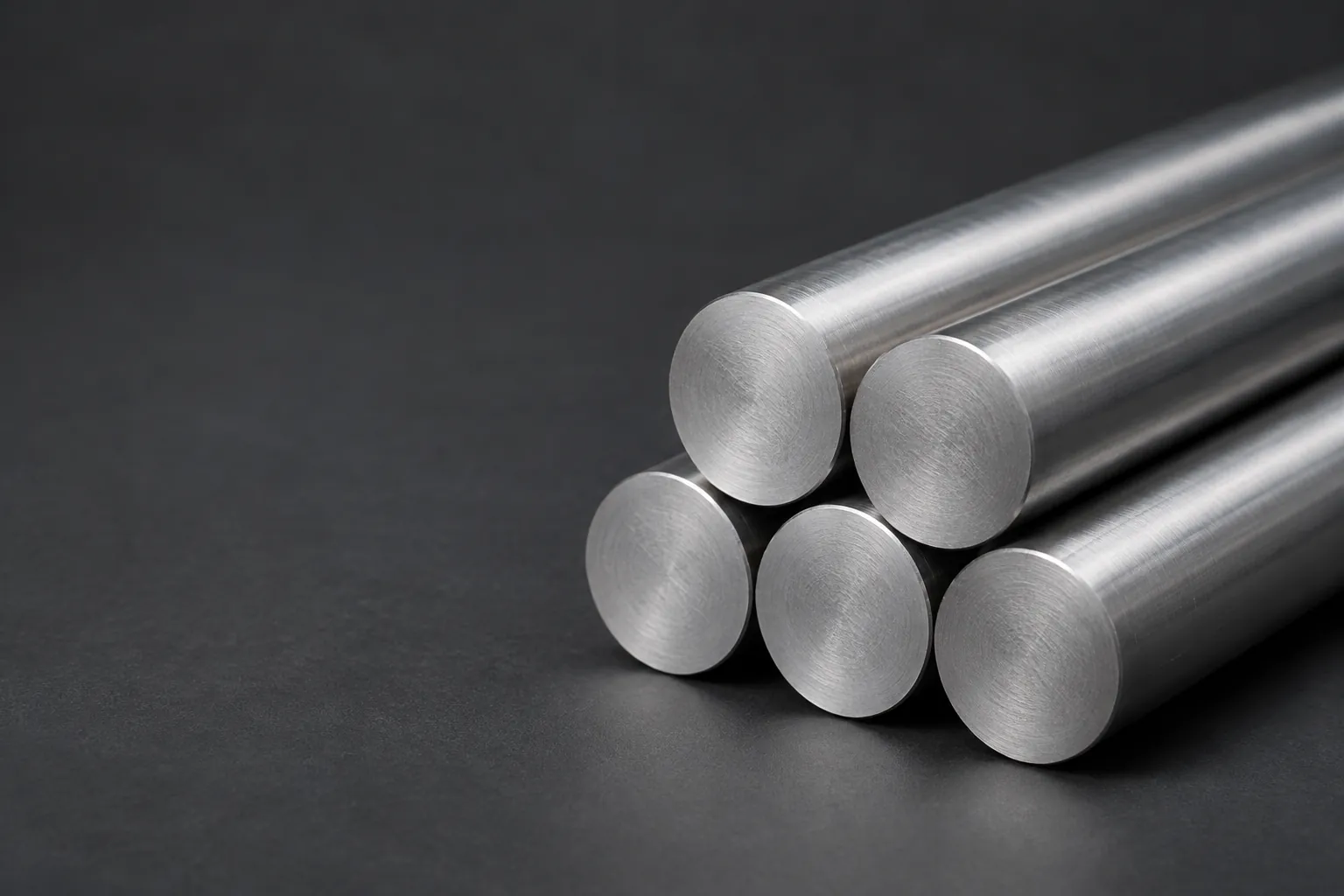
Materials Supply / Stainless Steels
316 Stainless Steel
Austenitic Stainless Steel | AISI 316 | UNS S31600 | EN 1.4401
316 stainless steel is a molybdenum-bearing austenitic stainless steel offering excellent corrosion resistance, good mechanical properties and improved resistance to pitting and crevice corrosion compared with 304 stainless steel in many chloride-containing environments.
It is widely specified for marine, chemical processing, energy, instrumentation and industrial engineering applications.
Raw & semi-finished materials
Available material forms
Available forms, dimensions and specifications are subject to confirmation.
- Round Bar
- Flat Bar
- Plate
- Sheet
- Seamless Tube
- Hollow Bar
- Forgings
- Cut-to-Size Material
Material overview
316 Stainless Steel
Molybdenum-bearing austenitic stainless steel for raw and semi-finished engineering material supply.
- Austenitic chromium-nickel-molybdenum stainless steel.
- Good general corrosion resistance, with improved resistance to chloride pitting compared with 304.
- Good ductility and toughness for a wide range of industrial applications.
- Generally non-magnetic in the annealed condition, although cold working can introduce some magnetism.
Material specifications & designations
| Designation | Reference |
|---|---|
| AISI | 316 |
| UNS | S31600 |
| EN Material Number | 1.4401 |
| EN Steel Name | X5CrNiMo17-12-2 |
| ASTM A276 | Stainless steel bars and shapes |
| ASTM A479 | Stainless steel bars for pressure applications |
| ASTM A240 | Stainless steel plate, sheet and strip |
| ASTM A182 | Forged or rolled alloy and stainless steel components |
| ASTM A312 | Austenitic stainless steel pipe |
| AMS 5648 | Applicable aerospace bar and forging products |
The applicable specification depends on material form, condition and customer requirements. These references are not interchangeable; confirm the required standard and revision at quotation stage. Reference associations only: no equivalence, stock availability, aerospace approval or certified conformity is established by this page. Specify the ordered revision, product form, dimensions, manufacture/melt route, delivery condition and acceptance tests; obtain matching supplier confirmation and inspection documents.
Specification review
Technical verification requirements
designations / product forms
Public grade associations do not establish revision-specific acceptance for every listed standard and offered form. Each row remains subject to contractual form, grade, process and delivery-condition checking; pipe is not generic tube, forging stock is not a finished forging, and long-product AMS is not flat product approval. This is an evidence gap, not a finding that all listed mappings are wrong.
Obtain ordered revisions; sign off each listed row against grade, form, size, melt route, condition and any slash designation; document offered tube specification separately where relevant.
mechanical / physical / certification
Published reference data are not a Quest certified delivery envelope. Some tables explicitly lack orientation, specimen size or test temperature; preserve those caveats. Conditional certificate/PMI/UT availability is not evidence of actual supplier capability or aerospace approval.
Retain typical-versus-minimum distinctions; confirm actual purchase-order test orientation, dimensions, temperature and certificate/test acceptance requirements before publication or supply.
designations
Scope/condition is less explicit than other revised pages: no solution-treatment condition, wire/tubing/rings coverage or exact scope evidence is provided.
Add a verified revision-specific AMS5648 scope/condition reference after reviewing controlled text; do not imply sheet/tube compliance.
Engineering reference
Technical data
| Element | Minimum % | Maximum % |
|---|---|---|
| Carbon | — | 0.08 |
| Chromium | 16.0 | 18.0 |
| Nickel | 10.0 | 14.0 |
| Molybdenum | 2.0 | 3.0 |
| Manganese | — | 2.0 |
| Silicon | — | 1.0 |
| Phosphorus | — | 0.045 |
| Sulphur | — | 0.030 |
| Nitrogen | — | 0.10 |
| Iron | Balance | Balance |
Representative ASTM A276 Type 316 bar/shape limits, expressed as mass percentages (wt. %), not a heat analysis. A dash indicates no minimum specified in this reference. Confirm the applicable standard and revision: EN and ASTM limits and limits for other product forms can differ; for example, the referenced ASTM A240 flat-product example uses 0.75% maximum silicon rather than 1.0%.
| Property | Reference value | Basis |
|---|---|---|
| Ultimate tensile strength | 500–700 MPa | Reference specification range |
| 0.2% proof strength | 200 MPa min. | Reference specification minimum |
| Elongation (A50 mm) | 40% min. | Reference specification minimum |
| Hardness | 215 HB max. | Reference specification maximum |
Representative annealed bar/section reference values at room temperature, based on the published EN 10088-3:2005 example below. These are specification limits, not typical measured values or guaranteed Quest supply properties. Actual requirements depend on product form, supply condition, dimensions and the agreed specification. Typical measured values must be confirmed from the applicable supplier data or material test certificate.
| Property | Indicative value | Condition |
|---|---|---|
| Density | ≈ 8.0 g/cm³ | Room temperature; annealed |
| Elastic modulus | ≈ 193 GPa | Room temperature; annealed |
| Thermal conductivity | ≈ 16.3 W/(m·K) | At 100°C; annealed |
| Mean thermal expansion coefficient | ≈ 15.9 × 10⁻⁶/K | Mean over 0–100°C; annealed |
Indicative, typical annealed-condition reference values, not specification acceptance limits. Thermal conductivity is stated at 100°C and expansion is a mean over 0–100°C, not a single room-temperature measurement. Properties vary with temperature and condition; use verified design data for the application.
Material selection
Corrosion resistance & performance
Good general atmospheric corrosion resistance and resistance in many chemical processing environments; suitability depends on the chemicals, concentration and temperature.
Molybdenum improves chloride pitting and crevice corrosion resistance compared with 304, but does not eliminate these risks.
Aggressive chlorides, stagnant seawater and warm marine conditions can cause pitting, crevice corrosion or stress-corrosion cracking. 316 is not completely resistant to seawater corrosion.
For elevated-temperature service, consider strength, oxidation, sensitisation and subsequent corrosion exposure. Confirm the grade and supply condition for the actual duty.
Typical applications
Engineering applications
- Aerospace hardware and instrumentation
- Marine equipment
- Chemical processing equipment
- Oil and gas equipment
- Pumps and valves
- Precision engineering
- Industrial fittings
- Pharmaceutical and food-processing equipment
Subsequent manufacturing
Machining & processing
Machinability
Use sharp tooling, suitable feeds and adequate coolant. Select stock condition and machining allowance to suit the intended manufacturing process.
Work hardening
316 work-hardens during cutting and deformation. Avoid dwelling or rubbing cuts, and account for cold-worked material when planning operations.
Forming
Good ductility supports common forming operations. Cold work increases strength and hardness and may require subsequent annealing.
Heat treatment
316 is not hardened by conventional quench-and-temper treatment. Solution annealing may restore ductility and corrosion resistance; the cycle must suit the product and specification.
Surface finishing
Grinding, polishing, pickling and passivation may be relevant. Avoid iron contamination and specify the required finish and cleaning condition when purchasing material.
Material certification & testing
Material may be supplied with documentation and testing according to customer requirements, including:
All documentation and testing are subject to confirmation at quotation stage. Specify required certificates, tests and acceptance criteria with your enquiry.
- EN 10204 3.1 material test certificates
- Manufacturer certificates of conformity
- Heat/batch traceability
- Chemical analysis
- Mechanical test reports
- Positive Material Identification (PMI)
- Ultrasonic testing where applicable
Material enquiry
Request a material quotation
316 Stainless Steel supplied to your material form, dimensions and specification.