Materials Supply / Stainless Steels
431 Stainless Steel
Martensitic Stainless Steel | AISI 431 | UNS S43100
Nickel-bearing martensitic stainless steel combining heat-treatable strength, toughness and useful corrosion resistance for shafting and fasteners.
Mechanical properties depend on supply condition, heat treatment and section size. The independently labelled condition tables are reference data, not guaranteed Quest Engineering supply properties.
Raw & semi-finished materials
Available material forms
Potential forms only, subject to supplier confirmation, dimensions, condition and the agreed product specification; no held stock or universal availability is claimed.
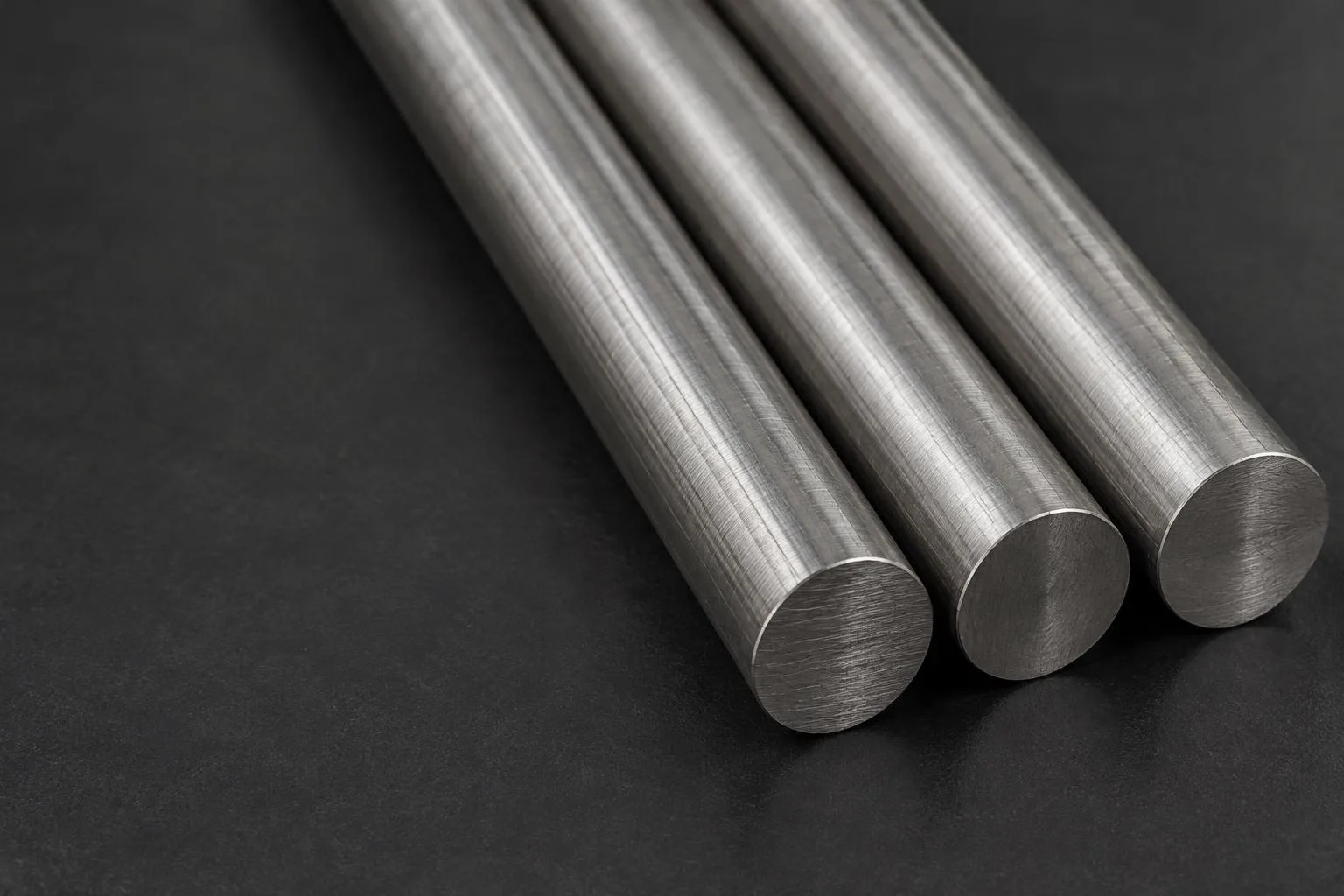
- Round Bar
- Cut-to-Size Material
Material overview
431 Stainless Steel
Nickel-bearing martensitic stainless steel combining heat-treatable strength, toughness and useful corrosion resistance for shafting and fasteners.
- Nickel-bearing martensitic stainless steel combining heat-treatable strength, toughness and useful corrosion resistance for shafting and fasteners.
- Magnetic martensitic grade; hardening and tempering alter strength, hardness and ductility.
- Select the product form, chemistry and heat-treatment condition together; reference values must not be transferred between conditions.
Material specifications & designations
| Designation | Reference |
|---|---|
| AISI | 431 |
| UNS | S43100 |
| EN comparison — not contractual equivalence | 1.4057 / X17CrNi16-2; compare chemistry and the ordered EN 10088-3 product requirements before substitution |
| ASTM A276 | Type 431 stainless steel bars and shapes; confirm ordered condition and edition |
UNS and EN references are comparison identifiers, not exact contractual equivalence. Current full ASTM, EN and AMS standards were not available for revision-specific verification. No A479, A182 or unverified blanket AMS equivalence is asserted. Reference associations only: no equivalence, stock availability, aerospace approval or certified conformity is established by this page. Specify the ordered revision, product form, dimensions, manufacture/melt route, delivery condition and acceptance tests; obtain matching supplier confirmation and inspection documents.
Specification review
Technical verification requirements
designations / product forms
Public grade associations do not establish revision-specific acceptance for every listed standard and offered form. Each row remains subject to contractual form, grade, process and delivery-condition checking; pipe is not generic tube, forging stock is not a finished forging, and long-product AMS is not flat product approval. This is an evidence gap, not a finding that all listed mappings are wrong.
Obtain ordered revisions; sign off each listed row against grade, form, size, melt route, condition and any slash designation; document offered tube specification separately where relevant.
mechanical / physical / certification
Published reference data are not a Quest certified delivery envelope. Some tables explicitly lack orientation, specimen size or test temperature; preserve those caveats. Conditional certificate/PMI/UT availability is not evidence of actual supplier capability or aerospace approval.
Retain typical-versus-minimum distinctions; confirm actual purchase-order test orientation, dimensions, temperature and certificate/test acceptance requirements before publication or supply.
Engineering reference
Technical data
| Element | Minimum % | Maximum % |
|---|---|---|
| Carbon | — | 0.20 |
| Chromium | 15.0 | 17.0 |
| Nickel | 1.25 | 2.50 |
| Manganese | — | 1.00 |
| Silicon | — | 1.00 |
| Phosphorus | — | 0.040 |
| Sulphur | — | 0.030 |
| Iron | Balance | Balance |
Single secondary ASTM A276 Type 431 bar reference from AZoM; standard edition not supplied. Values are mass percentages (wt. %). A dash means no limit stated on that side, not zero. Do not combine this basis with another product-form specification.
| Property | Indicative value | Condition |
|---|---|---|
| Density | ≈ 7,800 kg/m³ | Nominal ambient; source exact temperature not stated |
| Elastic modulus | ≈ 200 GPa | Nominal ambient; source exact temperature not stated |
| Thermal conductivity | ≈ 20.2 W/(m·K) | At 100°C |
| Mean thermal expansion coefficient | ≈ 10.2 × 10⁻⁶/K | Mean over 0–100°C |
Typical indicative values, not specification limits or design guarantees. Nominal ambient values lack an exact measurement temperature in the source. Resistivity is omitted where its test temperature is unsupported. ASSDA separately quotes density 7,700 kg/m³; this table consistently uses AZoM 7,800 kg/m³. Confirm design density with the producer.
Annealed — Condition A
| Property | Reference value | Basis |
|---|---|---|
| Ultimate tensile strength | 862 MPa | Typical reference |
| 0.2% proof strength | 655 MPa | Typical reference |
| Elongation (50 mm) | 20% | Typical reference |
| Hardness | 285 HB max. | Reported specification maximum |
ASTM A276 Condition A bar secondary reference. Strength and elongation are typical; hardness is the reported specification maximum. Test temperature, section size and standard edition are not stated.
Hardened + tempered — Condition T
| Property | Reference value | Basis |
|---|---|---|
| Ultimate tensile strength | 850–1000 MPa | Reported specification range |
ASSDA / Atlas, Australian Stainless issue 48 (2011): Condition T bar commonly supplied to AS 1444 or BS 970, not presented as ASTM A276 Condition T. Exact standard edition, section limits and test temperature require confirmation. Other numeric properties are omitted rather than borrowing annealed or differently tempered values.
ASSDA — Grade 431, Peter Moore (Atlas Steels), 2011; updated 2020
Sub-critical annealing
ASSDA guidance: 620–660°C followed by air cooling. Full annealing is not treated here as a standard generic softening route.
Hardening
ASSDA guidance: air or oil quench, usually from 950–1000°C. Temper as quickly as practicable after quenching to reduce cracking risk; no soak time is specified.
Tempering
ASSDA cites 580–680°C as usual and advises avoiding 370–570°C because impact toughness is reduced. These are processing reference ranges, not acceptance requirements for every Condition T order.
General processing guidance and separately labelled producer examples only; not guaranteed material specifications or a qualified production schedule. Confirm furnace control, section size, atmosphere, cooling and acceptance tests with the supplier and heat treater.
ASSDA — Grade 431 heat-treatment guidance (2011; updated 2020)
Material selection
Corrosion resistance & performance
Corrosion resistance depends on heat treatment, surface finish, exposure and cleanliness. These martensitic grades are not substitutes for the general corrosion resistance of 316 in aggressive environments.
431 offers useful resistance approaching 304 in some environments, but is usually inadequate for seawater. It does not provide 316-equivalent chloride resistance.
No universal chemical compatibility, marine suitability or maximum service temperature is implied. Assess the actual application and subsequent tempering or thermal exposure.
Typical applications
Engineering applications
- Pump and motor shafts
- High-strength bolts and fasteners
- Valve stems
- Industrial shafting in compatible environments
Subsequent manufacturing
Machining & processing
Machinability
Annealed or suitably tempered stock is generally easier to machine than fully hardened stock. Specify incoming hardness and allow for the intended finishing process.
Deformation and work hardening
Cold deformation changes hardness and residual stress; these grades do not have the forming behaviour of annealed 304/316. Avoid assuming deep-drawing or extensive cold-forming capability.
Heat treatment and stability
Account for distortion, dimensional movement and cracking during quenching. Specify machining allowance, final condition and hardness checks; agree welding and post-weld treatment separately.
Surface finishing
Use a clean, suitable ground or polished finish and avoid iron contamination. Cleaning and any passivation process must suit the grade, heat treatment and service environment.
Material certification & testing
Documentation and testing may be requested, subject to supplier confirmation:
Confirm certificates, testing, product condition and acceptance criteria at quotation stage. No certification or testing is promised unless specifically agreed.
- EN 10204 3.1 material certificates
- Manufacturer Certificates of Conformity
- Heat/batch traceability
- Chemical analysis
- Mechanical test reports
- Hardness testing
- Additional inspection or testing where applicable
Material enquiry
Request a material quotation
431 Stainless Steel supplied to your material form, dimensions and specification.