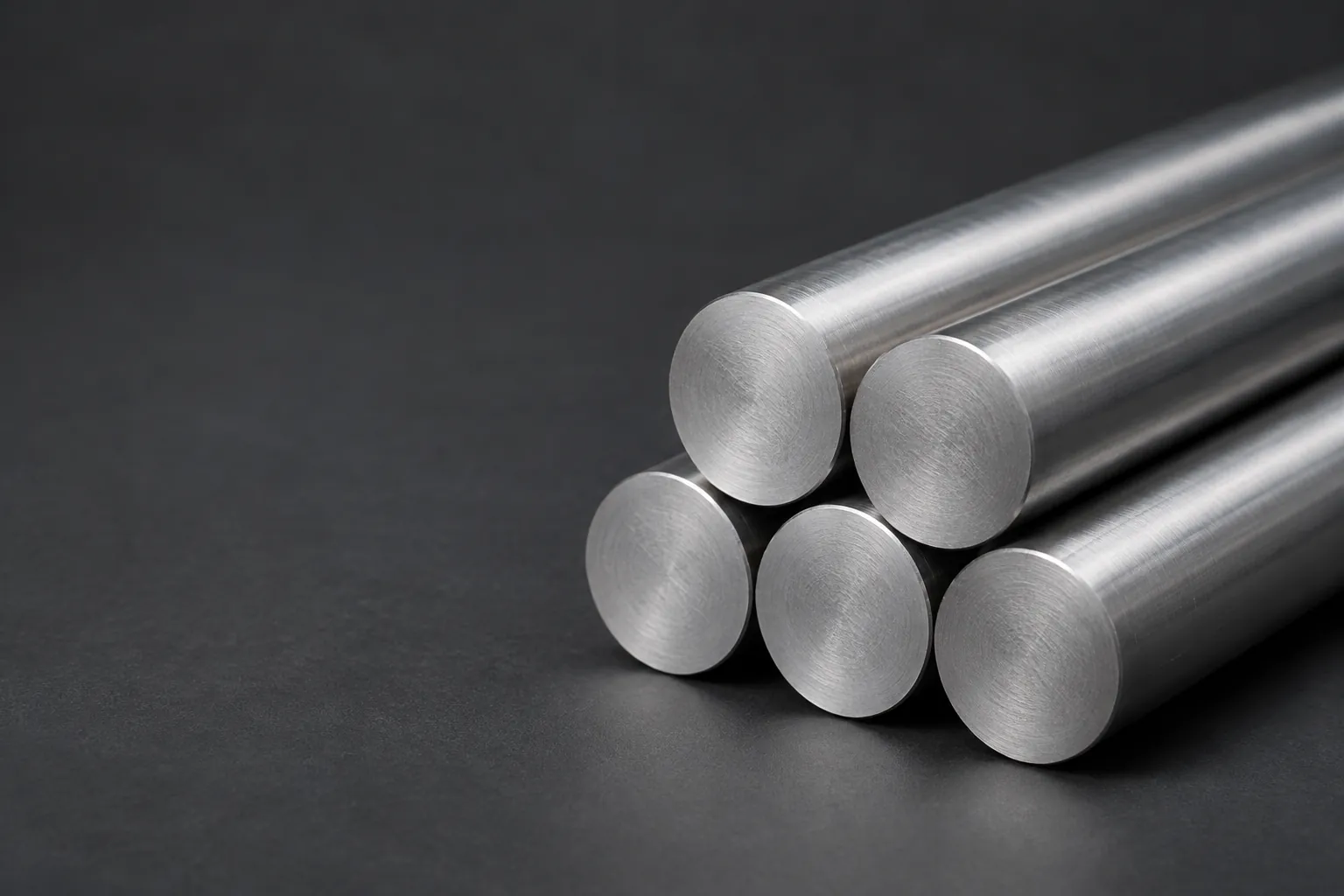
Materials Supply / Stainless Steels
Nitronic 50 Stainless Steel
Nitrogen-Strengthened Austenitic Stainless Steel | UNS S20910
High-strength, nitrogen-strengthened austenitic stainless steel combining corrosion resistance with useful toughness.
In commonly compared annealed supply conditions, the producer reports higher strength than conventional 304 and 316. Properties depend on product size, processing and condition; no universal corrosion advantage or application approval is implied.
NITRONIC® is a registered trademark of Cleveland-Cliffs Inc., as attributed in the cited producer bulletin.
Raw & semi-finished materials
Available material forms
Potential forms supported by producer references; size, material condition, availability and specification require supplier confirmation. No Quest Engineering stock holding or immediate availability is implied.
- Round Bar
- Flat Bar
- Plate
- Sheet
- Wire
- Forgings
- Cut-to-Size Material
Material overview
Nitronic 50 Stainless Steel
High-strength, nitrogen-strengthened austenitic stainless steel combining corrosion resistance with useful toughness.
- High-strength, nitrogen-strengthened austenitic stainless steel combining corrosion resistance with useful toughness.
- Strengthening is achieved by nitrogen alloying and controlled deformation, not conventional martensitic precipitation-hardening treatments.
- Agree the exact product form, size, condition and test requirements; typical reference measurements are not guaranteed supply properties.
Material specifications & designations
| Designation | Reference |
|---|---|
| UNS | S20910 |
| Commercial designation | Nitronic 50; XM-19 |
| ASTM A276 / A479 | Bars and shapes / bars and shapes for boiler and pressure-vessel construction, respectively; producer grade association |
| ASTM A240 | Plate, sheet and strip; producer-listed XM-19 / S20910 flat products |
| ASTM A314 | Billets and bars intended for forging, not finished forgings |
| ASTM A580 | Stainless wire in coils; straightened lengths require a different product standard |
| ASTM A182 | Producer-listed F/XM-19 forged or rolled pipe flanges, forged fittings, valves and parts; exact grade and ordered revision must be checked |
| AMS 5764 | Solution-treated bars, wire, forgings, extrusions, flash-welded rings and stock for forging/rings; SAE public scope, not flat products |
| EN reference | Related European grade 1.3964 is not an exact equivalent: Einsal producer limits give Ni 15–17% and Mo 3–3.5%, versus this S20910 producer basis of Ni 11.5–13.5% and Mo 1.5–3%. Chemistry and product requirements must be separately confirmed before substitution. |
Grade associations are producer-listed; public standard scopes are checked separately. Full current ASTM/AMS requirements were not available. Confirm grade, revision, product form, dimensions, condition and test requirements; no current-standard compliance or blanket aerospace approval is claimed. Reference associations only: no equivalence, stock availability, aerospace approval or certified conformity is established by this page. Specify the ordered revision, product form, dimensions, manufacture/melt route, delivery condition and acceptance tests; obtain matching supplier confirmation and inspection documents.
Specification review
Technical verification requirements
designations / product forms
Public grade associations do not establish revision-specific acceptance for every listed standard and offered form. Each row remains subject to contractual form, grade, process and delivery-condition checking; pipe is not generic tube, forging stock is not a finished forging, and long-product AMS is not flat product approval. This is an evidence gap, not a finding that all listed mappings are wrong.
Obtain ordered revisions; sign off each listed row against grade, form, size, melt route, condition and any slash designation; document offered tube specification separately where relevant.
mechanical / physical / certification
Published reference data are not a Quest certified delivery envelope. Some tables explicitly lack orientation, specimen size or test temperature; preserve those caveats. Conditional certificate/PMI/UT availability is not evidence of actual supplier capability or aerospace approval.
Retain typical-versus-minimum distinctions; confirm actual purchase-order test orientation, dimensions, temperature and certificate/test acceptance requirements before publication or supply.
Engineering reference
Technical data
| Element | Minimum mass % | Maximum mass % |
|---|---|---|
| Carbon | — | 0.06 |
| Chromium | 20.50 | 23.50 |
| Nickel | 11.50 | 13.50 |
| Manganese | 4.00 | 6.00 |
| Molybdenum | 1.50 | 3.00 |
| Nitrogen | 0.15 | 0.45 |
| Niobium | 0.10 | 0.30 |
| Vanadium | 0.10 | 0.30 |
| Silicon | — | 1.00 |
| Phosphorus | — | 0.040 |
| Sulphur | — | 0.030 |
| Iron | Balance | Balance |
One ARMCO producer composition basis, p. 1, in mass % (wt. %), not a current ASTM chemistry transcription or heat analysis. A dash means no minimum stated, not zero. Iron balance is an editorial remainder for this iron-base alloy; the producer does not tabulate iron. Electralloy standard nominal analysis uses N 0.20–0.40% and S ≤0.010%, versus ARMCO N 0.15–0.45% and S ≤0.030% here. Those alternatives are not blended; confirm the ordered specification and heat analysis.
| Property | Indicative value | Condition / temperature |
|---|---|---|
| Density | ≈ 7,880 kg/m³ | At 24°C; producer p. 12, condition not stated |
| Elastic modulus | ≈ 199 GPa | Annealed; room temperature, p. 9 Table 17 |
| Thermal conductivity | ≈ 15.6 W/(m·K) | At 149°C; p. 13 Table 26, condition not stated |
| Mean thermal expansion coefficient | ≈ 16.2 × 10⁻⁶/K | Annealed; mean 21–93°C, p. 13 Table 24 |
| Electrical resistivity | ≈ 820 nΩ·m | At 21°C; p. 12, converted from 82 μΩ·cm |
Typical informational values, not acceptance limits or design allowables. Conditions and temperatures are identified only where supplied; omitted source details are not assumed. Unit conversions use 1 μΩ·cm = 10 nΩ·m. Thermal conductivity at 149°C must not be relabelled as a room-temperature value.
Annealed
| Property | Reference value | Basis |
|---|---|---|
| Ultimate tensile strength | 827 MPa | Typical producer test value |
| 0.2% proof strength | 414 MPa | Typical producer test value |
| Elongation (4D₀) | 50% | Typical producer test value |
| Hardness | 98 HRB | Typical producer test value |
| Reduction of area | 70% | Typical producer test value |
October 2022 p. 3 Table 2: typical room-temperature values for 25.4 mm annealed bar. Elongation in 4D₀; specimen orientation and precise annealing cycle are not stated. This one producer test row is not the separate Table 1 acceptance proposal or verified current ASTM/AMS minima.
High Strength (HS)
| Property | Reference value | Basis |
|---|---|---|
| Ultimate tensile strength | 937 MPa | Typical producer test value |
| 0.2% proof strength | 731 MPa | Typical producer test value |
| Elongation (4D₀) | 33% | Typical producer test value |
| Hardness | 28 HRC | Typical producer test value |
| Reduction of area | 66% | Typical producer test value |
October 2022 p. 3 Table 2: typical room-temperature HS bar, diameter >50.8 to ≤101.6 mm, specially mill-processed. Elongation in 4D₀; orientation not stated. Not guaranteed properties for all HS diameters or verified current standard minima.
Super High Strength (SHS)
| Property | Reference value | Basis |
|---|---|---|
| Ultimate tensile strength | 1009 MPa | Typical producer test value |
| 0.2% proof strength | 830 MPa | Typical producer test value |
| Elongation (4D₀) | 27% | Typical producer test value |
| Hardness | 32 HRC | Typical producer test value |
| Reduction of area | 63% | Typical producer test value |
October 2022 p. 3 Table 2: typical room-temperature SHS bar, diameter >50.8 to ≤101.6 mm, specially processed. Elongation in 4D₀; orientation not stated. Do not apply this row to larger rotary-forged stock or treat it as an ASTM acceptance table.
Solution annealing
The producer lists 1066–1121°C for annealed supply. Its 1066°C example favours strength with corrosion resistance; 1121°C is recommended when welded material will face strongly corrosive media. Rapid cooling is required after hot working/annealing. No universal soak time is specified here.
High-strength processing and cold work
HS is obtained through special hot rolling; SHS through special hot plastic deformation, with section-dependent processing. These are not H900/H1150 ageing conditions. Hot forging, welding or brazing HS/SHS stock can reduce its mill-developed strength. Cold deformation work-hardens the alloy; agree the required incoming and final condition. The bulletin discourages prolonged HS service above 593°C and warns that material cold reduced by 60% or more can embrittle during exposure around 426–538°C; no universal service-temperature rating or spring stress-relief cycle is implied.
Grade-specific producer guidance only, not a qualified manufacturing schedule. Confirm section size, furnace controls, soak, cooling and required final tests against the ordered product specification.
Material selection
Corrosion resistance & performance
The producer reports useful corrosion resistance in many chemical and marine environments and improvements over 316/316L in selected tests. This is not superiority in every medium, temperature or surface condition.
High-strength processing can reduce corrosion resistance relative to annealed material. Assess chloride pitting, crevice conditions, applied stress and any sour-service hardness requirements against the actual duty; no blanket seawater or NACE approval is implied.
Typical applications
Engineering applications
- Pump and valve shafts
- Valve components and fittings
- Marine hardware
- Chemical-processing equipment
- Oil and gas components subject to qualified requirements
- Industrial fasteners
- High-strength mechanical components
Subsequent manufacturing
Machining & processing
Machinability
Use austenitic-stainless machining practice with sharp tooling, sustained cuts and appropriate coolant. Nitrogen strengthening and processing-derived hardness increase tool loads; avoid rubbing or dwelling. Producer tool-life examples are not universal cutting-speed factors.
Work hardening and forming
Cold deformation increases strength and reduces ductility. Match stock condition to forming requirements and allow for residual stress or any necessary intermediate annealing.
Welding
The producer describes conventional welding methods. Select qualified procedures and suitable filler for corrosion and mechanical requirements; welds can lose the strengthening of HS or cold-worked stock. Matching filler/weld deposits require independent weld-property assessment.
Surface finishing
Agree surface finish and cleanliness for the service. Avoid embedded carbon-steel contamination, remove weld/heat-treatment scale where required and qualify cleaning or passivation; surface finish affects corrosion and sliding-contact behaviour.
Material certification & testing
Documentation and testing may be requested subject to customer requirements and supplier confirmation:
Agree the ordered specification, revision, material condition and acceptance criteria before supply. Certification or aerospace conformity is not promised without matching supplier documents.
- EN 10204 3.1 material certificates
- Manufacturer Certificates of Conformity
- Heat/batch traceability
- Chemical analysis
- Mechanical testing
- Positive Material Identification (PMI)
- Additional testing where applicable
Material enquiry
Request a material quotation
Nitronic 50 Stainless Steel supplied to your material form, dimensions and specification.