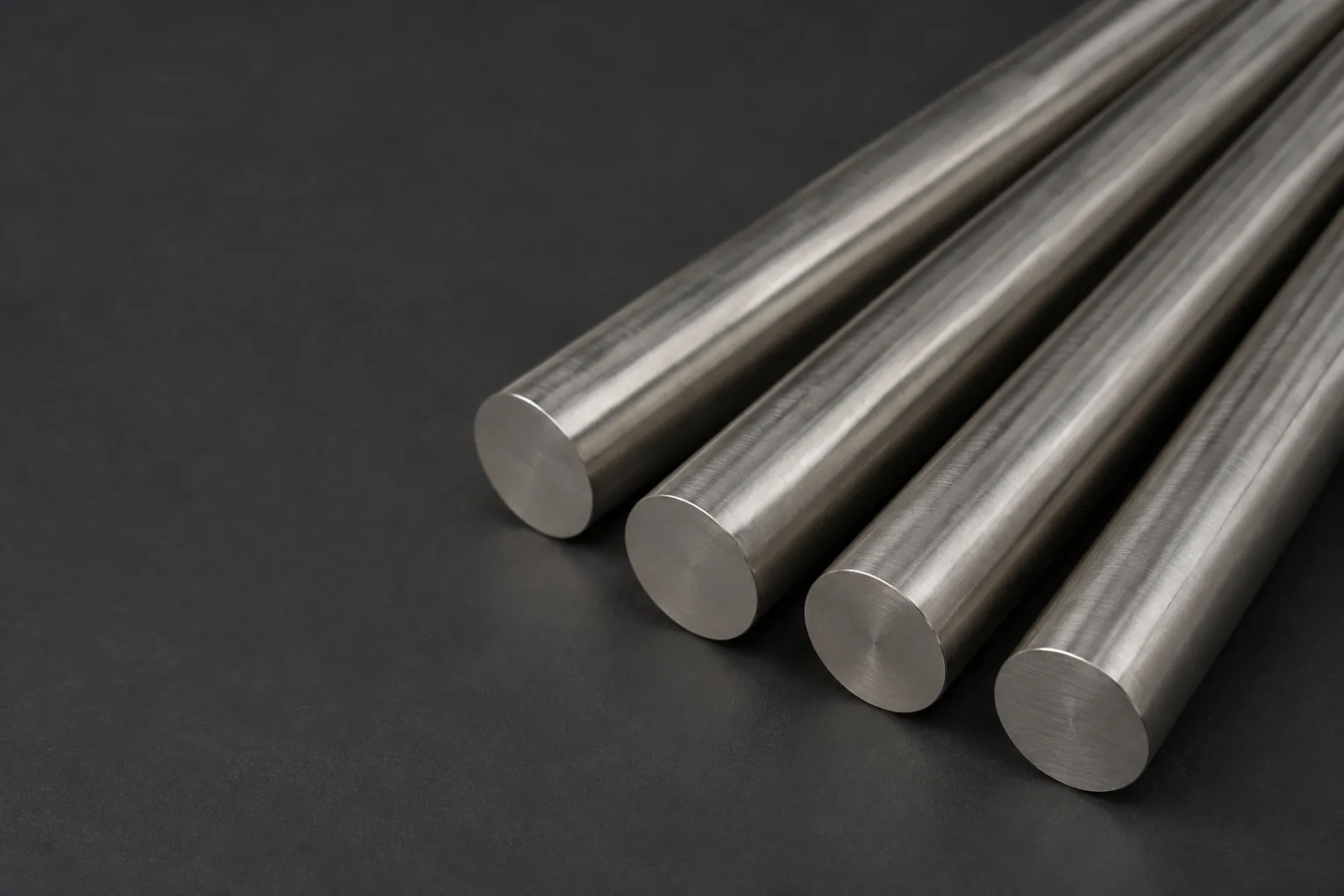
Materials Supply / Nickel, Cobalt & High-Temperature Alloys
Inconel 706 Nickel Alloy
Precipitation-hardenable nickel-iron-chromium alloy | UNS N09706
Inconel 706 combines high mechanical strength with good fabricability. It was developed for large forged gas-turbine components, with reduced segregation tendency and improved forgeability and machinability relative to alloy 718.
Strength is developed by gamma-double-prime Ni3Nb and gamma-prime Ni3(Al,Ti) precipitation. Grain-boundary eta, Laves phase and the processing history can strongly affect ductility, toughness and creep performance; high strength alone does not establish fitness for service.
INCONEL® is a trademark of the Special Metals Corporation group of companies. Quest Engineering does not own this trademark.
Raw & semi-finished materials
Available material forms
Producer-handbook-listed forms only, plus cut-to-size service. Availability depends on specification, dimensions and supplier confirmation; no stock is implied.
- Round Bar
- Forging Stock
- Cut-to-Size Material
Material overview
Inconel 706 Nickel Alloy
A precipitation-hardenable nickel-iron-chromium alloy developed for high-strength large forgings and elevated-temperature turbine applications.
- Designed for large high-strength components with good fabrication characteristics.
- Solution treatment, stabilisation and precipitation ageing are distinct operations; treatment must match the ordered specification.
- Rotating turbine service requires component-specific design qualification, inspection and material acceptance.
- Reference data are not design allowables. No authoritative European material number has been established.
Material specifications & designations
| Designation / specification | Product form / scope | Notes |
|---|---|---|
| UNS N09706 | Parent alloy identity | Confirmed by producer handbook; not a product acceptance specification. |
| W.Nr. / EN | Not established | No authoritative equivalence found; no numerical W.Nr. assigned. |
| AMS 5605 | Sheet, strip and plate | 982 °C solution-treated title; SAE public abstract verified. |
| AMS 5606 | Sheet, strip and plate | 954 °C solution-treated title; SAE AMS5606F public abstract verified. |
| AMS 5701 | Bars, forgings, flash-welded rings and stock for forging or flash-welded rings | 982 °C solution treated; public standards distributor scope for revision G (2023). |
| AMS 5702 | Bars, forgings, flash-welded rings and stock for forging or flash-welded rings | 954 °C solution treated; public standards distributor scope for revision F (2023). |
| AMS 5703 | Bars, forgings, flash-welded rings and stock for forging or flash-welded rings | 954 °C solution, stabilisation and precipitation treated; public standards distributor scope for revision F (2023). |
Handbook lists all five AMS references. Full current standards were not accessible. Public 2023 distributor abstracts for AMS 5701/5702/5703 limit finished forms to 101.6 mm inclusive and cross-sectional area below 81 cm²; forging/ring stock may be any size. Do not extend those finished-product scopes to large turbine forgings. Sheet specifications do not imply producer-listed commercial sheet availability. No verified ASTM or ASME parent-metal specification is assigned; verify the ordered revision and all acceptance requirements. Reference associations only: no equivalence, stock availability, aerospace approval or certified conformity is established by this page. Specify the ordered revision, product form, dimensions, manufacture/melt route, delivery condition and acceptance tests; obtain matching supplier confirmation and inspection documents.
Specification review
Technical verification requirements
Designations / ordered product condition
Handbook gives hardness range but no transcribed numerical tensile acceptance table; technical-paper experimental schedules do not qualify a production ageing cycle. Existing cautions do not prove conformity; no allegation that every listed scope is wrong. Obtain the ordered revision and map each cited specification to form, dimensions, manufacture, delivery condition and acceptance tests.
Obtain licensed ordered editions and issue a material-specific form/condition/size compliance matrix; retain existing caveats pending approval.
Engineering reference
Technical data
| Element | Mass % |
|---|---|
| Nickel + cobalt | 39.0–44.0 |
| Chromium | 14.5–17.5 |
| Iron | Remainder |
| Niobium + tantalum | 2.5–3.3 |
| Titanium | 1.5–2.0 |
| Aluminium | ≤0.40 |
| Carbon | ≤0.06 |
| Copper | ≤0.30 |
| Manganese | ≤0.35 |
| Sulphur | ≤0.015 |
| Silicon | ≤0.35 |
| Phosphorus | ≤0.020 |
| Boron | ≤0.006 |
| Cobalt | ≤1.00 |
Single producer source: limiting composition in mass %. Nickel includes cobalt; niobium includes tantalum. Cobalt also has a separate maximum.
| Property | Value | Basis |
|---|---|---|
| Density | 8050 kg/m³ | Temperature not specified |
| Melting range | 1334–1371 °C | Producer range |
| Specific heat | 444 J/(kg·K) | Temperature not specified |
| Electrical resistivity | 0.985 µΩ·m | Room temperature, as aged |
| Young’s modulus | 210 GPa | Room temperature, as aged |
| Shear modulus | 76 GPa | Room temperature, as aged |
| Thermal conductivity | 12.5 W/(m·K) | Room temperature, as aged |
| Mean linear thermal expansion | 13.3 µm/(m·K) | 21–93 °C |
| Mean linear thermal expansion | 14.9 µm/(m·K) | 21–260 °C |
| Mean linear thermal expansion | 15.4 µm/(m·K) | 21–427 °C |
| Mean linear thermal expansion | 15.7 µm/(m·K) | 21–538 °C |
| Mean linear thermal expansion | 16.2 µm/(m·K) | 21–650 °C |
Typical producer reference data, not specification limits. Temperatures not stated by the source have not been assumed.
Precipitation hardened — producer handbook reference
| Property | Value | Basis |
|---|---|---|
| Ultimate tensile strength | Not tabulated | Handbook curve only; no numerical value transcribed. |
| 0.2% yield strength | Not tabulated | Handbook curve only; no numerical value transcribed. |
| Elongation | Not tabulated | Handbook curve only; no numerical value transcribed. |
| Hardness | 36–42 HRC | Room temperature, as aged; producer reference range. |
| Reduction of area | Not reported | No numerical producer value available in handbook. |
Only directly tabulated producer data are included. Hardness is not a specification minimum. Exact ageing cycle, product section and specimen basis are not identified by the handbook; this is not a guaranteed supply condition. Obtain condition-specific certified tensile data before procurement.
Suitability depends on loading, temperature, exposure duration, atmosphere and required service life; there is no single maximum temperature rating.
The producer handbook shows precipitation-hardened elevated-temperature tensile curves but does not tabulate numerical tensile or stress-rupture results with a complete condition/form basis. No graph estimates or unsupported rupture values are supplied. Special Metals-authored literature relates creep/rupture behaviour to precipitate distribution and stabilisation; component qualification must address long-term microstructural change, fatigue and crack growth.
Solution-treated supply
Producer handbook lists solution-treated AMS families separately from the solution/stabilisation/precipitation-treated AMS 5703 family. Follow the ordered standard; do not substitute an alloy 718 cycle.
Precipitation ageing and stabilisation
Special Metals-authored technical literature describes gamma-prime/gamma-double-prime precipitation and an intermediate stabilisation treatment where stress-rupture performance is required. The printed common-ageing sentence contains an ambiguous cooling sequence; no executable numerical cycle is reproduced here. Confirm temperatures, holds, transfer and cooling requirements with the producer and ordered specification.
Verified numerical production cycle unavailable in the accessible handbook. Technical-paper phase transformation temperatures and experimental schedules are not supply heat-treatment instructions. Do not use this overview as a furnace work instruction or select a production route from conflicting source examples. A materials/process authority must approve the complete form- and condition-specific cycle, including precursor condition, section size, hold times, cooling and verification tests.
Smith and Patel (Special Metals), TMS 2005, pp.146–149
Material selection
Corrosion resistance & performance
Nickel and chromium contribute to oxidation and corrosion resistance; this is not a quantified corrosion-rate guarantee.
Atmosphere, contaminants, temperature and exposure duration require assessment. No numerical oxidation limit or universal aqueous-corrosion suitability is assigned.
Typical applications
Engineering applications
- Gas-turbine discs and large turbine forgings, subject to design and manufacturing qualification.
- Aerospace and industrial turbine components.
- High-strength shafts and large mechanical components where an approved design specifies alloy 706.
- Power-generation equipment requiring qualified high-strength forgings.
Subsequent manufacturing
Machining & processing
Machinability and tooling
The producer describes improved machinability relative to alloy 718, not easy machining. Select tooling and parameters for actual hardness, section and operation; no universal cutting speed is specified.
Work hardening
Use a machining plan that avoids rubbing and repeated ineffective cuts; maintain effective tool engagement and verify surface integrity.
Forming and large forgings
Control forging history, grain size and grain-boundary precipitation. Alcoa technical literature shows that heavy continuous grain-boundary precipitates can reduce ductility and impact toughness. Qualify large-section processing separately from small-bar AMS scopes.
Welding
Archived producer introductory text describes delayed hardening and resistance to postweld strain-age cracking. This does not eliminate solidification or heat-affected-zone cracking risks. Qualify procedure, filler, joint restraint and postweld treatment for the application; no filler specification is represented as a parent-metal specification.
Distortion
Plan machining allowance, fixturing and heat-treatment sequencing for dimensional changes; verify final dimensions after thermal processing.
Finishing
Specify cleanliness, oxide removal and surface finish for the service. Avoid contamination and qualify finishing routes for fatigue-critical surfaces.
Inspection
Agree sampling location, orientation, grain-size control and required surface/volumetric examinations. Chemical identity alone does not qualify rotating hardware.
Material certification & testing
Agree documentation and inspection at enquiry stage for the selected form, condition and specification.
Conformity must be demonstrated against the ordered specification, product form and condition. Tests and certificates are not automatic; agree requirements before order.
- EN 10204 3.1 material certificates
- Certificates of Conformity
- Heat/batch traceability
- Chemical analysis
- Mechanical testing
- Heat-treatment records
- Hardness testing
- Positive Material Identification (PMI)
- Ultrasonic testing where applicable
- Additional aerospace or customer-specific inspection requirements
Material enquiry
Request a material quotation
Inconel 706 Nickel Alloy supplied to your material form, dimensions and specification.