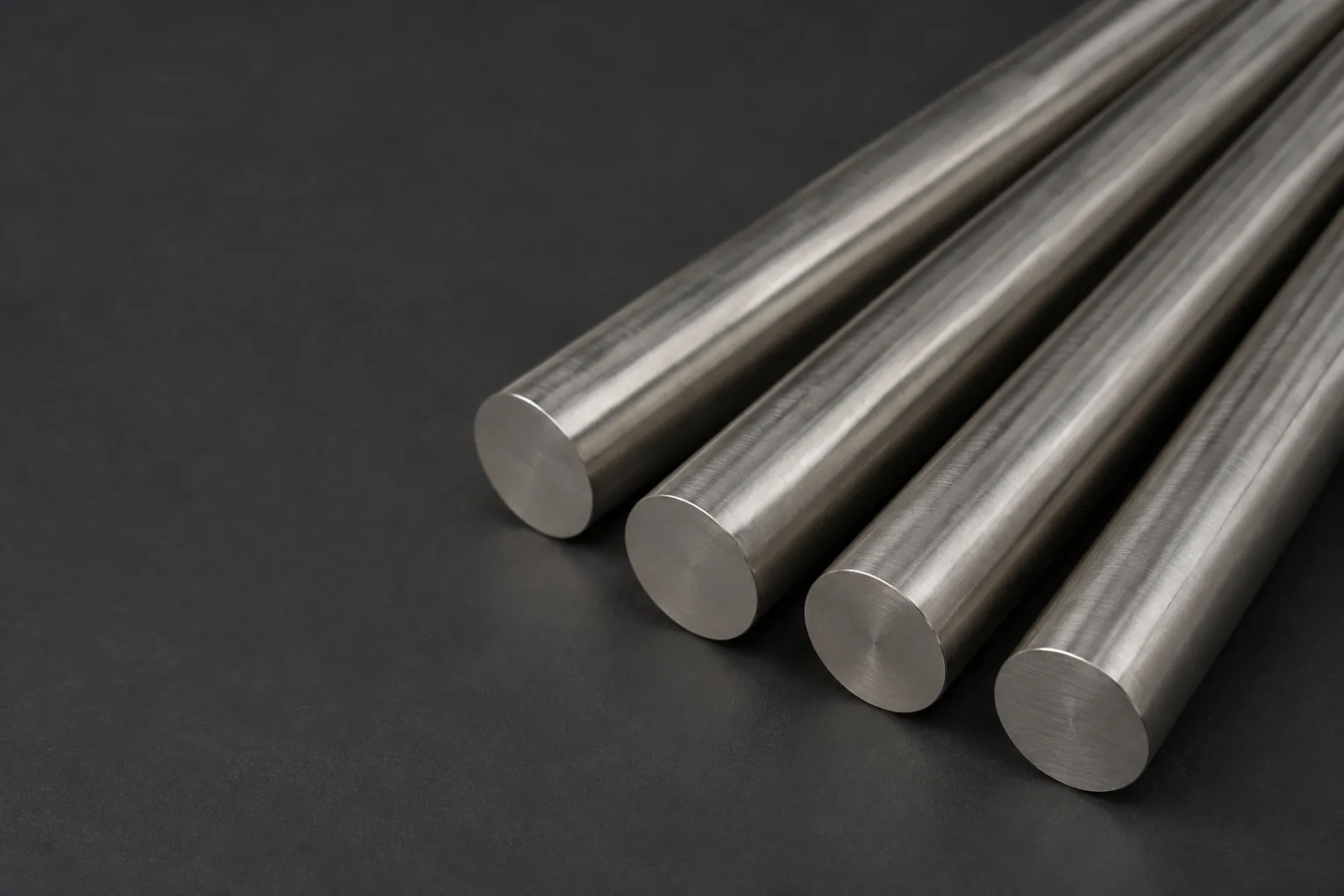
Materials Supply / Nickel, Cobalt & High-Temperature Alloys
Inconel X-750 Nickel Alloy
Precipitation-hardenable nickel-chromium alloy | UNS N07750 | W.Nr. 2.4669
Inconel X-750 contains aluminium and titanium, which form a strengthening gamma-prime precipitate during heat treatment. Its elevated-temperature strength, oxidation resistance and stress-relaxation behaviour depend strongly on product form, cold work and ageing history.
Bar and forging treatments must not be applied indiscriminately to annealed sheet, No. 1 temper wire or cold-worked spring-temper wire. Strength, ductility, creep resistance and fatigue performance must be assessed in the actual final condition.
INCONEL® is a trademark of the Special Metals Corporation group of companies, as stated in SMC-067. Quest Engineering does not own this trademark.
Raw & semi-finished materials
Available material forms
Availability depends on specification, dimensions, condition and supplier confirmation. Listed forms describe producer capability, not Quest stock.
- Round Bar
- Flat Bar
- Hexagon Bar
- Plate
- Sheet
- Strip
- Wire
- Tubing
- Forging Stock
- Extruded Section
- Cut-to-Size Material
Material overview
Inconel X-750 Nickel Alloy
Precipitation-hardenable nickel-chromium alloy for qualified high-temperature springs, fasteners and turbine components.
- Aluminium/titanium precipitation strengthening and cold work give distinct property combinations.
- Springs and fasteners require load-retention and fatigue qualification as well as tensile strength.
- Producer data below are historical reference data, not a substitute for the ordered specification.
Material designations and specifications
| Designation / specification | Product form / scope | Notes |
|---|---|---|
| UNS N07750 | Alloy designation | Producer verified |
| W.Nr. 2.4669 | European material number | Explicitly stated on bulletin pp.1 and 24; not a claim of compliance with every EN standard. |
| ASTM B637 | Precipitation-hardening nickel-alloy bars, forgings and forging stock | Producer-listed X-750; ordered condition and revision require confirmation. |
| ASME SB-637 | Bar, forgings and forging stock | Producer-listed; code suitability requires separate confirmation. |
| AMS 5667 | Bars, forgings, flash-welded rings; forging/ring/heading stock | SAE AMS5667P: equalized, precipitation hardenable; not supplied fully aged by title. |
| AMS 5668 | Bars, forgings, flash-welded rings ≤254 mm; forging/ring/heading stock any size | SAE AMS5668L: 1149°C solution and precipitation heat treated. |
| AMS 5670 | Bars, forgings, flash-welded rings <101.6 mm; forging/ring/heading stock any size | SAE AMS5670H: 982°C solution treated, precipitation hardenable. |
| AMS 5671 | Bars, forgings, flash-welded rings <101.6 mm; forging/ring stock any size | SAE AMS5671J: consumable electrode or vacuum induction melted, 982°C solution treated, precipitation hardenable. |
| AMS 5747 | Bars, forgings, flash-welded rings ≤101.6 mm; forging/ring stock any size | SAE AMS5747E: 982°C solution treated, precipitation hardenable; not interchangeable with 5670/5671. |
| AMS 5542 | Sheet/strip ≤4.76 mm; plate ≤101.6 mm | SAE AMS5542R: annealed. |
| AMS 5598 | Sheet/strip ≤4.75 mm; plate ≤101.6 mm | SAE AMS5598G: consumable electrode remelted or vacuum induction melted, solution treated, precipitation hardenable. |
| AMS 5698 | Round, square and flat wire ≤12.70 mm | SAE AMS5698H: solution treated, precipitation hardenable; capability tested in No. 1 temper. |
| AMS 5699 | Round, square and flat wire ≤15.88 mm | SAE abstract reproduced by Nimonik AMS5699H: solution treated, precipitation hardenable; capability tested in spring temper. Historical producer table calls this spring-temper wire; verify ordered delivery condition. |
| EN 10269 | Fastener steels and nickel alloys for elevated/low temperature properties | Producer-listed association only; exact current grade/condition not independently verified. |
Each specification is separate; no interchangeability or aerospace approval implied. SAE public abstracts verify scopes only. Full current standard texts were not accessed. See verification notes for individual URLs and revisions. Reference associations only: no equivalence, stock availability, aerospace approval or certified conformity is established by this page. Specify the ordered revision, product form, dimensions, manufacture/melt route, delivery condition and acceptance tests; obtain matching supplier confirmation and inspection documents.
Specification review
Technical verification requirements
Designations / ordered product condition
Producer sheet narrative and Table 27 disagree on first ageing temperature (1300 versus 1350°F); page acknowledges rather than resolves conflict. Existing cautions do not prove conformity; no allegation that every listed scope is wrong. Obtain the ordered revision and map each cited specification to form, dimensions, manufacture, delivery condition and acceptance tests.
Obtain licensed ordered editions and issue a material-specific form/condition/size compliance matrix; retain existing caveats pending approval.
Heat treatment — sheet/strip
The page faithfully exposes an unresolved conflict in the producer document, rather than an established website transcription error. Neither route is approved for production by this audit.
Ask producer to reconcile narrative/Table 27 and confirm product-specific ordered schedule.
Engineering reference
Technical data
| Element | Mass % |
|---|---|
| Nickel + cobalt | 70.00 minimum |
| Chromium | 14.0–17.0 |
| Iron | 5.0–9.0 |
| Titanium | 2.25–2.75 |
| Aluminium | 0.40–1.00 |
| Niobium + tantalum | 0.70–1.20 |
| Manganese | 1.00 maximum |
| Silicon | 0.50 maximum |
| Sulfur | 0.01 maximum |
| Copper | 0.50 maximum |
| Carbon | 0.08 maximum |
| Cobalt | 1.00 maximum |
Producer limiting composition, Table 1 only. Nickel includes cobalt; Nb+Ta retained combined. Cobalt determination is not required for routine acceptance in this producer table.
| Property | Value | Temperature / basis |
|---|---|---|
| Density | 8280 kg/m³ | Table 2; temperature not specified |
| Melting range | 1393–1427°C | Table 2 |
| Specific heat | 431 J/(kg·K) | 21.1°C; Table 3 |
| Thermal conductivity | 12.0 W/(m·K) | 21.1°C; Table 3 |
| Electrical resistivity | 1.215 µΩ·m | 21.1°C; Table 3 |
| Mean linear thermal expansion | 12.6 × 10⁻⁶/K | 21.1–93.3°C; Table 3 |
| Mean linear thermal expansion | 15.1 × 10⁻⁶/K | 21.1–648.9°C; Table 3 |
| Elastic modulus, static tension | 214 GPa | 26.7°C; Table 5 |
| Elastic modulus, static tension | 159 GPa | 648.9°C; Table 5 |
Typical, not specification limits. SI conversions from producer imperial tables, rounded. Table 3 footnote: material heat treated 2100°F/3 h air cool + 1550°F/24 h air cool + 1300°F/20 h air cool. Table 5 does not identify a treatment. Not condition-independent guarantees.
Bar — solution treated + furnace-cool aged (18 h)
| Property | Value | Basis |
|---|---|---|
| Ultimate tensile strength | 1351 MPa | See condition basis |
| 0.2% yield strength | 1027 MPa | See condition basis |
| Elongation | 24% | See condition basis |
| Hardness | 38 Rockwell (scale not identified in Table 9) | Not supplied unless stated |
| Reduction of area | 42.3% | Same tensile test row |
Typical room-temperature data, Table 9 row B, 12.7 mm hot-finished bar only; not forging acceptance values. 1800°F/1 h air cool + 1350°F/8 h, furnace cool to 1150°F, hold for total ageing time 18 h. Tensile specimen orientation and gauge length not stated. Hardness scale deliberately not inferred.
Sheet — annealed (0.254–0.6096 mm)
| Property | Value | Basis |
|---|---|---|
| Ultimate tensile strength | 931 MPa maximum | See condition basis |
| 0.2% yield strength | 517 MPa maximum | See condition basis |
| Elongation | 30% minimum | See condition basis |
| Hardness | Not reported | Not supplied unless stated |
Producer p.15 historical specification table, sheet 0.010–0.024 in inclusive; room temperature, elongation in 50.8 mm. These are bulletin-listed limits, not verified current AMS 5598 acceptance criteria. Annealing cycle not specified for this table.
Wire — No. 1 temper, as drawn
| Property | Value | Basis |
|---|---|---|
| Ultimate tensile strength | 958 MPa | See condition basis |
| 0.2% yield strength | 469 MPa | See condition basis |
| Elongation | 30% | See condition basis |
| Hardness | Not reported | Not supplied unless stated |
Typical room-temperature Table 32; 0.508 mm wire, elongation in 50.8 mm. No heat treatment. No reduction-of-area data. Not bar properties or current AMS minima.
Wire — No. 1 temper + 1350°F/16 h age
| Property | Value | Basis |
|---|---|---|
| Ultimate tensile strength | 1393 MPa | See condition basis |
| 0.2% yield strength | 972 MPa | See condition basis |
| Elongation | 16% | See condition basis |
| Hardness | Not reported | Not supplied unless stated |
Typical room-temperature Table 32; 0.508 mm wire, 1350°F/16 h air cool; elongation in 50.8 mm; orientation not stated. Not specification minima.
Wire — spring temper, as drawn
| Property | Value | Basis |
|---|---|---|
| Ultimate tensile strength | 1855 MPa | See condition basis |
| 0.2% yield strength | 1606 MPa | See condition basis |
| Elongation | 1.6% | See condition basis |
| Hardness | Not reported | Not supplied unless stated |
Typical room-temperature Table 32; 0.508 mm wire, elongation in 50.8 mm. Cold-worked spring temper, not solution-treated bar.
Wire — spring temper + 1200°F/4 h age
| Property | Value | Basis |
|---|---|---|
| Ultimate tensile strength | 2055 MPa | See condition basis |
| 0.2% yield strength | 2020 MPa | See condition basis |
| Elongation | 1.0% | See condition basis |
| Hardness | Not reported | Not supplied unless stated |
Typical room-temperature Table 32; 0.508 mm wire, 1200°F/4 h air cool; elongation in 50.8 mm. No numerical hardness/RA reported; not current AMS acceptance values.
Suitability depends on loading, temperature, exposure duration, atmosphere and required service life; there is no single maximum temperature rating.
Elevated-temperature tensile — solution-treated and 18 h aged 19.05 mm hot-rolled round
| Temperature °C | UTS MPa | Yield MPa | Elongation % |
|---|---|---|---|
| 315.6 | 1227 | 907 | 21 |
| 426.7 | 1193 | 907 | 21 |
| 537.8 | 1162 | 883 | 13 |
| 593.3 | 1086 | 872 | 8 |
| 648.9 | 986 | 845 | 6 |
| 732.2 | 786 | 738 | 5 |
| 815.6 | 533 | 530 | 10 |
Table 13, typical tests: 1800°F/1 h air cool + 1350°F/8 h, furnace cool to 1150°F, total ageing time 18 h, air cool. 0.2% offset yield. Specimen orientation and elongation gauge not stated.
Stress rupture — 0.7874 mm cold-rolled annealed and precipitation-treated sheet
| Temperature °C | Stress MPa | Rupture life h |
|---|---|---|
| 648.9 | 483 | 21.5 |
| 648.9 | 483 | 17 |
| 732.2 | 276 | 42.8 |
| 732.2 | 276 | 49.5 |
| 815.6 | 138 | 40.4 |
| 815.6 | 138 | 43.9 |
Table 26: annealed sheet aged 1300°F/20 h air cool. Separate test results, not guaranteed lives or allowable design stresses.
High-temperature springs — matched stress-relaxation comparison
| Wire temper | Temperature °C | Initial stress MPa | Exposure h | Relaxation % |
|---|---|---|---|---|
| No. 1 | 426.7 | 483 | 500 | 3 |
| Spring | 426.7 | 483 | 500 | 12 |
P.17 narrative: identical springs, both precipitation treated 1350°F/16 h. Initial load 70 ksi; spring dimensions and stress-correction convention not stated for this comparison. Do not extrapolate to other designs or treat retention as a guaranteed product property.
Numerical graph readings omitted. Spring suitability depends on geometry, stress, temperature, time and required load retention; higher cold-worked strength does not automatically mean lower relaxation. Fatigue qualification must include surface, notches and cyclic loading. Oxidation test numbers omitted where atmosphere/time were not established.
Equalized bar/forgings
Bulletin: 1625°F/24 h air cool + 1300°F/20 h air cool; associated historically with AMS 5667 response.
Solution treated and furnace-cool aged bar
Table 9 B: 1800°F/1 h air cool + 1350°F/8 h, furnace cool to 1150°F, hold for total ageing time 18 h, air cool.
Solution, stabilization and precipitation treatment
For sustained elevated-temperature service, bulletin bar/forging route: 2100°F/2 h air cool + 1550°F/24 h air cool + 1300°F/20 h air cool. Do not confuse with direct ageing.
Spring wire
Table 32 distinguishes No. 1 temper aged 1350°F/16 h air cool from spring temper aged 1200°F/4 h air cool. Triple treatment is another distinct route and removes the direct benefit of cold work.
Historical producer schedules, not instructions to certify to current AMS. Select product-specific treatment, cooling and qualified furnace controls. Ageing may cause dimensional change; inspect finished dimensions. Do not use this overview as a furnace work instruction or select a production route from conflicting source examples. A materials/process authority must approve the complete form- and condition-specific cycle, including precursor condition, section size, hold times, cooling and verification tests.
Material selection
Corrosion resistance & performance
Producer reports resistance to oxidation and many corrosive media; resistance is not immunity and depends on heat treatment and environment.
Evaluate stress-corrosion cracking, crevices, contaminants and applied stress for the actual duty. Producer mention of NACE MR-01-75 is historical and does not establish current sour-service compliance.
Typical applications
Engineering applications
- High-temperature helical and flat springs: select temper and ageing for required load retention, creep and fatigue life.
- Aerospace fasteners, high-temperature bolts and retaining components subject to drawing and inspection qualification.
- Gas-turbine rotor blades, wheels, bolts and structural members as producer examples, not universal rotating-part approval.
- Heat-treatment fixtures, forming tools, extrusion dies and test-machine grips.
- Airframe thrust reversers and hot-air ducting; rocket thrust chambers, where separately qualified.
- Industrial furnace and power-generation mechanical assemblies subject to service-specific design review.
Subsequent manufacturing
Machining & processing
Machining and work hardening
Plan rough machining before final ageing where practical. X-750 work-hardens; avoid rubbing and dwell, and allow for final heat-treatment movement. Aged stock requires a different machining plan from annealed stock.
Tooling
Use rigid setups, sharp suitable carbide or high-speed tooling and adequate coolant with a maintained cut. Qualify feeds and speeds for tool, section and condition; no universal cutting speed is specified.
Forming
Form in the appropriate soft condition; cold work changes spring strength and relaxation. Spring temper and No. 1 temper are not bar heat-treatment descriptions.
Welding
Use a qualified nickel-alloy welding procedure with clean surfaces, controlled restraint and the appropriate pre/post-weld treatment. Final precipitation strengthening and cracking risk must be assessed. Filler-metal data are not parent-metal properties.
Distortion control
Plan machining allowances, fixtures and thermal cycles; inspect dimensions after ageing and joining.
Finishing
Remove contamination and scale by a qualified cleaning or finishing process; preserve spring surface integrity and avoid fatigue-damaging marks.
Inspection
Confirm chemistry, condition, dimensions, surface quality and required nondestructive inspection against the drawing. Springs require load/relaxation and fatigue validation where specified.
Material certification & testing
Documentation and inspection can be requested at quotation stage.
Conformity must be demonstrated against the ordered specification, product form and condition. Tests and certificates are not automatic; agree scope before order.
- EN 10204 3.1 material certificates
- Certificates of Conformity
- Heat/batch traceability
- Chemical analysis
- Mechanical testing
- Heat-treatment records
- Hardness testing
- Positive Material Identification (PMI)
- Ultrasonic testing where applicable
- Additional aerospace or customer-specific inspection requirements
Material enquiry
Request a material quotation
Inconel X-750 Nickel Alloy supplied to your material form, dimensions and specification.