Materials Supply / Stainless Steels
15-7Mo Stainless Steel
Semi-Austenitic Precipitation-Hardening Stainless Steel | UNS S15700
Molybdenum-bearing semi-austenitic precipitation-hardening stainless steel for high-strength sheet, strip, springs and diaphragms.
Condition A is austenitic: heat conditioning or cold work must transform the structure before precipitation ageing. Choose the sheet, strip or spring condition for the actual form and duty.
Raw & semi-finished materials
Available material forms
Potential forms supported by the cited producer/specification references; dimensions, supply condition, availability and certification must be confirmed. No Quest Engineering stock holding is implied.
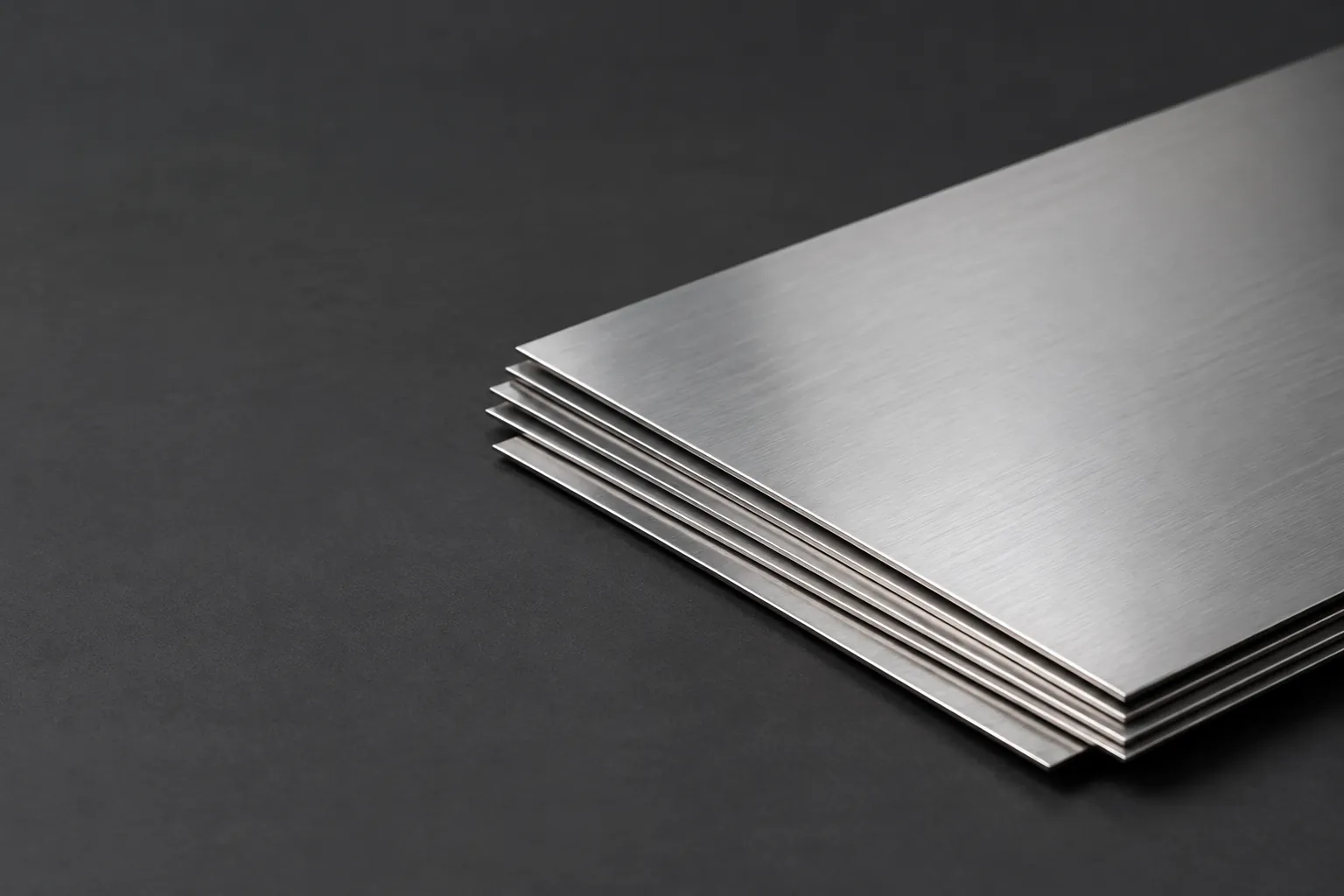
- Sheet
- Strip
- Plate
- Wire
- Cut-to-Size Material
Material overview
15-7Mo Stainless Steel
Molybdenum-bearing semi-austenitic precipitation-hardening stainless steel for high-strength sheet, strip, springs and diaphragms.
- Molybdenum-bearing semi-austenitic precipitation-hardening stainless steel for high-strength sheet, strip, springs and diaphragms.
- Aluminium contributes to precipitation strengthening after transformation or cold reduction.
- Verify the ordered product specification, ageing condition, size and test requirements for the application.
Material specifications & designations
| Designation | Reference |
|---|---|
| UNS | S15700 |
| Common designation | 15-7Mo |
| AMS 5520 | Solution heat treated sheet, strip, foil and plate; Rev H distributor scope: nominal thickness 0.038 mm and greater; exact ordered revision required. |
| AMS 5657 | Bars and forgings per ATI; verify exact long-product scope and condition separately |
| ASTM A693 / A564 | Flat products / bars, wire and shapes; no blanket condition equivalence |
| EN reference | No EN material number asserted: exact chemistry, product-form standard and contractual equivalence require separate verification. |
Specification applicability follows product form and condition, not similar chemistry. Public scope/producer listings were checked, but current full AMS/ASTM/EN acceptance tables were unavailable. Confirm the purchased revision and any slash-condition designation; no aerospace conformity is promised without matching certificates. Reference associations only: no equivalence, stock availability, aerospace approval or certified conformity is established by this page. Specify the ordered revision, product form, dimensions, manufacture/melt route, delivery condition and acceptance tests; obtain matching supplier confirmation and inspection documents.
Specification review
Technical verification requirements
designations / product forms
Public grade associations do not establish revision-specific acceptance for every listed standard and offered form. Each row remains subject to contractual form, grade, process and delivery-condition checking; pipe is not generic tube, forging stock is not a finished forging, and long-product AMS is not flat product approval. This is an evidence gap, not a finding that all listed mappings are wrong.
Obtain ordered revisions; sign off each listed row against grade, form, size, melt route, condition and any slash designation; document offered tube specification separately where relevant.
mechanical / physical / certification
Published reference data are not a Quest certified delivery envelope. Some tables explicitly lack orientation, specimen size or test temperature; preserve those caveats. Conditional certificate/PMI/UT availability is not evidence of actual supplier capability or aerospace approval.
Retain typical-versus-minimum distinctions; confirm actual purchase-order test orientation, dimensions, temperature and certificate/test acceptance requirements before publication or supply.
composition note
Smiths is a supplier reproduction, not the primary controlled AMS5520 text. Its sulphur limit conflicts with the separately identified Cleveland-Cliffs producer value; the page responsibly discloses the conflict but cannot settle contractual chemistry.
Describe as secondary reproduction and obtain ordered AMS5520 text; retain explicit conflict pending resolution.
heatTreatment
Overview intentionally omits some hold times/cooling/transition details. It must not function as a complete production route; semi-austenitic TH/RH/CH precursors in particular are not interchangeable. No exact numerical error is asserted where missing parameters are expressly deferred.
Have heat-treatment authority specify full applicable grade/form cycle, atmosphere, tolerances, transfer times, cooling and final acceptance tests; retain overview disclaimer.
Engineering reference
Technical data
| Element | Minimum % | Maximum % |
|---|---|---|
| Carbon | — | 0.09 |
| Chromium | 14.00 | 16.00 |
| Nickel | 6.50 | 7.75 |
| Molybdenum | 2.00 | 3.00 |
| Aluminium | 0.75 | 1.50 |
| Manganese | — | 1.00 |
| Silicon | — | 1.00 |
| Phosphorus | — | 0.040 |
| Sulphur | — | 0.030 |
| Iron | Balance | Balance |
Single primary specification basis: AMS 5520 sheet chemistry as reproduced by Smiths Advanced Metals, February 2022; standard edition unstated. Sulphur ≤0.030% is retained from this one source. Cleveland-Cliffs producer chemistry separately gives ≤0.040%; the two are not blended. Verify the ordered AMS edition before accepting supply. All values are mass percentages (wt. %); a dash means no bound specified on that side, not zero. No heat analysis or grade substitution is implied.
| Property | Indicative value | Condition / temperature |
|---|---|---|
| Density | ≈ 7.80 g/cm³ | Condition A; nominal ambient |
| Density | ≈ 7.67 g/cm³ | RH950 / TH1050; nominal ambient |
| Elastic modulus | ≈ 195 GPa | Condition A / RH950 / TH1050; nominal ambient |
| Mean thermal expansion coefficient | ≈ 14.4 × 10⁻⁶/K | Condition A; mean 21–93°C |
| Mean thermal expansion coefficient | ≈ 9.0 × 10⁻⁶/K | RH950; mean 21–93°C |
| Mean thermal expansion coefficient | ≈ 11.0 × 10⁻⁶/K | TH1050; mean 21–93°C |
| Thermal conductivity | ≈ 15.1 W/(m·K) | RH950 / TH1050; at 21°C |
Typical producer values, not acceptance limits or design allowables. Conditions and temperature intervals are stated wherever supplied; nominal ambient means exact temperature is not identified. Unsupported graph estimates and resistivity without test temperatures are omitted.
Condition A
| Property | Reference value | Basis |
|---|---|---|
| Ultimate tensile strength | 860 MPa | Typical producer reference |
| 0.2% proof strength | 380 MPa | Typical producer reference |
| Elongation (source gauge not stated) | 30% | Typical producer reference |
| Hardness | 88 HRB | Typical producer reference |
ATI p. 3 typical room-temperature sheet/strip reference. No specimen thickness or elongation gauge length is stated in this table. Not bar, forging or verified current AMS acceptance data.
TH1050
| Property | Reference value | Basis |
|---|---|---|
| Ultimate tensile strength | 1450 MPa | Typical producer reference |
| 0.2% proof strength | 1380 MPa | Typical producer reference |
| Elongation (source gauge not stated) | 6% | Typical producer reference |
| Hardness | 43 HRC | Typical producer reference |
ATI p. 3 typical room-temperature sheet/strip reference. No specimen thickness or elongation gauge length is stated in this table. Not bar, forging or verified current AMS acceptance data.
RH950
| Property | Reference value | Basis |
|---|---|---|
| Ultimate tensile strength | 1690 MPa | Typical producer reference |
| 0.2% proof strength | 1515 MPa | Typical producer reference |
| Elongation (source gauge not stated) | 6% | Typical producer reference |
| Hardness | 48 HRC | Typical producer reference |
ATI p. 3 typical room-temperature sheet/strip reference. No specimen thickness or elongation gauge length is stated in this table. Not bar, forging or verified current AMS acceptance data.
CH900
| Property | Reference value | Basis |
|---|---|---|
| Ultimate tensile strength | 1828 MPa | Typical producer reference |
| 0.2% proof strength | 1793 MPa | Typical producer reference |
| Elongation (50.8 mm) | 2% | Typical producer reference |
| Hardness | 50 HRC | Typical producer reference |
Cleveland-Cliffs May 2021, p. 4 Table 2 typical sheet/strip values, not acceptance limits. Condition C precursor is producer-listed for material 1.27 mm and thinner; sample thickness and exact test temperature for Table 2 are not supplied. Elongation gauge 50.8 mm. Do not blend with ATI RH950/TH1050 data.
Semi-austenitic transformation
15-7Mo requires austenite conditioning, transformation and precipitation ageing, or a separately controlled cold-reduced Condition C precursor. It is not the single-step Condition A ageing route of 17-4PH.
TH1050 route
ATI guidance: conditioning at 760°C, martensite transformation near room temperature, then ageing at 565°C. Times and cooling are not inferred from another grade.
RH950 route
ATI guidance: conditioning at 955°C, sub-zero transformation at −73°C, then ageing at 510°C. Confirm the complete cycle and hold times against the ordered product specification.
CH900 route
ATI confirms direct 482°C ageing of cold-reduced Condition C. Cleveland-Cliffs confirms a producer example of 482 ±5.5°C for 60 minutes then air cool, with Condition C precursor 1.27 mm and thinner. This is a separate producer sheet/strip example, not a universal AMS acceptance schedule.
Grade-specific producer processing guidance, not a qualified production schedule or guaranteed acceptance specification. Confirm furnace control, precursor condition, section size, hold times, cooling and tests to the ordered standard. The separately cited Cleveland-Cliffs CH900 mechanical table documents the additional cold-worked route. Do not use this overview as a furnace work instruction or select a production route from conflicting source examples. A materials/process authority must approve the complete form- and condition-specific cycle, including precursor condition, section size, hold times, cooling and verification tests.
Material selection
Corrosion resistance & performance
Useful corrosion resistance for compatible spring and aerospace-sheet environments, generally above conventional hardenable chromium grades. Molybdenum content alone does not make it equivalent to 316.
Assess medium, temperature, applied stress, crevices, surface finish and heat-treatment history. Remove contamination and heat-treatment scale; no marine suitability or maximum service temperature is implied.
Typical applications
Engineering applications
- Springs and diaphragms
- Retaining rings
- Aircraft bulkhead parts
- Welded or brazed honeycomb panels to qualified procedures
Subsequent manufacturing
Machining & processing
Machinability
Form and blank sheet or strip in the specified precursor condition before final hardening where practical. Spring-temper stock needs separate cutting and tool-wear allowances.
Work hardening and forming
Cold reduction is part of the CH900 transformation route; it changes the material structure and subsequent ageing response. Do not substitute Condition A for Condition C.
Heat treatment and dimensional stability
Ageing can change dimensions and surface condition; retain appropriate allowance and qualify the full cycle for the product geometry. Low-temperature ageing does not guarantee zero distortion.
Welding and finishing
Use a qualified welding procedure and protect aluminium from oxidation; high-strength welds may require the complete solution/conditioning/transformation/ageing sequence. Finish and clean surfaces with a grade-appropriate process; avoid embedded carbon-steel contamination.
Material certification & testing
Documentation and testing may be requested subject to supplier and quotation confirmation:
For aerospace orders, certificates must demonstrate conformity to the actual ordered specification, product form and material condition. Tests, traceability and acceptance criteria must be agreed at quotation; no certification is promised in advance.
- EN 10204 3.1 material certificates
- Manufacturer Certificates of Conformity
- Heat/batch traceability
- Chemical analysis
- Mechanical test reports
- Hardness testing
- Heat-treatment records
- Additional testing where required
Material enquiry
Request a material quotation
15-7Mo Stainless Steel supplied to your material form, dimensions and specification.