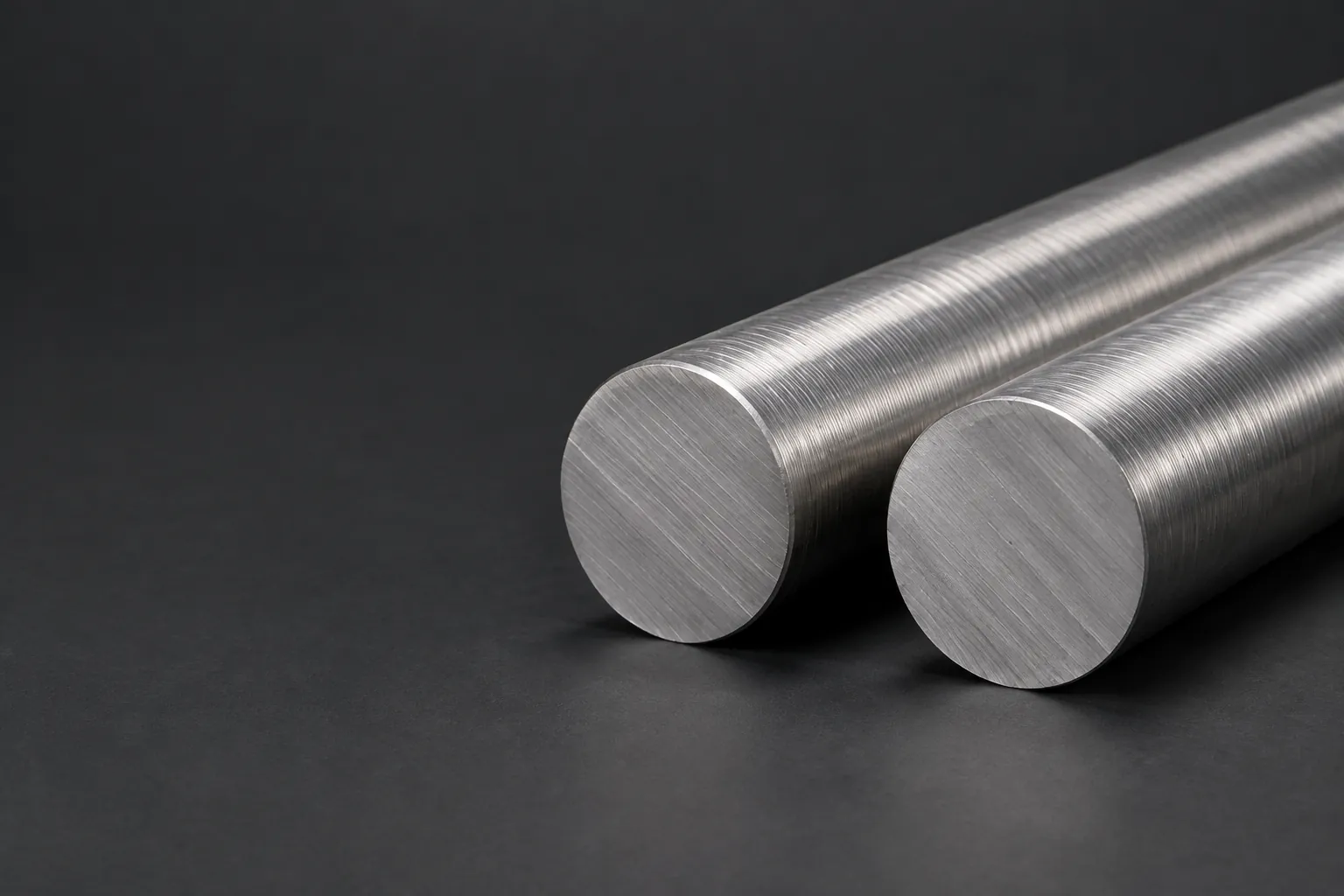
Materials Supply / Stainless Steels
17-4PH Stainless Steel
Martensitic Precipitation-Hardening Stainless Steel | UNS S17400
Chromium-nickel-copper martensitic precipitation-hardening stainless steel for shafts, fittings and high-strength components.
Supply condition and ageing determine the balance of strength, hardness and toughness. Condition-specific reference data must not be transferred between bar, plate, strip or forgings.
Raw & semi-finished materials
Available material forms
Potential forms supported by the cited producer/specification references; dimensions, supply condition, availability and certification must be confirmed. No Quest Engineering stock holding is implied.
- Round Bar
- Flat Bar
- Plate
- Forgings
- Cut-to-Size Material
Material overview
17-4PH Stainless Steel
Chromium-nickel-copper martensitic precipitation-hardening stainless steel for shafts, fittings and high-strength components.
- Chromium-nickel-copper martensitic precipitation-hardening stainless steel for shafts, fittings and high-strength components.
- Copper-containing precipitates strengthen the martensitic matrix.
- Verify the ordered product specification, ageing condition, size and test requirements for the application.
Material specifications & designations
| Designation | Reference |
|---|---|
| UNS | S17400 |
| Common designation | 17-4PH |
| AMS 5643 | Bars, wire, forgings, mechanical tubing and flash-welded rings; solution heat treated. SAE public scope and ATI producer listing; condition slash specifications must be separately ordered. |
| AMS 5604 | Sheet, strip and plate; producer-listed flat-product specification |
| ASTM A564 / A693 / A705 | Respectively bars/wire/shapes; plate/sheet/strip; forgings — do not interchange product requirements |
| EN reference | No EN material number asserted: exact chemistry, product-form standard and contractual equivalence require separate verification. |
Specification applicability follows product form and condition, not similar chemistry. Public scope/producer listings were checked, but current full AMS/ASTM/EN acceptance tables were unavailable. Confirm the purchased revision and any slash-condition designation; no aerospace conformity is promised without matching certificates.
Specification review
Technical verification requirements
designations / product forms
Public grade associations do not establish revision-specific acceptance for every listed standard and offered form. Each row remains subject to contractual form, grade, process and delivery-condition checking; pipe is not generic tube, forging stock is not a finished forging, and long-product AMS is not flat product approval. This is an evidence gap, not a finding that all listed mappings are wrong.
Obtain ordered revisions; sign off each listed row against grade, form, size, melt route, condition and any slash designation; document offered tube specification separately where relevant.
mechanical / physical / certification
Published reference data are not a Quest certified delivery envelope. Some tables explicitly lack orientation, specimen size or test temperature; preserve those caveats. Conditional certificate/PMI/UT availability is not evidence of actual supplier capability or aerospace approval.
Retain typical-versus-minimum distinctions; confirm actual purchase-order test orientation, dimensions, temperature and certificate/test acceptance requirements before publication or supply.
Engineering reference
Technical data
| Element | Typical wt. % |
|---|---|
| Carbon | 0.04 |
| Manganese | 0.40 |
| Phosphorus | 0.020 |
| Sulfur | 0.005 |
| Silicon | 0.50 |
| Chromium | 15.5 |
| Nickel | 4.5 |
| Niobium (columbium) + tantalum | 0.30 |
| Copper | 3.50 |
| Iron | Balance |
ATI typical composition (weight percent), not minimum/maximum acceptance limits or a heat analysis. Niobium (columbium) and tantalum are reported together; do not relabel the combined value as niobium alone. Confirm contractual chemistry against the ordered product specification and revision.
| Property | Indicative value | Condition / temperature |
|---|---|---|
| Density | ≈ 7.75 g/cm³ | Condition A; nominal ambient, exact temperature unstated |
| Density | ≈ 7.81 g/cm³ | H900; nominal ambient |
| Density | ≈ 7.83 g/cm³ | H1075; nominal ambient |
| Density | ≈ 7.86 g/cm³ | H1150; nominal ambient |
| Elastic modulus | ≈ 196 GPa | A / H900 / H1075 / H1150; nominal ambient |
| Thermal conductivity | ≈ 18.3 W/(m·K) | Condition A; source reports 21–100°C interval |
| Thermal conductivity | ≈ 17.8 W/(m·K) | H900; source reports 21–100°C interval |
| Mean thermal expansion coefficient | ≈ 11.3 × 10⁻⁶/K | Condition A; mean 21–427°C |
| Mean thermal expansion coefficient | ≈ 11.7 × 10⁻⁶/K | H900; mean 21–427°C |
Typical producer values, not acceptance limits or design allowables. Conditions and temperature intervals are stated wherever supplied; nominal ambient means exact temperature is not identified. Unsupported graph estimates and resistivity without test temperatures are omitted.
Condition A
| Property | Reference value | Basis |
|---|---|---|
| Ultimate tensile strength | 1030 MPa | Typical producer reference |
| 0.2% proof strength | 760 MPa | Typical producer reference |
| Elongation (50.8 mm) | 8% | Typical producer reference |
| Hardness | 33 HRC | Typical producer reference |
ATI p. 4 typical room-temperature tensile table for the producer flat-product reference. Specimen thickness and orientation are not stated. These are not ASTM/AMS acceptance limits and must not be transferred to bar or forgings. The four conditions shown have directly readable producer values; other conditions require separate data.
H900
| Property | Reference value | Basis |
|---|---|---|
| Ultimate tensile strength | 1340 MPa | Typical producer reference |
| 0.2% proof strength | 1240 MPa | Typical producer reference |
| Elongation (50.8 mm) | 10% | Typical producer reference |
| Hardness | 43 HRC | Typical producer reference |
ATI p. 4 typical room-temperature tensile table for the producer flat-product reference. Specimen thickness and orientation are not stated. These are not ASTM/AMS acceptance limits and must not be transferred to bar or forgings. The four conditions shown have directly readable producer values; other conditions require separate data.
H1075
| Property | Reference value | Basis |
|---|---|---|
| Ultimate tensile strength | 1070 MPa | Typical producer reference |
| 0.2% proof strength | 930 MPa | Typical producer reference |
| Elongation (50.8 mm) | 10% | Typical producer reference |
| Hardness | 36 HRC | Typical producer reference |
ATI p. 4 typical room-temperature tensile table for the producer flat-product reference. Specimen thickness and orientation are not stated. These are not ASTM/AMS acceptance limits and must not be transferred to bar or forgings. The four conditions shown have directly readable producer values; other conditions require separate data.
H1150
| Property | Reference value | Basis |
|---|---|---|
| Ultimate tensile strength | 1000 MPa | Typical producer reference |
| 0.2% proof strength | 860 MPa | Typical producer reference |
| Elongation (50.8 mm) | 10% | Typical producer reference |
| Hardness | 31 HRC | Typical producer reference |
ATI p. 4 typical room-temperature tensile table for the producer flat-product reference. Specimen thickness and orientation are not stated. These are not ASTM/AMS acceptance limits and must not be transferred to bar or forgings. The four conditions shown have directly readable producer values; other conditions require separate data.
Solution treatment
ATI solution-treated Condition A is martensitic after cooling. The source gives approximately 1040–1065°C; the p. 5 example uses 1066°C. Agree the ordered standard and section-specific cooling; no soak duration is inferred.
Ageing conditions
ATI p. 5 dated AMS 5604 reference: H900 at 482°C for 60 minutes; H925 at 496°C for four hours; H1025 at 552°C for four hours; H1075 at 579°C for four hours; H1100 at 593°C for four hours; H1150 at 621°C for four hours. Cooling requirements must be confirmed against the ordered specification. Only independently tabulated typical conditions are used in the mechanical selector.
Selection limitations
Higher ageing temperatures trade strength for other properties. Condition A and H900 are not interchangeable with overaged supply; the application requires its own toughness and stress-corrosion assessment.
Grade-specific producer processing guidance, not a qualified production schedule or guaranteed acceptance specification. Confirm furnace control, precursor condition, section size, hold times, cooling and tests to the ordered standard.
Material selection
Corrosion resistance & performance
Useful general corrosion resistance approaching austenitic grades in some mild media, but high-strength conditions can be sensitive to stress-corrosion cracking; no universal 304/316 equivalence is claimed.
Assess medium, temperature, applied stress, crevices, surface finish and heat-treatment history. Remove contamination and heat-treatment scale; no marine suitability or maximum service temperature is implied.
Typical applications
Engineering applications
- Shafts and valve components
- High-strength fasteners
- Actuator and mechanical fittings
- Application-qualified aerospace structural parts
Subsequent manufacturing
Machining & processing
Machinability
Machine in solution-treated or separately specified overaged stock where appropriate. Ageing increases hardness and cutting forces; do not transfer strip data to bar machining.
Work hardening and forming
Cold work changes residual stress and subsequent ageing response. Specify incoming condition and any intermediate solution treatment with the producer.
Heat treatment and dimensional stability
Ageing can change dimensions and surface condition; retain appropriate allowance and qualify the full cycle for the product geometry. Low-temperature ageing does not guarantee zero distortion.
Welding and finishing
Use a qualified welding procedure, suitable filler and agreed post-weld heat treatment; matching strength and toughness require specification-specific assessment. Finish and clean surfaces with a grade-appropriate process; avoid embedded carbon-steel contamination.
Material certification & testing
Documentation and testing may be requested subject to supplier and quotation confirmation:
For aerospace orders, certificates must demonstrate conformity to the actual ordered specification, product form and material condition. Tests, traceability and acceptance criteria must be agreed at quotation; no certification is promised in advance.
- EN 10204 3.1 material certificates
- Manufacturer Certificates of Conformity
- Heat/batch traceability
- Chemical analysis
- Mechanical test reports
- Hardness testing
- Heat-treatment records
- Additional testing where required
Material enquiry
Request a material quotation
17-4PH Stainless Steel supplied to your material form, dimensions and specification.